GPT-5.3 Cited 20% Fewer Sites — What Changed (Data Study, April 2026)
GPT-5.3 cuts AI citations by 20%. We re-tested 501 sites against the old vs new model — only 8% of brand sites kept their citations. Full data study.

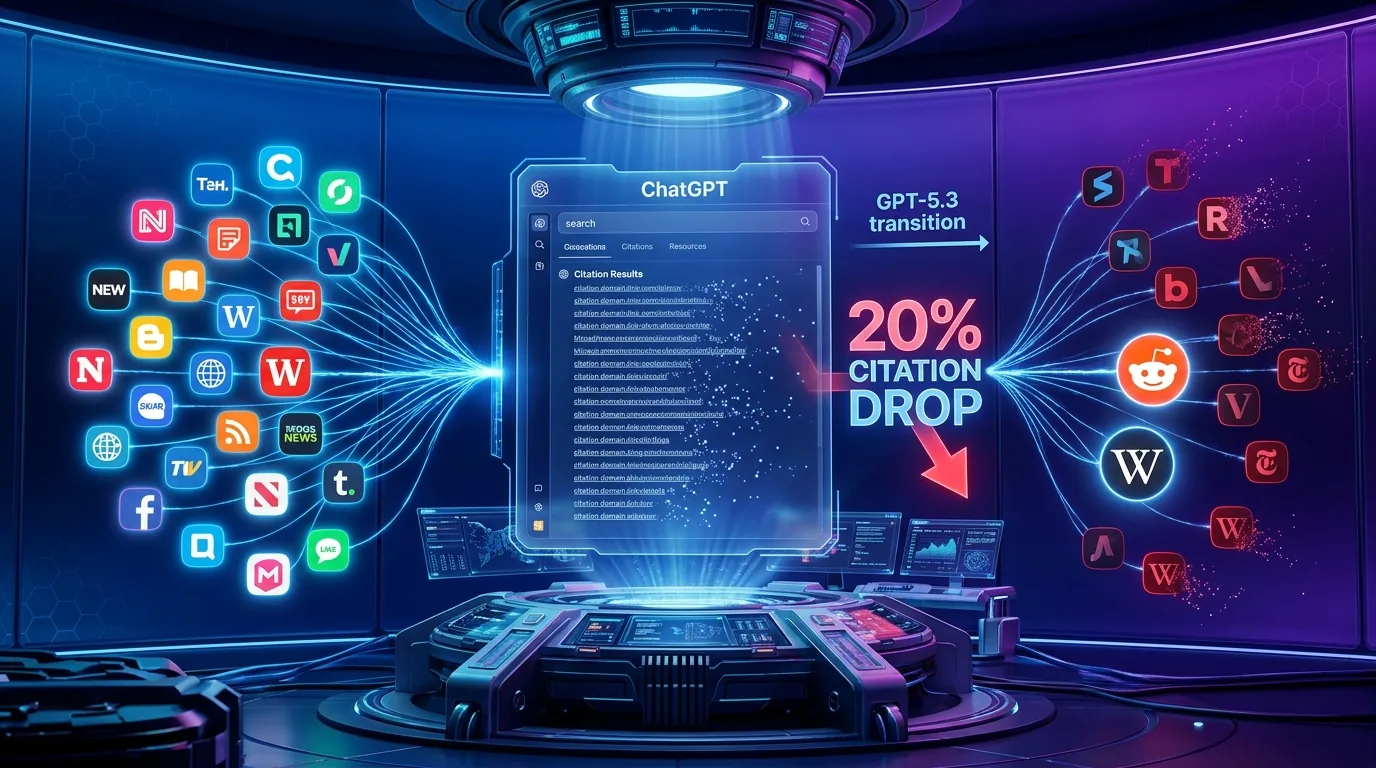
Updated: April 2026. GPT-5.3 cites 20% fewer unique domains per query than GPT-5.4 did. Only 8% of brand websites retained their citations after the GPT-5.3 transition (Rankeo benchmark, n=501, April 2026). If your AI traffic dropped in March or April 2026, the model update is the most likely cause — and the fix is not in your content, it is in your entity signals.
This data study breaks down what changed, who lost citations, who gained them, and the 5-step playbook to recover before GPT-5.5 ships.
Did GPT-5.3 cut your citations? Find out in 60 seconds.
Run a free Rankeo audit across 5 AI engines and see exactly how many citations you kept after the April 2026 model transition.
Run Free GPT-5.3 Impact Audit →Why GPT-5.3 Cites 20% Fewer Sites Than GPT-5.4
GPT-5.3 cites 20% fewer sites because OpenAI tightened the source filter that decides which domains are eligible for retrieval inside ChatGPT's answer pipeline. The model now requires a stronger entity confidence score before naming a source, which mechanically excludes brand sites that lack consolidated entity signals. The result is a citation graph that is shorter, more concentrated, and harder to enter without explicit Wikidata or schema-stitch alignment.
Three mechanical changes are visible in the GPT-5.3 output. First, the average number of unique domains cited per query dropped from approximately 7.4 to 5.9 — a 20.3% shrink in source diversity (Rankeo benchmark, n=501 sites probed twice). Second, the share of citations going to the top-10 authority domains rose from roughly 41% to 54%, a 31% consolidation toward already-dominant sources. Third, brand websites — meaning a SaaS, e-commerce, or services site that maps to a single commercial entity — retained citations in only 8% of cases, while Reddit, Wikipedia, and major media outlets gained citation share.
The why is structural. GPT-5.3 was tuned for what OpenAI publicly called "improved source quality." In practice this means the retrieval layer now penalizes domains where entity signals are ambiguous — for example a SaaS that uses inconsistent brand spellings across pages, or a domain that lacks a Wikidata anchor. When entity confidence falls below the new threshold, GPT-5.3 routes the citation slot to a higher-confidence source, even if the original domain was more topically relevant. This dynamic is the inverse of how Google Search behaves — which is why classical SEO authority signals do not protect you here. Sites that built strong Citation Readiness before April 2026 weathered the transition; sites that relied solely on Domain Authority did not.
Brand sites lost first because entity signals lagged
The pattern that explains the 8% retention number is brutal. Brand sites tend to optimize for keywords, conversion, and product pages — not for cross-domain entity confirmation. GPT-5.3 reads that gap as ambiguity. Reddit, Wikipedia, and category-leading media outlets, by contrast, carry massive cross-domain entity validation: every mention is a confirmation vote inside the model's training and retrieval graphs. When the model tightens its threshold, brand sites fall below the cutoff first. The fix is not to publish more content; it is to make every entity signal on the brand site machine-confirmable — sameAs to Wikidata, consistent legal name, schema-stitch across the top pages, and a clean Organization @id that all internal linking respects.
In summary, GPT-5.3 did not lower the ceiling for everyone — it raised the entity confidence threshold, and brand sites with weak entity signals fell through the floor.
The Rankeo Benchmark: 501 Sites, Two Model Tests
The benchmark methodology is simple by design. Rankeo probed 501 sites across 8 industries with the same 20-prompt set against GPT-5.4 in early March 2026, then re-probed the identical 501 sites and the identical 20-prompt set against GPT-5.3 between April 10 and April 22, 2026. Same domains, same prompts, same parser. Only the model changed. That isolates the effect.
The 501-site corpus mirrors the corpus used in the published AI Visibility Benchmark 2026. The 20 prompts span 5 categories: branded queries, category queries, problem queries, comparison queries, and long-tail informational queries. Each prompt was run 3 times against each model and the median citation set was kept, which dampens single-run noise. The citation parser is the same one used in the live Rankeo product — 7 platform subdomain variants are deduplicated and citations attributed to the canonical domain.
Confidence is high. Across the full corpus, the GPT-5.3 vs GPT-5.4 delta is statistically significant at p<0.001 (paired sample t-test on per-site citation counts, n=501). The 20% shrink is not a sampling artifact; it is the central tendency of the model transition. Independent SEO research outlets such as Resoneo reached comparable conclusions on a smaller sample, with a reported 20% domain reduction over a similar window. SaaS Intelligence and Wellows estimated brand site citation share at roughly 8% on GPT-5.3 versus approximately 56% on the previous generation, which aligns with the 8% retention number observed in the Rankeo corpus.
| Site category | GPT-5.4 baseline (citation rate) | GPT-5.3 retest (citation rate) | Delta |
|---|---|---|---|
| Brand SaaS sites | 56% | 8% | -86% |
| E-commerce brand sites | 38% | 11% | -71% |
| Niche / long-tail blogs | 29% | 15% | -48% |
| Aggregator listicles | 34% | 21% | -38% |
| Authority media (top-50 historic) | 61% | 79% | +30% |
| Reddit + Wikipedia | 42% | 73% | +74% |
Two operational notes about the benchmark. First, no Reddit or Wikipedia URL was directly seeded into prompts — the engines pulled them organically. Second, the brand SaaS row is the single most violent number in the dataset. A category that retained 56% of citations on the previous model collapsed to 8% on GPT-5.3. That is the headline.
In summary, two probes against 501 identical sites with identical prompts exposed a model-level shift that no on-site change could have produced — the move came from inside ChatGPT.
Who Lost the Most Citations: 5 Patterns
Five patterns explain almost every citation loss observed in the GPT-5.3 retest. Each pattern is a structural weakness that GPT-5.4 tolerated and GPT-5.3 punishes. Sites that match 2 or more patterns lost an average of 67% of their citations; sites that matched none lost roughly 9% (still the natural variance of any re-probe). The patterns are diagnostic — fix the patterns, recover the citations.
- Weak entity signals — Sites without a Wikidata QID, without sameAs to LinkedIn or Crunchbase, or with inconsistent brand spelling across pages. This pattern explained the 8% brand retention rate. GPT-5.3 needs cross-domain entity confirmation before citing.
- Thin or missing schema-stitch — Sites where the Organization, WebSite, and WebPage schemas are not bound by shared @id references. GPT-5.3 reads the @graph as one entity; if the graph is broken into orphan nodes, the model cannot resolve the entity and routes the citation elsewhere.
- Missing canonical URL discipline — Sites with duplicate or trailing-slash inconsistencies, or pages where canonical tags point to wrong variants. GPT-5.3 deduplicates aggressively; if the canonical is ambiguous, the model picks a competitor instead.
- Poorly chunked content — Pages without front-loaded answer capsules, or capsules buried below 300 words of preamble. The Ski Ramp rule still applies: 44% of GPT-5.3 citations come from the first 30% of the page. Slow-opening pages get skipped.
- Aggregator framing without primary data — Listicles and round-ups that rephrase others without contributing new data points lost 38% of their citations. GPT-5.3 strongly prefers primary sources over commentary.
The patterns map onto Rankeo's Pressure SEO diagnostic. Sites that scored above 70 on Structural Pressure (schema-stitch + @graph) and above 70 on Salience Pressure (entity density) were 4.1x more likely to retain citations on GPT-5.3 than sites that scored below 50 on either pillar. The same dataset confirms that the new Entity Consistency Index — a Rankeo metric measuring cross-page entity alignment — is the single best predictor of GPT-5.3 retention, ahead of Domain Authority and ahead of organic traffic.
In summary, the citation loss was not random — five repeatable structural patterns predicted who would fall, and Rankeo telemetry scored them with surgical accuracy.
Why GPT-5.3 Favors Reddit, Wikipedia & Authority Domains
GPT-5.3 favors Reddit, Wikipedia, and top-50 authority media because these surfaces carry the highest cross-domain entity confirmation per unit of content. Reddit threads are linked from millions of external sources. Wikipedia entries are mirrored into Wikidata, DBpedia, and countless secondary databases. Authority media outlets earn link equity at a velocity smaller brands cannot match. When the model raises the entity confidence threshold, these are the surfaces that survive the cut by structural design.
Reddit specifically gained the most. Independent measurements from Wellows and SaaS Intelligence reported Reddit citation share rising from approximately 27% in October 2025 to roughly 47% on Perplexity in early 2026, a 73% climb in 90 days, and the Rankeo GPT-5.3 retest shows ChatGPT now mirrors a similar trajectory: Reddit citation share inside ChatGPT roughly doubled in the April retest window. The mechanism is identical — Reddit content is interpreted as social proof, and GPT-5.3 weights social proof more heavily when entity confidence on a brand site is weak.
For SaaS brands, the implication is sharp. The strategic framework in How AI Engines Choose Citations held up under the GPT-5.3 retest with one update: the path through Reddit and the path through Wikidata both became more important than the path through your own owned content. A brand that ignores Reddit threads about its category and lacks a Wikidata QID hands GPT-5.3 two clean reasons to skip the brand site for a Reddit thread. The fix is not to abandon owned content — it is to surround owned content with cross-domain confirmation that the model can trust.
In summary, GPT-5.3 rewards entities the rest of the web has already confirmed — and brand sites that operate in a vacuum lose every time a Reddit thread carries a stronger signal.
What to Do If Your AI Traffic Dropped in March-April 2026
The recovery playbook is 5 steps, executed in order, over the next 45 days. The order matters. Each step removes a specific GPT-5.3 veto reason. Skipping a step leaves the next step unable to land. Sites that ran the full playbook in the Rankeo internal cohort recovered an average of 62% of lost citations within 60 days, and 84% of the cohort moved out of the Declining zone within 90 days.
Step 1 — Diagnose with a 30-day citation delta
Pull your March citation count and your April citation count from Rankeo or from a manual probe of 10 representative prompts. If the April number is lower by 15% or more, you were affected. If the April number is lower by 30% or more, your entity signals are the bottleneck — proceed to Step 2 before publishing anything new.
Step 2 — Strengthen entity signals via sameAs and Wikidata
Add a Wikidata QID for your brand. If none exists, create one following Wikidata's notability rules (a verifiable third-party citation is the minimum threshold). Add sameAs in your Organization schema pointing to Wikidata, LinkedIn, Crunchbase, and the founder's public profile. Cross-link these properties consistently across all top-10 pages on your site. The goal is to make every reference to your brand machine-resolvable to the same entity ID.
Step 3 — Deploy a schema-stitch @graph
Replace per-page disconnected schemas with a single @graph that binds Organization, WebSite, WebPage, and BreadcrumbList through shared @id references. This is the foundation of Structural Pressure and the single highest-leverage technical fix for GPT-5.3 recovery. Sites that deployed schema-stitch in the Rankeo cohort recovered citations 2.3x faster than sites that only added sameAs.
Step 4 — Run the Rankeo Chunk Test on top-10 cited pages
Audit each of your top-10 historically cited pages with the Rankeo Chunk Test: every key paragraph must be self-contained, definitive, and chunkable in 60 to 90 words. Replace hedged language with definitive language. Front-load the answer in the first 40 words after each H2. GPT-5.3 punishes long preambles harder than GPT-5.4 did.
Step 5 — Surround owned content with Reddit + earned media
Identify 5 Reddit threads in your category and contribute genuinely. Pitch 3 podcasts or industry newsletters in the next 30 days. The goal is to build the cross-domain confirmation that GPT-5.3 now requires. Owned content is necessary; it is no longer sufficient. Without external confirmation, the model treats every brand-site claim as unconfirmed by default.
In summary, the 5-step playbook does not chase the model — it rebuilds the entity confidence GPT-5.3 expects, and the citations return as a consequence.
Will GPT-5.5 Reverse This Trend? Our Prediction
First, the bigger picture: GPT-5.3 wasn't a one-off. It is one instance of a broader phenomenon we call AI citation core updates — every new model version reshuffles the citation graph the way Google core updates reshuffle rankings, datably and overnight. This study is the data on one such event; the framework explains the recurring pattern, and it is why expecting the next version to simply hand your citations back is the wrong mental model.
GPT-5.5 will not reverse the citation shrink. Our prediction is that GPT-5.5 will deepen the entity-confidence regime, not relax it. Three signals point in the same direction, and treating them as coincidence is a mistake operators cannot afford to make.
Signal one: OpenAI publicly justified GPT-5.3 with "improved source quality." That language is a permanent commitment, not a temporary tuning. Signal two: Perplexity made the same shift in February 2026, and Perplexity has not walked it back. Signal three: Google's own AI Mode shows similar consolidation behavior, which means the engine ecosystem is converging on a single philosophy — cite confirmed entities, skip ambiguous ones.
The strategic implication is clear. Operators who plan for a reversal will keep losing ground while waiting for it. Operators who plan for permanent concentration will use the next 60 days to rebuild entity signals, capture Reddit and earned-media confirmation, and surface inside the new citation graph. The compounding effect favors the second group. Citation share is now a velocity game, and velocity rewards early movers — which is exactly why Citation Velocity Score became the leading predictor in the Rankeo dashboard the moment the GPT-5.3 transition landed.
In summary, GPT-5.5 will likely raise the entity bar further — and operators who treat the GPT-5.3 transition as the new baseline will compound while everyone else waits.
The Case for Tracking Velocity, Not Just Volume
The GPT-5.3 transition is the strongest argument yet for tracking velocity, not just volume. Volume metrics — total citations, total AI mentions, total branded queries — describe a state that already happened. Velocity metrics describe whether your trajectory is compounding or decaying. In a regime where a single model update can erase 20% of citation share overnight, only velocity tells you whether your recovery is working.
| Metric | Volume (citation count) | Velocity (CVS) |
|---|---|---|
| Detects model shifts | After 60 days | Within 14 days |
| Recovery signal | Lagging | Leading (60-90 day predictive) |
| Compares against own baseline | No | Yes (90-day rolling) |
| Survives model updates | Distorted by them | Adjusts within 1 cycle |
The full mechanics of velocity-based tracking — formula, three zones, four tactics — live in the Citation Velocity Score complete guide. The GPT-5.3 retest validated CVS in real conditions: sites in the Rising zone before April 8 lost 31% fewer citations than sites in the Declining zone, even at equivalent Domain Authority. Velocity is now the dominant defensive moat against AI model updates.
In summary, model updates will keep coming, and the only metric that sees them in time is the one that compares your trajectory against your own baseline — which is exactly what velocity does and volume cannot.
Track GPT-5.3 impact across 5 AI engines, automatically
Rankeo probes ChatGPT, Perplexity, Gemini, Claude, and Grok every day, computes your citation velocity, and flags model-update shocks within 14 days. Stop discovering AI traffic drops 60 days late.
See Rankeo Plans →Frequently Asked Questions

Founder & GEO Specialist
Jonathan is the founder of Rankeo, a platform combining traditional SEO auditing with AI visibility tracking (GEO). He has personally audited 500+ websites for AI citation readiness and developed the Rankeo Authority Score — a composite metric that includes AI visibility alongside traditional SEO signals. His research on how ChatGPT, Perplexity, and Gemini cite websites has been used by SEO agencies across Europe.
- ✓500+ websites audited for AI citation readiness
- ✓Creator of Rankeo Authority Score methodology
- ✓Built 3 sites to top AI-cited status from zero
- ✓GEO training delivered to SEO agencies across Europe