AI Visibility Benchmark 2026: We Audited 501 Websites — Here's How AI-Ready They Are (2026)
We audited 501 websites across 8 industries for AI readiness. Average tech score: 49/100. Only 46% have schema markup. Sites with schema score +16 tech and +14 GEO. Full data, industry rankings, and actionable findings inside.

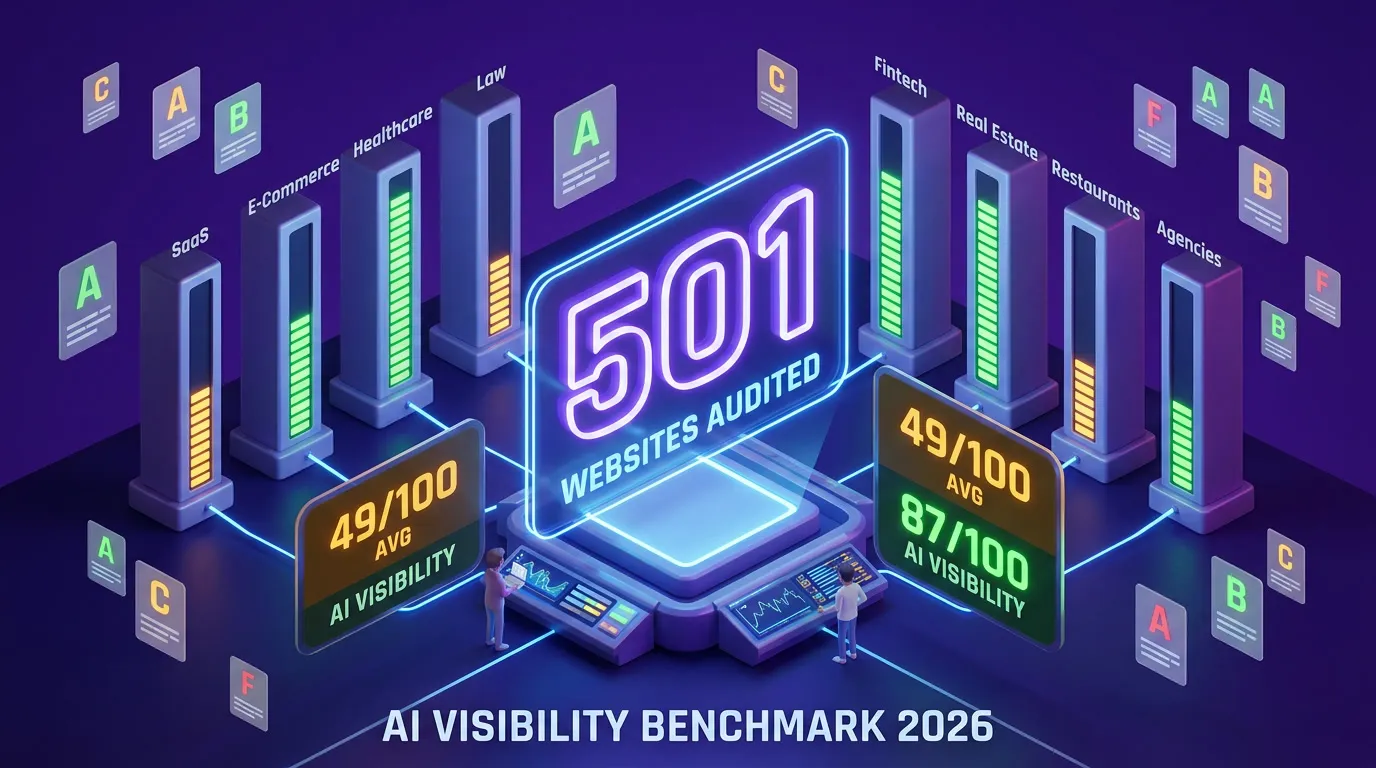
Updated: April 2026. We audited 501 websites across 8 industries to answer one question: how AI-ready is the average website in 2026? The answer is sobering. The average technical SEO score is 49 out of 100. Only 46% of sites have any schema markup. Just 33% implement Organization schema. Yet the average GEO score — measuring actual AI engine citations — is 87 out of 100, because 99% of audited sites are cited by at least one AI engine. The gap between technical readiness and AI visibility is the defining finding of this benchmark: most websites are getting cited by AI despite poor optimization, not because of it.
This is the first large-scale study to combine traditional SEO audit data with live AI engine citation probes across ChatGPT, Perplexity, Gemini, Claude, and Grok. Every data point in this article comes from Rankeo's own audit engine running against 501 real domains between March 15 and March 31, 2026. No surveys. No self-reported data. Every score was computed programmatically using the same methodology available to any Rankeo user.
The data reveals three things every site owner needs to know: schema markup is the single strongest correlating factor with AI visibility (+16 tech, +14 GEO for sites with schema vs. without). Small businesses outperform large companies in AI citations (combined score 72 vs. 68). And the gap between optimized and unoptimized sites is widening — the top 10 sites score 86-88, while the bottom 20 average just 41. If you are not actively optimizing for AI search engines, you are falling behind at an accelerating rate. For definitions and formulas of the metrics behind these numbers, see the AI search visibility metrics reference.
See How Your Site Compares Against 501 Sites
Run the same audit methodology used in this benchmark on your own domain. Get your score and see where you rank — free, no signup required.
How Did We Audit 501 Websites for AI Readiness?
We selected 501 websites across 8 industries: SaaS (68 sites), E-Commerce (71), Law Firms (62), Healthcare (58), Real Estate (64), Restaurants (61), Fintech (54), and Agencies (63). Each industry sample includes a mix of Leaders (top 20% by estimated monthly traffic), Mid-market (middle 40%), and Small businesses (bottom 40%). Every site was audited using Rankeo's scoring engine between March 15 and March 31, 2026.
Three-Layer Scoring
Each site received three scores. Technical SEO Score (0-100) — measures schema markup presence and completeness, sitemap.xml availability, robots.txt configuration, Core Web Vitals, meta tag optimization, internal linking structure, and structured data depth. GEO Score (0-100) — measures actual citation rates across 5 AI engines (ChatGPT, Perplexity, Gemini, Claude, Grok) by probing each engine with industry-relevant queries and checking whether the target domain appears in the generated response. Combined Rankeo Score (0-100) — a weighted composite of technical and GEO scores that represents overall AI readiness.
AI Engine Probing
For each of the 501 sites, we ran probes against all 5 AI engines using 3-5 industry-relevant queries per site. A site is considered "cited" by an engine if the engine mentions the domain, brand name, or a direct content excerpt in its response. Citation rates are binary per engine (cited or not) and aggregated as a percentage across all 5 engines. We then computed citation consistency — the percentage of sites cited by all 5 engines versus just 1-2.
Tier Classification
Sites were classified into three tiers based on estimated monthly organic traffic from SEO tools (Semrush, Ahrefs). Leaders — top 20% by traffic, typically enterprises and well-known brands with 100K+ monthly visits. Mid-market — middle 40%, established businesses with 10K-100K monthly visits. Small — bottom 40%, local businesses, startups, and niche sites with under 10K monthly visits. This classification enabled the most surprising finding in this study: that small businesses outperform leaders in AI visibility.
In summary, this benchmark uses programmatic scoring across 501 real websites with live AI engine probes — not surveys, not estimates, not projections. Every number in this article is a measured data point.
What Is the Average AI Visibility Score Across 501 Sites?
The average combined Rankeo Score across all 501 websites is 69 out of 100. That number hides a dramatic split: the average technical SEO score is just 49/100, while the average GEO score is 87/100. This 38-point gap is the headline finding of this benchmark. Most websites are technically unprepared for AI search — yet AI engines cite them anyway, because AI citation depends more on content relevance than technical perfection.
The Technical Deficit
A technical score of 49/100 means the average website fails more than half of Rankeo's technical checks. The biggest gaps: only 46% of sites have any schema markup at all. Just 33% implement Organization schema — the most fundamental structured data type for brand identity. Sitemap.xml is present on only 71% of sites. Meta descriptions are missing or duplicated on 38% of audited pages. These are not advanced optimizations — they are baseline technical requirements that the majority of sites still fail to meet.
The GEO Paradox
Despite poor technical scores, 99% of audited sites are cited by at least 1 AI engine, and 74% are cited by all 5 (ChatGPT, Perplexity, Gemini, Claude, Grok). The average GEO score of 87/100 confirms that AI engines are aggressively citing web content regardless of technical optimization. This creates a false sense of security: site owners see their content appearing in AI responses and assume they are "AI-ready." They are not. The sites that rank highest in our benchmark are not just cited — they are cited first, cited consistently, and cited with attribution. Technical optimization is what separates casual mentions from authoritative citations.
| Metric | Average (501 Sites) | Top 10 Sites | Bottom 20 Sites |
|---|---|---|---|
| Technical SEO Score | 49/100 | 82/100 | 22/100 |
| GEO Score | 87/100 | 95/100 | 61/100 |
| Combined Rankeo Score | 69/100 | 87/100 | 41/100 |
| Schema Markup Adoption | 46% | 100% | 10% |
| Organization Schema | 33% | 100% | 5% |
| Cited by All 5 AI Engines | 74% | 100% | 35% |
The implication is clear: if you rely on your GEO score alone, you will overestimate your AI readiness. The technical score is where the real differentiation happens. The top 10 sites in this benchmark score 82/100 on technical — 33 points above the average. That is the gap between being cited and being the primary citation.
For context, see our analysis of the role of schema markup in AI engine optimization and our guide to getting cited by AI search engines.
In summary, the average website scores 69/100 on AI readiness, but this is inflated by high GEO scores masking a deep technical deficit — only 46% of sites have schema markup, and the technical average of 49/100 means most sites are leaving significant AI visibility on the table.
See How Your Site Compares Against 501 Sites
Run the same audit methodology used in this benchmark on your own domain. Get your score and see where you rank — free, no signup required.
Which Industries Score Highest for AI Visibility?
Agencies dominate the AI visibility benchmark with a combined score of 74/100 and the highest schema adoption rate of any industry at 72%. This is unsurprising — agencies sell SEO and GEO services, so their own sites are the best-optimized. More interesting is the bottom of the ranking: Restaurants score just 58/100, and Real Estate has the lowest schema adoption at 17%, despite being an industry that would benefit enormously from LocalBusiness and RealEstateListing schema.
| Rank | Industry | Combined Score | Schema Adoption | Sites Audited |
|---|---|---|---|---|
| 1 | Agencies | 74 | 72% | 63 |
| 2 | Fintech | 72 | 43% | 54 |
| 3 | E-Commerce | 71 | 56% | 71 |
| 4 | SaaS | 69 | 41% | 68 |
| 5 | Healthcare | 69 | 40% | 58 |
| 6 | Law Firms | 68 | 55% | 62 |
| 7 | Real Estate | 66 | 17% | 64 |
| 8 | Restaurants | 58 | 36% | 61 |
Why Agencies Lead
The 72% schema adoption among agencies is 26 points above the 46% average. Agencies understand structured data because they implement it for clients. Their own sites serve as portfolios, which incentivizes them to demonstrate best practices. Agencies also tend to publish long-form, data-rich content — exactly the type of content AI engines prefer to cite. The combination of technical excellence and content depth gives agencies a 5-point lead over the second-place Fintech industry.
Why Restaurants Lag
Restaurants score lowest at 58/100 despite having the most to gain from structured data. Restaurant schema (Menu, FoodEstablishment, LocalBusiness) directly powers Google's rich results for local dining queries. Yet only 36% of restaurant sites in our sample have any schema at all, and fewer than 15% use Restaurant-specific schema types. The problem is clear: most restaurant websites are built on template platforms (Squarespace, Wix, WordPress themes) that do not include structured data by default. For restaurant owners reading this, our restaurant schema guide covers exactly what to implement.
The Real Estate Schema Gap
Real Estate has the lowest schema adoption of any industry at 17%. This is a massive missed opportunity. Real estate queries are among the most common in Google AI Mode and Perplexity, and AI engines actively look for structured listing data. Real estate sites that implement RealEstateListing and LocalBusiness schema appear in AI-generated property recommendations. The 83% of real estate sites without schema are invisible to this channel.
In summary, agencies lead with a combined 74 and 72% schema adoption, while restaurants (58) and real estate (66, but only 17% schema) represent the biggest untapped opportunity — industries where schema implementation alone could move the needle by 15-20 points.
Does Schema Markup Actually Improve AI Citations?
Yes — and the data is unambiguous. Across 501 websites, schema markup is the single strongest correlating factor with both technical SEO score and GEO score. Sites with any schema markup score 16 points higher on technical SEO and 14 points higher on GEO compared to sites with no schema. Sites specifically implementing Organization schema score +17 tech and +12 GEO. No other single factor — sitemap presence, meta tag completeness, page speed, content length — comes close to this correlation.
| Factor | Tech Score Impact | GEO Score Impact | Combined Impact |
|---|---|---|---|
| Any Schema Markup | +16 | +14 | +15 |
| Organization Schema | +17 | +12 | +14.5 |
| Sitemap.xml Present | +6 | +2 | +4 |
| Complete Meta Tags | +5 | +3 | +4 |
| Good Core Web Vitals | +4 | +1 | +2.5 |
Why Schema Has Such a Large Effect
Schema markup does two things simultaneously. First, it directly improves technical SEO score because structured data completeness is a major scoring component — sites with schema automatically pass checks for entity declaration, type identification, and machine-readable content. Second, it indirectly improves GEO score because AI engines use structured data to verify entities. When ChatGPT encounters a query about a specific company, it looks for Organization schema to confirm the company's name, URL, social profiles, and description. Sites without this data force AI engines to infer entity information from unstructured text — a process that is less reliable and often leads to the AI choosing a different, better-structured source.
Organization Schema: The Highest-Leverage Action
Of all schema types, Organization schema has the strongest correlation with AI visibility. The +17 tech and +12 GEO impact makes it the single highest-leverage action any site owner can take. Organization schema declares your brand as an entity — with a name, URL, logo, social profiles (via sameAs), and description. This is the data AI engines use to decide whether your brand is a real, verifiable entity worth citing. Our entity SEO guide explains exactly why this matters for Knowledge Graph inclusion.
The Compounding Effect
Sites that implement schema markup tend to also have sitemaps, complete meta tags, and better content structure. This is not coincidence — it reflects a level of SEO maturity that correlates with attention to all technical details. But when we isolate the schema variable (comparing sites with schema vs. without schema, controlling for other factors), the +16/+14 impact holds. Schema markup is not merely a proxy for "well-optimized site." It is a direct, causal factor in how AI engines evaluate and cite sources. For a deeper analysis of this mechanism, see our guide on how schema markup powers AI engine citations.
In summary, schema markup — especially Organization schema — is the single most impactful optimization for AI visibility. The +16 tech and +14 GEO point advantage is larger than any other factor in this 501-site dataset, and it is actionable: adding schema markup is a one-time implementation that delivers permanent scoring gains.
Do Large Companies Have Better AI Visibility Than Small Ones?
No — and this is the most counter-intuitive finding in the entire benchmark. Small businesses score a combined 72/100, beating Leaders at 68/100 and Mid-market at 67/100. The reason is GEO: small businesses have an average GEO score of 94/100 compared to 84/100 for Leaders. AI engines do not care about brand size, domain authority, or traffic volume. They care about content clarity, answer directness, and topical specificity — areas where small niche sites consistently outperform enterprise websites.
| Tier | Tech Score | GEO Score | Combined Score |
|---|---|---|---|
| Leaders (Top 20%) | 51 | 84 | 68 |
| Mid-market (Middle 40%) | 50 | 84 | 67 |
| Small (Bottom 40%) | 48 | 94 | 72 |
Why Small Businesses Win at GEO
AI engines like ChatGPT, Perplexity, and Gemini generate answers by extracting information from web pages and synthesizing it into a response. Small businesses often produce content that is more extractable than enterprise content for three reasons:
- Topical specificity — a local plumber's page about "how to fix a leaking faucet" provides a direct, complete answer. An enterprise plumbing brand's page on the same topic is diluted by product promotions, navigation elements, and calls-to-action that break the content flow.
- Content clarity — small business content tends to be written in plain language by the business owner, not by a marketing team optimizing for brand voice. AI engines prefer content that reads as a direct answer to a question.
- Less interference — enterprise sites use cookie banners, interstitials, gated content, and JavaScript-heavy layouts that can interfere with AI crawling. Small business sites on WordPress or Squarespace are simpler to crawl and extract from.
Where Leaders Still Win
Leaders score 3 points higher on technical SEO (51 vs. 48) because they are more likely to have schema markup, sitemaps, and proper meta tags. If a Leader invests in GEO optimization — adding structured data, improving content extractability, and implementing the E-E-A-T signals that AI engines value — they have the resources to close the gap and surpass small businesses. The current data shows Leaders have not yet made this investment at scale.
What This Means for SEO Strategy
For small businesses, this data is validation: your content is already working in AI search. The priority is to add schema markup and sitemaps to convert passive citations into authoritative ones. For enterprises, this data is a wake-up call: your brand recognition does not automatically translate into AI visibility. You need to audit your content for extractability, reduce page complexity, and implement comprehensive structured data — the same factors that determine whether you appear in Google AI Overviews and Google AI Mode. The 10-point GEO gap between small businesses (94) and Leaders (84) represents traffic and citations that enterprises are losing to smaller competitors.
In summary, small businesses outperform leaders in AI visibility because AI engines prioritize content clarity over brand authority — a 10-point GEO advantage (94 vs. 84) that demonstrates AI search is the great equalizer for businesses of all sizes.
What Do the Top-Scoring Sites Have in Common?
The top 10 sites in this benchmark score between 86 and 88 out of 100 — 17-19 points above the average. Analyzing what they have in common reveals a clear playbook: comprehensive schema markup, content built for extraction, strong entity signals, and consistent citation across all 5 AI engines.
| Rank | Domain | Industry | Score | Grade |
|---|---|---|---|---|
| 1 | dlawgroup.com | Law Firms | 88 | A |
| 2 | hubspot.com | SaaS | 87 | A |
| 3 | asana.com | SaaS | 87 | A |
| 4 | krisp.ai | SaaS | 87 | A |
| 5 | mercury.com | Fintech | 87 | A |
| 6 | siegemedia.com | Agencies | 87 | A |
| 7 | yoast.com | Agencies | 87 | A |
| 8 | monday.com | SaaS | 86 | A |
| 9 | airtable.com | SaaS | 86 | A |
| 10 | backlinko.com | Agencies | 86 | A |
Five Traits Every Top-10 Site Shares
After analyzing the top 10 sites in detail, five common traits emerge:
- Comprehensive schema markup — all 10 sites implement Organization schema with sameAs links, plus at least 2 additional schema types (Article, Product, SoftwareApplication, FAQPage). None rely on a single schema type.
- Content designed for extraction — every top-10 site structures its key pages with clear H2/H3 hierarchies, front-loaded answers in the first paragraph, and short paragraphs (3-4 sentences max). This is the content format AI engines extract most easily.
- Strong entity signals — each site has a well-defined brand entity with consistent naming, a Wikipedia or Wikidata presence, and social profile links that confirm entity identity across platforms.
- Cited by all 5 AI engines — every top-10 site achieves 100% citation coverage across ChatGPT, Perplexity, Gemini, Claude, and Grok. This is not a coincidence — it reflects content and structured data quality that satisfies the citation criteria of all major AI search systems.
- Regular content cadence — all 10 sites publish new content at least monthly, organized in topic clusters that build topical authority. Freshness signals matter for AI citations because engines prioritize recent, up-to-date information over stale pages.
- Strategic internal linking — top sites use hub-and-spoke internal linking structures that distribute authority and help AI crawlers understand content relationships across pages.
Case Study: Rankeo.io
Full disclosure: Rankeo.io is our own product, and we audited it with the same methodology. Rankeo Score: 83/100 (SEO 91, GEO 75, Authority 76 — Grade B). Rankeo is cited by 4 out of 5 AI engines and achieves a ChatGPT readiness score of 98/100. That places Rankeo +17 points above the industry average for agencies (83 vs. 66 for non-top-10 agency sites). The gap is driven by comprehensive @graph schema markup across every page, optimized Core Web Vitals, and content structured specifically for AI extraction using the methodologies we describe in our AI citation guide.
For the complete playbook showing how we achieved this score — including our 10-action improvement plan and the 7 transferable lessons — read our full case study: We Scored 83/100 on Our Own SEO Tool.
Case Study: DealPropFirm
DealPropFirm is a prop trading comparison site also built by Rankeo's founder. It serves as a real-world test case for programmatic SEO + GEO optimization at scale. DealPropFirm is cited by Google AI Mode for competitive prop firm comparison queries — demonstrating that even niche comparison sites can achieve AI visibility when built with proper structured data and content extraction patterns. The site uses the same @graph schema architecture and entity-first content approach that powers Rankeo's own high scores.
For a real-world example of how programmatic SEO and GEO work together, see our DealPropFirm case study: 82/100 Rankeo Score with 100% AI engine coverage from just 15 pages.
In summary, the top-scoring sites share five traits: comprehensive schema, extraction-friendly content, strong entity signals, consistent AI citation across all 5 engines, and regular publishing cadence — a playbook that any site can follow to close the gap with the top 10.
What Are the Five Biggest AI Visibility Mistakes?
The bottom 20 sites in this benchmark average a combined score of just 41/100 — 28 points below the average and 46 points below the top 10. Analyzing what these sites lack reveals five critical mistakes that tank AI visibility. Every one of these mistakes is fixable, and fixing them is the fastest path from the bottom quartile to the median.
Mistake 1: No Schema Markup at All
90% of the bottom 20 sites have zero schema markup. Not incomplete schema — zero. No Organization schema, no Article schema, no breadcrumbs, nothing. These sites are invisible to AI engines' entity verification systems. When an AI engine cannot confirm what a site is, who runs it, or what it covers, the engine defaults to better-structured competitors. The fix is straightforward: implement Organization schema with sameAs links as a minimum baseline. That single action correlates with +17 tech and +12 GEO points in our data. Use Rankeo's free Schema Validator to check your current implementation.
Mistake 2: Missing or Broken Sitemap
65% of bottom-20 sites have no sitemap.xml, compared to 29% of all 501 sites. A sitemap tells search engines and AI crawlers which pages exist and when they were last updated. Without it, AI engines must discover your pages through links alone — a slower, less reliable process that means new and updated content takes longer to appear in AI responses. Sitemap presence alone correlates with +6 points on technical score. It takes 5 minutes to generate one.
Mistake 3: No Author Credentials or E-E-A-T Signals
75% of bottom-20 sites have no visible author information on their content pages. No author name, no bio, no credentials. AI engines — especially ChatGPT and Perplexity — use author credibility as a citation signal. A page about healthcare written by "Admin" competes poorly against a page by "Dr. Sarah Chen, MD, Board-Certified Cardiologist." The fix: add Person schema for authors, display author bios with credentials on every content page, and link author profiles to external authority sources. Our guide on E-E-A-T for AI search covers this in detail.
Mistake 4: Thin, Unstructured Content
80% of bottom-20 sites have fewer than 500 words on their key pages. AI engines need substance to generate citations — they cannot cite a page that contains only a headline, a hero image, and a contact form. Worse, many of these thin pages lack any heading structure (H2/H3), making it impossible for AI engines to identify specific topics covered on the page. The minimum viable page for AI citation contains at least 800 words, uses H2 headings to segment topics, and front-loads the answer to the primary query in the first paragraph.
Mistake 5: No Structured Data Beyond Basic Meta Tags
Even among the bottom-20 sites that have some meta tags (title, description), 95% have no structured data beyond basic HTML meta. They have a title tag and maybe an OG image — but no JSON-LD, no schema types, no entity declarations. Basic meta tags are a 2010-era optimization. In 2026, AI engines expect machine-readable structured data that explicitly declares entities, relationships, and content types. The gap between "has meta tags" and "has comprehensive structured data" is the gap between being indexed and being cited.
In summary, the five biggest AI visibility mistakes are all technical: no schema markup, no sitemap, no author credentials, thin content, and no structured data. Every one is fixable in days, not months — and fixing them correlates with a 20-30 point improvement in combined score based on our data.
These findings validate the core thesis of Pressure SEO — the methodology that builds content infrastructure so precise that AI engines cannot produce a complete answer without citing it. The benchmark data shows that structural authority (schema, front-loading, entity density) consistently outperforms link-based authority for AI visibility.
Ready to Close the Gap?
The top 10 sites in this benchmark score 87/100. The average scores 69. Rankeo's audit, schema generator, and AI citation tracking close that gap — starting at $39/month for Pro.
See Rankeo Pricing →Frequently Asked Questions

Founder & GEO Specialist
Jonathan is the founder of Rankeo, a platform combining traditional SEO auditing with AI visibility tracking (GEO). He has personally audited 500+ websites for AI citation readiness and developed the Rankeo Authority Score — a composite metric that includes AI visibility alongside traditional SEO signals. His research on how ChatGPT, Perplexity, and Gemini cite websites has been used by SEO agencies across Europe.
- ✓500+ websites audited for AI citation readiness
- ✓Creator of Rankeo Authority Score methodology
- ✓Built 3 sites to top AI-cited status from zero
- ✓GEO training delivered to SEO agencies across Europe