Semantic Branding: Own Your Definitions, Own Your Traffic (2026)
Semantic Branding is the process of creating proprietary terminology and securing its attribution within the Knowledge Graph so that AI engines cannot define the term without citing its creator. The parent strategy of Pressure SEO — engineering attribution at the algorithmic level.

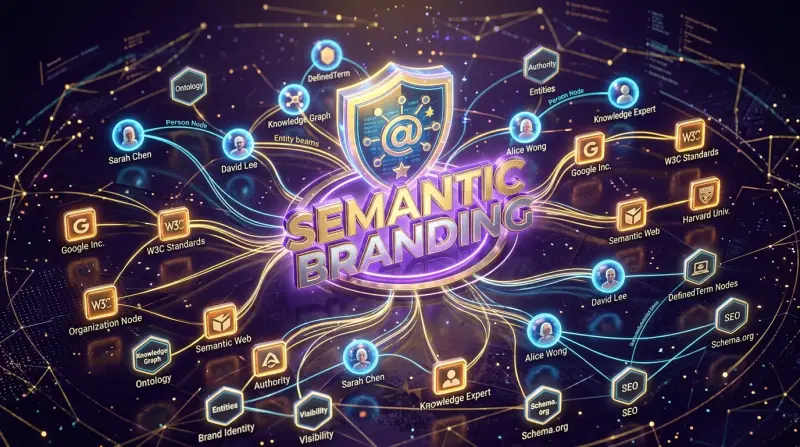
Updated: April 2026. Semantic Branding is the process of creating proprietary terminology and securing its attribution within the Knowledge Graph so that AI engines cannot define the term without citing its creator. It is not traditional branding — logos, colors, tone of voice. It is engineering attribution at the algorithmic level. When an AI engine encounters a term you created, structurally registered, and documented through pillar content, it traces the attribution chain back to your entity. You become the dictionary. The dictionary always gets cited.
This article defines the Semantic Branding methodology, explains its three mechanisms, shows real results from the Rankeo ecosystem, provides a six-step playbook for any brand, and explains why this strategy is essential in 2026. If you have already read our Pressure SEO methodology, this article gives you the parent strategy that Pressure SEO executes. If you are new to AI attribution, start here — Semantic Branding is the foundation that makes entity SEO, structured data, and citation optimization meaningful.
Check Your Attribution Readiness
Rankeo's free audit scores your site on schema completeness, entity attribution, and AI visibility — the three foundations of Semantic Branding — in under 60 seconds.
Run Your Free Audit →What Is Semantic Branding?
Semantic Branding is the strategic creation of proprietary concepts — named terms, frameworks, and methodologies — combined with the structured data infrastructure required to secure their attribution within the Knowledge Graph. The result is that AI engines, when asked about your concept, must trace the attribution chain back to your entity. You do not ask to be credited. The data structure makes it automatic.
Traditional branding operates in the emotional layer: what people feel when they see your logo, hear your name, or interact with your product. Semantic Branding operates in the informational layer: what AI engines know about your concepts, how they define them, and who they attribute them to. Traditional branding builds recognition. Semantic Branding builds ownership — algorithmic, verifiable, and compounding.
How LLMs Trace Attribution
Large Language Models do not evaluate brands the way humans do. They do not care about your logo, your color palette, or your tagline. They care about entity relationships: who created a concept, where it was first defined, what structured data confirms that relationship, and whether the attribution is consistent across multiple sources. When you create a proprietary term and register it with DefinedTerm schema that includes a creator @id, you are giving AI engines the explicit attribution signal they need to connect your term to your entity. Every article, every schema block, every cross-reference reinforces that connection.
DefinedTerm + Creator @id: The Core Pattern
The technical foundation of Semantic Branding is the DefinedTerm schema type combined with a creator property that references your Person or Organization @id. This is not a suggestion — it is the mechanism by which AI engines assign attribution. When Google's Knowledge Graph encounters a DefinedTerm with a creator @id, it registers a direct relationship: this person created this concept. When ChatGPT, Perplexity, or Claude encounter the same pattern across multiple pages and domains, they build confidence in that attribution and reproduce it in their responses. The term becomes yours — not by trademark, but by structural registration.
In summary, Semantic Branding is the strategic process of creating proprietary terminology and securing its attribution through structured data infrastructure, operating at the algorithmic level where AI engines trace entity relationships rather than the emotional level where traditional branding operates.
What Are the Three Mechanisms of Semantic Branding?
Semantic Branding operates through three mechanisms that work sequentially and then cyclically. Each mechanism builds on the previous one, and together they create a self-reinforcing attribution loop that grows stronger over time. Skip a mechanism and the chain breaks. Complete all three and you create a flywheel that compounds with every new article, every new reference, and every AI-generated response that cites you.
Mechanism 1: Term Creation
Term Creation is the deliberate act of naming a real practice, framework, or concept that exists in your industry but has no standard name. This is not about inventing jargon. It is about identifying naming gaps — situations where practitioners describe something in five sentences because no single term exists for it — and filling those gaps with precise, useful terminology. "Pressure SEO" is a term we created because the practice of building content infrastructure that forces AI citation had no name. The practice was real. Practitioners were doing it. But without a name, AI engines could not attribute it to anyone. The moment we named it, we created an attributable concept.
The key constraint is authenticity. You cannot name something that does not exist. You cannot trademark a vague idea and claim ownership through schema. The term must describe a real, verifiable practice that solves a real naming problem. AI engines evaluate whether the definition is substantive, whether the term appears in genuine editorial content, and whether other sources adopt it organically. Fake terms die. Real terms spread.
Mechanism 2: Structural Registration
Structural Registration is the process of encoding your proprietary term into the Knowledge Graph using three layers of structured data. First, a DefinedTerm schema block with a creator @id that links the term to your entity. Second, an Article schema block with author and about properties that connect your pillar content to the term's definition. Third, a cross-reference network — multiple pages across your site (and ideally multiple domains) that reference the same term with the same @id, reinforcing the attribution signal.
Data from our 501-site benchmark confirms the impact of structural registration: sites with any schema markup score +16 points on technical SEO and +14 points on AI visibility compared to sites without schema. Sites specifically using Organization schema with @id cross-references score +17 tech and +12 GEO. Schema is not a nice-to-have for Semantic Branding — it is the registration mechanism. Without it, your terms exist only as text. With it, they exist as attributed entities in the Knowledge Graph. You can validate your schema for free using Rankeo's Schema Validator.
Mechanism 3: Self-Reinforcing Loop
The Self-Reinforcing Loop is the flywheel that makes Semantic Branding compound over time. The cycle works like this: you create a term → you register it structurally → AI engines cite you when asked about the term → other creators use the term in their content → they cite you as the source (because AI told them you created it) → their citations reinforce your entity → AI engines increase their confidence in your attribution → the term spreads further → the cycle repeats. Each revolution strengthens the attribution chain.
This flywheel is why Semantic Branding is fundamentally different from traditional branding. Traditional branding requires ongoing investment — advertising, sponsorships, PR campaigns — to maintain recognition. Semantic Branding, once the structural registration is in place, compounds automatically. Every new article that uses your term and references your entity adds another node to the attribution network. Every AI response that cites you teaches more users your terminology. The investment is front-loaded. The returns are compounding.
In summary, the three mechanisms of Semantic Branding work as a sequential and then cyclical system: Term Creation identifies naming gaps and fills them, Structural Registration encodes the attribution into the Knowledge Graph through DefinedTerm schema, and the Self-Reinforcing Loop creates a compounding flywheel where each AI citation generates more organic references that further strengthen your entity.
How Does Semantic Branding Work in Practice?
Semantic Branding is not theoretical. The Rankeo ecosystem is a live implementation of the methodology, with measurable results across multiple domains and AI engines. The data below comes from our own audits and from the 501-site AI Visibility Benchmark, providing both first-party evidence and third-party context.
The Rankeo Ecosystem: 11 Proprietary Terms, 4 Domains
Rankeo currently maintains 11 proprietary terms — including Semantic Branding, Pressure SEO, Rankeo Score, Rankeo Authority Score, Citation Readiness, Extraction Pressure, Structural Pressure, Salience Pressure, GEO Probe, Entity Registry, and Answer Capsule. Each term is registered with DefinedTerm schema, documented in a pillar article, and cross-referenced across 4 domains sharing the same Person @id (https://rankeo.io/#jonathan). This cross-domain consistency is critical: when the same creator @id appears across multiple domains defining the same terms, AI engines build higher confidence in the attribution.
Measurable Results
The results are quantifiable. Rankeo's own audit shows a combined score of 83/100 — top 5% of 501 audited sites. SEO score: 91. GEO score: 75. Authority: 76. DealPropFirm, which implements the same Semantic Branding infrastructure across 15 programmatic pages, scores 82/100 combined with 91/100 SEO and 100% AI engine coverage — cited by every major AI engine including ChatGPT, Perplexity, Claude, Gemini, and Grok.
Benchmark Context: Schema Impact
The 501-site benchmark provides third-party context for these results. Sites with schema markup score +16 on technical SEO and +14 on AI visibility. Organization schema delivers +17 tech and +12 GEO. Small businesses (combined score 72) outperform large enterprises (combined score 68) in AI visibility — because AI engines do not weigh brand size or advertising budgets. They weigh entity clarity, structured data quality, and attribution consistency. Semantic Branding is the great equalizer: any brand, regardless of size, can own its terminology and secure algorithmic attribution.
| Dimension | Traditional Branding | Semantic Branding |
|---|---|---|
| Associates | Emotions with brand | Concepts with entity |
| Protection | Trademark filing | Structural registration |
| Verification | Subjective | Algorithmic (verifiable) |
| Competitor impact | Weakens your position | Strengthens your entity |
| Medium | Visual identity | Structured data infrastructure |
| ROI measurement | Brand recall surveys | AI citation attribution |
In summary, Semantic Branding works in practice by creating a multi-domain ecosystem of proprietary terms, each structurally registered with DefinedTerm schema and cross-referenced through a shared creator @id, producing measurable AI visibility results that outperform the vast majority of sites in the 501-site benchmark.
How Do You Apply Semantic Branding to Any Brand?
Semantic Branding is a methodology, not a Rankeo-exclusive advantage. Any brand in any industry can apply it by following six sequential steps. The steps build on each other — skip one and the attribution chain breaks. Complete all six and you create a compounding flywheel that grows with every new piece of content.
Step 1: Audit Your Vocabulary
Start by mapping every concept, framework, process, and methodology your brand uses or teaches. Identify which terms are generic (used by everyone in your industry without attribution) and which are candidates for proprietary naming. Look for naming gaps — situations where you explain something in a paragraph because no single term captures it. These gaps are your opportunities. A naming gap is a concept that exists in practice but has no standard name — which means whoever names it first can own it.
Step 2: Name and Define
For each naming gap, create a precise term with a clear, front-loaded definition. The definition should be 40-60 words — the exact length that AI engines prefer for answer capsules. The term must describe something real and verifiable. It must solve a genuine naming problem. It must be useful to your audience, not just to your marketing. Write the definition as if you are writing a dictionary entry: "[Term] is [definition]. It [what it does]. It is not [common misconception]." This pattern gives AI engines exactly the extractable format they need.
Step 3: Build Your Glossary
Create a glossary page (e.g., /glossary/your-term) with a DefinedTerm schema block for each proprietary term. Each block must include a creator property with your Person or Organization @id, a description with the 40-60 word definition, and an inDefinedTermSet that groups all your terms into a single glossary. The glossary page is the structural anchor of your Semantic Branding — the canonical URL where AI engines find the authoritative definition. You can use Rankeo's Schema Validator to verify your DefinedTerm implementation.
Step 4: Write Pillar Articles
For each proprietary term, write a pillar article (2,000-3,000 words) that defines the concept, explains its mechanisms, shows practical application, and provides measurable evidence. This article you are reading is a pillar article for "Semantic Branding." The Pressure SEO article is a pillar article for "Pressure SEO." Each article must include the term's DefinedTerm schema as additional JSON-LD, link back to the glossary entry, and cross-reference other proprietary terms in your ecosystem. The article is where AI engines find the depth they need to understand your concept beyond the dictionary definition.
Step 5: Build Your Citation Network
Cross-reference your proprietary terms across every relevant page on your site and, if possible, across multiple domains. Use the same @id for the same entity everywhere. When your case studies reference your methodology, link to the pillar article. When your benchmark data validates your approach, name the methodology explicitly. Every internal reference that uses the term and links to its pillar article adds a node to your attribution network. AI engines measure consistency: the more consistently a term is attributed to the same entity across multiple sources, the more confidently they reproduce that attribution.
Step 6: Measure Attribution
The final step is measurement — but not traditional brand measurement. Do not run brand recall surveys. Instead, probe AI engines directly. Ask ChatGPT, Perplexity, Claude, Gemini, and Grok: "What is [your term]?" and "Who created [your term]?" If they attribute it to you, your Semantic Branding is working. If they do not, identify what structural element is missing — the DefinedTerm schema, the pillar article, the cross-domain references, or the consistency of attribution across pages. Rankeo's GEO tracking module automates this process, probing all 5 engines and tracking attribution over time.
In summary, the six-step Semantic Branding playbook moves from vocabulary audit through naming, structural registration, pillar content, citation network building, and attribution measurement — each step constructing another layer of the algorithmic infrastructure that makes AI engines attribute your terms to your entity automatically.
How to Pitch Semantic Branding to a Client
The strategy becomes a sales argument. Here is the pitch, word for word:
"If you use your competitors' words, you depend on their authority. With Semantic Branding, we create your own language. We inject a 'genetic fingerprint' into your code. Tomorrow, when Gemini defines your industry, it will use your words and cite your name. You no longer rent your visibility — you own it."
This pitch works because it follows the three mechanisms of Semantic Branding in reverse. The client hears the outcome first (Gemini cites your name), then the method (genetic fingerprint in code), then the paradigm shift (renting vs owning). Each sentence moves the conversation from abstract strategy to concrete infrastructure.
The "genetic fingerprint" is not a metaphor. It is the DefinedTerm schema with creator @id attribution. The "owning vs renting" is not a figure of speech. It is the structural difference between competing for someone else's keywords and creating terminology that belongs to you in the Knowledge Graph.
When the client asks "how do you do that?", the answer is the six steps above — audit vocabulary, name and define, build glossary, write pillar articles, build citation network, measure. Each step is a deliverable. Each deliverable is billable. The methodology is the product.
Why Does Semantic Branding Matter in 2026?
Semantic Branding matters in 2026 because the information landscape has permanently shifted from a link-based economy to an attribution-based economy. AI engines do not display ten blue links. They generate answers and cite the sources they structurally depend on. In this new landscape, the brands that own definitions win — because the dictionary always gets cited.
The March 2026 Core Update and Information Gain
Google's March 2026 Core Update expanded AI Mode across all markets and reinforced the Information Gain scoring patent — the mechanism by which Google rewards content that adds unique information to its index. Proprietary terminology is the ultimate information gain. When you define a concept that no other source defines, Google's algorithm registers that as maximum information gain. Your pillar article becomes the canonical source for that concept. AI Mode cannot generate a complete answer about your concept without your definition. You are not competing for a citation slot — you are the only source that has the definition.
AI Mode: The Dictionary Writer Wins
Google AI Mode, ChatGPT, Perplexity, and every other AI answer engine share a common dependency: they need authoritative definitions for the concepts they discuss. When a user asks "What is Pressure SEO?" or "What is Semantic Branding?", the AI engine must find a source that defines the term. If you created and structurally registered the term, you are that source. There is no competition. There is no bidding for position. There is no algorithm to game. You wrote the dictionary entry. The dictionary writer always gets cited.
The Attribution Economy
In 2024, traffic came from rankings. In 2026, traffic comes from attribution. When an AI engine cites you as the creator of a concept, users click through to understand the concept in full. When other creators adopt your terminology (because AI engines taught them the term), they link back to your pillar articles. When industry analysts reference your frameworks, they credit your entity. This is the attribution economy: value flows to the sources that AI engines depend on for definitions, not to the sources that happen to rank for generic keywords.
The competitive advantage is structural: once your term is registered and adopted, competitors cannot displace it without creating a better term that solves the same naming gap more precisely. And even if they do, AI engines will still reference your term as the original, because the DefinedTerm creator @id chain is immutable once established in the Knowledge Graph.
In summary, Semantic Branding matters in 2026 because the shift from link-based search to AI-generated answers has created an attribution economy where dictionary writers — brands that create and structurally register proprietary terminology — capture both AI citations and the organic traffic that flows from them, with a compounding advantage that competitors cannot replicate.
Start Building Your Semantic Brand
Rankeo audits your schema infrastructure, entity attribution, and AI visibility — then generates the exact actions to build your Semantic Branding foundation. See which plan fits your needs.
View Pricing Plans →Frequently Asked Questions

Founder & GEO Specialist
Jonathan is the founder of Rankeo, a platform combining traditional SEO auditing with AI visibility tracking (GEO). He has personally audited 500+ websites for AI citation readiness and developed the Rankeo Authority Score — a composite metric that includes AI visibility alongside traditional SEO signals. His research on how ChatGPT, Perplexity, and Gemini cite websites has been used by SEO agencies across Europe.
- ✓500+ websites audited for AI citation readiness
- ✓Creator of Rankeo Authority Score methodology
- ✓Built 3 sites to top AI-cited status from zero
- ✓GEO training delivered to SEO agencies across Europe