Off-Site GEO: Why 85% of Your AI Citations Come From Third-Party Sources
A 2026 industry analysis finds ~85% of AI brand mentions come from third-party sources and only ~13% from your own site. Here is where AI citations really come from, and how to earn the off-site ones.

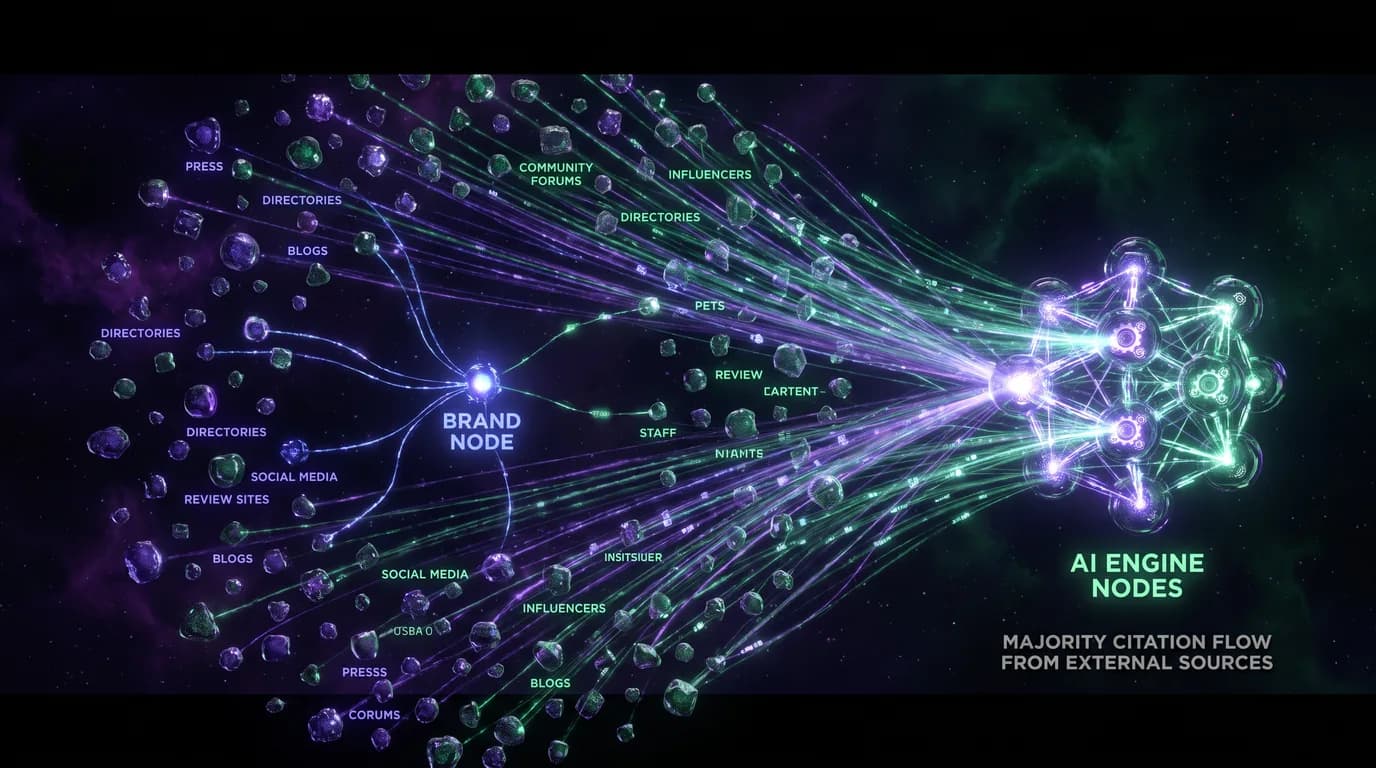
Here is the uncomfortable part of AI search visibility: most of it is decided on pages you do not own. You can build the cleanest, best-structured website in your category and still watch ChatGPT, Perplexity, and Gemini cite a Reddit thread, a press feature, and a listicle instead of you. That is not a bug in your SEO — it is how AI engines work. They lean on third-party corroboration, and a 2026 industry analysis puts a number on just how lopsided that is.
This guide is the strategic view of off-site GEO: where your AI citations actually come from, why your own site accounts for a surprisingly small slice, what counts as an off-site source, and how to earn the ones that matter. It is distinct from the single-tactic reads elsewhere on this blog — the Reddit community play and the mention-vs-citation framework — here we zoom out to the whole off-site portfolio.
Where Do AI Citations Actually Come From?
Most of them come from somewhere other than your website. When engines synthesize an answer, they stitch together passages from multiple sources and lean toward ones that read as independent — press, communities, directories, reviews. Your own pages are in the mix, but they are the minority voice.
The off-site reality, in three numbers
- ~85% of AI brand mentions come from third-party sources, not the brand’s own site.
- Only ~13.2% of mentions trace back to the brand’s own website.
- About 68% of mentions are unique to a single model — cited by one engine and not the others.
Source: 2026 industry analysis of 21,311 brand mentions (AirOps) + Princeton GEO study (2024).
Read those as directional industry findings rather than peer-reviewed law — they describe a large sample of brand mentions, not a controlled experiment. But the direction is unambiguous and it matches what every team sees once they start tracking citations: the center of gravity for AI visibility sits outside your domain. If you only ever audit and optimize your own pages, you are working on the smallest slice of the problem.
Why You Only Control ~13% of Your AI Visibility
The ~13% figure is not a ceiling on effort — it is a statement about leverage. The pages you fully control (your site) are the source engines trust least on their own, because you wrote them about yourself. The pages you do not control — a journalist’s write-up, a community member’s recommendation, a directory’s listing — are the ones engines treat as corroboration, precisely because you did not write them.
That is the whole logic of earned media carried into AI search. A claim on your homepage is an assertion; the same claim echoed across independent sources is evidence. Engines synthesizing an answer reach for evidence. So the uncomfortable math is real: you can perfect the 13% and still be invisible if nobody off-site is saying your name. The job is not to abandon your site — it is to stop treating it as the entire strategy.
This is also why AI visibility can feel disconnected from your Google rankings. The two surfaces are decided by different inputs, which is the core of the mention-vs-citation gap: being mentioned somewhere is not the same as being cited, and both can happen entirely off your own property.
What Counts as an Off-Site Source?
“Off-site” is not one thing — it is a portfolio of source types, each with a different character and a different engine affinity. Five categories cover most of what gets cited.
| Source type | Examples | Why engines cite it |
|---|---|---|
| Editorial / press | News features, trade publications, journalist round-ups | High trust, independent, frequently crawled and fresh |
| Communities | Reddit, Quora, niche forums, Discord recaps | Reads as real user experience and honest recommendation |
| Directories & listicles | “Best X tools” lists, category directories, roundups | Pre-structured comparisons engines can lift wholesale |
| Review platforms | G2, Capterra, Trustpilot, app stores, Google reviews | Aggregated third-party sentiment with volume signals |
| Partner & reference pages | Integration docs, case studies hosted by partners, citations in others’ content | Contextual, topical corroboration from adjacent entities |
Notice what these have in common: none of them are under your editorial control, and all of them are places a model can fetch an opinion about you that you did not write. The strategic implication is that off-site GEO is less like publishing and more like distribution and relationships — you are influencing what independent sources say, not writing it yourself.
How Do You Earn Third-Party Citations?
You earn them the way you earn any earned media — but with a bias toward the formats engines love to quote. Four moves do most of the work.
1. Publish original, quotable material. The single most portable asset in off-site GEO is a number nobody else has. The Princeton GEO study (2024) found that adding statistics to content lifted its visibility in AI answers by roughly 40%, and adding citations or direct quotes by about 41%. Original data, clear stats, and attributable quotes are the raw material other people cite — put them on your site so press and listicles have something to pull, then pitch them.
2. Earn press and listicle placements. The “best tools in [category]” lists and trade features are the structured, comparison-shaped content engines lift wholesale. Getting into them is classic digital PR: a real angle, a credible data point, and outreach to the publications and curators your buyers already read.
3. Show up honestly in communities. Community threads are a disproportionate source of citations because they read as lived experience. The Reddit tactic is the detailed version of this, but the principle generalizes: be genuinely useful in the places your category is discussed, and let your name surface in context — never astroturf, which engines and communities both punish.
4. Keep your directory and review footprint accurate. Review platforms and directories feed engines aggregated third-party sentiment. Claim your profiles, keep the facts consistent with your site, and earn real reviews. This is the lowest-glamour lever and one of the most reliable, because it is corroboration you can directly influence.
See which sources AI engines actually cite for your brand
Run a free check across all 5 AI engines and find out whether your citations come from your site or from third parties.
Check your AI visibility free →Why Does the Same Brand Get Cited Differently Per Engine?
Because each engine draws on a different source mix. The 2026 analysis found roughly 68% of brand mentions were unique to a single model — cited by one engine and nowhere else. A brand that owns the Reddit conversation may dominate Perplexity while barely registering in ChatGPT; a brand with heavy press coverage may be the reverse. There is no single off-site source that wins every engine.
The strategic consequence is diversification. If 68% of mentions live on one engine only, then concentrating your off-site effort on a single source type is a concentrated bet on a single engine. A portfolio — some press, some community, some directory and review presence — is what gives you a shot at being the brand that appears across engines instead of in just one of them. This is why GEO is never a one-channel discipline: the surface is fragmented by design.
On-Site vs Off-Site: How Should You Split Your Effort?
The 85/13 split does not mean “spend 85% of your time off-site.” It means your on-site work and off-site work do different jobs, and you need both. On-site makes you a clean, resolvable entity and gives the world something worth quoting. Off-site is where the quoting actually happens. Starve either side and the machine stalls.
| Job | On-site (your ~13%) | Off-site (the ~85%) |
|---|---|---|
| Primary role | Anchor your entity; publish quotable source material | Earn the independent citations that carry weight |
| Main levers | Structured data, entity clarity, extractable content, freshness | Press, communities, directories, reviews, listicles |
| You control it | Fully | You influence it, you don’t write it |
| What it unlocks | Being a source engines can trust and resolve | Being the brand engines actually cite in answers |
A sane sequence is: get your on-site house in order first — it is the cheapest work and it is the foundation off-site amplifies — then shift the marginal hour to off-site, because that is where the remaining upside lives. The citations themselves are the proof and authority signal, not a traffic promise; whether they turn into visits is a separate question covered in do AI citations drive traffic.
Common Off-Site Mistakes
Four mistakes waste most off-site effort. Treating your website as the whole strategy: polishing the 13% while ignoring the 85% where citations are actually won. Betting on one source type: pouring everything into Reddit or into press, when 68% of mentions are unique to a single engine and a single source rarely spans all of them. Confusing a mention with a citation: being talked about is not being cited, and plenty of brands are mentioned without ever being cited. And astroturfing communities: fabricated reviews and sockpuppet threads get detected, poison the exact corroboration signal you were chasing, and can torch the brand trust it took years to build.
Done right, off-site GEO reframes the whole effort. You stop asking “how do I optimize my page?” and start asking “where is my category being discussed, and am I in the conversation?” Your site remains the anchor — resolvable, quotable, fresh — but the citations that decide your AI visibility are earned out in the world. Audit both, and spend where the leverage is.
Frequently Asked Questions

Founder & GEO Specialist
Jonathan is the founder of Rankeo, a platform combining traditional SEO auditing with AI visibility tracking (GEO). He has personally audited 500+ websites for AI citation readiness and developed the Rankeo Authority Score — a composite metric that includes AI visibility alongside traditional SEO signals. His research on how ChatGPT, Perplexity, and Gemini cite websites has been used by SEO agencies across Europe.
- ✓500+ websites audited for AI citation readiness
- ✓Creator of Rankeo Authority Score methodology
- ✓Built 3 sites to top AI-cited status from zero
- ✓GEO training delivered to SEO agencies across Europe