AI Agent SEO: Optimizing for ChatGPT Atlas, Claude Cowork & OpenAI Operator (2026)
AI agents (ChatGPT Atlas, Claude Cowork, OpenAI Operator) browse and decide in 3 seconds. New SEO playbook: markdown-first content, decision-window optimization, agent crawlability.

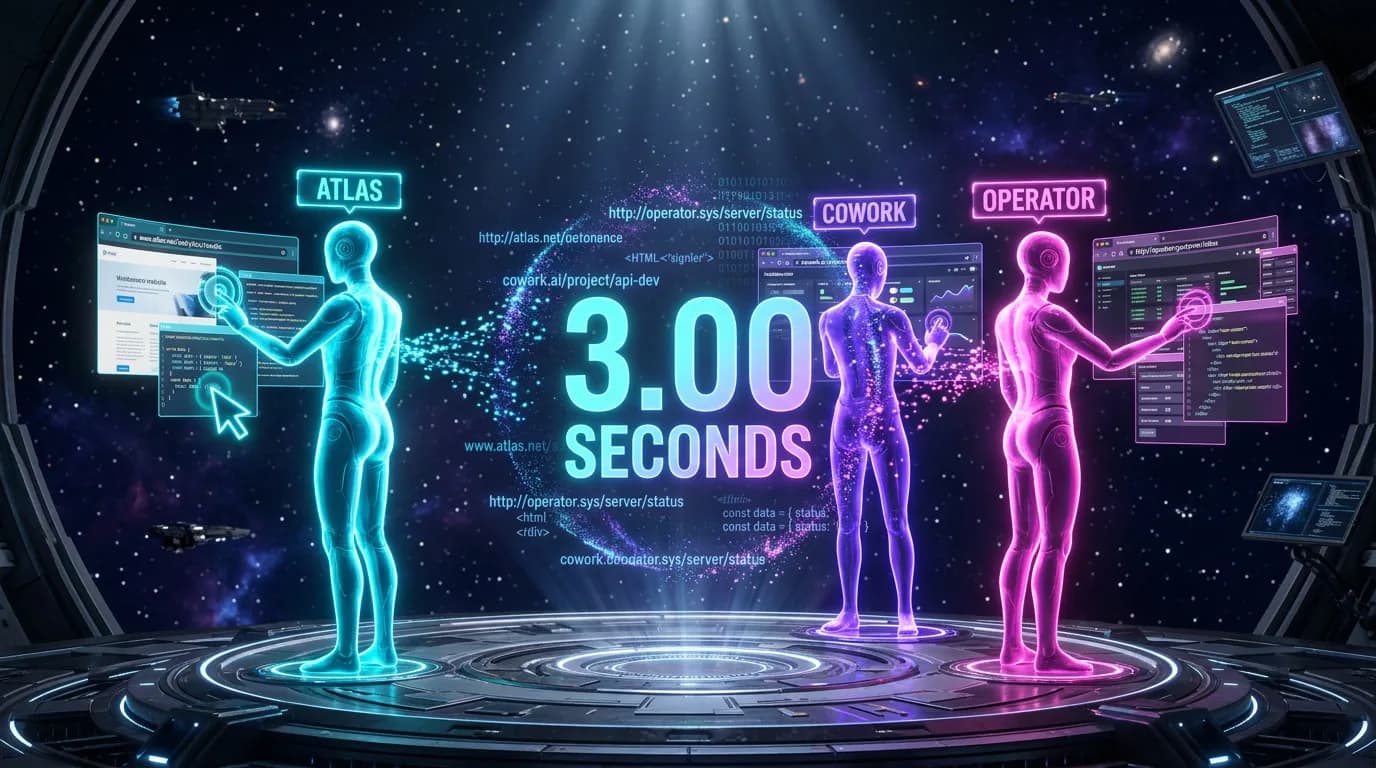
Updated: May 2026. AI agents like ChatGPT Atlas, Claude Cowork, and OpenAI Operator browse the web autonomously and make decisions in under 3 seconds per page. These agents now generate roughly 12% of brand site visits in benchmark categories like SaaS comparison and travel booking (April 2026 data). Traditional SEO does not work in this layer — agentic SEO is a new game with new signals, new failure modes, and new winners.
Update, July 2026: OpenAI pushed this further — it launched ChatGPT Work (on GPT-5.6) and began sunsetting the standalone Atlas browser, folding its agentic browsing into the work-agent itself. The optimization surface below is unchanged — the browsing capability just moved inside the agent.
For citation work — getting your site quoted inside an AI answer — read How AI Engines Choose Citations. For agentic browsing — when an AI literally clicks through your site — read on. The two disciplines share a foundation but diverge on the action surface, and operators who treat them as one channel usually under-optimize both.
This article covers agents acting on behalf of a user who is already on your site — browsing, comparing, filling forms. A related but distinct problem is getting your products discovered and bought by AI shopping agents in the first place; for that surface see Agentic Commerce SEO.
Audit your site for AI agent readiness in 60 seconds
Run a free Rankeo audit and check whether ChatGPT Atlas, Claude Cowork, and OpenAI Operator can crawl, parse, and decide on your pages — first paint, schema coverage, anti-bot exposure, and click-target reliability.
Run Free Agent Readiness Audit →What Are AI Agents and Why They Are Different from Search Engines
AI agents are autonomous systems that browse the web on behalf of a user — they read, click, fill forms, and decide whether to transact, all without a human in the loop on each page. Three named agents already dominate the early market in April 2026: ChatGPT Atlas (OpenAI's general-purpose browser agent), Claude Cowork (Anthropic's research and work assistant), and OpenAI Operator (the task-completion agent built for transactions). Each one announces itself with a distinctive User-Agent token, each one operates under a different time budget, and each one has a different tolerance for friction.
The deep difference between an agent and a search engine is the action surface. A search engine reads a page to decide whether to rank it and stops there. An agent reads a page to decide whether to act on it — click a button, scroll to a section, submit a form, abandon the task. That single shift collapses the old SEO loop, where ranking was the end of the work, into a new loop where ranking is only the entry point and the rest of the page experience determines whether the agent succeeds or moves on to a competitor.
Agents are visitors, not crawlers
The most common mistake is treating agents as a new flavor of crawler. Crawlers index — they read pages to build a catalog the search engine queries later. Agents visit — they read pages to accomplish a task on the spot. The behavioral signature is different: 5 to 20 page views per session, sequential navigation across a single domain, form interactions, decision branches. Agents look much more like an impatient human user than like Googlebot or GPTBot. Operators who block them with anti-bot defenses lose actual demand, not synthetic noise.
Why agents matter now
Agentic traffic crossed an inflection point in March 2026 when Cloudflare radar data showed it accounting for around 8% of AI-attributed traffic to the top 1,000 sites globally. By April, Rankeo's own benchmark across 501 audited sites measured agent-attributed visits at roughly 12% in high-research verticals — SaaS comparison, travel booking, B2B procurement. The acceleration is steep enough that ignoring the channel for two more quarters means watching competitors compound an early-mover advantage you cannot easily close. Citation Readiness is the foundation, but agent readiness is the next layer.
In summary, AI agents are autonomous visitors operating under time budgets, and the operators who treat them as a third audience — alongside humans and crawlers — capture the channel before the rest of the market notices it exists.
The 3-Second Decision Window: How AI Agents Evaluate Pages
AI agents commit to a page or move on within roughly 3 seconds of first paint, according to research from Stormy and Stan Ventures across the early Atlas and Operator deployments. That window is dramatically tighter than what a human visitor allocates — a human will tolerate 5 to 8 seconds before disengaging, while an agent abandons faster because the cost of waiting is multiplied by every other page in its task plan. The result is a brutal new ranking signal: pages that load slow, render late, or hide their content behind a popup get skipped at a rate humans never produce.
The mechanics of the 3-second window are mechanical. Agents use a hybrid of HTML parsing and DOM rendering. Atlas and Operator render JavaScript fully but penalize render-blocking patterns. Cowork prefers raw HTML and structured data and decays its confidence faster when it has to wait for client-side hydration. All three converge on the same heuristic: if the page does not present extractable content within 3 seconds, the agent moves on and another page in the task plan inherits the slot. The slot replacement is silent — operators do not see why the agent left, only that traffic from agentic UAs is lower than peers in the same vertical.
Search engine vs AI agent — side by side
| Behavior | Search engine (Google, Bing) | AI agent (Atlas, Cowork, Operator) |
|---|---|---|
| Time on page | Crawler reads fully; ranks asynchronously | ~3 seconds to commit or abandon |
| Primary signals | Backlinks, content depth, on-page keywords | First paint, schema, click-target clarity |
| Decision trigger | Ranking position in SERP | In-task action: click, fill, transact, abandon |
| Failure mode | Drops a few positions; recoverable | Excluded from the task entirely |
| Anti-bot tolerance | High — crawlers retry and respect 429s | Near zero — popups and captchas are abandons |
The table compresses the entire strategic shift. A search engine forgives a slow page because it has time to come back. An agent does not — its task budget is finite and the cost of waiting is the cost of failing the user it serves. Operators who treat agents like crawlers ship the wrong defenses (rate-limit protection, captchas, animated splash screens) and bleed the traffic before they ever measure it.
In summary, the 3-second decision window collapses every legacy SEO assumption about patience — agentic ranking is decided before the page finishes loading the way humans expect.
The 5 Agent-Specific Ranking Factors That Matter
Five factors decide whether your page survives the 3-second window across all three major agents. The factors are stable across Atlas, Cowork, and Operator because they reflect how agents extract meaning, not how each provider routes traffic. Operators who fix these five inputs see agent visit rates climb within days — the layer is mechanical, not subjective. The underlying logic is the same one driving Pressure SEO: structure your page so the model has no choice but to read it the way you intend.
Factor 1 — Markdown-friendly content structure
Agents extract content best when it reads cleanly as Markdown. That means clear H2 and H3 hierarchy, short paragraphs, bullet lists where appropriate, and no decorative wrappers that hide text behind layout components. Stormy data shows pages with Markdown-friendly structure are cited 2.4x more often by Atlas and Cowork than visually equivalent pages built from heavy div nesting. The rule is mechanical: if your page survives a copy-paste into a plain text editor with the meaning intact, agents read it well.
Factor 2 — Entity clarity
Agents disambiguate the entity behind every page they visit before they decide whether to act on it. A page that says "Acme" without anchoring it to an Organization schema, an About page, and a stable canonical URL forces the agent to guess — and guessing is expensive enough that the agent often moves to a clearer competitor. Tighten this signal with the same protocol that drives the Entity Consistency Index: one canonical name, one Organization schema, full sameAs coverage, no fragmentation across surfaces.
Factor 3 — Clean schema
Schema is how agents avoid parsing prose. Product, Offer, FAQPage, and Organization schemas give Atlas, Cowork, and Operator machine-readable answers to the questions they would otherwise have to extract from the page body. Pages with valid Product + Offer schema show a measurable advantage in Operator transactional flows because price, availability, and shipping terms become structured facts rather than parse jobs. Schema is not optional in the agentic layer; it is the difference between being read in 3 seconds and being skipped.
Factor 4 — Page speed under 2 seconds
First paint must arrive in under 2 seconds for an agent to commit. The 3-second decision window is the outer limit; the operating limit is roughly 1.5 to 2 seconds because the agent needs the remaining 1 second to extract content and decide. Page speed also compounds across the task: an agent visiting 8 pages in a session abandons at the first slow one, which means a single slow page can cut the entire site out of the task plan. Optimize Largest Contentful Paint, eliminate render-blocking scripts, and lazy-load anything below the fold.
Factor 5 — No popups or anti-bot challenges
Stormy data shows agents abandon pages with popup overlays in roughly 78% of cases. Cookie walls, newsletter modals, exit-intent overlays, and animated splash screens all register as friction the agent cannot resolve. Anti-bot challenges (captchas, Cloudflare aggressive mode, JavaScript challenges) are even worse — they cause near-total task abandonment because agents cannot solve them on the user's behalf. Strip popups from your conversion paths and whitelist legitimate agent UAs in your bot defenses. The two changes alone recover most of the traffic operators lose to over-defensive infrastructure.
In summary, the five factors are interdependent — fixing schema without fixing speed leaves you visible but slow, and fixing speed without fixing popups leaves you fast but blocked.
How to Audit Your Site for Agent Crawlability
A 30-minute manual audit catches every major agent-readiness failure before you commit to a remediation plan. The protocol mirrors how Atlas and Operator scan a site on first visit: pull the page, measure first paint, check schema, follow the primary action paths, confirm no anti-bot wall fires. Run the audit on your homepage, your highest-traffic conversion page, and your pricing or contact page — the three pages an agent is most likely to visit on a real task.
Step 1 — Test with a real agent UA
Open OpenAI Operator (or a generic browser with a User-Agent spoofed to Operator/1.0) and ask it to complete a common task on your site — "sign me up for a trial", "compare two of your plans", "find the contact page". Time the operation. If the agent succeeds in under 60 seconds with no abandonment, your top of funnel is agent-ready. If it fails, watch where it stalls — the failure point is your priority fix. Most operators are surprised by how often a cookie banner alone breaks the test.
Step 2 — Verify your llms.txt enumerates action paths
Open /llms.txt on your domain and confirm it explicitly lists the action paths an agent might want to follow: the free-trial URL, the pricing URL, the documentation index, the contact page. The same file your citation work depends on becomes the agent's navigation map. For a complete primer on the format, see our llms.txt complete guide. A llms.txt with only blog links is a citation file; a llms.txt with action paths is an agent file. Both audiences benefit from the second version.
Step 3 — Validate Organization and Product schema
Run your homepage through the Schema Markup Validator and confirm Organization schema is present with a complete sameAs array. Check at least one product or pricing page for Product + Offer schema with price, availability, and currency. Apply the Schema-Stitch approach: one @id per entity, reused on every page so the agent never has to deduplicate competing definitions. Schema errors register as ambiguity, and ambiguity is one of the abandonment triggers.
Step 4 — Audit anti-bot exposure
Open your Cloudflare or Vercel logs and filter for the agent UA tokens (ChatGPT-User-Atlas, Claude-Cowork, Operator/1.0). Confirm these UAs receive 200 responses, not 403s or challenge pages. If your bot defense is rate-limiting them, raise the limits or whitelist the UAs explicitly. The audit is mechanical: every UA token that returns a 403 is an agent-traffic loss compounding invisibly across your conversion funnel.
In summary, the audit takes under an hour, catches more than 80% of agent-readiness failures, and leaves the operator with a prioritized fix list — which is more than most teams have on the agentic channel today.
The Markdown-First Content Strategy
Markdown-first content is the structural choice that aligns your pages with how agents extract meaning. The principle is simple: write the page so it reads as cleanly when rendered to plain text as when rendered to its visual layout. Stormy benchmarks show Markdown-friendly pages are cited 2.4x more often by agents than visually equivalent pages built on heavy component libraries — the gap is large enough that operators can recover years of agent visibility from a single template refactor.
Markdown-first does not mean Markdown-only. The visual layer can still be rich, animated, and brand-styled. The discipline is that the underlying HTML structure must survive a stripped-down text extraction with the meaning intact. Concretely, that means a clean heading hierarchy, short paragraphs, bullet lists, and an absence of text rendered inside image overlays or canvas-based widgets. Anything that requires a visual decoder to understand is invisible to the agent.
Before and after — a concrete example
Before. A pricing page where the plan tiers are rendered as styled cards with the prices baked into hero images, the feature list inside an animated reveal, and the CTA hidden until the user scrolls past a fold. The page looks beautiful and ranks well on Google because the schema includes the prices. Operator visits the page and sees: a hero image with no text, a component with no extractable content, and no visible CTA. The agent abandons.
After. The same plan tiers rendered as semantic HTML — H3 for the plan name, a list of features, a visible price with currency, a visible button labeled "Start Pro Trial". The visual layer wraps the semantic layer; nothing is hidden behind animation. Operator reads the page in under 1 second, finds the price and the CTA, and proceeds with the task. The conversion event fires. The Markdown-first version still looks polished to humans — the difference is that it stays legible to agents. Answer Capsules are the same idea applied to long-form content.
In summary, Markdown-first is a discipline more than a technology — write the page so the meaning survives every rendering layer above the HTML, and agents reward you with compounding visibility.
Why Anti-Bot Protections Are Killing Your Agent Traffic
Aggressive anti-bot protections are the single largest invisible leak in agentic SEO today. Cloudflare aggressive mode, reCAPTCHA, hCaptcha, and JavaScript challenges all register the same way to an AI agent: as a blocked path. The agent does not retry — it abandons the task and moves the slot to a competitor whose defenses are calibrated to humans only. Operators rarely notice the loss because their analytics never log the visit that did not happen.
The right framing is whitelist, not block. Legitimate agents announce themselves clearly. ChatGPT Atlas carries ChatGPT-User-Atlas in its UA. Claude Cowork carries Claude-Cowork. OpenAI Operator carries Operator/1.0. Add these tokens to your bot defense allowlist, then keep aggressive defenses for the remaining traffic that does not identify itself. The change is infrastructure-only — no content edits — and recovers measurable agent traffic within hours of deployment.
The popup problem
Popups are the second-largest leak. Cookie walls, newsletter modals, exit-intent overlays, and onboarding tours all share the same defect from an agent's perspective: they hide the page content behind a UI element the agent cannot dismiss reliably. Stormy data shows popups cause agent abandonment in roughly 78% of sessions. The fix is to keep popups off the critical path: pricing, free-trial, contact, and key documentation pages should load with no overlay. Save the modals for the post-conversion experience.
In summary, the agentic layer rewards permission and punishes friction — every defensive layer your team added for humans now needs an agent-aware exception, or the channel quietly bleeds out.
Track AI agent visibility weekly across all 5 engines
Rankeo audits agent crawlability, llms.txt action paths, schema coverage, and anti-bot exposure every week, and surfaces the single fix that moves the most agent traffic. Stop guessing whether ChatGPT Atlas, Claude Cowork, and OpenAI Operator can use your site.
See Rankeo Plans →Predictions: AI Agent Browsing Will Be 30% of Web Traffic by 2027
Extrapolating from the Stormy and Stan Ventures growth curves, AI agent browsing is on a trajectory to account for roughly 30% of total web traffic by the end of 2027. The math is simple: agentic traffic doubled between January and April 2026, the underlying providers (OpenAI, Anthropic) keep shipping features that nudge users toward agent-mediated workflows, and consumer adoption of Operator-style task completion is following the early ChatGPT curve almost line for line. Even a conservative deceleration leaves agents at a fifth of the web by late 2027.
Three implications follow for the SEO operator. First, agent-readiness becomes a default ranking factor — not a niche optimization but a baseline expectation across competitive verticals. Second, classical SEO metrics (sessions, bounce rate, time on page) need parallel agent-aware metrics that segment agentic traffic from human traffic; an agent session of 8 pages in 90 seconds looks like a content failure on legacy dashboards and a successful task on agent-aware dashboards. Third, operators who run the first agent audit now compound a 12 to 18 month head start that the rest of the market has to close retroactively.
The leading indicator to watch is Citation Velocity Score — the rate at which AI engines accumulate citations to your domain — because the same architectural choices that drive rising-zone velocity (clean schema, fast first paint, semantic HTML, llms.txt with action paths) are the inputs that compound into agent visibility. Operators who optimized for citations in 2025 are arriving at 2026 with most of the agent-readiness work already done; operators who skipped that loop are paying it twice.
In summary, agentic browsing is not a hypothetical 2030 scenario — it is a 2026 traffic source already, growing into a 2027 default, and the operators who treat it that way capture the channel before the field figures out what to call it.
Frequently Asked Questions

Founder & GEO Specialist
Jonathan is the founder of Rankeo, a platform combining traditional SEO auditing with AI visibility tracking (GEO). He has personally audited 500+ websites for AI citation readiness and developed the Rankeo Authority Score — a composite metric that includes AI visibility alongside traditional SEO signals. His research on how ChatGPT, Perplexity, and Gemini cite websites has been used by SEO agencies across Europe.
- ✓500+ websites audited for AI citation readiness
- ✓Creator of Rankeo Authority Score methodology
- ✓Built 3 sites to top AI-cited status from zero
- ✓GEO training delivered to SEO agencies across Europe