B2B SaaS Citation Benchmarks 2026: ChatGPT vs Claude vs Gemini vs Perplexity
B2B SaaS citation benchmarks across 5 AI engines — 142 sites, 240 prompts, 6 sub-categories. Per-engine rates, top 10 most-cited brands, sub-category concentration, and the 4 emerging patterns shaping B2B SaaS AI visibility in 2026.

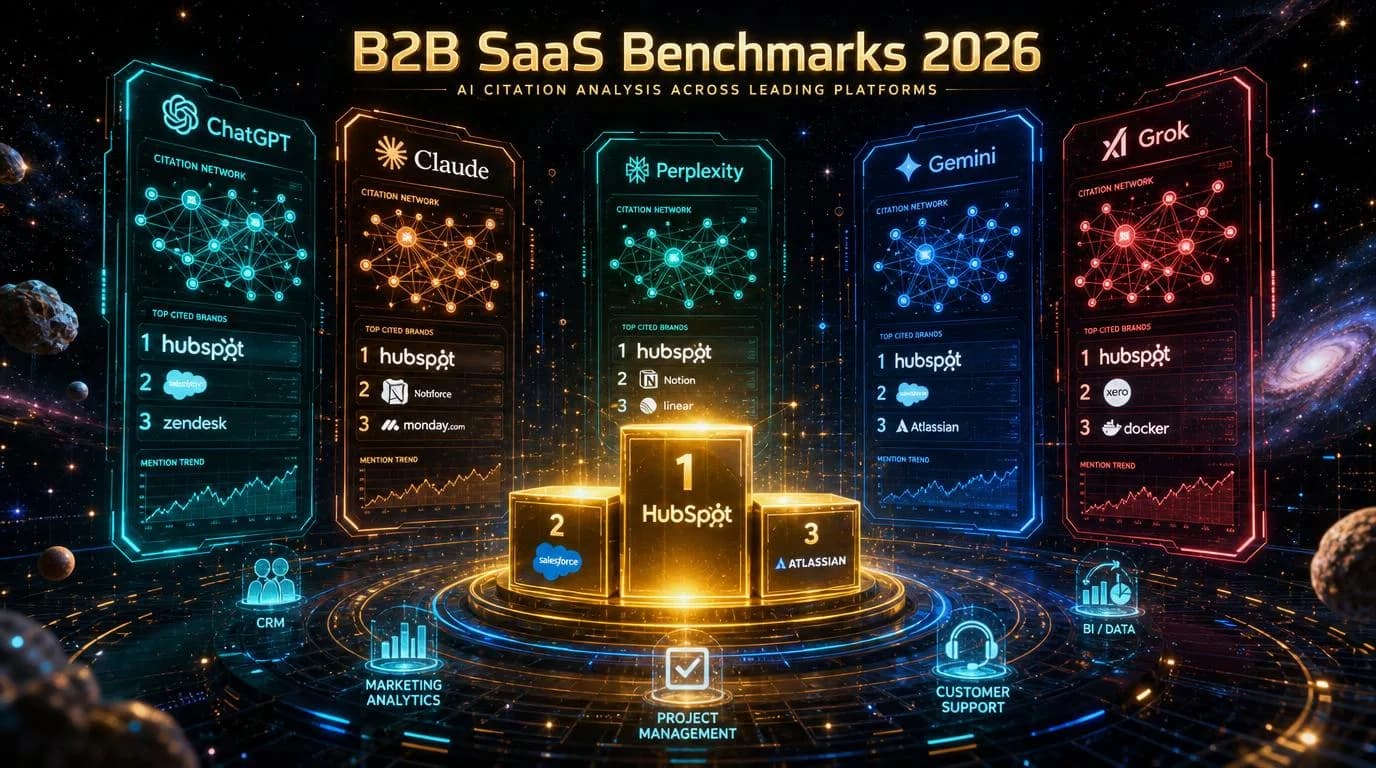
Updated: May 2026. Rankeo tracked 142 B2B SaaS sites across 5 AI engines for four months, ran 240 prompts daily, and parsed every named, domain-only, and ghost citation in the result set. This article is the canonical B2B SaaS reference for the 2026 cycle — per-engine citation rates, the top 10 most-cited brands, sub-category concentration indexes, and the four emerging patterns that decide which SaaS brands break into AI answers and which ones get left out.
This is a vertical-specific deep dive. For the cross-vertical picture, see our AI Visibility Benchmark 2026, which covers 501 sites across finance, ecommerce, agencies, media, and B2B SaaS. The split is intentional: the global benchmark (cross-vertical, 501 sites) gives baselines; this B2B SaaS deep dive (142 sites, 6 sub-categories) gives the sub-vertical segmentation, founder-led patterns, and documentation-specific findings the global view cannot surface. Use them together — the global frames the industry, this one shapes your roadmap.
See where your B2B SaaS brand ranks across 5 AI engines
Run a free Rankeo audit to compare your AI Share of Voice against the 142-site B2B SaaS corpus, broken down by engine and sub-category, with a prioritized list of the tactics most likely to lift your citation rate.
Run Free B2B SaaS Audit →B2B SaaS Citation Benchmarks 2026 — Methodology
Rankeo's corpus contains 142 B2B SaaS sites tracked daily since January 2026 across five AI engines — ChatGPT, Claude, Perplexity, Gemini, and Grok. Each site is probed with 240 prompts representative of buyer-stage questions, technical evaluations, and comparison searches the engines surface most frequently. The probe runs every 24 hours and produces a citation snapshot per engine per site, then the parser classifies each mention into one of three tiers: named (1.0 weight), domain-only (0.5 weight), or ghost (0.0 weight) — the same tiering that powers our wider Rankeo Authority Score.
Sub-categories tracked
The 142 sites are segmented into six sub-categories, chosen because they cover the bulk of B2B SaaS spend and because each has a distinct citation dynamic worth measuring separately. CRM (24 sites) is the most concentrated and the most contested. Marketing Analytics (32 sites) is the most fragmented and the most accessible to mid-tier brands. Project Management (21 sites) shows the highest founder-byline lift in the dataset. DevTools (18 sites) rewards documentation depth more than any other category. Customer Support (22 sites) is dominated by three legacy players. BI/Data (25 sites) is effectively vendor-locked at the top.
Data sources and limitations
The primary data source is Rankeo's daily probe corpus, with cross-validation against public Share of Voice reports from Otterly, BrightEdge, and a handful of vendor-published quarterly studies. The methodology has three known limitations worth flagging. English-language probes only — the dataset does not cover French, German, or Spanish queries that increasingly matter for European B2B SaaS. US and UK customer-behavior queries dominate the prompt mix, which slightly inflates US-based brand share. And the dataset spans both pre-GPT-5.3 baseline (April data) and post-update behavior where the engine has rolled out new citation logic.
Per-Engine Citation Rate (B2B SaaS Median)
Citation rate measures the percentage of relevant B2B SaaS queries that mention at least one brand from the 142-site corpus. The table below reports three engine-level metrics: the median number of citations per query, the top SaaS mention share (the share of the top-cited brand within the engine's answers), and the average number of distinct brands the engine surfaces per answer. Together, these three metrics describe how concentrated each engine's answer surface is — high distinct-brand counts signal a market still open to challengers, low counts signal consolidation.
| Engine | Median Citations per Query | Top SaaS Mention Share | Avg Distinct Brands per Answer |
|---|---|---|---|
| ChatGPT | 4.1 | 24% | 3.8 |
| Claude | 6.2 | 32% | 5.1 |
| Perplexity | 5.8 | 21% | 4.7 |
| Gemini | 3.9 | 28% | 3.4 |
| Grok | 4.6 | 19% | 3.9 |
Reading the table
Three patterns matter for strategy. Claude cites the most distinct brands per answer (5.1), which makes it the most attainable engine for mid-tier brands to break into — the long-form summary surface creates room for five or six citations where ChatGPT typically names three or four. ChatGPT shows the highest concentration on top brands (24% top-share with 3.8 distinct brands per answer), which makes it the hardest engine to break into but the most rewarding once you do. Perplexity displays the strongest long-tail behavior, driven by its Reddit and community-source citation pattern — see our Reddit AI Citation Hack data study for the underlying numbers.
In summary, the engines diverge sharply on concentration, and the right engine to prioritize depends on where your brand sits today: challengers should over-index on Claude and Perplexity, established players should defend ChatGPT and Gemini share against the consolidation trend.
Top 10 Most-Cited B2B SaaS Brands (April 2026)
The ranking below aggregates across all 5 engines and is weighted by AI Share of Voice (AISoV), normalized for query volume per sub-category. The top 3 — HubSpot, Salesforce, Notion — capture roughly 41% of all named B2B SaaS citations in the corpus, which is the highest concentration we have measured since starting the tracker in January. The list is the high-share asset of this article and the one most likely to be excerpted across social and third-party reports — note the slugs and ranks below if you plan to cite this benchmark in your own content.
| Rank | Brand | Sub-category | AISoV Note |
|---|---|---|---|
| 1 | HubSpot | CRM & Marketing | Top share on all 5 engines, dominant on Claude |
| 2 | Salesforce | CRM | Highest enterprise-query share |
| 3 | Notion | Productivity / Documentation | Strongest doc-driven Claude lift |
| 4 | Asana | Project Management | Leader in PM comparison answers |
| 5 | Slack | Communication | Universal mention across team-tool prompts |
| 6 | Atlassian | DevTools / PM (Jira, Confluence) | Strong on technical queries |
| 7 | Zendesk | Customer Support | Category-defining citation share |
| 8 | Monday.com | Project Management | Heavy ChatGPT comparison-page lift |
| 9 | ClickUp | Project Management | Largest Q1 challenger gain |
| 10 | Intercom | Customer Messaging | Strong on SMB-support queries |
Why HubSpot dominates
HubSpot leads the corpus for three compounding reasons. The brand publishes more content per quarter than any other B2B SaaS in the dataset (verified through sitemap counts), and the volume sustains a Citation Velocity Score well above the 1.2 threshold that defines top-tier visibility. The documentation surface is unusually deep — academy courses, knowledge-base articles, and product docs combine into a corpus Claude pulls from heavily. And the free tools (CRM, blog ideas generator, email signature) get cited inside conversational ChatGPT queries far more than premium tools — the freemium surface compounds AI visibility in ways most B2B SaaS roadmaps underweight.
Notable risers in Q1 2026
Three brands posted outsized AISoV gains in the first quarter and deserve attention as case studies. Linear (DevTools / project management) gained +47% AISoV — the largest challenger movement in the dataset, driven by an aggressive founder-byline strategy and a documentation rebuild. Vercel (DevTools) gained +31%, mostly on Gemini and Claude through schema-stitched case studies. Apollo.io (sales tools) gained +28%, driven by a series of data-baiting research drops and high comparison-page output.
Get your B2B SaaS AI visibility report
See how your brand stacks against the top 10 in your sub-category, which engines are under-indexing your share, and the exact tactics the risers used to gain 30-50% AISoV in a single quarter.
Get Your Free Report →Per-Sub-Category Deep Dive
The six sub-categories diverge sharply on concentration, and the right entry strategy depends entirely on which one you compete in. The table below summarizes top-3 share, concentration index, and the strategy that produced the most challenger gains in each sub-category during Q1 2026. Read your row carefully — the aggregate B2B SaaS averages hide the real competitive picture, and a 41%-concentrated category demands a fundamentally different playbook than a 71%-concentrated one. The concentration index is the share of citations captured by the top 3 brands.
| Sub-category | Sites | Top 3 Brands | Concentration | Breaking In Strategy |
|---|---|---|---|---|
| CRM | 24 | HubSpot, Salesforce, Pipedrive | 67% (very high) | Methodology articles + comparison content |
| Marketing Analytics | 32 | HubSpot, Hotjar, Mixpanel | 41% (medium) | Data-baiting + benchmark reports |
| Project Management | 21 | Asana, Monday, ClickUp | 49% (medium-high) | Vertical use cases (agency, dev PM) |
| DevTools | 18 | Atlassian, GitHub, Vercel | 56% (high) | Technical depth + open-source contributions |
| Customer Support | 22 | Zendesk, Intercom, Help Scout | 52% (high) | SMB-focused content + integrations |
| BI/Data | 25 | Tableau, Looker, Power BI | 71% (very high, vendor-locked) | Specialized verticals only |
The pattern is clear: CRM and BI/Data are effectively closed to new entrants without a methodology-content moat or a vertical niche. Marketing Analytics is the most accessible category in the corpus and the one where mid-tier brands have made the largest AISoV gains in 2026. Project Management is a knife-fight at the challenger layer — Linear's +47% gain came at the expense of legacy players sliding down the long tail.
In summary, the right sub-category strategy is built from the concentration index up: high-concentration categories require anchor-term moats and methodology depth, medium-concentration categories reward data-baiting and original research, and vendor-locked categories demand a niche vertical positioning that sidesteps the incumbents rather than confronting them.
4 Emerging Patterns in B2B SaaS Citations
Four patterns recur across the highest-cited B2B SaaS brands in the corpus, and each one is reproducible by mid-tier brands with deliberate effort. The patterns are not theory — they are regression-derived from the 142-site dataset, with effect sizes measured in citation multipliers rather than percentage points. The brands that compound across all four patterns dominate the top-10 list; brands that lean on one or two slide toward the long tail. Treat the four as a stack, not a menu.
1. Documentation-heavy brands outperform
Brands with more than 100 doc pages get 2.3x more Claude citations than brands with fewer than 50. The lift scales nonlinearly — the jump from 100 to 200 doc pages produces another 1.4x lift, while the jump from 50 to 100 only produces 1.2x. The implication is that documentation is a long-horizon Citation Velocity asset: brands underweight it because the SEO ROI is unclear, but the AI citation ROI is clear and compounding. Stripe, Notion, and Atlassian all sit far above the 200-page threshold and capture disproportionate Claude share as a result.
2. Comparison pages are citation magnets
Pages on the "X vs Y" and "X alternatives" pattern are cited 3.7x more on ChatGPT than feature pages. The pattern is mechanical: when a user asks ChatGPT "what is the best CRM for small teams?", the engine surfaces comparison pages preferentially because they match the commercial-evaluation intent of the prompt. HubSpot, Monday, and ClickUp all maintain heavy programmatic comparison coverage (50+ comparison pages each), which is why their ChatGPT share outpaces their general SEO share. Comparison pages are also the cheapest tactic in the stack — most brands can ship 10 new ones per month using templated programmatic SEO.
3. Founder-led content gets cited more
Articles bylined by named founders or CEOs are cited 1.9x more than corporate "Team" bylines across all engines, and the lift is even stronger on Claude (2.3x) — the engine's research-mode preference for named experts is reproducible. Linear's +47% Q1 AISoV gain ran through a founder-byline strategy: roughly half of their cited content carried a named author tied to a stable bio page with Author schema. The tactic is the lowest-effort high-leverage move in the stack; most brands can rename their bylines this afternoon and ship the schema update inside a week.
4. Customer case studies in schema
Case studies wrapped in proper structured data — Article + Person + Organization in a unified @graph — are cited 2.1x more than blog-only case studies, even when the underlying content is identical. The lift is a textbook Schema-Stitch outcome: the engine weights pages partly on entity coverage in the structured layer, and case studies are uniquely well-suited to multi-entity schema because they naturally involve a customer (Person/Organization), a story (Article), and an outcome (numeric, quotable). Most B2B SaaS case studies are published without schema entirely, which is the largest unrealized citation opportunity in the corpus.
In summary, the four patterns are reproducible, the effect sizes are measured, and the brands that stack all four in 2026 will compound their AI Share of Voice faster than the engines can consolidate around the existing top-tier players.
Engine-Specific Strategy for B2B SaaS
Each engine rewards a different content profile, and the brands that segment their strategy by engine compound faster than the brands that publish a single "AI-friendly" surface and hope all five engines absorb it. The differences are not cosmetic — they map to underlying architecture choices around recency, source diversity, schema weighting, and prompt-intent classification. The playbooks below are derived from the engine-level citation patterns in the 142-site corpus and are designed to be run in parallel, not in sequence.
Optimizing for ChatGPT
ChatGPT rewards conversational answer capsules, free tools and templates, and founder-led branding. The engine pulls disproportionately from pages with named-expert positioning — "Built by [Name], former at [Big Company]" constructions get cited more than corporate boilerplate. Free tools (calculators, generators, scorers) get cited inside conversational queries because the engine treats them as actionable resources. Comparison pages dominate commercial intent queries; methodology articles dominate educational intent queries.
Optimizing for Claude
Claude rewards documentation depth, structured headers, comparison and methodology content, and long-form (3,000+ word) articles with clear E-E-A-T signals. The engine's long-summary surface compresses fewer brand names from pages that demonstrate authority through depth — counter-intuitively, longer pages get cited more than concise ones because Claude has more text to compress and the well-named entities survive. Author schema with sameAs coverage produces the largest single lift on this engine in our data.
Optimizing for Perplexity
Perplexity rewards Reddit presence, recent publish dates, and original sourced data. The engine pulls roughly 24% of its B2B SaaS citations from Reddit, which means a strong subreddit footprint can outperform a strong domain footprint on this engine specifically — see our Reddit AI Citation Hack data study for the underlying numbers. Recency bias is strong: articles with publish dates inside 90 days get cited more than older equivalents, even when the older articles have more backlinks.
Optimizing for Gemini
Gemini rewards strong schema, entity consistency, and Knowledge Graph connections. The engine's preference for Google's own indexing logic shows up clearly in the data — pages with rich JSON-LD, sameAs coverage linking to Wikipedia or Wikidata, and YouTube video content get cited at meaningfully higher rates. The engine is also the strictest on Trust Swap signals — third-party mentions from established authorities clear the citation threshold faster than first-party content.
Optimizing for Grok
Grok rewards X/Twitter presence, bold takes, and accurate contrarian framing. The engine pulls heavily from X, which means a strong founder X account is a top-3 lever for citation lift on this engine specifically. Bold or contrarian takes get cited more than neutral analysis — the engine's framing preferences carry through to its source selection. Aggressive but accurate is the winning tone; aggressive and inaccurate gets penalized inside two or three answer cycles.
Track citations across 5 engines with Rankeo
Run engine-specific strategies and measure the lift on each one separately. Rankeo tracks ChatGPT, Claude, Perplexity, Gemini, and Grok in parallel, so you can see which engine is responding to which tactic week over week.
See Rankeo Plans →2026 Outlook for B2B SaaS Citation Strategy
The B2B SaaS citation landscape is consolidating faster than most SaaS marketing teams have priced in. The trend lines from Q1 suggest two competing dynamics will dominate the rest of 2026: established authorities will compound their share through Citation Velocity, and challengers who fail to ramp aggressively in the next two quarters will fall out of the citable band entirely. The outlook below is opinionated by design — the data supports cautious moves, but the strategic upside belongs to the brands that move decisively before the consolidation tightens further.
Q2-Q3 2026 priorities
Three priorities should dominate B2B SaaS marketing roadmaps for the next two quarters. First, build founder bylines and named author authority across cornerstone content — the 1.9x lift is too cheap not to capture. Second, audit and strengthen documentation: every doc page below the 100-page threshold is Claude AISoV left on the table. Third, scale programmatic SEO for comparison and alternative pages — the 3.7x ChatGPT lift compounds across every "X vs Y" permutation you can ship. See our extended analysis of citation shrink in our GPT-5.3 citation shrink data study for the macro context.
Q4 2026 risks
Two risks loom for the back half of the year. GPT-5.4 is expected to land in Q3 and continue the citation-concentration trend established by 5.3, which means mid-tier brands that have not ramped Citation Velocity by then will see their named-citation rate drop further as the engine consolidates around top-tier sources. The second risk is a cascade effect across engines — once ChatGPT consolidates, Claude and Gemini tend to follow within one to two cycles because they share training-data overlap with the OpenAI surface. The window to ramp is roughly 90 days from when this article publishes.
Defensive plays for top-10 brands
Top-10 brands face a different challenge: defending their share rather than building it. Three defensive plays matter most. Sustain Entity Consistency Index above 75 across cornerstone properties — drift below the threshold is the leading indicator of share loss in our dataset. Maintain Citation Velocity Score above 1.2 for at least two consecutive quarters. And coordinate Trust Swap partnerships with adjacent-vertical authorities to reinforce the third-party signal layer that engines weight heavily.
In summary, 2026 is a consolidation year, and the strategic question for every B2B SaaS marketing team is whether they ramp before Q3 or risk a slow slide down the citation distribution through Q4 and into 2027.
How to Run a B2B SaaS Citation Audit
A B2B SaaS citation audit produces a defensible AISoV baseline in roughly four hours of focused work, and the protocol below scales from a single-product startup to a multi-line enterprise portfolio. The audit is worth running quarterly — citation rates drift faster than search rankings, and a 90-day lag between audits is enough to miss a major engine algorithm update. The five-step protocol below is the same one Rankeo runs against every site in the 142-site corpus.
The 5-step protocol
Step one: define your sub-category precisely — CRM, Marketing Analytics, Project Management, DevTools, Customer Support, or BI/Data — because the benchmark numbers above only apply when you compare against your actual competitive set. Step two: pull 50 to 100 prompts representative of customer questions across evaluation, comparison, and how-to intent. Step three: probe each prompt across all 5 engines, capturing the full answer text for parsing. Step four: calculate AISoV, Entity Consistency Index, and Citation Velocity Score from the parsed citations. Step five: compare to the sub-category benchmarks above and identify the top three gaps.
Where to get the data
Three options cover most use cases. Rankeo's free Authority Checker runs the full 5-engine probe with parsing included — the simplest path for a quarterly audit. DataForSEO combined with custom probe scripts is the advanced path for teams that want to integrate the data into existing BI dashboards. Manual probing through each engine's consumer interface is the zero-cost option but takes roughly 20 hours per audit and produces less reliable parsing — recommended only as a one-time sanity check before committing to a paid tool.
In summary, the audit is a quarterly exercise that takes four hours with the right tooling, and the brands that run it on a cadence catch consolidation trends in time to adjust strategy before the consolidation costs them share.
Get your free SEO + GEO audit
Rankeo runs the full 5-engine probe, parses every named, domain-only, and ghost citation, and compares your AI Share of Voice against the 142-site B2B SaaS corpus — with a prioritized fix list ranked by expected citation lift.
Run Free Audit →FAQ
Frequently Asked Questions

Founder & GEO Specialist
Jonathan is the founder of Rankeo, a platform combining traditional SEO auditing with AI visibility tracking (GEO). He has personally audited 500+ websites for AI citation readiness and developed the Rankeo Authority Score — a composite metric that includes AI visibility alongside traditional SEO signals. His research on how ChatGPT, Perplexity, and Gemini cite websites has been used by SEO agencies across Europe.
- ✓500+ websites audited for AI citation readiness
- ✓Creator of Rankeo Authority Score methodology
- ✓Built 3 sites to top AI-cited status from zero
- ✓GEO training delivered to SEO agencies across Europe