Bing Became AI Grounding Infrastructure: We Watched a Site Go From 693 Copilot Citations to Zero (2026)
Bing is shifting from search to AI grounding. We measured a monitored site’s Copilot citations collapse from 693/day to zero in 72 hours — then, after ten days at zero, partially recover. Proof the volatility is structural and bidirectional, not a one-way death. What the search-to-grounding shift means — and how to protect your AI visibility.

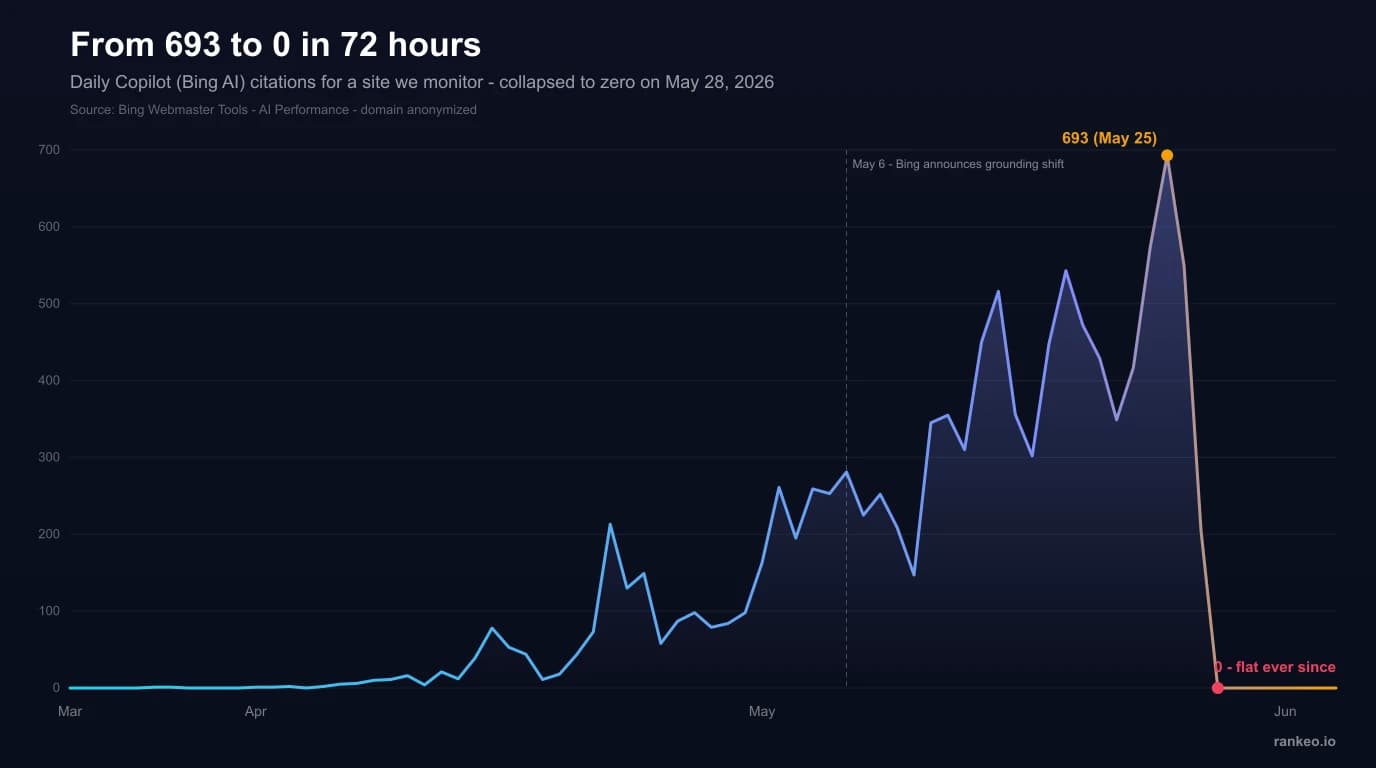
Updated: June 2026. Bing is quietly turning its index from a search engine for humans into grounding infrastructure for AI — the data layer that feeds Copilot and ChatGPT. We watch AI citations across a set of sites, and we saw what that shift can do up close: one site we monitor climbed for two months to a peak of 693 Copilot citations in a single day, then dropped to zero in 72 hours and stayed there for ten days — before beginning to recover in June (see the June 2026 update below). No penalty. Google untouched. Only the engine that runs on Bing's index went dark — and then came back.
This is the under-reported story behind the "is search dying?" debate. Bing didn't lose the search war — it is stepping back from the consumer click business and repositioning as the wholesaler of AI grounding. This article shows exactly what we measured (anonymized), explains the "indexed but not served" mechanism, separates what is proven from what is not, and gives you the playbook so a single engine's index change can never zero you out.
The collapse in four numbers
693 → 0
Daily Copilot citations, peak to zero in 72 hours (our data)
10 days → 244
Flat at zero for ten days, then recovered to 244/day (June 15)
+40–483%
Cost jump after Bing retired its raw Search API for grounding
86%
of AI citations come from brand-managed sources (Yext, 6.8M citations)
Are you visible — or one index change from zero?
Rankeo's free audit checks whether you are cited across all 5 AI engines — ChatGPT, Perplexity, Gemini, Claude, and Grok — so you know how concentrated your AI visibility really is before an engine pulls the rug.
Run Free Audit →Update — June 2026: The Citations Came Back
The zero was not permanent — and that is the real lesson.
After ten consecutive days at zero (May 28 to June 6), the monitored site's Copilot citations recovered — erratically at first, then fast: 244 on June 15 across 47 cited pages, more pages than the 43 cited at the original peak. The site changed nothing: no new content push, no technical fix, no outreach. The cutoff came from Bing, and so did the return. The takeaway is not "your citations will come back" — it is that this visibility is structurally volatile in both directions, switched on and off by an index you do not control.
The full arc — climb, collapse, recovery (daily Copilot citations)
Bing Webmaster Tools, AI Performance report, anonymized site. Bars scaled to the all-time peak (693, May 25). The ten-day floor at zero is the flat band before the June recovery.
Note: the Bing export is dated June 19 but trails off at June 15 (the usual 3–4 day reporting lag), so the recovery curve was still climbing when this data was pulled.
The recovery did not arrive as a clean switch-back. The first ten days (May 28 to June 6) were a hard floor of zero. Then it flickered: a single citation on June 7, back to zero on June 8, 21 on June 9, 16 on June 10, zero again on June 11. Only from June 13 did it find a slope — 33 citations across 13 pages, then 149 across 39 pages on June 14, then 244 across 47 pages on June 15. By volume, June 15 sits at roughly 35% of the May peak; by reach, it is already wider than the peak ever was, citing more distinct pages than the day the site set its record.
We can no more prove why the citations returned than we could prove why they vanished. Microsoft has not commented on either the cutoff or the recovery, and we are not going to invent a cause. What the round trip does settle is the shape of the risk: this is not a one-way "death of Bing visibility" story. It is volatility. The same serving layer that zeroed the site out brought it back, on its own timeline, with no signal either way — which is exactly why concentration on any single grounding index is the exposure, regardless of which direction the line is moving.
If the collapse looked like a Bing-specific anomaly, the recovery makes it legible as a pattern — and there is now a framework for that pattern. Citation volatility is becoming a recurring, datable phenomenon across AI engines; we treat it as its own category in our analysis of AI citation core updates. The distinction matters: that pillar documents volatility driven by model-version swaps (a new ChatGPT / GPT-5.5 build reshuffling who gets cited), whereas the Bing arc here is volatility of the serving and grounding infrastructure beneath the model — same lesson (citation share is unstable and must be monitored continuously), different mechanism (a new model version versus an index that toggles what it serves). And beneath the serving layer sits access itself — a page that is throttled or toll-gated at the crawl never reaches grounding in the first place.
What Did We Actually Measure?
We measured a clean, two-month rise in Copilot citations followed by a total collapse to zero — in Bing's own first-party data. The numbers below come straight from the Bing Webmaster Tools AI Performance report for a single site we monitor (domain anonymized). This is not a forum anecdote or a third-party estimate; it is Microsoft's own count of how often the site was cited in Bing-grounded AI answers.
From near-zero in late March 2026, the site's daily Copilot citations compounded through April and May, peaking at 693 on May 25 across 43 cited pages. Two days later the line fell off a cliff.
| Date (2026) | Copilot citations | What happened |
|---|---|---|
| Late March | ~0 | Barely surfaced in Copilot |
| Apr 22 | 213 | First major spike |
| May 15 | 516 | Compounding fast |
| May 25 | 693 | All-time peak (43 pages cited) |
| May 27 | 205 | Sharp drop begins |
| May 28 | 0 | Total collapse |
| Jun 6 | 0 | Day 10 — still flat at zero |
| May 28 → Jun 6 | 0 | Flat for 10 days — then recovered (see Update) |
| Jun 15 | 244 | Recovery — 47 pages cited (wider than the peak) |
Two honest caveats. First, this is one site — a first-hand signal, not a measured industry-wide wave. Second, "clean site" is our own assessment: the site rose steadily for two months, received no penalty notification, and had no technical change before the drop. We are reporting what we observed, not a verdict from Microsoft.
In summary, in Bing's own data a monitored site went from a record 693 Copilot citations a day to zero in 72 hours, held at zero for ten days, then recovered through June — with no penalty, no warning, and no change on the site's side in either direction.
Why Did Copilot Citations Vanish but Google Didn't?
Copilot citations vanished while Google stayed stable because Copilot is grounded by Bing's index and Google runs a completely separate one. A change on the Bing side hits everything that drinks from Bing's index — and leaves Google untouched. On the site we monitored, Google organic traffic did not move while Copilot went to zero, which points to a Bing-side serving issue rather than a site-wide quality problem.
The mechanism has a name: "indexed but not served." A page can remain fully indexed in Bing Webmaster Tools yet stop appearing in results or AI answers. A Microsoft moderator confirmed on Microsoft Q&A that indexing and serving are separate systems, so URLs can show as indexed while being filtered out of what users (and AI systems) actually see. Multiple site owners reported this exact pattern across 2026 — pages crawled and stored, but no longer surfaced.
This is the part most "Bing de-indexing" takes get wrong: the pages were never removed from the index. They were removed from serving — the layer that decides what is eligible to appear. When that layer also feeds AI grounding, losing serving means losing your Copilot citations, even though Webmaster Tools still says you are indexed.
In summary, Copilot citations collapsed and Google didn't because Copilot runs on Bing's index, and the site was de-served (not de-indexed) on the Bing side — a distinction Microsoft itself acknowledges.
What Is Bing's Shift From Search to Grounding?
Bing's shift is a deliberate repositioning of its index from helping humans choose pages to helping AI systems construct answers. On May 6, 2026, Microsoft AI published a post titled "Evolving role of the index: From ranking pages to supporting answers" that states the change in plain words:
"Search indexing was built to help humans decide what to read. Grounding indexing is being built to help AI systems decide what to say."
— Microsoft AI, Bing blog, May 6, 2026
In the same post, Microsoft reframes the core question: traditional search asks "which pages should a user visit?" while grounding asks "what information can an AI system responsibly use to construct a response?" The unit of value, it says, shifts "from documents to groundable information" — discrete, supportable facts with clear provenance.
This is not just rhetoric. Microsoft retired its consumer Bing Search APIs on August 11, 2025 and replaced them with "Grounding with Bing Search," which costs 40–483% more and, by design, does not return raw content — results are filtered through a model before delivery. Microsoft is also packaging grounding as a sellable layer (its Web IQ APIs) that it says already power Copilot and ChatGPT's web responses. The raw, queryable index is being privatized into a paid answer layer.
In summary, Bing has publicly reframed its index around grounding for AI, retired its raw search API in favor of a pricier filtered grounding product, and now positions itself as infrastructure that feeds Copilot and ChatGPT rather than a destination that competes for your clicks.
Did the Grounding Shift Cause the Collapse?
We cannot prove the grounding shift caused the collapse, and we won't pretend otherwise. The honest read is correlation with a plausible mechanism, not established causation. The site's citations kept rising for three full weeks after the May 6 announcement before dropping on May 28, and Microsoft has never connected any serving change to that blog post.
What we can say is that the timing fits a broader pattern. Across 2026, site owners documented the same Bing-specific "indexed but not served" behavior, with several reports clustering in mid-to-late May — one site collapsed on May 16, another dropped on May 24 and recovered about four days later. Our case (May 28) sits inside that cluster. None of this is confirmed by the SEO trade press as a coordinated event, so treat it as a real, recurring, grassroots-documented behavior rather than a single dramatic "wave."
The intellectually honest framing: Bing's blog tells you why a serving-and-grounding split is now plausible; the field reports and our own data tell you that sites are being de-served. Connecting the two into a clean cause-and-effect would be a guess. What would confirm it is Microsoft acknowledging a grounding-driven serving change — which it has not done.
In summary, the grounding shift is the credible context, not a proven cause: the collapse came three weeks after the announcement, fits a documented 2026 pattern, and remains officially unexplained.
Who Else Is Exposed to Bing's Index?
Anyone who depends on Bing's index is exposed — and that is far more of the web than most marketers realize. DuckDuckGo sources its traditional web results largely from Bing's index (unchanged as of 2026), and Yahoo is Bing-powered too. A serving change on the Bing side can therefore propagate downstream to engines that never touched your site directly.
Underneath the de-serving story is a bigger one: ranking and citation have decoupled. Being cited by AI is no longer the same as ranking in search, and the gap is enormous. Hive Digital reported a single article that earned 1,064 Bing AI citations but only 3 Bing search impressions over three months — roughly a 333x gap between AI visibility and search visibility. You can be a grounding favorite and a search ghost at the same time, which means a serving change can hit one without warning you through the other.
And the citations that matter increasingly live off your own site. Yext's analysis of 6.8 million AI citations found that 86% come from brand-managed sources — 44% from first-party websites, 42% from listings and directories, and 8% from reviews and social. If you optimize only your website, you leave roughly half of your citation surface unclaimed. This is the same multi-engine reality we cover in our breakdown of Google's "GEO is just SEO" guidance and the structural search shift in the AI Mode era playbook.
In summary, Bing's index quietly underpins DuckDuckGo and Yahoo, ranking and citation have decoupled (Hive's 333x gap), and 86% of AI citations come from brand-managed sources — so exposure to one index is broader and more invisible than it looks.
How Do You Protect Your AI Visibility?
You protect your AI visibility by refusing to depend on any single engine's index — exactly the lesson our monitored site learned the hard way. Concentration is the risk; diversification and entity clarity are the defense.
The four moves that reduce single-engine risk
- Build entity clarity — one canonical entity per page, a definitional opener, consistent Organization schema, and
sameAslinks to Wikipedia, LinkedIn, and Crunchbase so every engine can attribute your content and re-find you after an index change. - Own the 86% — keep your name, description, and category consistent across the brand-managed sources AI engines actually cite: your site, listings and directories, and review platforms, not just your homepage.
- Monitor the grounding layer — check your Bing AI Performance report and your citation share across all 5 engines so you see a de-serving event in days, not after a quarter of lost traffic.
- Diversify off any one citation surface — build direct channels (email, brand search, community, social) so that when one index zeroes you out, your audience does not disappear with it.
The deeper shift is one of measurement. A citation is not a click, and a ranking is not a citation. If you only track Google rankings, you would never have seen this collapse — it happened entirely inside Bing's AI grounding layer. Tracking citation presence across engines is now the only way to know where you actually stand.
In summary, you protect AI visibility with entity clarity, brand-managed presence across the 86%, continuous monitoring of the grounding layer, and traffic diversification — so no single index change can take you to zero.
The Verdict
Bing didn't die — it changed jobs. It is becoming the grounding layer that feeds AI answers, and in that world your visibility can be switched off in 72 hours by a serving decision you never see coming, on an index you don't control. We watched it happen to a healthy site, in Microsoft's own data, with Google completely unaffected. The takeaway is not "abandon Bing" — it is "never let any one engine own your visibility." Build for citation across all of them, and build channels that survive when one goes dark. And as the June recovery proved, the volatility runs both ways: the same index that switched the site off in 72 hours switched it back on ten days later, on its own schedule, with no notice either time — which is the whole point. When your visibility can be revoked and restored without warning on infrastructure you do not control, the only durable position is to never depend on it alone.
Know how concentrated your AI visibility is
Rankeo tracks your citations across ChatGPT, Perplexity, Gemini, Claude, and Grok, and scores your AI Visibility so you can see single-engine dependence before it becomes a zero. Start with the free Authority Checker or read why measuring AI matters in our zero-click search analysis.
See Rankeo Plans →FAQ
Frequently Asked Questions

Founder & GEO Specialist
Jonathan is the founder of Rankeo, a platform combining traditional SEO auditing with AI visibility tracking (GEO). He has personally audited 500+ websites for AI citation readiness and developed the Rankeo Authority Score — a composite metric that includes AI visibility alongside traditional SEO signals. His research on how ChatGPT, Perplexity, and Gemini cite websites has been used by SEO agencies across Europe.
- ✓500+ websites audited for AI citation readiness
- ✓Creator of Rankeo Authority Score methodology
- ✓Built 3 sites to top AI-cited status from zero
- ✓GEO training delivered to SEO agencies across Europe