The Search Box Is Dead: Your Google AI Mode Strategy Playbook (2026)
Google killed the classic search box at I/O 2026 — AI Mode is now the default front door to the web. This is the strategic 5-phase playbook to win the AI Mode era: audit, restructure, schema-stitch, monitor, distribute.

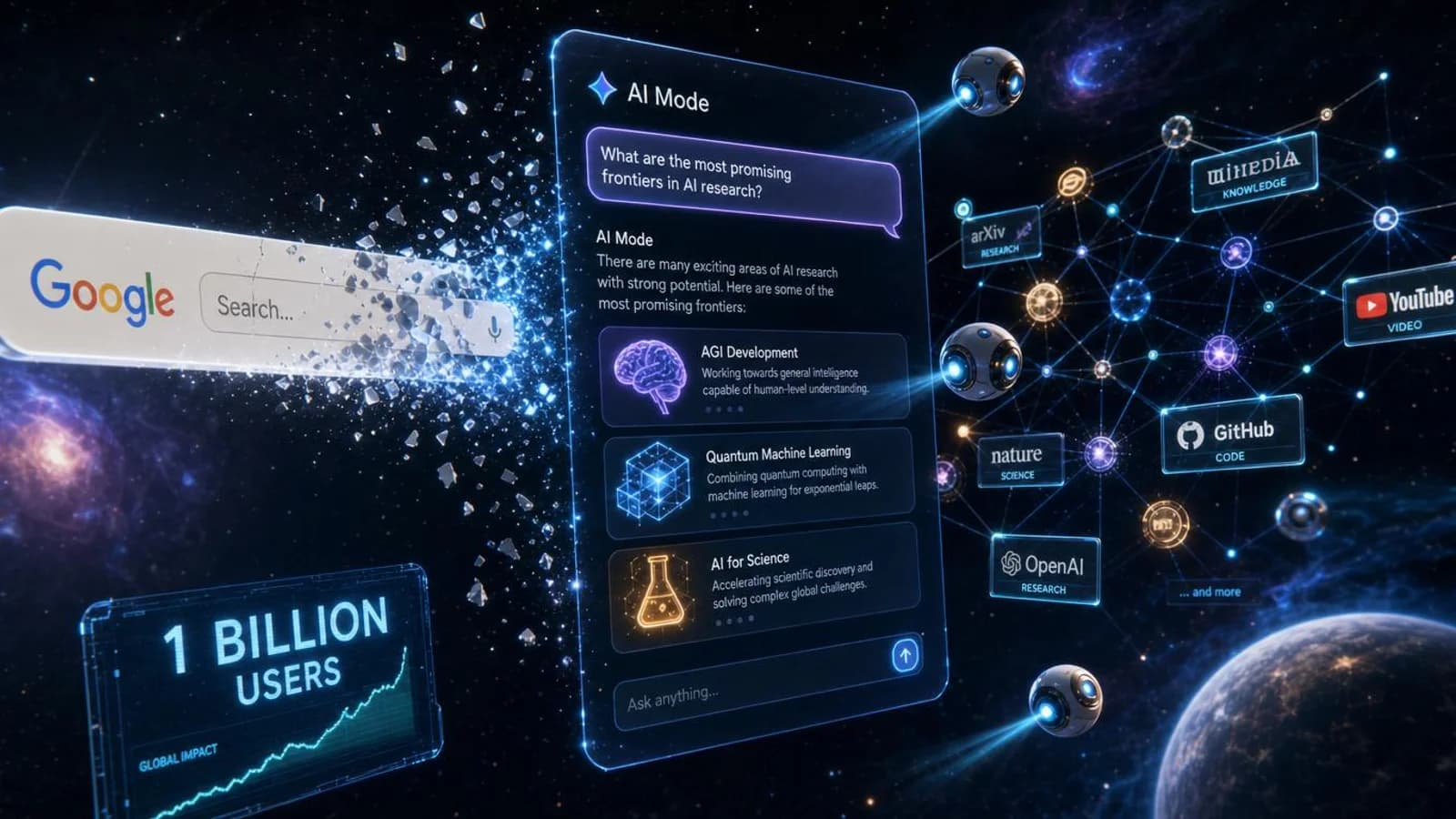
Updated: May 2026. The classic Google search box is dead. At Google I/O 2026, Google announced the biggest redesign of its search box in 25 years and made AI Mode the default experience, retiring the ten blue links as the primary interface. AI Mode crossed 1 billion monthly users in 12 months, with query volume doubling every quarter, which means the conversational answer layer is now the front door to the web — and the unit of visibility has shifted from a blue-link position to a citation inside the generated answer.
This article is the strategic playbook for that shift, organized as five action phases: audit, restructure, schema-stitch, monitor, and distribute. For the breaking-news breakdown of the I/O announcement, see our news coverage. This article is the strategic playbook — the framework you execute over the next 12 months, not the headline of the day.
The AI Mode era in four numbers
1B+
AI Mode monthly users (12 months in)
×2 / quarter
AI Mode query growth rate
24/7
Information agents crawl continuously
Gemini 3.5 Flash
Default model behind AI Mode
Why the Search Box Died and What Replaced It
The search box died because users stopped wanting links and started wanting answers. Google made AI Mode the default at I/O 2026 because the data was decisive: AI Mode reached 1 billion monthly users in a year and query volume doubles every quarter, while classic ten-blue-link sessions declined across the same period. The product followed the behavior — Google replaced the list interface with a conversational answer engine powered by Gemini 3.5 Flash because that is where the attention went.
Two announcements from I/O 2026 redefine how visibility works. The first is the interface change itself, documented in Google's own I/O 2026 search announcement. The second is the launch of information agents — AI systems that crawl and re-evaluate the web continuously rather than at periodic crawl events — covered in TechCrunch's analysis of the shift. Together they end the era of optimize-once-and-wait.
The five things that fundamentally changed
- Entry point — the front door is a conversation, not a query box returning ten links. Users type or speak a question and read a synthesized answer.
- Ranking signal — a blue-link position no longer guarantees visibility; the question is whether your content gets extracted and named inside the answer.
- Visibility unit — the unit is a citation, not a rank. You are either quoted in the answer or invisible, with little middle ground.
- Measurement — you measure citation presence and velocity across answers, not average position in a ranking report.
- Crawl frequency — information agents re-read your pages 24/7, so freshness and structure are judged continuously rather than at a monthly index refresh.
Classic Search vs the AI Mode era
The clearest way to internalize the shift is to put the two regimes side by side. Every row below changed at I/O 2026, and each one rewrites a different part of the optimization playbook.
| Dimension | Classic Search (RIP) | AI Mode Era |
|---|---|---|
| Entry point | Search box → 10 blue links | AI Mode conversation, default |
| Ranking signal | Position 1-10 on the SERP | Extractability + entity trust |
| Visibility unit | A ranked listing | A named citation in the answer |
| Measurement | Average position, CTR | Citation presence + velocity |
| Crawl frequency | Periodic index refresh | 24/7 continuous information agents |
In summary, the search box died because attention moved to answers, and the replacement is a continuously-crawled, citation-based answer layer where being extracted matters more than being ranked.
Phase 1 — How Do You Audit Your AI Mode Visibility?
You audit AI Mode visibility by checking whether your pages are actually cited in AI-generated answers today, not by checking your ranking position. The audit answers one question with precision: when a user asks AI Mode a question your content should win, does your domain get named in the answer? Most sites that rank well in the legacy index discover they are absent from the answer layer entirely — a gap that is invisible in a traditional rank tracker.
Run the three diagnostic checks
- Citation presence — for your 20 highest-value queries, ask AI Mode and the other engines directly and record whether your domain is cited and whether it is named. Citation without naming is the answer capsule problem — your content fed the answer but your brand vanished.
- Extractability — read your top pages as a machine would: is the answer to the headline question in the first 40-60 words, or buried under an intro? Buried answers do not get extracted.
- Entity clarity — does the engine know who you are? A fragmented entity graph means the engine cannot reliably attribute a citation to your brand even when it uses your content.
The audit produces a single honest map: which queries you already win, which you feed anonymously, and which you are absent from. This map drives every later phase, because you restructure the pages that feed anonymously and build entity clarity for the queries where you are absent. Skipping the audit means optimizing blind in a regime where the old ranking metrics no longer describe reality. Generative Engine Optimization — see our GEO definition — starts with this measurement, not with content production.
In summary, auditing AI Mode visibility means measuring citation presence, extractability, and entity clarity across your top queries — the three signals that decide whether AI Mode names you or ignores you.
Audit your AI Mode visibility free
Rankeo's free audit checks extractability, schema hygiene, and your citation footprint across the AI engines — the exact three signals Phase 1 measures. Start with the data before you touch a single page.
Run Free Audit →Phase 2 — How Do You Restructure Content Answer-First?
You restructure content answer-first by putting the direct answer to every question in the first 40-60 words of each section, then supporting it below. AI Mode runs on Gemini 3.5 Flash, a speed-optimized model that synthesizes answers under tight latency budgets, so it extracts from the top of a section and skips pages that bury the answer. Front-loading is no longer a style preference — it is the mechanical condition for being quoted.
The three restructuring moves
- Front-load every section — open each H2 with a self-contained, definitive answer. Research on 1.2 million AI responses found roughly 44% of citations come from the first 30% of a page (Indig, 2026), so the opening lines carry the citation weight.
- Chunk into extractable units — break content into tight 100-150 word blocks, each answering one question. AI Mode extracts chunks, not whole articles; a clean chunk is a citable unit.
- Use definitive language — write "X is Y", not "X can sometimes be Y". Definitive statements are roughly twice as likely to be cited (Indig, 2026) because the model can lift them verbatim without hedging.
Restructuring also means writing structures that name your brand inside the extractable unit, so a citation arrives with attribution rather than anonymously. Tables matter here too: comparison tables earn roughly 4.1x more AI citations than prose because they pack high data density into a machine-readable shape. The goal of the entire phase is to convert pages that currently feed AI Mode anonymously into pages that get named — and the deeper page-level mechanics live in our tactical companion, the Google AI Mode SEO guide, which this strategic playbook now sits above.
In summary, restructuring content answer-first means front-loading every section, chunking into extractable units, and writing definitive, brand-named statements that Gemini 3.5 Flash can lift directly into the answer.
Phase 3 — How Do You Schema-Stitch Your Entity?
You schema-stitch your entity by connecting every page, author, and organization reference into one consistent structured-data graph that AI Mode can resolve to a single trusted source. Extractable content gets you quoted; a stitched entity graph gets you named and trusted. When your Organization, WebSite, WebPage, Article, and Person schemas all reference the same stable @id values, the engine resolves a clean entity and attributes citations to your brand with confidence.
The schema-stitch checklist
- One @graph per page — emit a single JSON-LD block with a connected @graph rather than scattered disconnected snippets, so the engine reads one coherent entity.
- Stable @id references — reuse the same @id for your Organization and author across every page, so the graph stitches into one node instead of fragmenting into dozens.
- sameAs and authorship — link your entity to authoritative profiles with sameAs and attribute every article to a consistent Person, building the trust signals AI Mode weighs when deciding whom to name.
- Consistent NAP and naming — keep name, address, and phone identical everywhere; inconsistency forces the engine to guess, and a guessing engine drops your name from the citation.
A fragmented entity is the most common reason a page that feeds AI Mode never gets credited for it. The fix is mechanical and one-time per template: stitch the graph, stabilize the @ids, and the engine begins attributing answers to your brand instead of leaving them anonymous. This is the difference between contributing to the answer layer and owning a recognized position in it.
In summary, schema-stitching your entity means unifying your structured data into one connected @graph with stable @ids and consistent naming, so AI Mode resolves a single trusted brand and attributes citations to you.
Phase 4 — How Do You Monitor Citation Velocity?
You monitor citation velocity by tracking how fast and how often your domain gets cited across AI answers over time, because information agents now crawl continuously and your visibility is re-judged 24/7. In the periodic-crawl era you could check rankings monthly; in the information-agent era a competitor's restructure can erode your citation share within days. Continuous crawling demands continuous monitoring — a one-time audit goes stale almost immediately.
The metric that matters is Citation Velocity Score, which measures the rate at which AI engines pick up and cite your content. A rising velocity signals that the information agents are re-reading your restructured pages and amplifying them; a flat or falling velocity signals that your content has gone stale relative to competitors who are publishing fresher, better-structured answers. The full methodology lives in our Citation Velocity Score complete guide.
What to monitor continuously
- Citation velocity trend — track week-over-week whether your citation rate is rising, flat, or falling across the AI engines, not just a snapshot.
- Named vs anonymous citations — watch the share of citations that name your brand versus those that use your content anonymously; rising anonymity flags an entity-graph regression.
- Query coverage — track how many of your target queries you are cited on, so you catch a competitor displacing you on a key answer within days rather than after a quarter.
In summary, monitoring citation velocity means continuously tracking the rate, naming, and query coverage of your AI citations, because 24/7 information agents make visibility a moving target that a periodic audit cannot capture.
Track citation velocity across all 5 AI engines
Rankeo measures Citation Velocity Score, named-citation rate, and query coverage continuously across ChatGPT, Perplexity, Gemini, Claude, and Grok — the monitoring layer the information-agent era requires. Stop checking rankings monthly in a world that re-crawls you hourly.
See Rankeo Plans →Phase 5 — How Do You Accelerate Information-Agent Detection?
You accelerate information-agent detection by distributing every new or restructured page across multiple authoritative surfaces in a tight window, so the continuously-crawling agents encounter the same signal from many directions at once. Because information agents re-read the web 24/7, a coordinated burst of mentions, links, and submissions compresses the time between publishing and being cited from weeks to days. Distribution is the throttle on how fast the answer layer picks you up.
The detection-acceleration moves
- Instant submission — ping IndexNow and submit updated URLs the moment a page changes, so the agents are pointed at fresh content immediately rather than discovering it on their own schedule.
- Synchronized amplification — fire owned, community, and earned channels in a tight window so the agents see consistent, reinforcing signals about the same page from multiple domains at once.
- Authoritative cross-links — earn links and mentions from trusted sources inside the same window; third-party validation is what pushes a fresh page past the citation threshold fastest.
- Internal re-amplification — link the new page from your highest-traffic existing pages, which the agents re-read most often, so the freshness signal compounds inside your own domain.
The strategic insight is that continuous crawling rewards continuous, coordinated distribution — sporadic publishing in a 24/7-crawl world leaves citation velocity flat. Sites that pair answer-first restructuring with synchronized distribution see the information agents re-read and re-cite them within days, turning the new crawl cadence from a threat into a compounding advantage.
In summary, accelerating information-agent detection means instant submission plus synchronized, cross-linked distribution in a tight window, so the 24/7 agents pick up and cite your content in days instead of weeks.
What This Means for the Next 12 Months
Over the next 12 months, the answer layer becomes the only layer that matters for most informational queries, and brands that have not restructured for citation will lose visibility they cannot easily recover. AI Mode query volume doubles every quarter, so by mid-2027 the conversational interface will handle several times the volume it does today, and the legacy ten-blue-link experience will be a fallback that a shrinking minority of users invoke. The strategic window to adapt is now, while citation real estate is still being claimed.
Three predictions for the AI Mode era
- Citation share replaces market share as the KPI — executive dashboards will track AI Share of Voice and Citation Velocity Score the way they once tracked keyword rankings, because those metrics now predict revenue.
- Entity trust becomes the moat — as extractable content commoditizes, the durable advantage shifts to brands with the cleanest, most authoritative entity graphs, since the engine names whom it trusts.
- Speed of adaptation compounds — with 24/7 crawling, early movers accumulate citation velocity that late movers must fight uphill to displace, so the gap between adapted and unadapted sites widens every quarter rather than resetting.
The honest framing is that I/O 2026 did not introduce a new SEO tactic to layer on top of the old ones — it changed the substrate. The five phases in this playbook are not a campaign you run once; they are an operating system you adopt, because the information agents that judge you never stop reading. The brands that internalize this in 2026 will own the answer layer that defines the next decade of search.
In summary, the next 12 months belong to brands that treat citation share as the primary KPI, build entity trust as their moat, and adapt fast — because continuous crawling makes early citation velocity a compounding, defensible advantage.
Get your free SEO + GEO audit
The search box is gone — find out exactly where your site stands in the AI Mode era. Rankeo audits extractability, entity clarity, and your citation footprint across all 5 AI engines, then hands you the prioritized actions to execute the five phases in this playbook. You can also start with the free Authority Checker for an instant read.
Run Free Audit →FAQ
Frequently Asked Questions

Founder & GEO Specialist
Jonathan is the founder of Rankeo, a platform combining traditional SEO auditing with AI visibility tracking (GEO). He has personally audited 500+ websites for AI citation readiness and developed the Rankeo Authority Score — a composite metric that includes AI visibility alongside traditional SEO signals. His research on how ChatGPT, Perplexity, and Gemini cite websites has been used by SEO agencies across Europe.
- ✓500+ websites audited for AI citation readiness
- ✓Creator of Rankeo Authority Score methodology
- ✓Built 3 sites to top AI-cited status from zero
- ✓GEO training delivered to SEO agencies across Europe