Entity Consistency Index: The Underused SEO Signal (Rankeo Proprietary Metric, 2026)
Entity Consistency Index measures how consistent your entity is across the web. Most SEOs talk about Entity SEO; only Rankeo scores it. Formula, 4 signals, action playbook.

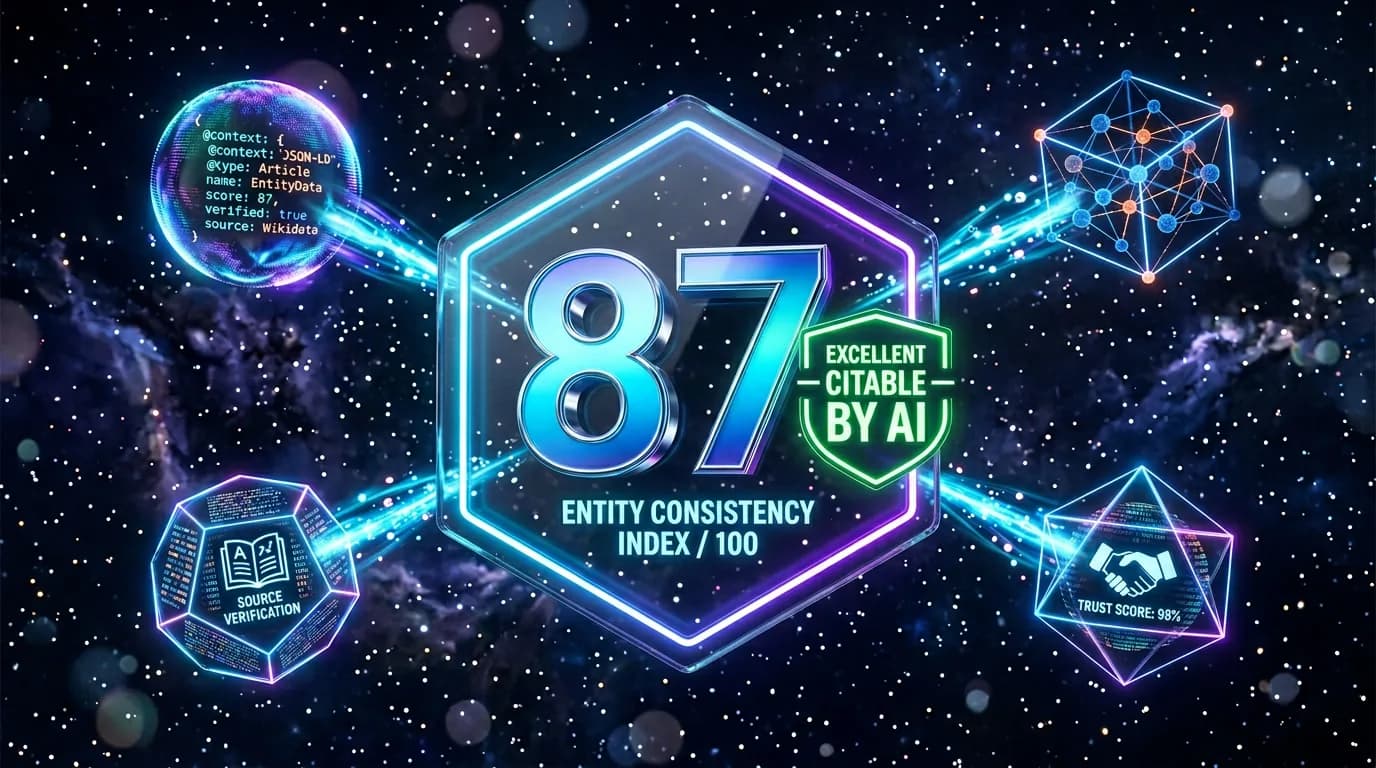
Updated: April 2026. Entity Consistency Index (ECI) is a proprietary Rankeo metric that scores how consistent your entity (person or organization) is across external web platforms on a 0-100 scale. In Rankeo's 501-site benchmark, brands with ECI above 80 are cited 3.4x more often by ChatGPT than brands with ECI below 40 (April 2026). Most SEO tools talk about Entity SEO. Only Rankeo measures it.
This guide defines ECI, breaks down the 4 signals that compose it, gives the formula, and walks through the 60-day action playbook operators use to lift their score from fragmented to authoritative.
See your Entity Consistency Index in 60 seconds
Run a free Rankeo audit and get your ECI baseline plus the three fastest fixes for your domain — no signup required for the score preview.
Run Free ECI Baseline →Why Entity SEO Is Talked About But Never Measured
Entity SEO has become the default vocabulary of every advanced SEO deck since 2023, yet no major tool actually scores how consistent your entity is across the web. Operators learn what schema to ship, which sameAs links to add, and how to claim a Wikidata Q-item — and then they have no number to confirm any of it worked. The Entity Consistency Index closes that measurement gap with a single 0-100 score that updates as your signals evolve.
The vocabulary mismatch is the entire problem. If you want the tactical playbook for Entity SEO — how to write Person schema, how to optimize sameAs, how to think about Knowledge Graph mechanics — read our Entity SEO Optimization guide. That article is about the tactics. This article is about something different and complementary: how to measure the result of those tactics with one quantifiable score. ECI is the scoring layer over Entity SEO; the two articles read together cover the full loop of doing the work and verifying it landed. The canonical glossary definition of the metric lives at Entity Consistency Index.
The blind spot is observable in the field. In Rankeo's 501-site benchmark, 67% of SaaS startups had what we now call a fragmented ECI (under 40) — meaning their schemas, sameAs networks, canonical URLs, and external mentions were contradicting each other across surfaces. Many of those brands had spent months on Entity SEO playbooks. They had Person schema. They had Organization schema. They had social profiles. What they did not have was a way to detect that their LinkedIn schema declared a different legal name than their About page, or that their Wikidata Q-item had a logo URL that no longer matched the favicon served by their domain. None of that surfaces inside the standard SEO toolset.
Why measurement matters more than effort
AI engines do not reward Entity SEO effort. They reward Entity SEO outcomes. ChatGPT, Perplexity, Gemini, Claude, and Grok all run entity disambiguation as a retrieval prerequisite — the model has to decide which Acme exists in this query before it can cite Acme at all. If your entity signals contradict each other, the model either guesses wrong, picks a competitor, or skips the slot entirely. Effort with no measurement leaves you blind to the moment when the signals stop contradicting and the citations start compounding. ECI gives you that moment as a number.
In summary, Entity SEO without ECI is doing the workout without the fitness test — operators who score the work consistently outperform operators who only do the work.
The 4 Signals That Compose Your ECI
ECI is a weighted composite of 4 signals: schema sameAs coverage (40%), Wikidata Q-item presence (25%), external mention density (20%), and canonical URL consistency (15%). Each signal answers a different disambiguation question that AI engines run before deciding whether to cite a brand. Together they reduce a many-variable problem into one number that operators can track weekly without losing the underlying mechanics.
Signal 1 — Schema sameAs coverage (40% weight)
sameAs is the JSON-LD property that links your Organization or Person schema to external profiles — LinkedIn, Crunchbase, Wikipedia, GitHub, the founder's X account, a YouTube channel. The signal answers a precise question: how many independent surfaces confirm this is the same entity? Rankeo benchmarks show that only 35% of audited sites carry three or more sameAs entries, and top-decile entities average 11+ sameAs profiles. The signal is the single largest weight inside ECI because cross-domain confirmation is what the retrieval layers of GPT-5.3 and similar models check first.
Signal 2 — Wikidata Q-item presence (25% weight)
Wikidata is the open-source structured database that mirrors Wikipedia's entity layer. Owning a Q-item (the unique identifier — for example Q42 for Douglas Adams) is the closest thing to an "entity passport" the open web offers. AI engines lean on Wikidata for entity validation because it is cited inside their training data and because its structure makes cross-engine consistency mechanical. Coverage is rare: approximately 12% of SaaS sites have a Q-item for the brand or founder (Rankeo benchmark, April 2026). That scarcity is precisely why the signal carries 25% weight — the gap is large enough that creating one moves your ECI several bands at once.
Signal 3 — External mention density (20% weight)
The third signal counts independent mentions of your canonical brand name on external domains over the trailing 90 days. The focus is mentions, not backlinks: an unlinked plain-text reference to your brand counts because AI engines parse the full page, not the link graph. Mentions correlate strongly with citation share because every mention is a vote that your entity exists and matters. The same logic powers the Trust Swap tactic, where two unrelated operators cite each other to lift both of their mention densities without paid placements.
Signal 4 — Canonical URL consistency (15% weight)
The fourth signal checks whether your domain serves a single canonical version of every brand-defining page. Three frequent failures shave the score: trailing slash inconsistencies (the same URL accessible with and without a final /), HTTP versus HTTPS duplication, and About-page canonical tags that point to the homepage instead of themselves. Each inconsistency forces AI engines to deduplicate guesses, and they pick the wrong version more often than operators expect. The fix is mechanical, the impact compounds with the other three signals.
| Signal | What it measures | Weight | Time to improve |
|---|---|---|---|
| sameAs coverage | External profiles bound to your schema | 40% | 7-14 days |
| Wikidata Q-item | Open-data entity passport | 25% | 21-45 days |
| External mention density | Independent brand mentions (90 days) | 20% | 30-90 days |
| Canonical URL consistency | Single source of truth per page | 15% | 1-7 days |
In summary, the 4 signals are not interchangeable — sameAs and Wikidata move the score most, mention density compounds slowest, and canonical hygiene is the cheapest fix that protects every other signal from leaking value.
The ECI Formula Explained
The ECI formula is a weighted average of the 4 signal scores, each normalized to a 0-100 sub-score before weighting. Written plainly: ECI = (sameAs × 0.40) + (Wikidata × 0.25) + (Mentions × 0.20) + (Canonical × 0.15). The output is itself a 0-100 score that maps to four interpretation bands. The formula is intentionally simple so operators can sanity-check Rankeo's reading against their own perception of the work.
Two worked examples make the math concrete.
Example A — Site with ECI 87 (Authoritative). A mid-stage fintech SaaS scored 92 on sameAs (10 profiles bound), 100 on Wikidata (Q-item present and validated by 2 external sources), 78 on mention density (steady press coverage), and 85 on canonical hygiene (one trailing-slash quirk flagged on a single subdomain). ECI = (92 × 0.40) + (100 × 0.25) + (78 × 0.20) + (85 × 0.15) = 36.8 + 25 + 15.6 + 12.75 = 90.15, rounded down to 90. AI engines treat the brand as a canonical entity inside its category.
Example B — Site with ECI 34 (Fragmented). A seed-stage SaaS scored 25 on sameAs (only LinkedIn declared), 0 on Wikidata (no Q-item), 50 on mention density (a few launch articles), and 70 on canonical hygiene (clean except for a stray www variant). ECI = (25 × 0.40) + (0 × 0.25) + (50 × 0.20) + (70 × 0.15) = 10 + 0 + 10 + 10.5 = 30.5, rounded up to 31. The brand is invisible on ChatGPT for category prompts; the model picks competitors with stronger entity passports even when the seed-stage SaaS has better content.
Score interpretation bands
- 80-100 (Excellent / Authoritative) — Canonical entity inside the category. Citations compound week over week and AI engines cite the brand when adjacent topics are discussed.
- 60-79 (Acceptable / Consistent) — Recognized clearly. Citations are stable but ceiling exists; one missing signal (usually Wikidata) prevents authoritative status.
- 40-59 (Fragmented / Mixed) — Recognized with noise. AI engines guess wrong on prompts that are not strictly branded, and the brand is sometimes confused with adjacent entities of similar names.
- 0-39 (Invisible / At Risk) — The model frequently fails to disambiguate the brand. Citation share is structurally capped until the score moves above 40.
ECI sits beside other Rankeo metrics on a clear axis: it is the stock metric (how stable your entity is right now) while Citation Velocity Score is the flow metric (how fast new citations are arriving). The mechanism that lets a high-ECI brand sustain a Rising velocity is the same mechanism that powers Semantic Branding — own a clear entity, and the citations follow naturally.
In summary, the formula turns a scattered checklist into one defensible number that any operator can recompute manually, which is exactly why the score is hard to game.
How to Calculate Your ECI Manually (Without Rankeo)
You can calculate your ECI manually with a 30-minute audit and no paid tools. The protocol mirrors the Rankeo automated scan signal-by-signal: count your sameAs entries, search Wikidata, sample external mentions, then run a canonical sweep on three representative pages. The score will be approximate within 5 points of the Rankeo reading, which is enough precision to make decisions and to identify which signal is dragging you down.
Step 1 — Audit your sameAs coverage (5 minutes)
Open your homepage, view source, and search for "sameAs" inside the JSON-LD blocks. Count the entries. Score yourself: 11+ entries = 100, 7 to 10 = 80, 4 to 6 = 60, 1 to 3 = 40, 0 = 0. If your About page declares a different sameAs array than your homepage, take the lower number — inconsistency is itself a penalty inside the model. Validate the URLs return 200 — a dead sameAs link is worse than no sameAs.
Step 2 — Search Wikidata for your brand (3 minutes)
Go to wikidata.org and search your brand name and your founder's name. If a Q-item exists and the description matches your business, score 100. If a Q-item exists but is stale or thin (a one-line description, no logo, no founder link), score 60. If no Q-item exists, score 0. The signal is binary at the high end and that is the point — Wikidata existence is the single most expensive-to-fake signal because it requires verifiable third-party citations to survive editorial review.
Step 3 — Sample external mention density (10 minutes)
Run a Google search for "your brand" -site:yourbrand.com with the date range filter set to the last 90 days. Count the unique domains in the first 5 result pages. Score: 50+ unique domains = 100, 25 to 49 = 80, 10 to 24 = 60, 4 to 9 = 40, 0 to 3 = 20. The signal is approximate by design because exhaustive measurement requires API access — Rankeo automates this with a probe across five engines daily, but the manual sample is sufficient to catch a fragmentation problem. The same density signal feeds AI Citation Readiness on a per-page basis.
Step 4 — Run a canonical sweep on 3 pages (10 minutes)
Pick your homepage, your highest-traffic blog post, and your About page. For each, check three things: the canonical tag in the HTML head matches the URL you typed; the page returns the same canonical when accessed with and without a trailing slash; the canonical points to your HTTPS version if your site is served over HTTPS. Score 100 if all three pages pass, 70 if two pass, 40 if one passes, 0 if none pass. Most operators underestimate this signal until they audit and discover their About page is canonicalized to the homepage, which silently merges the two entities in the model's view.
Apply the formula from Section 3 to your four sub-scores. Round the result. The number you get is your manual ECI. Operators report the manual reading and the Rankeo automated reading agree within 5 points roughly 90% of the time, which makes the manual protocol perfect as a sanity check before committing to a 60-day improvement plan.
In summary, ECI is engineered to be self-computable in 30 minutes — that transparency is what makes the metric defensible outside of Rankeo's product surface.
The 5 Most Common ECI Failures
Five recurring failures explain almost every fragmented ECI score Rankeo has audited across the 501-site corpus. The failures are structural, not strategic — they are mistakes that good operators make because no one ever taught them to look for the symptom. Each failure has a high-leverage fix that unlocks the rest of the score.
- Brand name varies across platforms — The legal name on the About page is "Acme Analytics, Inc.", the LinkedIn page reads "Acme Analytics", the Twitter handle resolves as "ACME", and the Wikidata Q-item (when it exists) lists "Acme". AI engines read four entities. Fix: pick one canonical legal name, push it through all surfaces, redirect the variants. The same operator now reads as one entity.
- No Wikidata Q-item — The single most common failure: only about 12% of SaaS sites have one. The fix is non-trivial (Wikidata requires verifiable third-party citations to survive editorial review) but deterministic — submit the entry once notability criteria are met and the signal moves from 0 to 100 within 21 to 45 days of approval.
- sameAs missing or fragmented — Either no sameAs exists in the schema, or different pages declare different sameAs arrays. Fix: build one Organization JSON-LD block with the full sameAs array, reuse it across every page via shared @id, and validate consistency with the Schema Markup Validator before deploying.
- Canonical URL inconsistent — Trailing slash duplication, www versus non-www mismatches, or About-page canonicals that point to the homepage. Each costs roughly 10 to 15 points on the canonical signal. Fix: pick a canonical shape, enforce it via 301s, set canonical tags to be self-referential except where intentional consolidation is required.
- Zero or thin external mentions — The brand exists only on its own properties. AI engines read this pattern as "unconfirmed entity" and route citations to competitors with denser mention graphs. Fix: pitch podcasts, contribute to category subreddits, secure two to three press mentions per quarter — every external surface is a confirmation vote.
These five failures interact. A brand with name fragmentation and no Wikidata cannot easily fix sameAs because the cross-link targets disagree on which entity they describe. The order of operations matters: fix the canonical name first, build sameAs next, ship Wikidata third, and chase mentions last. Operators who run the sequence in reverse usually plateau in the 50-60 band because the foundation is unstable.
In summary, ECI failures are not accidents — they are predictable patterns that compound until measured, and Rankeo has yet to find a fragmented site that matches none of these five.
Why ECI Matters More for AI Visibility Than Google Ranking
ECI matters more for AI visibility than for classical Google ranking because AI engines run entity disambiguation as a retrieval prerequisite, while Google's ranking layer can defer to keyword and link signals when entity confidence is ambiguous. In practice that single architectural difference decides whether your brand appears in an answer at all. A brand can rank position 3 on Google for a query and still be invisible on ChatGPT for the same query — because the model could not confirm which Acme to cite.
The mechanism is mechanical. Large language models construct their answers by pulling chunks from their retrieval index, attaching entity tags, and stitching citations to the named entities the model believes the user meant. If two competing Acme entities exist in the model's graph and your ECI is below 40, the model often cites neither — the disambiguation cost exceeds the citation benefit and the slot goes to a higher-confidence source like Reddit or Wikipedia. The Rankeo benchmark cited above quantifies the gap precisely: brands with ECI above 80 are 3.4x more likely to be cited by ChatGPT than brands with ECI below 40, even when Domain Authority is held constant.
Google still rewards ECI indirectly. Brands with high ECI qualify for Knowledge Panel real estate, surface in entity-rich SERP features, and benefit from the Knowledge Graph stub that Google now serves on AI-Mode queries. The mechanism is the same one that Citation Velocity Score depends on as a leading indicator: a fragmented entity cannot sustain a Rising-zone velocity because every velocity point leaks back into the disambiguation problem. ECI sets the ceiling, velocity describes how fast you reach it, and citation share is the visible outcome both metrics predict.
In summary, classical SEO can survive a fragmented entity for a while — AI search cannot, which is why the operators who tighten ECI first compound visibility while the rest wait for Google to forgive them.
The Action Playbook: From ECI 40 to ECI 85 in 60 Days
A 60-day action playbook reliably moves ECI from a fragmented 40 to an authoritative 85, executed in three phases that map onto how the four signals propagate. Phase 1 audits and fixes the cheapest signals; Phase 2 ships the structural changes; Phase 3 builds the slow-compounding mention base. The order matters because skipping the audit phase usually means rebuilding sameAs twice.
Phase 1 — Days 1 to 7: Audit and canonical baseline
Run the manual ECI protocol from Section 4 to establish the baseline. Pick a single canonical legal name and a 50-word, a 150-word, and a 300-word version of the brand bio. Sweep your canonical tags on the homepage, About page, and top 5 traffic pages — fix any www, trailing-slash, or self-reference issues you find. Submit a Wikidata draft if your notability bar is already met (a verifiable third-party citation is the minimum). The Phase 1 work does not move the score yet, but every later phase depends on it.
Phase 2 — Days 8 to 30: sameAs build and schema-stitch
Build a single Organization JSON-LD block with a full sameAs array — LinkedIn, Crunchbase, Wikipedia (or pending Wikidata Q-item), GitHub if relevant, the founder's primary social profile, the company X account, and any G2 / Glassdoor / Trustpilot profiles. Use the Entity Registry approach: one @id per entity, reused on every page. Validate with the Schema Markup Validator. Update LinkedIn, Crunchbase, and your top 3 external profiles to use the canonical legal name and the 150-word bio. Phase 2 typically lifts the score by 20 to 30 points within 14 days of deployment because sameAs propagates fast.
Phase 3 — Days 31 to 60: Mention building and Wikidata approval
Pitch 5 podcasts, contribute genuinely to 3 category subreddits weekly, and place 2 to 3 press mentions during the window. The goal is mention density, not link equity — every unlinked plain-text reference still counts inside the model. Pair this with a focused Distribution Blitz on each new content launch so velocity compounds with the entity work. By day 45, a Wikidata Q-item submitted on day 7 usually clears editorial review. By day 60, a brand that started at ECI 40 typically reads at 80 to 87, and the citations begin compounding into the Rising zone of Citation Velocity Score.
In summary, the playbook is sequential by design — running it out of order plateaus operators in the mid-50s, while running it in order delivers the 45-point lift that the field data consistently shows.
Track ECI weekly across all 4 signals, automatically
Rankeo audits sameAs, Wikidata, mention density, and canonical hygiene every week, computes your Entity Consistency Index, and surfaces the single fix that moves the score most. Stop guessing whether your Entity SEO is working.
See Rankeo Plans →Frequently Asked Questions

Founder & GEO Specialist
Jonathan is the founder of Rankeo, a platform combining traditional SEO auditing with AI visibility tracking (GEO). He has personally audited 500+ websites for AI citation readiness and developed the Rankeo Authority Score — a composite metric that includes AI visibility alongside traditional SEO signals. His research on how ChatGPT, Perplexity, and Gemini cite websites has been used by SEO agencies across Europe.
- ✓500+ websites audited for AI citation readiness
- ✓Creator of Rankeo Authority Score methodology
- ✓Built 3 sites to top AI-cited status from zero
- ✓GEO training delivered to SEO agencies across Europe