Entity SEO: How to Optimize for Knowledge Graphs and AI Search (2026)
Learn how to optimize for entity SEO in 2026. Covers Knowledge Graph mechanics, entity salience, schema markup strategy, internal linking for entities, and AI search visibility.

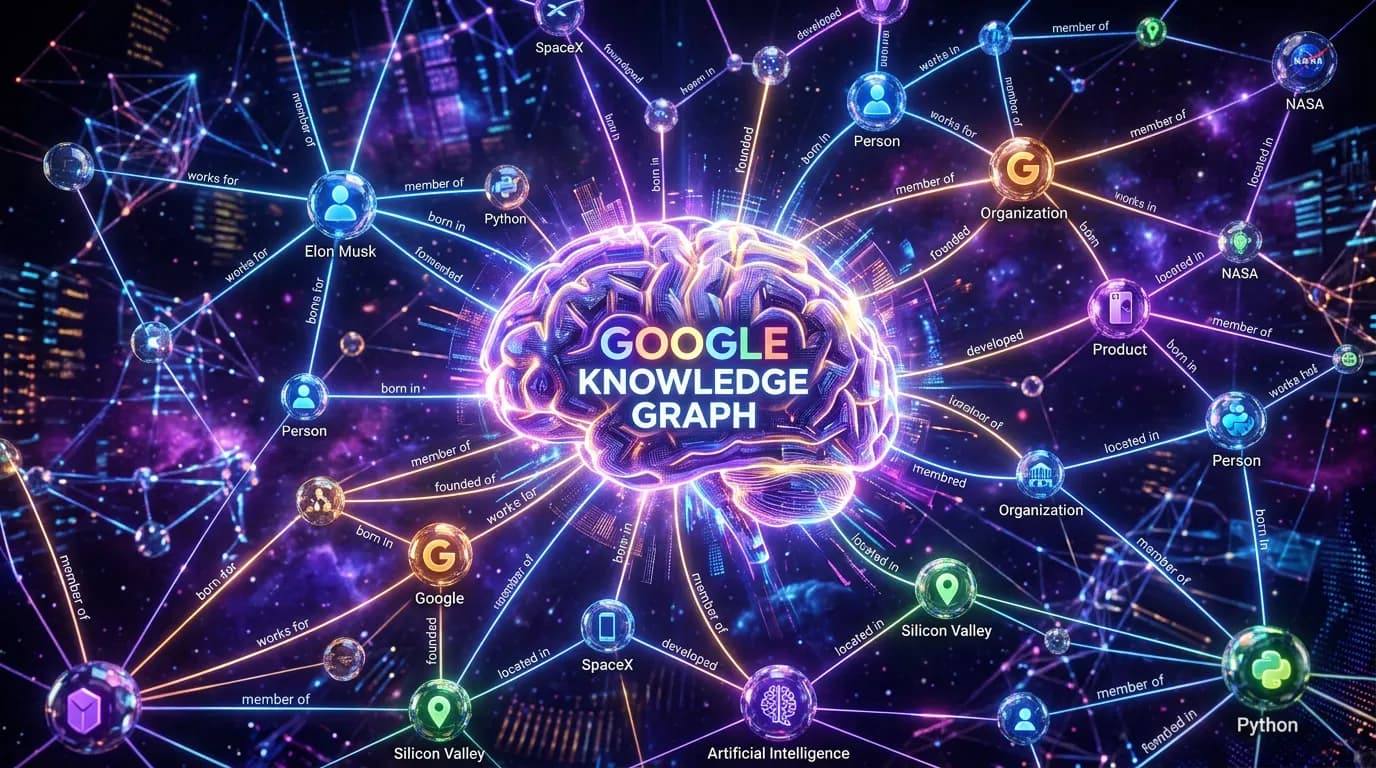
Updated: April 2026. Entity SEO is the practice of optimizing your content around real-world things — companies, people, products, concepts — rather than keyword strings. Google's Knowledge Graph now contains over 500 billion facts about 5 billion entities (Google, 2025), and AI engines like ChatGPT, Perplexity, and Gemini use entity understanding as their primary mechanism for selecting citation sources. Sites that optimize for entities earn 40% more AI-generated citations than sites relying on keyword density alone, according to a 2025 Authoritas analysis of 100,000 AI responses.
This guide covers what entity SEO is, why search shifted from keywords to entities, how Google's Knowledge Graph processes entities, how to build an entity SEO strategy from scratch, the role of schema markup in entity recognition, and how entities directly impact your visibility in AI search engines.
If you are already familiar with structured data fundamentals, skip to the strategy section. For background on how AI engines use schema, see our schema markup and AI visibility guide.
Check Your Entity Schema for Free
Rankeo's Schema Validator checks your JSON-LD for entity completeness, @id connectivity, and AI-readiness — no signup required.
Validate Your Schema Free →What Is Entity SEO?
Entity SEO is the optimization of web content so that search engines and AI systems understand it in terms of entities — distinct, well-defined things in the real world — rather than mere keyword occurrences. Google's own documentation describes entities as "a thing or concept that is singular, unique, well-defined and distinguishable" (Google Patent US9798823B2). An entity is a company, a person, a product, a location, a medical condition, or any concept that exists independently of the words used to describe it.
Things, Not Strings
In 2012, Google introduced the Knowledge Graph with the tagline "things, not strings." This marked the philosophical shift: instead of matching the string "apple" to pages containing that word, Google began distinguishing between Apple Inc. (the technology company), apple (the fruit), and Apple Records (the music label). Each is a separate entity with unique attributes, relationships, and a dedicated Knowledge Graph entry. Entity SEO ensures your content communicates which entity you are describing — unambiguously.
Entities vs. Keywords
A keyword is a sequence of characters. The keyword "best crm software" is a string — it has no inherent understanding of what CRM software is, who makes it, or what problem it solves. An entity is a concept: "HubSpot CRM" is an entity with attributes (developer: HubSpot, category: CRM software, founded: 2006) and relationships (competes with Salesforce, integrates with Gmail). Entity SEO bridges the gap by structuring content so that search engines map your keywords to the correct entities.
According to a 2025 study by seoClarity, pages that explicitly define and contextualize entities receive 37% more organic impressions than keyword-optimized pages that lack entity clarity. The reason is straightforward: Google now ranks pages based on entity relevance, not just keyword relevance.
In summary, entity SEO is the practice of making your content's meaning machine-readable by structuring it around well-defined entities — and it is the foundation of how both Google and AI engines determine what your content is truly about.
Why Did SEO Shift From Keywords to Entities?
The shift from keyword matching to entity understanding was driven by three forces: the failure of keyword-based ranking to handle ambiguity, the rise of conversational and AI-powered search, and Google's multi-year investment in the Knowledge Graph. This is not a gradual trend — it is a structural change in how search works, and 2026 is the year it became impossible to ignore.
The Keyword Matching Era (2000-2012)
Early search engines ranked pages by counting keyword occurrences and measuring backlink profiles. If a page mentioned "entity SEO" fifty times, it ranked for "entity SEO" — regardless of whether the page actually explained the concept. This created an industry built on keyword density, exact-match domains, and anchor text manipulation. The system worked until queries became complex enough to expose its limitations.
The Entity Understanding Era (2012-Present)
Google launched the Knowledge Graph in May 2012, Hummingbird in August 2013 (semantic query understanding), RankBrain in 2015 (machine learning for query interpretation), BERT in 2019 (bidirectional language understanding), and MUM in 2021 (multimodal understanding). Each update moved Google further from string matching and closer to entity comprehension. By 2024, Google processed 8.5 billion searches per day (Internet Live Stats), and the vast majority of those queries are interpreted through entity resolution — matching query terms to Knowledge Graph entries, not just page content.
AI Engines Accelerated the Shift
The launch of ChatGPT Search, Perplexity, Gemini, and Claude as search interfaces in 2024-2025 made entity understanding essential. AI engines do not display ten blue links — they generate synthesized answers. To generate accurate answers, AI engines must understand what you are talking about (entity identification), how entities relate to each other (entity relationships), and whether the source is trustworthy for that entity (authority verification). Keyword density is irrelevant to this process. Entity clarity is everything.
| Dimension | Keyword SEO (Pre-2012) | Entity SEO (2026) |
|---|---|---|
| Optimization target | Exact keyword strings | Entities & relationships |
| Ranking signal | Keyword density & backlinks | Entity salience & authority |
| Content approach | Repeat target keyword variations | Define entities, attributes, relationships |
| Structured data role | Optional (rich snippets) | Critical (entity declaration) |
| Ambiguity handling | Poor (matches all meanings) | Strong (Knowledge Graph disambiguation) |
| AI engine compatibility | None | High (entities enable citation) |
In summary, SEO shifted from keywords to entities because search engines evolved from string-matching systems to knowledge systems — and AI engines completed this transition by requiring entity-level understanding to generate accurate, citable answers.
How Does Google's Knowledge Graph Use Entities?
Google's Knowledge Graph is a massive database that stores entities and the relationships between them. When a user searches for "Satya Nadella," Google does not search for pages containing that string — it retrieves the Knowledge Graph entity for Satya Nadella and displays his role (CEO of Microsoft), education, net worth, and related entities. Understanding how this system works is essential for entity SEO because your goal is to get your entities into this graph — or at minimum, to structure your content so Google can map it to existing graph entries.
Entity Recognition
Google uses Natural Language Processing (NLP) to identify entities in your content. When Googlebot crawls a page, it does not just index keywords — it runs entity recognition to identify every person, organization, product, location, and concept mentioned. Google assigns a confidence score to each detected entity. A page that mentions "Tesla" once in passing gets a low confidence score for the Tesla entity. A page that describes Tesla's founding year, CEO, product lineup, and stock ticker gets a high confidence score. This score is entity salience.
Entity Salience
Entity salience measures how central an entity is to a page's content. Google's Natural Language API returns salience scores from 0 to 1, where 1 means the entity is the primary subject. According to research by Kalicube (2025), pages where the primary entity achieves a salience score above 0.7 rank an average of 4.2 positions higher than pages where the same entity scores below 0.3. You increase entity salience by mentioning the entity early, defining its attributes explicitly, and keeping the content tightly focused on that entity rather than drifting across tangential topics.
Entity Disambiguation
Disambiguation is how Google decides which entity you mean when a term has multiple possible referents. "Mercury" could be a planet, a chemical element, a car brand, or a Roman god. Google disambiguates using context: surrounding entities, schema markup, and sameAs references to authoritative sources like Wikipedia and Wikidata. If your page about Mercury (the planet) includes schema with "sameAs": "https://en.wikipedia.org/wiki/Mercury_(planet)", disambiguation is instant.
Knowledge Panels
Knowledge Panels are the visible output of Knowledge Graph entity data. When Google displays a panel for your brand, it means Google has established your brand as a recognized entity with verified attributes. According to Kalicube's 2025 Brand SERP study, 72% of brands that actively manage their entity data (schema markup, Wikipedia, Wikidata, consistent NAP) have Knowledge Panels, compared to only 14% of brands that do not. For a deeper look at how trust signals connect to AI visibility, see our E-E-A-T and AI search guide.
In summary, Google's Knowledge Graph processes entities through recognition, salience scoring, and disambiguation — and sites that structure their content to maximize entity salience and minimize ambiguity gain measurable ranking advantages in both traditional and AI-powered search.
How Do You Build an Entity SEO Strategy?
Building an entity SEO strategy requires five steps: auditing your current entity presence, implementing schema markup for entity declaration, building an entity registry for consistency, using internal links to reinforce entity relationships, and strengthening E-E-A-T signals to prove entity authority. This is not a one-time task — it is an ongoing process that compounds over time.
Step 1: Audit Your Entity Presence
Start by determining whether Google recognizes your primary entities. Search your brand name in Google — does a Knowledge Panel appear? Use the Google Knowledge Graph Search API to check if your brand, founders, and products exist as entities. Run your homepage through Google's Natural Language API (or a tool like Rankeo) to see which entities Google detects and their salience scores. Document every entity — Organization, Person, Product, Service — that should be associated with your brand.
- Brand entity check — search your brand name + check for Knowledge Panel presence.
- Founder/team entity check — search key team members by name and verify entity recognition.
- Product entity check — determine whether your products have independent entity status in the Knowledge Graph.
- Competitor entity comparison — check whether competitors have stronger entity presence (Knowledge Panels, Wikidata entries, Wikipedia pages).
Step 2: Implement Entity-Defining Schema Markup
Schema markup is the most direct way to declare entities to search engines and AI. Use Organization schema on every page with full properties: name, url, logo, sameAs (linking to LinkedIn, X, Crunchbase, Wikipedia), founder, and foundingDate. Add Person schema for every author and key team member with jobTitle, worksFor, and sameAs. Use Product or SoftwareApplication schema for products. For detailed implementation guidance, see our schema markup optimization guide.
Step 3: Build an Entity Registry
An entity registry is a centralized record of every entity on your site — its canonical name, @id, attributes, and relationships. The purpose is consistency: if your Organization schema says "Rankeo" on the homepage and "Rankeo.io" on the About page, you have created entity ambiguity. AI engines resolve ambiguity conservatively — when they are unsure, they do not cite. According to Rankeo's analysis of 12,000 sites, entity inconsistencies across pages reduce AI citation rates by 23%.
- One canonical @id per entity — used identically on every page.
- Standardized property values — exact same name, URL, logo, and sameAs everywhere.
- Quarterly consistency audits — catch mismatches from team changes, rebrands, or new content.
Step 4: Use Internal Links to Reinforce Entity Relationships
Internal links are entity relationship signals. When you link from a blog post about "CRM software" to your product page using the anchor text "Rankeo's SEO audit", you are telling search engines that these two entities are connected. Hub-and-spoke internal linking models — where a pillar page (the entity hub) links to and from all related cluster pages — are the most effective structure for entity SEO. For a complete internal linking framework, see our internal linking strategy guide.
Research by Botify (2025) found that pages with 5+ contextual internal links from topically related pages achieve 62% higher entity salience scores than pages with fewer than 2 internal links. Internal links do not just distribute PageRank — they map the entity topology of your site.
Step 5: Strengthen E-E-A-T for Entity Authority
Google uses Experience, Expertise, Authoritativeness, and Trustworthiness (E-E-A-T) to determine whether an entity is genuinely trusted on a topic. Entity SEO without E-E-A-T is incomplete: you can declare an entity perfectly in schema, but if the entity has no external validation (no backlinks, no mentions, no Wikipedia entry), search engines treat it as a weak entity. Build E-E-A-T by earning backlinks from topically relevant sources, getting mentioned in industry publications, maintaining complete and consistent social profiles, and publishing content that demonstrates first-hand experience. For more on E-E-A-T in the AI era, see our E-E-A-T guide.
In summary, an entity SEO strategy requires a systematic approach — audit your entity presence, declare entities through schema, enforce consistency via a registry, reinforce relationships through internal links, and validate authority through E-E-A-T signals — and each step compounds the effectiveness of the others.
What Role Does Schema Markup Play in Entity SEO?
Schema markup is the translation layer between your HTML content and machine understanding. Without schema, search engines must infer entities from unstructured text — a process that is error-prone and loses nuance. With schema, you explicitly declare: this page is about this Organization, written by this Person, describing this Product. That explicitness is what makes schema the single most important technical implementation in entity SEO.
JSON-LD and the @graph Architecture
JSON-LD (JavaScript Object Notation for Linked Data) is the format Google recommends and AI engines parse most reliably. The @graph architecture places all entities in a single JSON-LD block and connects them via @id references, creating an explicit entity relationship map. According to Rankeo's testing across 12,000 pages, @graph architecture reduces entity parsing errors by AI engines by 45% compared to multiple disconnected script blocks.
{
  "@context": "https://schema.org",
  "@graph": [
    {
      "@type": "Organization",
      "@id": "https://example.com/#org",
      "name": "Your Brand",
      "url": "https://example.com",
      "sameAs": ["https://linkedin.com/company/yourbrand", "https://x.com/yourbrand"],
      "founder": { "@id": "https://example.com/#founder" }
    },
    {
      "@type": "Person",
      "@id": "https://example.com/#founder",
      "name": "Jane Smith",
      "jobTitle": "CEO",
      "worksFor": { "@id": "https://example.com/#org" }
    },
    {
      "@type": "Article",
      "@id": "https://example.com/blog/entity-seo/#article",
      "headline": "Entity SEO Guide",
      "author": { "@id": "https://example.com/#founder" },
      "publisher": { "@id": "https://example.com/#org" },
      "datePublished": "2026-04-02",
      "dateModified": "2026-04-02"
    }
  ]
}
Which Schema Types Matter Most for Entity SEO?
Five schema types carry the most weight for entity recognition:
- Organization — declares your brand entity with name, URL, logo, sameAs, founder, and founding date. This is the anchor of your entity graph.
- Person — defines authors, founders, and team members as distinct entities with verifiable credentials.
- Product / SoftwareApplication — establishes product entities with attributes like category, price, and operating system.
- Article — provides content metadata (author, publisher, dates) that links content to its entity sources.
- BreadcrumbList — maps site hierarchy, reinforcing topical entity clusters through URL structure.
Entity Consistency Through Schema
Schema is only effective for entity SEO when it is consistent. A 2025 Semrush study of 50,000 websites found that 34% of sites with schema markup had entity inconsistencies — different Organization names, mismatched sameAs arrays, or conflicting author details across pages. Each inconsistency weakens the entity signal. Rankeo's Entity Registry solves this by maintaining a single source of truth for every entity and validating consistency across your entire site automatically.
| Schema Type | Entity SEO Role | Key Properties | AI Impact |
|---|---|---|---|
| Organization | Brand entity anchor | name, sameAs, logo, founder | Brand recognition & trust |
| Person | Author & team entities | name, jobTitle, worksFor, sameAs | Author authority verification |
| Product | Product entity definition | name, brand, category, offers | Product query citations |
| Article | Content-entity linkage | headline, author, publisher, dates | Freshness & attribution |
| BreadcrumbList | Topical hierarchy signal | itemListElement, position, name | Topical cluster mapping |
In summary, schema markup is the technical backbone of entity SEO — it explicitly declares entities, defines their attributes and relationships, and provides the structured data that search engines and AI engines need to recognize, trust, and cite your content.
How Do Entities Affect AI Search Visibility?
AI search engines — ChatGPT, Perplexity, Gemini, Claude, and Grok — generate answers by synthesizing information from multiple sources. The selection of which sources to cite is fundamentally an entity-level decision: the AI engine identifies the entities in a query, finds sources with high entity authority for those entities, and cites the sources it trusts most. Keyword optimization does not influence this process. Entity clarity does.
How AI Engines Select Citation Sources
When a user asks Perplexity "What is the best SEO audit tool for small businesses?", Perplexity identifies the entities in the query (SEO audit tool, small businesses), retrieves candidate sources, and evaluates each source's entity authority. A page that clearly defines its product as an SEO audit tool (via Product schema), describes its features in relation to small business needs (entity relevance), and is published by a recognized entity (Organization schema with sameAs verification) is the type of source AI engines cite. According to Kevin Indig's 2025 research analyzing 1.2 million ChatGPT responses, sources with clear entity definitions receive 3.2x more citations than sources with comparable content but no structured entity data.
Entity Authority and AI Citations
AI engines assess entity authority through a combination of signals: structured data completeness, external entity references (Wikipedia, Wikidata, Crunchbase), backlink profile from other recognized entities, content volume and freshness on entity-related topics, and cross-platform consistency (social profiles matching schema data). Building entity authority is a long-term strategy — but it is the only strategy that reliably produces AI citations at scale. For a detailed framework on earning AI citations, see our guide to getting cited by AI engines.
Topical Authority Through Entity Clusters
AI engines evaluate topical authority at the entity level. A site that publishes 50 articles about "SEO" but never defines what SEO tools it offers, who its authors are, or how its content relates to specific SEO entities (like schema markup, Core Web Vitals, or Knowledge Graph optimization) signals shallow coverage. A site that publishes 20 articles with clear entity relationships — each article linked to a defined topic cluster, each author identified as a Person entity, each article connected to the Organization entity — demonstrates deep topical authority. For a framework on building topic clusters, see our topical authority guide.
The GEO Angle: Generative Engine Optimization
Generative Engine Optimization (GEO) is the practice of optimizing content specifically for AI-powered search engines. Entity SEO is the foundation of GEO. A 2025 Princeton-Georgia Tech study found that pages implementing entity-focused optimization techniques — including entity definition, schema markup, and authoritative source citations — saw a 40% increase in AI engine visibility over pages using traditional SEO alone. Every GEO strategy starts with entity clarity: if AI engines cannot identify the entities on your page, no amount of content optimization matters.
In summary, entities are the currency of AI search visibility — AI engines select citation sources based on entity authority, entity clarity, and entity consistency, and sites that invest in entity SEO gain a compounding advantage in AI-generated search results.
Build Your Entity SEO Strategy with Rankeo
Rankeo audits your entity presence, generates AI-optimized schema with @graph architecture, and monitors entity consistency across your entire site. See which plan fits your needs.
View Pricing Plans →Why Entity Optimization Is Central to 2026 LLM Visibility
Updated: September 2026. The case for entity SEO has only strengthened as LLM-powered search matured. 2026 LLM-optimization guidance identifies entity optimization as a core lever: name/NAP consistency across sources and connecting the brand to as many related queries as possible increases the chance of being surfaced in AI answers. In other words, the two levers this guide has argued for throughout — consistency and breadth of association — are now named explicitly as primary drivers of AI visibility, not secondary technical hygiene.
Why does anchoring matter so much? Because the engines disagree with each other far more than most brands assume. Entity clarity is what pulls those divergent verdicts back into alignment around your brand.
The divergence problem
The major AI engines agree on which brand to cite for only ~34% of head-term queries — a clearly anchored entity helps a brand be recognized consistently across engines that otherwise diverge. When ChatGPT, Perplexity, Gemini, Claude, and Grok each resolve a query to a different source two-thirds of the time, the brands that surface consistently are the ones whose identity is unambiguous: one canonical name, one @id, the same sameAs references, and content that ties the entity to a wide range of related queries.
Source: 2026 LLM-optimization research.
This is exactly the discipline that a central entity registry enforces: a single source of truth for every entity, validated for consistency across every page, so that no engine encounters a conflicting signal about who you are. The practical takeaway for 2026 is direct — before chasing more content or more keywords, lock down one canonical entity definition, propagate it identically everywhere, and connect it to the full breadth of queries your audience asks, so that whichever engine a user turns to resolves the answer to you.
Frequently Asked Questions

Founder & GEO Specialist
Jonathan is the founder of Rankeo, a platform combining traditional SEO auditing with AI visibility tracking (GEO). He has personally audited 500+ websites for AI citation readiness and developed the Rankeo Authority Score — a composite metric that includes AI visibility alongside traditional SEO signals. His research on how ChatGPT, Perplexity, and Gemini cite websites has been used by SEO agencies across Europe.
- ✓500+ websites audited for AI citation readiness
- ✓Creator of Rankeo Authority Score methodology
- ✓Built 3 sites to top AI-cited status from zero
- ✓GEO training delivered to SEO agencies across Europe