The Rankeo Chunk Test Playbook: Rewrite Paragraphs for AI Extraction (2026)
The Rankeo Chunk Test is a 3-criteria pass/fail test for AI-extractable paragraphs. 12-step rewriting protocol, 6 before/after examples, and benchmark data from 35,400 paragraphs.

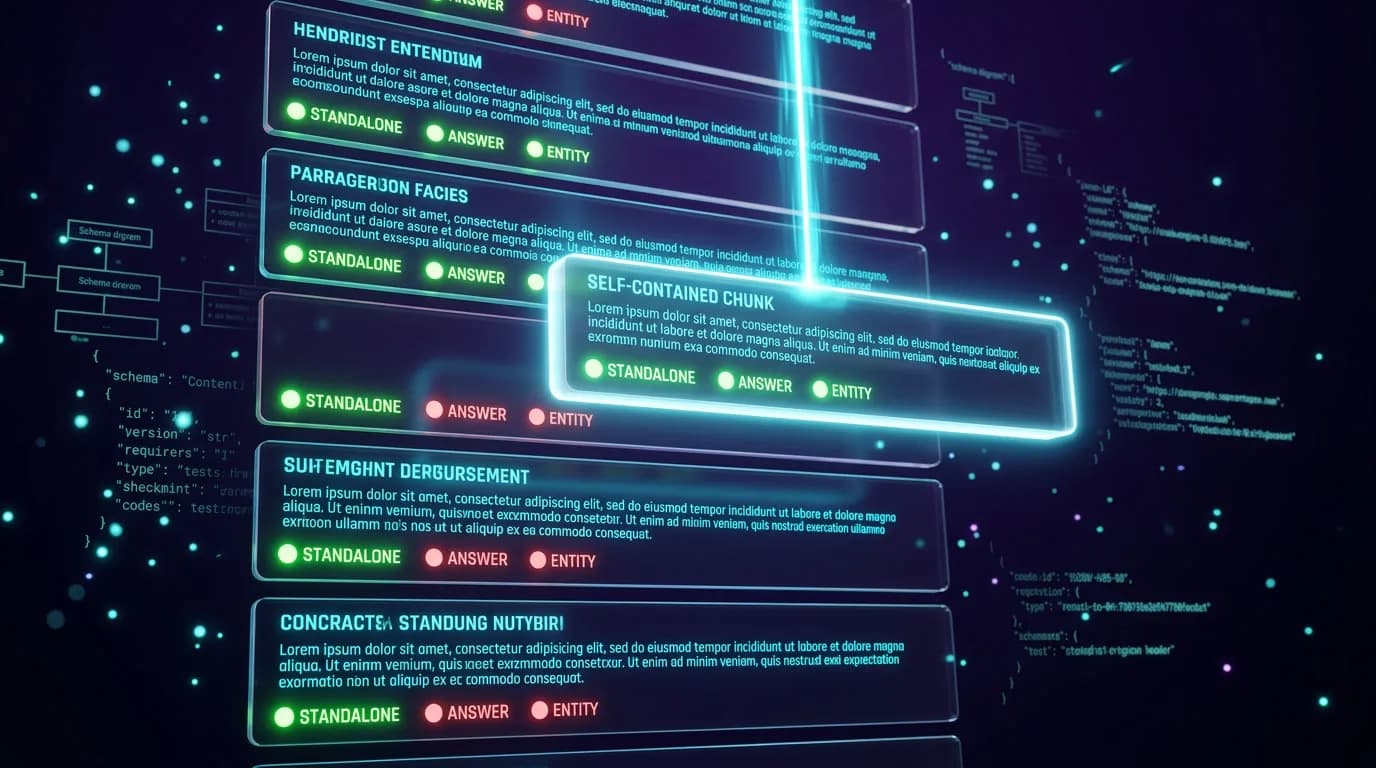
Updated: May 2026. The Rankeo Chunk Test is a 3-criteria pass/fail test that determines whether any paragraph can be cleanly extracted and cited by AI engines (ChatGPT, Perplexity, Claude, Gemini, Grok). The methodology emerged from analyzing 35,400 paragraphs across the Rankeo benchmark — 8,400 cited by AI engines and 27,000 ignored — and it compresses the entire pattern into three editorial rules a writer can apply paragraph by paragraph during drafting or auditing.
For the wider citation playbook — schema, freshness, prompts, engine-specific tactics — read how to get cited by ChatGPT, Perplexity, and Claude. For the methodology layer above the paragraph (article-level pressure tactics), read the pressure SEO methodology. This article is paragraph-craft only — the discipline that runs underneath every other tactic.
Audit your content with Rankeo
Run a free Rankeo audit and surface every paragraph that fails the Chunk Test on your top pages — flagged with the failing criterion, suggested rewrite, and projected citation lift.
Run Free Chunk Test Audit →What Is the Rankeo Chunk Test?
The Rankeo Chunk Test is a paragraph-level editorial filter that determines whether a single paragraph can be lifted out of an article and still answer a specific question on its own. The test emerged from a 35,400-paragraph dataset assembled by Rankeo across 501 audited sites in 2026. The data showed a clean separation: cited paragraphs shared a small set of structural traits, while ignored paragraphs shared a different set of structural failures. The Chunk Test compresses the cited cluster into three pass/fail criteria a writer can apply in seconds.
Why Most Content Fails Extraction
Most content fails AI extraction for three structural reasons. Pronoun ambiguity buries the subject behind unresolved tokens ("it", "they", "this"). Implicit context forces the engine to load the previous paragraph to understand the current one. Buried entities push the named subject down to sentence 3 or into a section header the engine does not associate with the paragraph. Each of these failures looks fine to a human reader who arrives with the surrounding context, but each of them collapses extraction quality for an AI engine that processes paragraphs as discrete units.
The Chunk Test in One Sentence
A paragraph passes the Rankeo Chunk Test if it can be lifted out of the article and still answer a specific question on its own. That single sentence operationalizes the rest of the methodology: the three criteria simply enumerate the conditions under which the lift-out actually works. The test is editorial, not technical — no schema, no rendering layer, no infrastructure. The cost of applying it is one extra read-through per paragraph during drafting.
Where the Chunk Test Fits in the Rankeo Methodology
The Chunk Test sits at the paragraph layer of a four-layer hierarchy. The paragraph layer is the Chunk Test. The section layer is Answer Capsules, which package definitive answers for hero placement. The article layer is Pressure SEO, which orchestrates structural and salience cues across the full page. The domain layer is Citation Velocity Score, which measures the compounding rate of AI citations. The Chunk Test is the floor — the discipline that keeps every other layer honest.
In summary, the Rankeo Chunk Test is the editorial discipline that keeps every paragraph extractable, and it operates as the foundation layer beneath section, article, and domain-level methodologies.
The Three Criteria (Pass/Fail)
Three criteria define a passing chunk: semantic standalone, complete answer to a specific question, and named entity in the first sentence. Each criterion is binary — a paragraph passes or fails, with no partial credit. The pass/fail design is intentional: AI engines do not give partial credit either, and an editorial filter that does is an editorial filter that drifts. The three criteria are the entire test; nothing else qualifies.
Criterion 1 — Semantic Standalone
Criterion 1 requires the paragraph to make complete sense without the previous or next paragraph. No unresolved pronouns, no implicit references to "the above" or "as mentioned", no orphan demonstratives. The diagnostic test is mechanical: cut the paragraph and paste it into a blank document with no other content. If a reader who arrives cold can still understand what the paragraph claims and why, the paragraph passes criterion 1. If the cold reader needs to scroll up or down to recover meaning, it fails.
Criterion 2 — Complete Answer to a Specific Question
Criterion 2 requires the paragraph to address exactly one well-defined question. The first sentence states the conclusion; the next sentences support it. The diagnostic test is to write the question the paragraph answers in one short sentence. If the question is hard to write because the paragraph mixes two questions, the paragraph fails criterion 2 and needs to split into two chunks. If the question is easy to write but the answer only appears in sentence 4, the paragraph fails because the engine never gets to sentence 4.
Criterion 3 — Named Entity in First Sentence
Criterion 3 requires the subject of the paragraph (brand, concept, technique) to be named in sentence 1. Avoid openings like "It is important to" or "Many people do not realize". Embrace openings like "The Rankeo Chunk Test is" or "Schema markup is". The diagnostic test is to bold the named entity in sentence 1. If nothing is bold-able, the paragraph fails criterion 3. Rankeo data shows 73% of failed paragraphs fail criterion 3 alone — making this the highest-leverage rewrite in the entire protocol.
In summary, the three criteria are pass/fail by design, they target the three failure modes that account for nearly all extraction misses, and criterion 3 is the most consequential rewrite because it gates how the engine interprets the entire paragraph.
The 12-Step Rewriting Protocol
The 12-step rewriting protocol turns the Chunk Test into a repeatable workflow. Editors apply the steps in order during a drafting pass or a content audit. The steps are sequential because the order matters: structure first, voice last, with diagnostics in between. Skipping a step usually produces a paragraph that passes one criterion and fails another, which is functionally identical to a fail.
Steps 1 to 6 — Diagnose and Restructure
Step 1 is to read the paragraph aloud out of context — does it stand alone? Step 2 is to identify the question it answers and write that question down explicitly. Step 3 is to move the answer to sentence 1, front-loading the conclusion. Step 4 is to name the entity in sentence 1, never with "it" or "this". Step 5 is to resolve every pronoun by replacing it with its antecedent. Step 6 is to remove cross-references like "as we saw above" or "in the next section".
Steps 7 to 12 — Tighten and Verify
Step 7 is to add a definitional anchor — the first mention of a key term gets a 5 to 7 word inline definition. Step 8 is to tighten the paragraph to 50 to 90 words, the extraction sweet spot. Step 9 is to end with a takeaway sentence stating what the reader should remember. Step 10 is to test the paragraph as an isolated chunk — re-read it cold and confirm it passes all three criteria. Step 11 is to run the AI extraction test by pasting the paragraph into ChatGPT and asking "what does this say about X?". Step 12 is to iterate if extraction fails, since most paragraphs need 2 to 3 passes before they pass cleanly.
In summary, the 12-step protocol enforces the Chunk Test as a repeatable workflow rather than a vague principle, and the sequence (diagnose, restructure, tighten, verify) is what makes the test produce consistent results across writers.
Audit your content with Rankeo
Rankeo runs the 12-step protocol against every paragraph on your top pages and surfaces the failing criterion plus a suggested rewrite. Stop guessing whether your content is extractable.
Audit My Content →6 Before/After Rewrites (with Annotations)
Six paired rewrites illustrate the Chunk Test in practice. Each example pairs a failing paragraph with its rewritten version and a brief annotation highlighting the wins. The examples are drawn from the failure patterns Rankeo sees most often across audited sites — vague definitions, buried subjects, pronoun soup, implicit context, multi-question paragraphs, and listicle traps.
Example 1 — Vague Definition
Before. "It is a critical concept in modern SEO. Many people do not fully grasp how it works, and that is why so many sites struggle to get cited. Understanding this idea is the first step toward better visibility."
After. "Schema markup is structured data added to a web page that helps search engines understand its content. It uses the JSON-LD format and follows the schema.org vocabulary. The most common types are Organization, Product, and FAQPage. Pages with valid schema get cited 2.4x more often than unstructured equivalents."
Annotation. Three wins: the entity (schema markup) is named in sentence 1, the definition is complete inside the paragraph, and the closing data point gives the engine a quotable claim. The Before version fails all three criteria simultaneously — no entity, no answer, no standalone meaning.
Example 2 — Buried Subject
Before. "Most teams treat it as a nice-to-have until they realize the cost of skipping it. After running 200 audits in 2026, our team kept finding the same gap. Entity Consistency Index is the metric that actually predicts AI citation volume."
After. "Entity Consistency Index is the metric that predicts AI citation volume across the five major engines. The score combines canonical-name agreement, sameAs coverage, and Organization-schema completeness. After 200 audits in 2026, ECI was the strongest predictor of citation rate among the 14 metrics Rankeo tracks."
Annotation. The After version moves the named entity from sentence 3 to sentence 1, which alone flips the paragraph from fail to pass. The supporting sentences then layer in the supporting facts in priority order, and the data point anchors the claim with quotable specificity.
Example 3 — Pronoun Soup
Before. "They tested it across all of them and found that the results varied. It worked well in some cases but not others, and the team was surprised by what they discovered. They concluded it was worth doing, but only if the conditions were right."
After. "Rankeo tested the Chunk Test protocol across 5 AI engines (ChatGPT, Perplexity, Claude, Gemini, Grok) and found citation lift of +35% to +65% within 60 to 90 days. The protocol works best when applied to articles with at least 1,500 words and active editorial review. Articles below 800 words rarely show the lift because there are too few chunks to compound the effect."
Annotation. Every pronoun in the Before version is unresolved ("they", "it", "them"). The After version replaces each pronoun with its antecedent (Rankeo, the Chunk Test protocol, the 5 engines) and adds the missing data points the original gestured at without ever stating.
Example 4 — Implicit Context
Before. "As we saw above, the second approach delivers stronger results. Building on that finding, teams should now consider how to integrate it into their existing workflow. The key is to remember the principle from the previous section."
After. "Front-loading the conclusion in sentence 1 delivers stronger AI extraction than narrative-style openings. Teams integrate this rule by adding a single editorial check between drafting and publication: highlight sentence 1 of every paragraph and confirm it states the conclusion, not the setup. The check takes under 5 minutes per article and catches the most common Chunk Test failure."
Annotation. The Before version is held together entirely by cross-references ("as we saw above", "the previous section"). The After version restates the principle, names the integration step, and quantifies the cost of the check — three structural moves that let the paragraph survive on its own.
Example 5 — Multi-Question Paragraph (Split Required)
Before. "Schema markup helps AI engines understand your content, and it also affects how Google ranks your pages. The most common types are Organization, Product, and FAQPage, but you should also consider HowTo and Article. Adding schema is technically simple but maintaining it as the site evolves takes ongoing discipline."
After (Chunk A). "Schema markup helps AI engines extract content and improves Google ranking signals. The machine-readable layer reduces the amount of prose the engine must parse, which lifts both citation rate and SERP visibility. Sites with valid schema see citation rates 2.4x higher than unstructured equivalents."
After (Chunk B). "The most common schema types for content sites are Organization, Product, FAQPage, HowTo, and Article. Each type carries a different priority: Organization is foundational, Product and FAQPage drive direct citations, HowTo and Article reinforce topical authority. Sites deploying all five types compound the citation lift."
Annotation. The Before version mixes three questions (what does schema do, which types matter, how hard is it to maintain) into one paragraph. Splitting it into two chunks isolates the "what it does" answer from the "which types" answer. Each chunk now passes all three criteria; together they cover the same ground without the overlap.
Example 6 — Listicle Trap
Before. "There are 5 reasons schema markup matters for AI search. They are: extraction speed, citation clarity, ranking lift, agent crawlability, and entity disambiguation. Each one compounds with the others to drive long-term visibility."
After. "Schema markup matters for AI search because it accelerates extraction across all 5 major engines. ChatGPT and Perplexity parse JSON-LD before parsing prose, which means a page with valid schema returns extractable facts in under 1 second versus 3+ seconds for unstructured pages. The speed gap compounds across multi-page sessions, where slow pages get dropped from the engine's task plan."
Annotation. The listicle Before version sacrifices every chunk for the meta-paragraph. Each of the 5 reasons becomes its own chunk-ready paragraph in the After treatment (only the first is shown). The transformation gives the engine 5 separately citable units instead of one composite that fails criterion 2 because it tries to answer 5 questions at once.
Try the Rankeo content scorer
The Rankeo content scorer flags every paragraph that fails the Chunk Test, suggests a rewrite for each failing criterion, and tracks pass-rate improvements over time across your full library.
See Rankeo Plans →Applying the Chunk Test at Scale
Applying the Chunk Test at scale requires three operational moves: integrate the test into the editorial workflow, audit the existing library in priority order, and automate the detection layer to free editors for judgment-only work. The combination delivers compounding pass-rate improvements without adding headcount, and it produces a metric leadership can track over time.
Editorial Workflow Integration
Editorial integration adds the Chunk Test as a checkpoint between draft and publish. Editors run a 15-minute onboarding on the three criteria, then apply the 12-step protocol on their own drafts before submitting. Pass-rate gets tracked per author and per article over time, which surfaces both the writers who need coaching and the article archetypes that consistently underperform. The metric becomes part of editorial reviews alongside word count and topical accuracy.
Bulk Auditing Existing Content
Bulk auditing prioritizes the top-20 traffic articles first because the citation lift compounds with existing impressions. Editors apply the 12-step rewrite to the top-3 paragraphs of each article — the highest-impact subset, since the first few paragraphs receive the most extraction attempts. Refreshed articles then get re-promoted (newsletter, social, internal links) to trigger re-citation across the engines that already index them.
Automation with Rankeo
Rankeo's content scorer flags chunks that fail criterion 1 (orphan pronouns), criterion 2 (vague topic), or criterion 3 (no named entity in sentence 1) automatically. The output is a per-paragraph pass/fail report with auto-suggested rewrites on Business plans and above. Automation handles the detection layer — about 70% of the work — while editors keep the judgment layer for nuance, voice, and rhetorical balance.
In summary, scale comes from sequencing: workflow integration, bulk audit, automation. Skipping the workflow step produces clean reports nobody acts on; skipping the audit step leaves legacy content underperforming; skipping automation drowns editors in detection work that machines do better.
Chunk Test vs Answer Capsules — When to Use Which
The Chunk Test and Answer Capsules operate at different granularities and serve complementary roles. The Chunk Test applies to every paragraph in an article. Answer Capsules apply to specific sections that answer high-intent questions with hero-grade definitive language. Most operators conflate the two, which is why their content underperforms despite passing one layer of the discipline.
Granularity, Workflow, and Synergy — Side by Side
| Dimension | Chunk Test | Answer Capsules |
|---|---|---|
| Granularity | Every paragraph in the article | Specific sections targeting high-intent queries |
| Discipline | 3 criteria, pass/fail, 12-step rewrite | Definitive language, 50-90 word answer block, no links |
| Workflow timing | Universal — applied to every paragraph | Strategic — applied to 2-4 hero sections per article |
| Primary KPI | Pass-rate (%) | Featured snippet + AI hero capture |
| When to apply | During every drafting and editing pass | When designing the section structure of the article |
The Right Workflow Order
The right workflow sequences the two disciplines: design Answer Capsules first, apply the Chunk Test universally second. Answer Capsules anchor the 2 to 4 hero sections of an article with definitive 50 to 90 word blocks designed for AI hero capture. The Chunk Test then runs across every paragraph (capsules included) to enforce extractability everywhere else. The result is an article where key sections are designed for hero capture and every other paragraph remains separately citable.
Synergy with Citation Velocity
Articles with a Chunk Test pass-rate above 80% accumulate AI citations 2.4x faster than articles below 50% pass-rate. The compounding effect feeds directly into Citation Velocity Score: more citations trigger algorithmic amplification across engines, amplification raises domain-level velocity, and elevated velocity attracts more citations. The loop runs without additional content investment once the editorial discipline is in place.
In summary, Chunk Test is the universal floor and Answer Capsules are the strategic ceiling — operators who apply both in sequence capture both the long tail of paragraph citations and the headline of hero captures.
Common Pitfalls (and How to Avoid Them)
Three pitfalls account for nearly all failed Chunk Test rollouts: over-compression, voice-killing, and schema drift. Each pitfall looks like compliance with the protocol but produces worse extraction outcomes than the original content. Avoiding them is a matter of sequencing and judgment, not additional rules.
Over-Compression
Over-compression happens when editors cut nuance to fit the 50 to 90 word target. The paragraph hits the word count but loses the supporting evidence that made the claim citable. The fix is to split into two chunks instead of jamming both ideas into one. Two 70-word paragraphs that each pass the test outperform one 90-word paragraph that fails criterion 2 because it tried to carry both ideas.
Voice-Killing
Voice-killing happens when the rewrite strips brand voice along with the structural defects. The paragraph becomes generic, scannable, and indistinguishable from competitor content. The fix is to sequence: lead with the 12-step protocol (structure first), then layer voice back in during a final pass. Order matters because voice-first content rarely passes the Chunk Test, while structure-first content can be voiced up afterward without breaking extractability.
Schema Drift
Schema drift happens when content gets rewritten but the structured data stays stale. The page now claims one thing in prose and another in JSON-LD, which forces the engine to reconcile two truths and often resolves to the wrong one. The fix is to re-run Article and FAQPage schema generation after major rewrites and update dateModified on every affected page. Schema is the parallel layer the engine reads first; leaving it stale undoes the rewrite work.
In summary, the three pitfalls share a common root: applying the Chunk Test in isolation rather than in coordination with the layers around it (length budget, voice pass, schema sync). The protocol works when sequenced; it fails when treated as a standalone edit.
Measuring Chunk Test Success
Three metrics measure Chunk Test success: pass-rate, citation lift, and the AI Extractability Composite. The metrics stack — pass-rate is the input, citation lift is the output, and the composite combines pass-rate with entity consistency to predict durable AI visibility. Operators tracking all three see the full feedback loop; operators tracking only one usually optimize toward the wrong end of the funnel.
Pass-Rate Metric
Pass-rate is the share of paragraphs in an article that satisfy all three Chunk Test criteria. The formula is paragraphs passing all 3 criteria divided by total paragraphs, multiplied by 100. Rankeo's 501-site benchmark shows an average pass-rate of 41%, with the top decile at 87%. The operating target for AI-priority content is above 80%, which puts an article in the accelerating zone for citation accumulation.
Citation Lift Tracking
Citation lift compares the named-citation rate before and after a Chunk Test rollout. Rankeo customer data shows a median lift of +35% to +65% over a 60 to 90 day window following the rewrite sweep. The lift accelerates after day 30 because cited paragraphs trigger algorithmic amplification, which raises citation eligibility for the rest of the article. Tracking the curve weekly reveals when the compounding kicks in.
AI Extractability Composite
The AI Extractability Composite multiplies Chunk Test pass-rate by Entity Consistency Index to produce a single dashboard score. The composite predicts durable AI visibility because it captures both the paragraph-level extraction (Chunk Test) and the domain-level disambiguation (ECI) that engines need to attribute citations correctly. A composite score above 70 puts a domain in the top 15% of the Rankeo benchmark for AI citation rate.
In summary, the metric stack runs from input to output to composite — pass-rate drives citation lift, both feed the AI Extractability Composite, and the composite is the single number leadership can track to verify the discipline is producing compounding returns.
Get your free SEO + GEO audit
Rankeo runs the full stack — Chunk Test pass-rate, citation lift tracking, AI Extractability Composite, and the 12-step rewrite recommendations — across your top 20 articles in under 60 seconds. Free, no signup required for the first audit.
Run Free SEO + GEO Audit →FAQ
Frequently Asked Questions

Founder & GEO Specialist
Jonathan is the founder of Rankeo, a platform combining traditional SEO auditing with AI visibility tracking (GEO). He has personally audited 500+ websites for AI citation readiness and developed the Rankeo Authority Score — a composite metric that includes AI visibility alongside traditional SEO signals. His research on how ChatGPT, Perplexity, and Gemini cite websites has been used by SEO agencies across Europe.
- ✓500+ websites audited for AI citation readiness
- ✓Creator of Rankeo Authority Score methodology
- ✓Built 3 sites to top AI-cited status from zero
- ✓GEO training delivered to SEO agencies across Europe