Schema Markup for AI Visibility: The Complete Guide to Getting Cited by ChatGPT, Gemini & Perplexity
How JSON-LD schema markup helps ChatGPT, Gemini, and Perplexity cite your site. 8 essential types with copy-paste code and before/after examples.

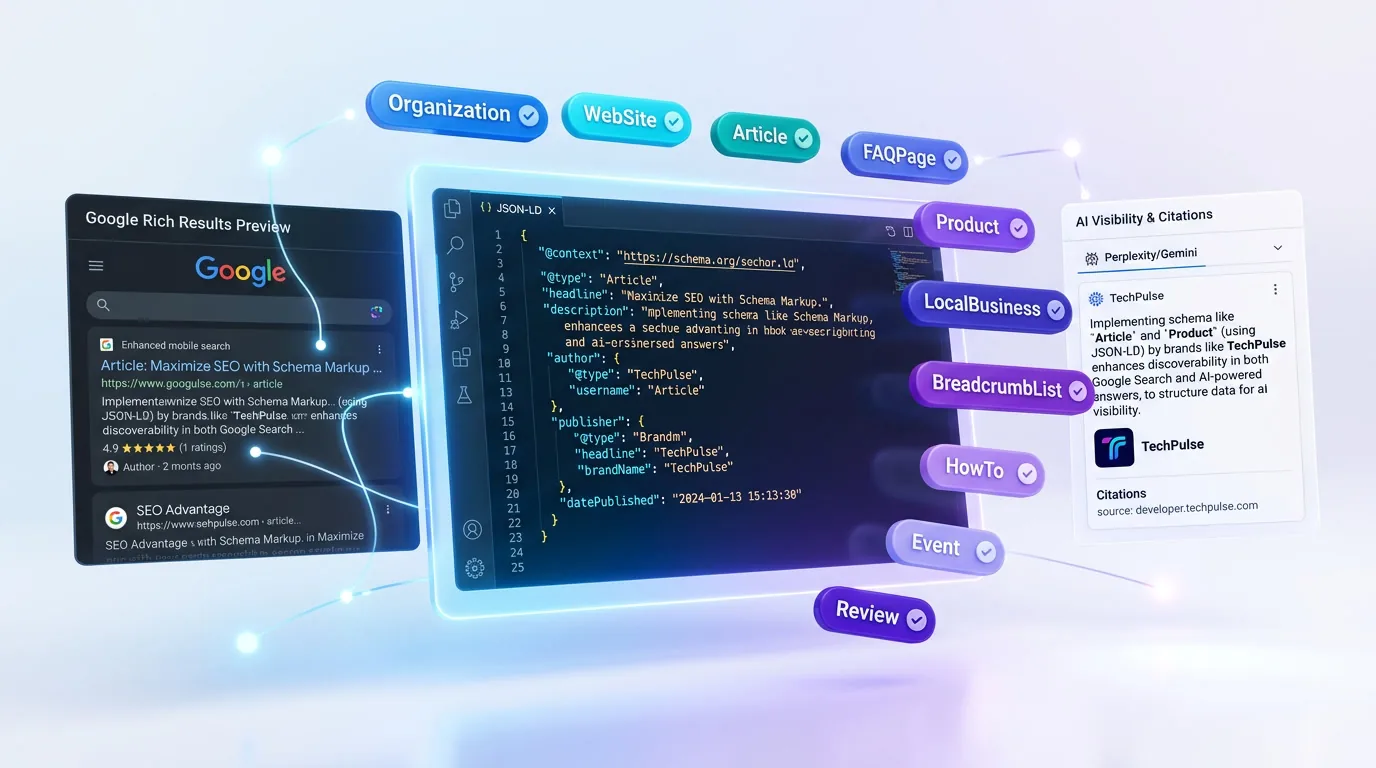
Schema markup was invented for Google Rich Results. A way to get star ratings, FAQ dropdowns, and product prices to appear beneath your blue links. For a decade, that was its primary value: a nice-to-have that boosted click-through rates. (Google retired the FAQ rich result in May 2026 — but, as you'll see, schema's value has since shifted decisively toward AI engines.)
In 2026, schema markup is no longer a nice-to-have. It is the language that AI engines speak.
When ChatGPT generates an answer about your industry, when Perplexity compiles a research summary, when Gemini recommends a product, they are not reading your page the way a human does. They are scanning structured data to answer three questions: Who are you? What do you do? Can I trust this enough to cite it?
If your site has clean, comprehensive JSON-LD schema markup, you are giving AI engines a machine-readable map of your brand, your content, and your expertise. If your site has none, you are asking algorithms to guess. And algorithms that have millions of sources to choose from do not spend time guessing. They skip you.
This guide covers the 8 essential schema types that matter for AI visibility. For each type, you will get a complete, copy-paste JSON-LD code block that you can drop into your site today. No fluff, no theory without implementation. By the end, you will know exactly which schema types your site needs and how to implement them for both Google Rich Results and AI engine citations.
If you want the broader context on schema markup for SEO in general, read our complete schema markup guide. This article focuses specifically on the AI visibility angle: how structured data determines whether ChatGPT, Gemini, Perplexity, Claude, and Grok cite your site or ignore it.
This guide and the one above explain how to implement schema for AI visibility. For the harder question — whether schema markup actually moves the needle on AI citations, tested in a controlled study — see Does Schema Markup Help AI Citations? What a Controlled Study Really Found.
Why Schema Markup Matters Beyond Google Rich Results
For years, the pitch for schema markup was simple: add structured data, get rich results in Google, get more clicks. That pitch still holds. Rich results increase click-through rates by 20-30% on average, and they are more important than ever in a search landscape where zero-click searches dominate.
But focusing only on rich results in 2026 is like optimizing your storefront while ignoring the highway they just built past your building. The highway is AI search, and structured data is the on-ramp.
Large language models do not browse the web like humans. They do not admire your design, skim your headlines, or read your about page. When an LLM processes a webpage, it looks for structured signals that it can parse efficiently and trust programmatically. JSON-LD schema is the most important of those signals because it is explicitly designed to be machine-readable.
Without schema markup, an AI engine must infer who you are from scattered text on your pages. It has to guess whether "Apple" means a fruit or a tech company. It has to figure out whether the address on your contact page is your headquarters or a client's office. It has to determine whether the person who wrote your blog post is a credentialed expert or an anonymous contributor.
With schema markup, none of that guessing is necessary. Your Organization schema says exactly who you are. Your Article schema says exactly who wrote the piece, when it was published, and what it covers. Your FAQPage schema presents question-answer pairs in a format that an LLM can extract directly without parsing messy HTML.
Rich Results = Google bonus. Schema for AI = survival. In 2026, structured data is not just about getting fancy snippets in search results. It is about being understood, trusted, and cited by the AI engines that are rapidly becoming primary information sources for millions of users.
The bottom line: if you only implement schema for Google, you get rich results. If you implement schema for AI engines, you get citations, recommendations, and visibility in an entirely new channel. The code is the same. The stakes are much higher.
How Each AI Engine Uses Your Schema
Not all AI engines use schema the same way. Understanding the differences helps you prioritize which schema types matter most for your audience. Here is how the five major AI engines process structured data in 2026.
| AI Engine | How It Uses Schema | What It Prioritizes |
|---|---|---|
| ChatGPT | Parses JSON-LD to identify entities and extract factual claims. Uses Organization and Article schema to attribute sources in responses. | Entity identity (Organization, Person), content freshness (datePublished), authority signals (sameAs links) |
| Perplexity | Indexes structured data alongside page content. Uses schema to build source cards and inline citations with rich metadata. | FAQPage (direct Q&A extraction), Article metadata, BreadcrumbList for site context |
| Gemini | Deeply integrated with Google's Knowledge Graph. Trusts first-party structured data heavily for entity disambiguation and fact verification. | First-party content signals (52% of citations from what brands say about themselves), Organization, LocalBusiness, Product |
| Claude | Processes structured data as part of broader page context. Uses schema to understand content structure and verify factual claims against entity metadata. | Content depth and structure (Article, WebPage), author credentials (Person schema), topical relevance |
| Grok | Leverages schema for real-time information extraction. Combines structured data with X (Twitter) signals for recency and relevance scoring. | Real-time freshness (dateModified), social proof via sameAs, Product and Organization schema |
The key insight from this table comes from Yext's research on AI citations: Gemini trusts first-party content, with 52% of its citations coming from what a brand says about itself. That means your Organization schema, your about page structured data, and your self-published content are disproportionately important for Gemini visibility.
Across all five engines, three patterns emerge. First, entity identity matters most. If an AI engine cannot confirm who you are and what you do via structured data, it will not cite you. Organization and Person schema are the foundation. Second, content freshness is a differentiator. The datePublished and dateModified properties in Article schema tell AI engines whether your content is current. Third, sameAs links build trust. Connecting your schema to verified social profiles and authoritative directories gives AI engines external validation of your identity.
Want to see how AI engines currently perceive your brand? Run a free check with our Authority Checker to get a baseline score.
The 8 Essential Schema Types for AI Visibility
Schema.org defines over 800 types. You do not need 800. For AI visibility, 8 types cover 95% of what matters. Below is each type with a complete, valid JSON-LD code block that you can copy, customize, and deploy today.
Before we dive in, check which schema types your site already has:
📋 Schema Completeness Score
Check which schema types your site currently has:
Now let us go through each type, starting with the most foundational and working toward more specific use cases.
Organization — Your Brand's Digital ID Card
Organization schema is the single most important schema type for AI visibility. It is your brand's digital identity card: the structured data that tells every AI engine who you are, what you do, and where to verify your existence.
Without Organization schema, AI engines have to piece together your identity from scattered mentions across the web. With it, you are handing them a clean, authoritative record. The sameAs property is especially critical because it connects your schema to your verified social profiles, creating a web of trust that AI engines use for entity disambiguation.
AI impact: Organization schema is the primary signal that ChatGPT, Gemini, and Perplexity use to confirm your brand exists and is legitimate. Without it, you are far less likely to appear in brand-related AI queries.
{
  "@context": "https://schema.org",
  "@type": "Organization",
  "@id": "https://yourdomain.com/#organization",
  "name": "Your Company Name",
  "url": "https://yourdomain.com",
  "logo": {
    "@type": "ImageObject",
    "url": "https://yourdomain.com/logo.png",
    "width": 512,
    "height": 512
  },
  "description": "Brief description of what your company does and who it serves.",
  "foundingDate": "2020-01-15",
  "founder": {
    "@type": "Person",
    "name": "Founder Name",
    "url": "https://yourdomain.com/about"
  },
  "contactPoint": {
    "@type": "ContactPoint",
    "contactType": "customer service",
    "email": "hello@yourdomain.com",
    "availableLanguage": ["English"]
  },
  "sameAs": [
    "https://www.linkedin.com/company/yourcompany",
    "https://twitter.com/yourcompany",
    "https://www.facebook.com/yourcompany",
    "https://github.com/yourcompany"
  ]
}
Place this in the <head> of your homepage inside a <script type="application/ld+json"> tag. The @id property creates a reusable reference that other schema types can link back to, building a connected knowledge graph across your site.
WebSite — Tell Engines What Your Site Is About
WebSite schema provides site-level context that helps AI engines understand your domain as a whole. It tells them what your site is about, who publishes it, and how to search it. The SearchAction property is especially valuable because it enables sitelinks search boxes in Google and gives AI engines a structured way to understand your site's content organization.
This type works hand-in-hand with Organization schema. While Organization identifies who you are, WebSite identifies what your online presence contains. Together, they form the foundation that every other schema type builds on.
AI impact: AI engines use WebSite schema to understand the scope and purpose of your domain. When Perplexity or ChatGPT encounters a query that could be answered by your content, WebSite schema helps them determine whether your site is relevant before they even look at individual pages.
{
  "@context": "https://schema.org",
  "@type": "WebSite",
  "@id": "https://yourdomain.com/#website",
  "name": "Your Site Name",
  "url": "https://yourdomain.com",
  "description": "A concise description of your website and its purpose.",
  "publisher": {
    "@id": "https://yourdomain.com/#organization"
  },
  "inLanguage": "en-US",
  "potentialAction": {
    "@type": "SearchAction",
    "target": {
      "@type": "EntryPoint",
      "urlTemplate": "https://yourdomain.com/search?q={search_term_string}"
    },
    "query-input": "required name=search_term_string"
  }
}
Notice how the publisher field references the Organization @id from above. This creates a linked relationship between your site and your brand entity, which AI engines can follow to build a richer understanding of your domain.
WebPage — Page-Level Context for Better Indexing
WebPage schema provides granular, page-level metadata that helps AI engines understand what each individual page covers. While WebSite tells engines about your domain, WebPage tells them about specific URLs. This is particularly useful for large sites where AI engines need to distinguish between hundreds or thousands of pages.
The breadcrumb property connects this schema to your BreadcrumbList, giving AI engines a complete picture of where each page sits in your site hierarchy. The lastReviewed property signals content freshness, which is a significant ranking factor for AI citation selection.
AI impact: Claude and Gemini in particular use WebPage schema to assess content depth and topical relevance. Pages with explicit WebPage schema are easier for AI engines to categorize and match to user queries.
{
  "@context": "https://schema.org",
  "@type": "WebPage",
  "@id": "https://yourdomain.com/services/#webpage",
  "name": "Our Services — Your Company Name",
  "url": "https://yourdomain.com/services/",
  "description": "Detailed description of the services offered on this page.",
  "isPartOf": {
    "@id": "https://yourdomain.com/#website"
  },
  "about": {
    "@id": "https://yourdomain.com/#organization"
  },
  "primaryImageOfPage": {
    "@type": "ImageObject",
    "url": "https://yourdomain.com/images/services-hero.jpg"
  },
  "datePublished": "2025-06-15",
  "dateModified": "2026-02-20",
  "lastReviewed": "2026-02-20",
  "inLanguage": "en-US",
  "breadcrumb": {
    "@id": "https://yourdomain.com/services/#breadcrumb"
  }
}
Add this to every important page on your site. The key fields are dateModified and lastReviewed. AI engines treat outdated content with suspicion. Keeping these dates current signals that your information is actively maintained and trustworthy.
Article — Make Your Content Citable
Article schema is the most directly impactful type for AI citations. When ChatGPT or Perplexity cites a source, they need three things: a headline, an author, and a publication date. Article schema provides all three in a clean, structured format. Without it, AI engines may still find your content, but they are far less likely to attribute it properly or cite it at all.
The author property is especially important for E-E-A-T (Experience, Expertise, Authoritativeness, Trustworthiness). AI engines increasingly weight author credentials when deciding which sources to cite. Linking your author to a Person schema with jobTitle and worksFor properties builds a credibility chain that algorithms can verify.
AI impact: Article schema is the number one driver of AI citations for content-publishing sites. The headline, author, and datePublished properties are used by every major AI engine to construct attributed citations in their responses.
{
  "@context": "https://schema.org",
  "@type": "Article",
  "@id": "https://yourdomain.com/blog/your-article-slug/#article",
  "headline": "Your Article Title Goes Here",
  "description": "A brief summary of the article in 1-2 sentences.",
  "url": "https://yourdomain.com/blog/your-article-slug/",
  "image": {
    "@type": "ImageObject",
    "url": "https://yourdomain.com/images/blog/article-image.jpg",
    "width": 1200,
    "height": 630
  },
  "datePublished": "2026-03-01",
  "dateModified": "2026-03-04",
  "author": {
    "@type": "Person",
    "name": "Author Name",
    "url": "https://yourdomain.com/about/author-name",
    "jobTitle": "Senior SEO Strategist",
    "worksFor": {
      "@id": "https://yourdomain.com/#organization"
    }
  },
  "publisher": {
    "@id": "https://yourdomain.com/#organization"
  },
  "mainEntityOfPage": {
    "@id": "https://yourdomain.com/blog/your-article-slug/#webpage"
  },
  "wordCount": 2500,
  "keywords": ["keyword one", "keyword two", "keyword three"],
  "isPartOf": {
    "@type": "Blog",
    "name": "Your Company Blog",
    "url": "https://yourdomain.com/blog/"
  }
}
Three fields are non-negotiable for AI visibility: headline, author (with name and credentials), and datePublished. If you skip any of these, you dramatically reduce your chances of being cited. ThedateModified field is almost as important because AI engines deprioritize stale content.
FAQPage — The Easiest Schema Win
FAQPage schema is the single easiest schema win for AI visibility. Large language models are fundamentally question-answering systems. When your page includes structured Q&A pairs via FAQPage schema, you are literally serving content in the exact format that AI engines consume natively.
Perplexity in particular extracts FAQ pairs directly from FAQPage schema and uses them to construct concise answers with inline citations. ChatGPT and Gemini also favor FAQ content because it provides clear, verifiable claims in a question-answer structure that maps perfectly to how users query AI engines.
Google retired the FAQ rich result in May 2026, so FAQPage no longer produces expandable dropdowns in search results. But the schema.org type remains valid and more valuable than ever: it structures your Q&A for direct extraction and citation by AI engines like ChatGPT, Perplexity, Gemini, and Claude. The deprecation effectively turned FAQPage into a pure AI-visibility play.
AI impact: FAQPage is the most directly extractable schema type. LLMs can lift Q&A pairs verbatim and use them as cited answers. If you have expert knowledge to share, wrapping it in FAQPage schema is the fastest path to AI citations.
{
  "@context": "https://schema.org",
  "@type": "FAQPage",
  "@id": "https://yourdomain.com/faq/#faqpage",
  "mainEntity": [
    {
      "@type": "Question",
      "name": "What services does your company offer?",
      "acceptedAnswer": {
        "@type": "Answer",
        "text": "We offer web design, SEO optimization, and digital marketing services for small and medium businesses. Our packages start at $499/month and include monthly reporting and strategy sessions."
      }
    },
    {
      "@type": "Question",
      "name": "How long does it take to see SEO results?",
      "acceptedAnswer": {
        "@type": "Answer",
        "text": "Most clients see measurable improvements in organic traffic within 3-6 months. Competitive keywords may take 6-12 months to rank on page one. We provide monthly progress reports so you can track improvements in real time."
      }
    },
    {
      "@type": "Question",
      "name": "Do you offer free consultations?",
      "acceptedAnswer": {
        "@type": "Answer",
        "text": "Yes, we offer a free 30-minute consultation to discuss your current website performance and identify opportunities for improvement. Book your free session at yourdomain.com/contact."
      }
    }
  ]
}
The best practice is to include 3-8 FAQ pairs per page. Each answer should be concise (2-4 sentences), factual, and self-contained. Avoid answers that just say "contact us for more information." AI engines want concrete, citable facts. The more specific your answers, the more likely they are to be extracted and cited.
BreadcrumbList — Site Architecture for Bots
BreadcrumbList schema maps your site's hierarchical structure in a format that both Google and AI engines can parse instantly. While it may seem like a minor technical detail, breadcrumbs serve a critical function for AI visibility: they give engines context about where a page sits in your site's information architecture.
When an AI engine processes a page at example.com/blog/seo-guide/link-building, BreadcrumbList schema tells it that this page is a sub-topic of "SEO Guide," which is part of "Blog." This hierarchical context helps AI engines understand topical depth and authority. A site with deep, well-structured breadcrumbs signals expertise in a subject area.
AI impact: Perplexity and Claude use breadcrumb data to assess content depth and site authority. A page nested three levels deep in a well-organized hierarchy signals topical expertise that a flat site structure does not.
{
  "@context": "https://schema.org",
  "@type": "BreadcrumbList",
  "@id": "https://yourdomain.com/blog/seo-tips/#breadcrumb",
  "itemListElement": [
    {
      "@type": "ListItem",
      "position": 1,
      "name": "Home",
      "item": "https://yourdomain.com/"
    },
    {
      "@type": "ListItem",
      "position": 2,
      "name": "Blog",
      "item": "https://yourdomain.com/blog/"
    },
    {
      "@type": "ListItem",
      "position": 3,
      "name": "SEO Tips",
      "item": "https://yourdomain.com/blog/seo-tips/"
    }
  ]
}
Every page on your site should have BreadcrumbList schema. The cost of implementation is minimal (it is the simplest schema type), and the benefit is cumulative: the more pages that include breadcrumbs, the clearer your overall site structure becomes to AI engines. This is one of those schema types where consistency matters more than complexity.
Product — Get Your Products Recommended
Product schema is essential for any site that sells physical goods, software, or services. AI engines are increasingly used for product research and comparison. When a user asks ChatGPT "What is the best project management tool for small teams?" or asks Perplexity to compare CRM platforms, the AI engine needs structured product data to generate accurate recommendations.
Without Product schema, your product information is buried in unstructured HTML that AI engines may or may not parse correctly. With it, your product name, price, features, and reviews are presented in a format that LLMs can extract and compare against competitors instantly.
AI impact: Gemini and ChatGPT use Product schema to populate comparison tables and recommendation lists in AI-generated answers. Products with complete schema (including reviews and pricing) are significantly more likely to be recommended than products without it.
{
  "@context": "https://schema.org",
  "@type": "Product",
  "@id": "https://yourdomain.com/products/product-name/#product",
  "name": "Your Product Name",
  "description": "A clear, detailed description of what the product does and who it is for.",
  "url": "https://yourdomain.com/products/product-name/",
  "image": [
    "https://yourdomain.com/images/products/product-front.jpg",
    "https://yourdomain.com/images/products/product-side.jpg"
  ],
  "brand": {
    "@id": "https://yourdomain.com/#organization"
  },
  "sku": "PROD-001",
  "category": "Software > Project Management",
  "offers": {
    "@type": "Offer",
    "url": "https://yourdomain.com/products/product-name/",
    "priceCurrency": "USD",
    "price": "39.00",
    "priceValidUntil": "2026-12-31",
    "availability": "https://schema.org/InStock",
    "seller": {
      "@id": "https://yourdomain.com/#organization"
    }
  },
  "aggregateRating": {
    "@type": "AggregateRating",
    "ratingValue": "4.7",
    "reviewCount": "156",
    "bestRating": "5",
    "worstRating": "1"
  },
  "review": [
    {
      "@type": "Review",
      "author": {
        "@type": "Person",
        "name": "Sarah Johnson"
      },
      "datePublished": "2026-01-15",
      "reviewRating": {
        "@type": "Rating",
        "ratingValue": "5",
        "bestRating": "5"
      },
      "reviewBody": "This product transformed how our team manages projects. Setup took 10 minutes and we saw results in the first week."
    }
  ]
}
Key fields for AI visibility: name, description, offers (with price), and aggregateRating. AI engines use ratings and review counts as trust signals when generating product recommendations. If your product has real reviews, include them in the schema. If it does not, focus on the other fields and add reviews once you have them.
LocalBusiness — Own Your Local AI Results
LocalBusiness schema is critical for any business with a physical location. Local queries are one of the fastest-growing categories in AI search. Users ask ChatGPT "best Italian restaurant near downtown Austin," or ask Perplexity "top-rated dentists in Brooklyn." AI engines compile these answers from structured local business data, and LocalBusiness schema is the primary source.
This schema type extends Organization with location-specific information: your address, phone number, business hours, geographic coordinates, and the specific area you serve. For Gemini, which is tightly integrated with Google Maps and the Knowledge Graph, LocalBusiness schema is particularly powerful. Businesses with comprehensive local schema appear more frequently in Gemini's location-based recommendations.
AI impact: Local business queries in AI search are growing rapidly. LocalBusiness schema is the foundation for appearing in AI-generated local recommendations. Without it, AI engines rely on third-party directories that may have incomplete or outdated information about your business.
{
  "@context": "https://schema.org",
  "@type": "LocalBusiness",
  "@id": "https://yourdomain.com/#localbusiness",
  "name": "Your Business Name",
  "description": "Brief description of your business, services, and what makes you unique.",
  "url": "https://yourdomain.com",
  "telephone": "+1-555-123-4567",
  "email": "hello@yourdomain.com",
  "image": "https://yourdomain.com/images/storefront.jpg",
  "logo": {
    "@type": "ImageObject",
    "url": "https://yourdomain.com/logo.png"
  },
  "address": {
    "@type": "PostalAddress",
    "streetAddress": "123 Main Street, Suite 100",
    "addressLocality": "Austin",
    "addressRegion": "TX",
    "postalCode": "78701",
    "addressCountry": "US"
  },
  "geo": {
    "@type": "GeoCoordinates",
    "latitude": "30.2672",
    "longitude": "-97.7431"
  },
  "openingHoursSpecification": [
    {
      "@type": "OpeningHoursSpecification",
      "dayOfWeek": ["Monday", "Tuesday", "Wednesday", "Thursday", "Friday"],
      "opens": "09:00",
      "closes": "18:00"
    },
    {
      "@type": "OpeningHoursSpecification",
      "dayOfWeek": "Saturday",
      "opens": "10:00",
      "closes": "14:00"
    }
  ],
  "priceRange": "$$",
  "areaServed": {
    "@type": "City",
    "name": "Austin"
  },
  "sameAs": [
    "https://www.google.com/maps/place/?q=place_id:YOUR_PLACE_ID",
    "https://www.yelp.com/biz/your-business-name",
    "https://www.linkedin.com/company/yourcompany"
  ]
}
Two fields are especially important for local AI visibility. First, geo with exact latitude and longitude. AI engines with location awareness (especially Gemini) use these coordinates to match your business with location-based queries. Second, sameAs with your Google Maps and Yelp URLs. These cross-references help AI engines verify your business exists at the claimed location.
5 Schema Mistakes That Make You Invisible to AI
Having schema markup is not enough. Having broken schema markup can be worse than having none at all, because it sends conflicting signals that AI engines resolve by ignoring your site entirely. Here are the five most common mistakes we see when analyzing sites with Rankeo's Schema Validator.
1. Missing @context
Every JSON-LD block must start with "@context": "https://schema.org". Without it, the entire block is just random JSON. Google's Rich Results Test will flag this immediately, and AI engines will skip the block completely. It sounds basic, but we see this on roughly 15% of sites that attempt schema implementation.
// WRONG - missing @context
{
  "@type": "Organization",
  "name": "My Company"
}

// CORRECT
{
  "@context": "https://schema.org",
  "@type": "Organization",
  "name": "My Company"
}
2. Organization Without sameAs
An Organization schema without sameAs links is like an ID card without a photo. It tells AI engines your name, but it does not give them any way to verify your identity. The sameAs property connects your schema to your LinkedIn, Twitter, Facebook, and other verified profiles. AI engines use these cross-references for entity disambiguation. Without them, an AI engine cannot distinguish your company from others with similar names.
Always include at least 2-3 sameAs links to active, verified profiles. LinkedIn is the most trusted for business entities. Include your Google Business Profile URL for local businesses.
3. Article Without datePublished
If your Article schema is missing datePublished, AI engines have no way to assess content freshness. In a world where LLMs increasingly weight recency, an article without a date is treated as potentially outdated. Always include both datePublished and dateModified. If you update an old article, update the dateModified field to signal that the content has been reviewed and is still accurate.
4. Duplicate or Conflicting Schemas
Multiple JSON-LD blocks with conflicting information about the same entity confuse AI engines. The most common case: a site has one Organization schema in the header (from a plugin) and a different one in the footer (added manually), with different names or descriptions. AI engines see the conflict and trust neither.
The fix is to use a single @graph approach where all schema types live in one JSON-LD block with consistent @id references. This eliminates conflicts and creates a coherent knowledge graph that AI engines can trust. This is the approach that our complete schema guide recommends and that Rankeo generates automatically.
5. Microdata Instead of JSON-LD
Microdata (inline HTML attributes like itemscope and itemprop) technically works, but it is significantly harder for AI engines to parse reliably. JSON-LD lives in a clean, separate script block that AI crawlers can extract in milliseconds. Microdata is scattered throughout your HTML, mixed with styling, JavaScript, and content. Parsing errors are common.
If your site currently uses Microdata, consider migrating to JSON-LD. You can run both simultaneously during the transition. Test your JSON-LD implementation with our free Schema Validator before removing the Microdata.
Test Your Schema: 2 Free Tools
Implementing schema is half the battle. Validating it is the other half. Invalid or malformed schema is silently ignored by both Google and AI engines. You will not see an error in your browser console, and your pages will look perfectly normal to visitors. The only way to know if your schema is working is to test it.
Here are two free tools that cover both Google compatibility and AI engine readability.
1. Google Rich Results Test
Google's Rich Results Test (search.google.com/test/rich-results) is the official tool for validating schema compatibility with Google Search. It tells you which rich result types your page is eligible for, flags errors and warnings in your JSON-LD, and shows you exactly how Google interprets your structured data.
Use it for: Confirming that your schema is syntactically valid, checking eligibility for specific rich results (product snippets, review stars, etc.), and debugging implementation errors.
Limitation: It only validates against Google's requirements. A schema that passes the Rich Results Test might still be missing properties that AI engines need for optimal citation selection, like sameAs or author credentials.
2. Rankeo Schema Validator
The Rankeo Schema Validator is a free tool we built specifically to validate JSON-LD for both Google compliance and AI engine readability. You paste your JSON-LD code, and the validator checks it against a comprehensive set of rules that include standard Schema.org validation plus AI-specific best practices.
What it checks that Google's tool does not:
- Whether your Organization schema includes
sameAslinks for AI entity disambiguation - Whether your Article schema has the author credentials that AI engines look for
- Whether you are using the
@graphapproach for connected entities - Whether your schema types are comprehensive enough for AI visibility (not just Google eligibility)
The validator is free with no account required and no usage limits. Use it every time you add or modify schema on your site. Try the Schema Validator now.
For a complete picture of your site's visibility to both traditional and AI search engines, check your Authority Score. It combines technical SEO signals, content quality, schema completeness, and AI visibility into a single score. Understanding where you stand is the first step to improving.
Ready to implement comprehensive schema markup and track your AI visibility over time? Create your free Rankeo account to access automated schema generation, AI visibility monitoring, and actionable recommendations tailored to your site.
The Bottom Line
Schema markup is no longer optional for AI visibility. Sites with three or more JSON-LD schema types get cited up to 3x more by ChatGPT, Perplexity, and Gemini than sites with none. The reason is straightforward: AI engines cannot reliably extract entities from raw HTML, but they parse structured data instantly. If your competitors have schema and you do not, AI search will recommend them by default.
Deploy Organization, WebSite, and Article schema this week using the @graph approach. Then validate every implementation before it goes live, because malformed schema is silently ignored by every engine.
Frequently Asked Questions

Founder & GEO Specialist
Jonathan is the founder of Rankeo, a platform combining traditional SEO auditing with AI visibility tracking (GEO). He has personally audited 500+ websites for AI citation readiness and developed the Rankeo Authority Score — a composite metric that includes AI visibility alongside traditional SEO signals. His research on how ChatGPT, Perplexity, and Gemini cite websites has been used by SEO agencies across Europe.
- ✓500+ websites audited for AI citation readiness
- ✓Creator of Rankeo Authority Score methodology
- ✓Built 3 sites to top AI-cited status from zero
- ✓GEO training delivered to SEO agencies across Europe