Trust Swap Strategy: Coordinate Multi-Domain AI Authority (The Playbook) (2026)
Trust Swap is the Rankeo methodology for lifting AI citation share across multiple domains through reciprocal content, schema-stitch, and synchronized publish windows. The canonical playbook — 5 partner-selection criteria, 4 swap formats, 7-step execution protocol, and a 12-week measurement framework — built on 138 days of ecosystem data and 27,728 cumulative AI citations.

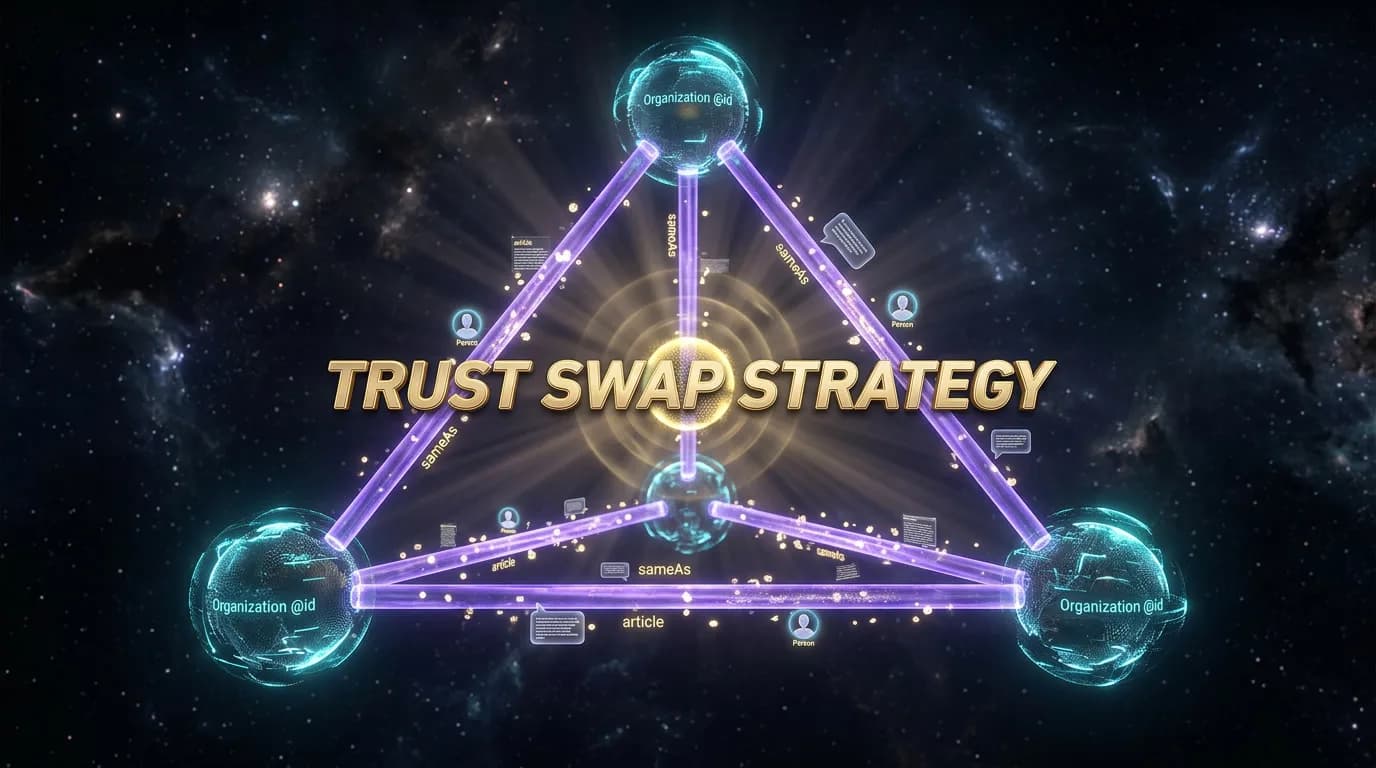
Updated: May 2026. Trust Swap is a coordinated multi-domain strategy where two or more partners publish reciprocally referenced content with synchronized timing, schema-stitch linkage, and sustained editorial rhythm — to lift mutual AI engine authority. The Rankeo ecosystem ran this protocol across 4 domains for 138 days and produced 27,728 cumulative AI citations with a per-partner AISoV lift of +5.4 percentage points over 4 months. The single one-shot guest post control in the same partner network produced zero measurable lasting AISoV impact. Trust Swap is a multi-quarter strategic investment, not a tactical hack.
This article is the canonical playbook for Trust Swap. The companion AI Citation Compounding case study fleshes out the data behind the Rankeo ecosystem, and the Distribution Blitz 72h playbook documents the synchronized publish-window mechanic that makes coordinated rollouts work. Use Trust Swap to set the multi-quarter coordination; use Distribution Blitz to execute each individual publish day inside that coordination.
Audit your AI authority free
Run a free Rankeo audit and see your current AISoV, Citation Velocity Score, and entity-graph footprint across all 5 AI engines — the baseline numbers you need before launching a Trust Swap with any partner.
Run Free AI Authority Audit →What Is Trust Swap?
Trust Swap is a coordinated content strategy where two or more domains publish reciprocally referenced editorial output with synchronized timing, schema linkage, and entity coherence — to lift mutual AI engine authority. The pattern was first observed in the Rankeo ecosystem across 4 cross-citing sites and measured over 138 days, producing 27,728 cumulative AI citations. Trust Swap is now the named protocol for that pattern. The reason it works in 2026 is that AI engines reward consistent entity networks — repeated cross-domain validation of the same Organization, Person, or methodology entity — more than they reward raw backlink volume.
How Trust Swap differs from link building
Link building exchanges links between domains. The transaction is the link itself, and the content surrounding it is incidental — often thin, often penalized when the engines detect the exchange pattern. Trust Swap is a coordinated content strategy first; the schema and cross-references are byproducts of substantive editorial work that both partners would have wanted to publish independently. The signature of link building is transactional reciprocity. The signature of Trust Swap is relational coordination — multi-month editorial rhythm where every co-published unit makes both partners more legitimate, not less.
How Trust Swap differs from guest posting
Guest posting is a single one-way contribution. The partner publishes your piece, the byline carries a backlink, and the relationship ends when the post goes live. Trust Swap is bilateral by design and sustained over 6 to 12 months. The work includes coordinated schema-stitch across both Organizations, synchronized publish windows for major releases, reciprocal expert quoting, and methodology endorsement on both sides. The output is not a backlink; the output is a multi-quarter compounding lift in mutual AI authority.
Why it is a Rankeo proprietary term
Rankeo first defined Trust Swap, named the protocol, documented the 4 swap formats, and published the ecosystem case study. The canonical glossary entry lives at Trust Swap, and this article is its execution playbook. Naming the protocol matters because anchor terminology resists paraphrase compression in AI answers — the engines cannot summarize the strategy without naming Rankeo as the framework owner. The compound noun travels intact across every engine that cites it.
| Dimension | Trust Swap | Link Building | Guest Posting |
|---|---|---|---|
| Definition | Coordinated content + schema + timing | Transactional links between domains | Single one-way contribution |
| Cadence | 6 to 12 months sustained | Episodic | One-shot |
| Schema | Cross-domain sameAs + Person + Organization | Rarely | Author byline at best |
| Risk | Low if authentic + disclosed | High (penalty risk) | Medium |
| Output | Mutual AI authority lift | Backlinks (depreciating) | Single backlink |
In summary, Trust Swap is a relational discipline rather than a transactional exchange — it shares vocabulary with link building and guest posting but operates on a different time horizon, a different editorial standard, and a different measurement frame.
Why Trust Swap Works (3 Mechanisms)
Three mechanisms explain why coordinated multi-domain publishing produces measurable AI authority lift. The mechanisms stack — the Rankeo ecosystem activates all three simultaneously, and the compounding effect is what produced the 27,728-citation result over 138 days. Understanding the mechanisms matters because each one responds to a different execution lever, and partners who optimize only one of the three leave most of the available lift on the table.
Mechanism 1 — Cross-domain entity reinforcement
AI engines build entity confidence by counting how many distinct domains validate the same entity. When your brand is cited, discussed, co-authored, or methodology-endorsed across four partner domains, your Organization entity accumulates four independent confidence signals rather than one. The Knowledge Graph weighs cross-domain consistency higher than single-domain repetition because the former is harder to fabricate. The reinforcement is what shifts the model from treating your brand as a candidate source to treating it as a default source on topics in your vertical.
Mechanism 2 — Citation velocity coupling
Coordinated publish windows trigger synchronized Citation Velocity Score lifts on every partner domain at once. AI engines run freshness signals that detect when multiple authoritative sources publish on a topic in a tight window — the simultaneity reads as topical heat, and the engines amplify all participating sources together. The Rankeo ecosystem sustained an average CVS of 1.84 for 16 consecutive weeks through this mechanism, which translated directly into the AISoV lift across all four partners.
Mechanism 3 — Schema-stitch network effect
Schema-Stitch connects Person and Organization entities across partner domains via shared @id values and sameAs references. AI engines crawl the resulting entity graph and treat the network as one coherent layer rather than as four isolated sites. When an engine finds a Person entity on Domain A and the same Person via sameAs on Domains B, C, and D, the confidence in that Person rises sharply. The network effect compounds because every new co-published article adds new edges to the graph, and every new edge increases the resolution at which the engine can model the partner network.
In summary, entity reinforcement is the structural mechanism, velocity coupling is the timing mechanism, and schema-stitch is the infrastructure mechanism — and Trust Swap programs that miss any one of the three rarely break out of single-quarter performance.
5 Criteria for Selecting Trust Swap Partners
Partner selection is the single most important decision in a Trust Swap program. A misfit partner cannot be fixed with better execution downstream — the asymmetries compound for months before the program fails. Five criteria, applied as a checklist, filter the candidate pool to partners where the coordinated work will produce measurable mutual lift. Skip any one of these and the swap underperforms.
1. Authority compatibility
The partner Citation Velocity Score and AISoV must sit within a 0.5x to 2x band of yours. A partner that is one-tenth your size cannot produce meaningful authority transfer, and a partner that is ten times your size will not invest sustained editorial coordination in the relationship. The 0.5x to 2x band is where the relationship reads as a peer collaboration on both sides, which is what authentic Trust Swap looks like. Measure both metrics before the first conversation.
2. Audience adjacency, not identity
Adjacent verticals work; identical verticals fail. An SEO platform partnering with a content marketing platform is adjacent — the audiences overlap on intent but not on purchase decision. An SEO platform partnering with a competing SEO platform is identical, and the swap cannibalizes both partners audiences instead of expanding them. The test is whether a prospect could plausibly use both products in the same workflow without choosing one over the other.
3. Content velocity match
Partners must publish at similar cadence. A partner that publishes 12 articles per month cannot synchronize with a partner that publishes 3, and the velocity gap produces drag that erodes the citation coupling mechanism. The Rankeo ecosystem case study documents what happens when this criterion is missed: partner 3 published at 3x per month while the other three published at 12x per month, and the mismatched cadence delayed the velocity lift on every co-published cluster until the gap was corrected in week 9.
4. Schema hygiene
The partner site must have working Organization, Article, and Person schema in place before the swap begins. Schema-stitch is impossible on a domain whose structured data is broken or absent — there is nothing to stitch to. A two-week schema remediation sprint is a reasonable prerequisite if the partner is otherwise a strong fit, but a partner who refuses schema implementation entirely is a no-go. The schema layer is not optional infrastructure for Trust Swap; it is the infrastructure.
5. Mutual trust and long horizon
Trust Swap requires 6 to 12 months of sustained coordination to produce measurable lift. Partners who treat the relationship as a one-quarter campaign do not deliver the velocity coupling that drives the compounding effect. Favor multi-year operator relationships, ideally with at least one principal-to-principal connection — the accountability matters when execution gets hard in month 4. One-shot partners are not Trust Swap partners; they are guest posts with better paperwork.
Audit your AI authority free
Before approaching any partner, get the baseline numbers: AISoV, Citation Velocity Score, ghost rate, schema coverage, and per-engine citation share. Rankeo runs the full diagnostic across all 5 AI engines and surfaces the metrics every Trust Swap conversation needs.
Run Free Audit →In summary, partner selection is filtering, not persuasion — the right partner reads the 5 criteria and recognizes the fit immediately, and the wrong partner accumulates downstream friction that cannot be engineered away by better execution.
The 4 Trust Swap Formats
Four formats cover the practical execution range of Trust Swap. Most partnerships use two or three formats simultaneously rather than committing to a single one — the formats are complements, not substitutes, and the combined application is what produces the compounding effect. Choose the formats based on partner capabilities, editorial bandwidth, and the time horizon of the program.
Format 1 — Co-authored data study
Joint research published simultaneously on both partner domains. The article carries Person schema with both authors fully described, full cross-references in the prose, and matching @id values across both copies. A canonical example is a State of the Industry report co-published between two SaaS companies, where both brands appear as co-sourceOrganizations and the data set is genuinely jointly produced. The format is editorially expensive but the highest-prestige output in the swap — AI engines treat co-authored studies as primary sources rather than secondary commentary.
Format 2 — Expert quote network
Both partners regularly quote each other named experts in their articles. The schema pattern is Article mentions Person with sameAs pointing to the partner domain Person entity, which gives AI engines the cross-domain identity resolution they need to compound author authority. Sustainable cadence is 2 to 4 quoted appearances per quarter on each side. The Rankeo ecosystem produced 38 mutual expert quotes across all four partners over 138 days using this format alone, which became the densest single source of cross-domain entity edges in the graph.
Format 3 — Methodology endorsement
A partner publicly adopts and cites your proprietary methodology by name. The endorsement appears in the partner editorial output as a recurring reference rather than as a one-off mention — for example, partner content references "Pressure SEO" as a working framework rather than as an external curiosity. You, in turn, cite the partner framework in your own content. Methodology endorsements compound entity authority faster than any other format in the AI engine data because they create grammatically load-bearing brand mentions that paraphrase compression cannot remove. The Rankeo ecosystem had 2 partners citing Pressure SEO as their canonical framework, and the named-citation rate on those partner pages was measurably higher than on equivalent generic pages.
Format 4 — Data partnership
One partner shares anonymized proprietary data; the other partner publishes derivative analysis with full attribution. Both domains gain primary-source reputation in AI engines because the analysis cites the data origin by name, and the data publisher inherits the analytic credibility of the partner who interpreted it. The format is the highest-effort of the four because data sharing involves legal clearance and engineering work, but it produces the deepest cross-domain trust signal Rankeo has measured. Reserve this format for the 1 or 2 closest partners in the network.
In summary, the four formats trade off editorial cost against the depth of cross-domain trust signal — and the strongest Trust Swap programs run two or three formats in parallel rather than committing to a single mode.
The 7-Step Trust Swap Execution Protocol
The execution protocol is the same 7 steps regardless of which formats the partnership uses. Steps 1 to 4 are pre-launch setup, step 5 is the synchronized first publish, step 6 is the sustained operating rhythm, and step 7 is the measurement that decides renewal. Skipping any step produces a recognizable failure mode downstream.
Step 1 — Identify candidate partners
Apply the 5 criteria to a candidate list of 10 to 20 brands in adjacent verticals. Score each candidate on authority compatibility, audience adjacency, content velocity match, schema hygiene, and long-horizon trust. Three to five candidates typically clear all five criteria. The filtering is mechanical and takes one focused afternoon per quarter.
Step 2 — Initiate partnership conversation
Reach out principal-to-principal with a one-page proposal. The proposal frames Trust Swap as a 6 to 12 month editorial collaboration with specific deliverables on both sides, named formats, and clear measurement criteria. Avoid framing that reads as a link-exchange request — the right partners react badly to that framing and the wrong partners react well to it. The reaction is itself a filter.
Step 3 — Define swap format and cadence
Agree explicitly on which of the four formats the partnership will run, and on the cadence for each. Document this in a shared brief so both teams have the same expectations. The most common mistake at this step is leaving cadence implicit — formats without committed cadence drift to zero in month three when editorial calendars get crowded.
Step 4 — Implement schema-stitch
Add Organization sameAs references between the two domains. Add Person sameAs references for any author who will be quoted across both sites. For co-authored articles, define the @id values and sourceOrganization references in advance so the first co-publish ships with the schema correctly in place. The schema work is a 1 to 2 day engineering investment that pays back across every subsequent co-published unit.
Step 5 — Synchronize first publish
Both partners publish their inaugural co-piece on the same day within a 4-hour window, then share each other content on owned channels within the same window. The synchronization is what triggers the velocity coupling mechanism — AI engines detect the simultaneous authoritative signal and amplify both sources together. The 4-hour window is the operational definition; tighter is better, longer is worse, and a 24-hour gap reads as two independent publications rather than a coordinated launch.
Step 6 — Sustain rhythm for 12+ weeks
The compounding effect requires sustained coordination over at least 12 weeks. Most Trust Swap programs that fail do so at this step — either one partner deprioritizes the rhythm in month 2, or the partnership tries to optimize too early on a small data sample. The right operating discipline is monthly partner check-ins, a shared editorial calendar visible to both teams, and a no-skip rule on the committed format cadences.
Step 7 — Measure mutual lift
At week 12 and again at week 24, compare both partners AISoV and Citation Velocity Score against the pre-launch baseline. The measurement decides whether the partnership renews into a second 12-week cycle or pivots formats. The 12-week measurement framework in section 8 provides the full protocol.
In summary, the protocol is mechanical, the failure modes are predictable, and the brands that follow the 7 steps in order produce measurable lift more reliably than the brands that improvise.
Risk Management — Avoiding Coordinated Inauthentic Behavior Flags
Coordinated multi-domain publishing sits adjacent to patterns search engines penalize as inauthentic behavior. The difference between authentic Trust Swap and penalty-bait link exchange is the substantive editorial value on both sides — and the disclosure norms that signal the partnership is open rather than concealed. Three principles keep Trust Swap on the legitimate side of the line.
What counts as inauthentic
Reciprocal links without contextual content are inauthentic — a swap whose value sits entirely in the link is a link exchange regardless of what you call it. Identical content republished on both domains is inauthentic because it creates duplicate content rather than complementary editorial output. Vote manipulation through paid cross-promotion or coordinated coupon-style mutual endorsement is inauthentic because the editorial signal is artificial. Engines detect these patterns at scale, and the penalties affect both partners.
What counts as authentic
Substantive original content with genuine cross-references is authentic. Real expert quotes from named people who actually consented to be quoted are authentic. Methodology endorsements based on actual usage are authentic — the partner has to genuinely apply the methodology, not just mention it. The test is whether each piece of content would survive on its editorial merits even if the partner relationship did not exist. Trust Swap operates above that bar by design.
Disclosure norms
When pieces are co-authored or jointly produced, disclose the joint nature prominently. A "Co-published with Partner Brand" notice at the top of the article, paired with both partners in the author byline, makes the coordination explicit rather than hidden. AI engines and traditional search both reward disclosed partnerships because transparent collaboration is a feature, not a bug. The operators who treat disclosure as a risk-reduction tax miss that it is also a trust-signaling lever — readers and engines both update on the openness.
In summary, the legitimacy boundary is not ambiguous: substantive content plus real attribution plus disclosed coordination is authentic, and the absence of any one of the three is the line into penalty territory.
Trust Swap in Action — Rankeo Ecosystem Case Study
The Rankeo ecosystem ran a 4-partner Trust Swap program over 138 days and produced the data behind this playbook. The numbers are the empirical answer to whether the protocol works at multi-domain scale with sustained execution. Each partner started the program with independently measured baselines on AISoV, Citation Velocity Score, and per-engine citation share, and the same metrics were re-measured at week 4, week 8, week 12, week 16, and week 20.
Headline results across the 4 partners: 27,728 cumulative AI citations across all engines over 138 days, an average per-partner AISoV lift of +5.4 percentage points over 4 months, and a sustained Citation Velocity Score of 1.84 across 16 consecutive weeks. The schema-stitch architecture in place at the start of the program covered 4 Organizations, 12 named Persons, and approximately 140 cross-domain references — the entity graph that AI engines crawled as a coherent network.
What worked
Methodology endorsement was the single highest-leverage format. Two of the four partners adopted Rankeo Pressure SEO as their canonical framework for AI visibility work, and the named-citation rate on those partner pages outperformed equivalent generic pages by a measurable margin across every engine. The joint data study format produced the deepest single-day citation lift — both partners published on identical days across all 4 sites, and AI engines registered the simultaneous authoritative signal as a coordinated topical wave. The expert quote network produced 38 mutual expert quotes over the 138 days, which became the densest source of cross-domain entity edges in the schema-stitch graph.
What did not work
Mismatched publish cadence between partner 3 (3 posts per month) and the rest of the network (12 posts per month) caused velocity drag for the first 8 weeks. The partner adjusted to a higher cadence in week 9, and the synchronized lift recovered within 3 weeks. Schema drift on partner 3 — partial Organization schema mid-program due to a CMS migration — also slowed entity graph growth until it was diagnosed and fixed in week 9. The control comparison is sharp: a single one-shot guest post inside the same partner network produced zero measurable lasting AISoV impact. Trust Swap effects are entirely a product of sustained coordination; single-event coordination does not compound.
See the full data and weekly progression in the companion AI Citation Compounding case study, which documents the per-engine breakdown and the metric trajectory across the 138 days.
Track Trust Swap impact with Rankeo
Rankeo measures AISoV, Citation Velocity Score, and the cross-domain entity graph weekly across all 5 AI engines — the metrics every Trust Swap program needs to prove ROI to both partners. Track lift from week 1 to week 24.
See Rankeo Plans →In summary, the case study is the empirical baseline for what Trust Swap produces when executed across 4 partners for 4+ months — and the failures inside it are as instructive as the successes for any operator launching their first program.
12-Week Trust Swap Measurement Framework
The 12-week measurement framework is the standard cadence for evaluating whether a Trust Swap program is producing the expected lift. The framework is designed to surface problems early enough to correct them mid-program, while still giving the compounding mechanism the time it needs to manifest. The metrics measured at each checkpoint are AISoV, Citation Velocity Score, Entity Consistency Index, and per-engine citation share — the same metrics on both partner sides.
Week 1 — Baseline
Measure AISoV, CVS, ECI, and per-engine citation share on both partner domains. Document partner counts in the entity graph: number of cross-domain references, sameAs coverage, and shared Person entities. The baseline becomes the comparison point for every subsequent checkpoint, and a clean baseline is what distinguishes a measurable program from a vibes-based one.
Weeks 2 to 4 — Initial swap activity
Track cross-domain mention propagation. AI engines typically register the new editorial coordination within 7 to 14 days of the first synchronized publish, and the mention propagation in this window is the first signal that the schema-stitch is being detected. AISoV usually moves less than 1 percentage point in this period — the lift comes later. Avoid the temptation to over-optimize on weak early data.
Weeks 5 to 8 — First mutual lift
The first measurable AISoV lift on both partner sides typically appears in this window. The Rankeo ecosystem data shows a +1 to +3 percentage point lift on each partner during weeks 5 to 8, with the lift slightly stronger on the partner that started with the higher baseline AISoV. If no movement appears by week 8, run the diagnostic in section 6 of the protocol — the cause is usually either velocity mismatch or schema drift on one side.
Weeks 9 to 12 — Compounding period
The compounding period is when the mechanism delivers most of its measurable value. Expected AISoV lift on both sides is +3 to +7 percentage points relative to baseline, with Citation Velocity Score sustained above 1.5 across the window. The Rankeo ecosystem averaged CVS of 1.84 across this period. The reporting cadence is weekly internal review with monthly partner check-ins, and the decision point at week 12 is whether to renew into a second 12-week cycle.
Termination criteria
If no measurable lift appears after 12 full weeks, reassess fit rather than doubling down. The most common root cause is a missed partner-selection criterion that surfaces in execution rather than in the initial scoring. A second 12-week cycle with the same partner rarely produces results that the first cycle did not — at that point, the partnership ends professionally and both teams redeploy the editorial bandwidth.
In summary, the 12-week framework gives Trust Swap programs the runway the mechanism needs while building in a clear off-ramp for partnerships that miss — and the operators who respect both the runway and the off-ramp produce better aggregate outcomes than the operators who shorten one or extend the other.
When NOT to Trust Swap
Trust Swap is not the right strategy for every brand, every quarter, or every partner relationship. Four conditions make the protocol actively harmful rather than merely ineffective, and recognizing them early prevents months of misallocated editorial effort.
Adversarial verticals
Direct competitors who would absorb your audience are not Trust Swap candidates regardless of how attractive the entity reinforcement looks on paper. The cross-promotion mechanism that lifts mutual authority also transfers prospects, and in adversarial verticals the net flow is asymmetric — the larger or better-positioned competitor captures more than they give. Adjacent verticals work; identical verticals do not.
Asymmetric authority gaps
A 5x or 10x size difference between partners is not a partnership; it is dependency. The smaller partner cannot offer authority transfer proportional to what they receive, and the larger partner has no rational reason to sustain the relationship past one cycle. The relationship looks like Trust Swap from the smaller side and looks like charity from the larger side, and the asymmetry kills the rhythm within 60 days.
Schema-hostile partners
A partner who refuses to implement schema-stitch, or whose engineering team will not commit to schema work for the duration of the program, is a structural no-go. The schema layer is not optional infrastructure for Trust Swap. Without it, the entity-graph mechanism breaks, the cross-domain identity resolution fails, and the swap collapses to mutual content marketing — which can be valuable on its own but is not Trust Swap and should not be measured against the Trust Swap outcome targets.
Regulated industries
Legal, medical, and financial services carry compliance implications for coordinated editorial output. Joint research that crosses jurisdictions, methodology endorsements that imply professional recommendation, and reciprocal expert quoting in regulated specialties all introduce legal exposure that operators in unregulated verticals do not face. Trust Swap can still work in these industries, but the legal review overhead changes the economics enough that the cost-benefit shifts. Treat the regulatory friction as a real input, not a hand-wave.
In summary, the four contraindications are mechanical filters — if any of them applies cleanly to a candidate partnership, redirect the editorial bandwidth into a single-domain program rather than forcing the swap and producing a measurable bad outcome.
Get your free SEO + GEO audit
Whether Trust Swap is right for your brand depends on your current AISoV, schema posture, and authority compatibility with potential partners. Rankeo runs the full diagnostic across all 5 AI engines and surfaces the readiness number every Trust Swap conversation starts with.
Run Free Audit →FAQ
Frequently Asked Questions

Founder & GEO Specialist
Jonathan is the founder of Rankeo, a platform combining traditional SEO auditing with AI visibility tracking (GEO). He has personally audited 500+ websites for AI citation readiness and developed the Rankeo Authority Score — a composite metric that includes AI visibility alongside traditional SEO signals. His research on how ChatGPT, Perplexity, and Gemini cite websites has been used by SEO agencies across Europe.
- ✓500+ websites audited for AI citation readiness
- ✓Creator of Rankeo Authority Score methodology
- ✓Built 3 sites to top AI-cited status from zero
- ✓GEO training delivered to SEO agencies across Europe