The Distribution Blitz 72h Playbook: Synchronize 6-8 Touchpoints to Drive AI Velocity (2026)
Distribution Blitz is Rankeo's proprietary 72-hour synchronized launch protocol that hits 6-8 touchpoints in a tight window to trigger AI engine velocity amplification. Inside: the 8 touchpoints, the hour-by-hour timeline, 4 blitz formats, the measurement framework, and 3 case studies with CVS peaks from 2.7 to 4.1.

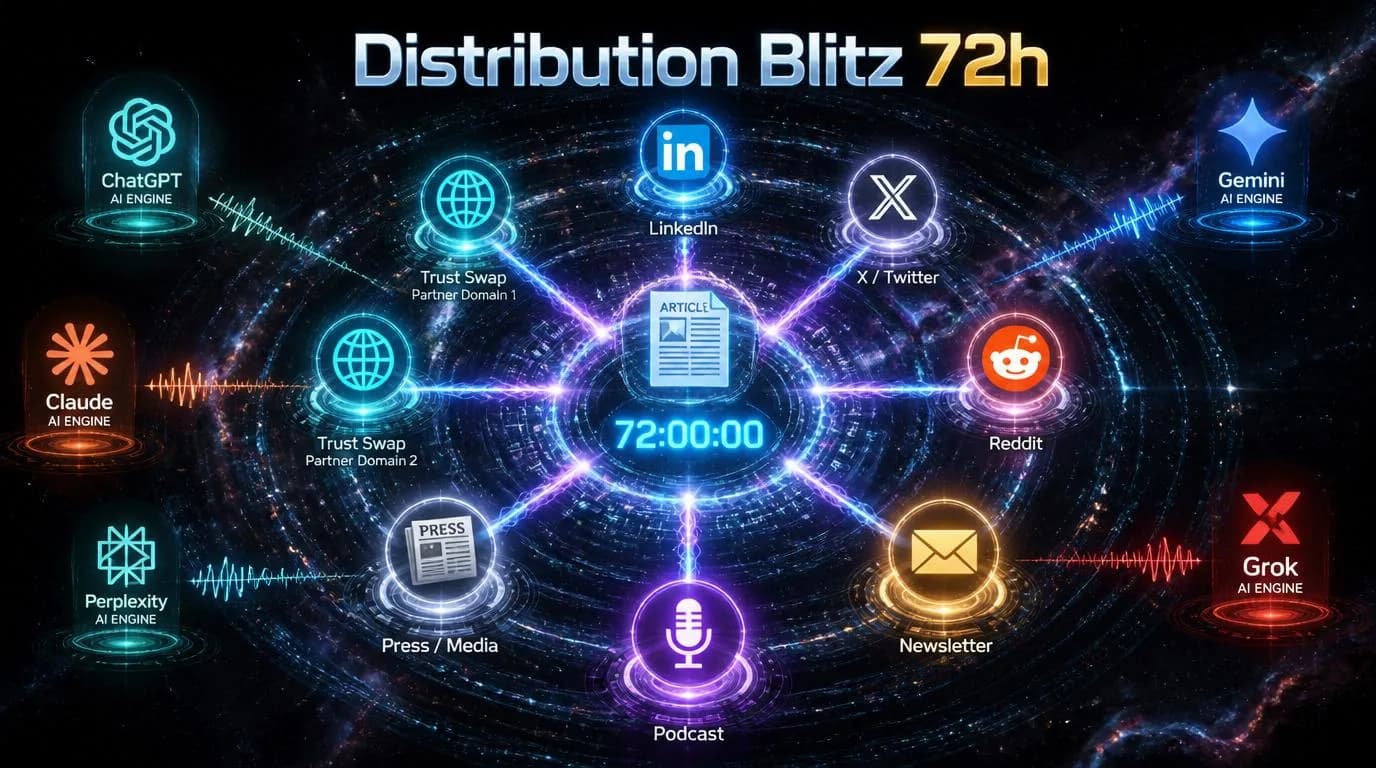
Updated: May 2026. Most content distribution is sequential — publish on Monday, post to LinkedIn on Wednesday, email the newsletter on Friday, pitch press the following week. That cadence reads as normal to AI engines and produces no amplification. The Distribution Blitz reverses this: all 6-8 touchpoints fire inside a tight 72-hour window, producing a synchronized signal burst that AI engines detect through their rising-sources surfaces and amplify into citation velocity.
This article documents the canonical Distribution Blitz playbook as Rankeo runs it. The 72-hour window correlates with the 24-72h rising-sources detection that ChatGPT, Perplexity, Gemini, Claude, and Grok run on fresh authority signals. Across Rankeo's own launches in 2026, Distribution Blitz consistently delivered 4-7x baseline citation velocity in launch week, with Citation Velocity Score peaks ranging from 2.7 to 4.1 — the latter measured during the AI Visibility Benchmark 2026 release with four Trust Swap partners coordinated inside the window.
Run a free Rankeo audit before your next launch
Before you blitz, verify your anchor is citation-ready. Rankeo audits the Chunk Test pass-rate, schema hygiene, and Entity Consistency Index — the three signals that decide whether your synchronized signal gets amplified or absorbed.
Run Free Audit →What Is the Distribution Blitz?
The Distribution Blitz is a 72-hour synchronized content distribution protocol that hits 6-8 touchpoints in a tight window to maximize AI engine velocity amplification. The pattern emerged from Rankeo's own launches in early 2026 and has been refined across nine sequential blitzes spanning research drops, methodology launches, product announcements, and contrarian takes. Every protocol step is measured against a single criterion: does it preserve or dilute the synchronized signal that AI engines detect inside the 24-72-hour rising-sources window.
Why sequential distribution fails in 2026
Spreading distribution over 7-14 days signals normal publishing cadence to AI engines and produces no amplification. The engines treat your content as routine output, the rising-sources detector never trips, and the velocity score stays flat at baseline. This is the default mode for most marketing teams in 2026 — and it explains why their cornerstone launches generate the same citation traffic as their weekly posts. Sequential drips dilute the velocity signal in two ways: each touchpoint fires alone without compounding the previous one, and the spread-out cadence teaches the engines that your domain is not currently in a fresh authority moment.
Why Distribution Blitz works
A blitz triggers Citation Velocity Score above 2.0 in the launch window, which is the threshold where rising-sources detection kicks in across ChatGPT, Perplexity, Gemini, Claude, and Grok. Above 2.0, the engines start treating your domain as a fresh authority and amplify retrieval — your content gets cited more frequently and named more often in answers about the topic. The amplification compounds with Trust Swap partners' coordinated boosts: each partner publishing inside the same 72h window adds a referring domain signal that lifts your domain's authority score in the engines' freshness model.
Sequential vs Distribution Blitz — the comparison
The clearest way to see the gap is to put both approaches side by side across the five dimensions that decide AI engine amplification. Distribution Blitz is more intense to prepare but produces a measurably stronger signal across every dimension that the engines reward.
| Dimension | Sequential Distribution | Distribution Blitz |
|---|---|---|
| Timeline | 2-14 days spread | 72 hours all-in |
| Signal to AI engines | Normal cadence — no amplification | Rising-sources detection → amplification |
| Effort | Lower per-day, longer overall | Concentrated burst, more intense prep |
| Citation Velocity lift | Marginal (CVS ~1.1-1.3) | Strong (CVS 2.0-4.1 measured) |
| ROI (AISoV lift 30d) | +0.5-1 pp typical | +1-5 pp typical |
In summary, sequential distribution treats AI engines as passive archives that index everything you publish at the same weight, while Distribution Blitz treats them as active amplifiers that reward synchronized signal density — and the measured gap in CVS peak between the two approaches is consistently 2x or more across every launch Rankeo has run in 2026.
The 8 Distribution Touchpoints
Distribution Blitz organizes around eight canonical touchpoints, each with a defined firing window inside the 72 hours. The sequence matters: anchor article first, then push channels in order of audience proximity (newsletter, then owned social), then community channels (Reddit), then earned channels (podcast, press, Trust Swap partners). A minimum-viable blitz fires six of the eight; a full blitz fires all eight; a partner-amplified blitz layers two to four Trust Swap partners on top of the eighth. The touchpoint ordering is what keeps the signal synchronized rather than scattered.
1. Anchor article (T+0h)
The anchor is the hero piece — long-form, definitive, and published on your own domain. The minimum bar is 3,000 words, schema-rich (Article + Person + Organization + FAQPage where applicable), and citation-ready with a Chunk Test pass-rate above 70%. This is the canonical version every other touchpoint links back to, so quality at T+0 determines the ceiling of the entire blitz. A weak anchor amplified loudly produces louder rejection signals, not louder approval — Trust Swap partners and press contacts notice thin work fast.
2. Newsletter (T+0h to T+4h)
Send to the full list within four hours of the anchor going live. The subject line should echo the anchor article framing so the engines see consistent terminology across both surfaces. A well-segmented newsletter produces 20-40% of the first 24-hour's traffic to the anchor and seeds the early backlink signal — readers who share the email forward it to colleagues, which generates inbound links from their domains during the same window.
3. LinkedIn (T+2h)
Founder or CEO post, not company page — personal accounts get 2-4x algorithmic reach on LinkedIn for the same content. The post should contain an excerpt, one fresh insight not in the article, and a clean link. Tag two or three relevant industry figures in the post to seed engagement inside the first hour, which is the signal LinkedIn's ranking model uses to decide whether to keep amplifying the post into broader feeds across the next 24 hours.
4. X / Twitter (T+4h)
Thread format, 8-12 tweets summarizing the key insights of the anchor. The final tweet carries the link — never the first one, because X downranks posts with outbound links in the opening tweet. Threads outperform single posts for cornerstone launches because they trigger longer dwell times, which amplifies recommendation across the discovery feed. A well-built thread from a launch can produce 5-15 secondary citations on its own, and the screenshots travel into LinkedIn carousels and Reddit threads for weeks after.
5. Reddit (T+8h to T+24h)
Submit to one or two vertical subreddits where your audience actually participates — generic subs produce no lift and risk moderator backlash. Post the content directly with a link to the anchor for full context. Reddit is the highest-leverage community channel because Perplexity weights Reddit threads at roughly 24% of its citation surface; see our Reddit AI citation playbook for vertical-specific subreddit selection and submission timing.
6. Podcast or video (T+12h to T+72h)
Pre-recorded podcast appearance or YouTube video on the same topic, dropped inside the window. Coordinate recording two to four weeks ahead so the publish date aligns with launch. Audio and video signals are weighted independently by some AI engines (Gemini in particular), so a podcast appearance inside the window adds a non-redundant signal to the synchronization that textual touchpoints cannot replicate on their own.
7. Earned media / industry press (T+24h to T+72h)
Pitch five to ten industry publications seven days before launch with a strict embargo lifted at T+24h. Aim for two or three secondary mentions inside the window. Earned media adds external domain authority to the synchronized signal and produces referring domains the engines treat as third-party validation — which clears the attribution threshold faster than self-published content alone ever does.
8. Trust Swap partners (T+24h to T+72h)
Coordinated cross-mentions from Trust Swap partners publishing inside the same 72h window. Two partners typically lift CVS peak by 30-50%; four partners produce the peak values measured in case studies below. See our Trust Swap strategy playbook for the multi-week partnership work required to have partners ready when a blitz fires. Partner coordination is the single largest amplification multiplier in the protocol.
In summary, the eight touchpoints stack into a single synchronized signal that AI engines read as "this domain is currently a fresh authority on this topic", and the order of firing matters as much as the touchpoint coverage — owned channels first, community channels middle, earned channels last.
The Hour-by-Hour 72h Timeline
The hour-by-hour timeline is the operational core of the playbook. Print the table below, share it with your launch team the week before fire-day, and assign owners for every line item. The blitz is composed of six phases — a 7-day preparation phase, the T+0 launch hour, and four post-launch waves — each with defined deliverables and timing.
Phase 1 — T-7d to T-1d: preparation
- Anchor article finalized — schema validated, FAQPage live, internal links ready to update at T+0
- All distribution assets queued — LinkedIn post draft, Twitter thread, Reddit submission, newsletter HTML
- Press pitches sent with a 7-day embargo to five to ten publications
- Trust Swap partners aligned on coordinated mentions — they get the anchor draft 48h ahead
- Podcast recording done; publish date set inside the window
Phase 2 — T+0 (launch hour)
- Anchor article goes live on the domain
- Newsletter sends to the full list within four hours
- IndexNow ping submitted for cross-engine fast indexing
- Internal links from existing high-traffic articles updated to point at the anchor
- Schema dateModified refreshed on three to five related pages
Phase 3 — T+0 to T+24h: Wave 1 (owned + community)
- T+2h — LinkedIn post from founder or CEO account
- T+4h — X / Twitter thread (8-12 tweets)
- T+8h — Reddit submission to one or two vertical subreddits
- T+12h — Respond to every LinkedIn and Twitter comment within an hour
- T+24h — Sweep: check IndexNow status, monitor early engagement, fix any broken links
Phase 4 — T+24h to T+48h: Wave 2 (earned)
- T+24h — Press embargo lifts; first two or three secondary mentions land
- T+24h to T+48h — Podcast or video drops inside the window
- T+36h — Trust Swap partners publish coordinated cross-mentions
- T+48h — Mid-blitz check: log CVS, named-citation rate, referring domains
Phase 5 — T+48h to T+72h: Wave 3 (repurpose)
- Snippet posts on LinkedIn — extract three or four insights into standalone posts
- Follow-up Twitter posts referencing the thread and adding new data
- Engagement deep-work: respond to every comment, DM, Reddit reply received in 48h
- Internal re-amplification — link the anchor from any new content shipping that week
Phase 6 — T+72h: close and measure
- Stop active blitz pushes — let organic momentum carry from here
- Begin 30-day measurement window (CVS, AISoV, brand mentions, backlinks, direct traffic)
- Schedule the next launch cadence; never blitz twice inside the same month
Summary table — every touchpoint, every hour
| Hour | Action | Channel |
|---|---|---|
| T-7d | Press pitches sent (embargo) | Earned |
| T-2d | Anchor draft to Trust Swap partners | Partner |
| T+0h | Anchor live + IndexNow ping | Owned |
| T+0-4h | Newsletter sends | Owned |
| T+2h | LinkedIn founder post | Social |
| T+4h | X / Twitter thread | Social |
| T+8h | Reddit submission | Community |
| T+12-72h | Podcast / video drops | Audio / Video |
| T+24h | Press embargo lifts | Earned |
| T+36h | Trust Swap cross-mentions | Partner |
| T+48-72h | Repurpose snippets + engage | Social |
| T+72h | Close blitz; measurement starts | All |
In summary, the timeline runs on owner accountability and clock discipline — every line has a name and a time, and the synchronized signal only forms when the team holds the clock rather than letting the timeline drift across days.
Run a free Rankeo audit before your next launch
Verify your anchor is ready to absorb the synchronized signal. Rankeo audits Chunk Test pass-rate, schema hygiene, and internal linking — the three signals that decide whether a blitz amplifies or fizzles.
Run Free Audit →4 Distribution Blitz Formats
Not every launch is the same. Distribution Blitz works across four distinct content formats, each with its own strength profile and risk surface. The format choice should match your editorial inventory — pick the format you can execute at the highest editorial bar inside the window, not the format that sounds the most ambitious in a planning doc.
Format 1 — Research drop
Anchor: original data study with specific numbers. Strengths: data-baiting effect plus named-citation magnetism — the engines cannot quote your numbers without citing your domain, and the numbers themselves become the keyword that anchors retrieval. An example is the "62% of brands get cited without being named" framing from our Ghost Citation Problem study — the percentage becomes the unit travelling through every AI answer for the topic, carrying brand attribution along with it.
Format 2 — Methodology launch
Anchor: definitional article for a proprietary term — Rankeo Chunk Test, Entity Consistency Index, Pressure SEO. Strengths: anchored terminology compounding with glossary linkage. The article ships alongside a fresh glossary entry, and the two cross-link to form a defensible knowledge graph node that engines treat as an authoritative source on the term. This format produces the longest tail — methodology articles compound for years because the term itself becomes the keyword.
Format 3 — Product announcement
Anchor: launch post for a new feature, tool, or release. Strengths: triggers Trust Swap endorsements and earned media coverage because journalists and partners have a clear story hook. Risk profile: lower than research drops because product news requires less editorial investment, but the citation half life is shorter — announcements lose freshness fast after the first 30 days, while methodology launches keep compounding through year-one and beyond.
Format 4 — Contrarian take
Anchor: well-reasoned dissent from industry consensus. Strengths: viral velocity on X and Reddit traction — contrarian framings produce the highest engagement rates per touchpoint of any format. Risk: requires solid data to back the contrarian position; a thin contrarian take produces backlash and damages credibility faster than any other format. The rule of thumb is that a contrarian blitz needs proprietary data behind it, not opinion — otherwise the engines and the audience both push back in unison.
In summary, research drops produce the highest CVS peaks, methodology launches produce the longest citation tails, product announcements produce the broadest earned-media coverage, and contrarian takes produce the highest engagement-per-impression — and the strongest editorial calendars rotate across all four formats over a year rather than locking into one.
Common Distribution Blitz Mistakes
Six failure modes recur across teams running their first or second blitz. Each one dilutes the synchronized signal in a predictable way, and each one has a mechanical fix. The diagnostic is to map your last launch against the six below and identify which two or three were dominant — those are the levers with the most upside on the next attempt.
Mistake 1 — Over-spreading the window
Mistake: extending the blitz to 7 days "to be thorough" or to fit a more comfortable team cadence. Fix: keep all eight touchpoints inside 72 hours. Synchronization is the mechanism; spreading the window past 72h reverts the launch into sequential mode and produces no amplification. If your team cannot fire eight touchpoints in 72h, fire six and skip the weakest two rather than stretching the window.
Mistake 2 — Skimping on anchor quality
Mistake: publishing a 1,500-word thin anchor and amplifying it anyway because the launch date was already calendared. Fix: the anchor must be 3,000+ words, schema-rich, and citation-ready — if it is not ready on launch day, postpone the launch by a week. A weak anchor amplified loudly produces louder rejection signals, not louder approval. Press contacts and Trust Swap partners notice thin work fast and remember it for the next pitch.
Mistake 3 — Solo mode (no Trust Swap)
Mistake: running the blitz without partner coordination because partner relationships felt like a separate workstream. Fix: even one or two Trust Swap partners doubles amplification. Build partnerships before you need them — the multi-week Trust Swap cycle has to start months before a launch, not the week of. A solo blitz still works, but at 50-70% of the CVS peak a partner-amplified blitz produces, which is a major opportunity cost on every launch run solo.
Mistake 4 — No embargo on press
Mistake: pitching press the day of launch and getting random publish times across the next week. Fix: send pitches seven days before with a strict embargo lifted at T+24h. Random press timing dilutes synchronization by adding earned-media signal outside the 72h window, where AI engines no longer count it toward rising-sources detection. Embargo discipline is the difference between earned media being a multiplier and earned media being a missed window.
Mistake 5 — Forgetting internal links
Mistake: publishing the anchor as an orphan with no inbound links from existing high-traffic content. Fix: at T+0, update three to five top-traffic articles to link to the anchor. The internal-link signal is one of the fastest ways AI engines attribute freshness — the engines re-crawl your top pages weekly, and finding new links to the anchor from those pages raises the anchor's authority score during the same window the external signal is firing.
Mistake 6 — No schema update
Mistake: shipping the anchor with schema validated weeks earlier and dateModified not refreshed on related pages. Fix: at T+0, ensure Article + dateModified + FAQPage (where applicable) are live on the anchor, and refresh dateModified on three to five related pages that link to the anchor. Schema freshness compounds with content freshness in the engines' ranking model — both signals together produce a stronger lift than either alone.
In summary, every one of the six mistakes dilutes the synchronized signal in a measurable way, and avoiding three or four of them on the next blitz is enough to lift CVS peak by 30-60% over a typical first attempt.
Measurement Framework — 30 Days Post-Blitz
The measurement window opens at T+72h and runs for 30 days. Five metrics decide whether the blitz succeeded, and the rule of thumb is that three of five must hit their targets for the launch to be considered a hit. Below-target on three or more means the next blitz should adjust on anchor quality, partner coordination, or touchpoint coverage — those are the three levers that move the most metrics at once.
Metric 1 — Citation Velocity (days 0-30)
Target: CVS above 2.0 sustained for 14 days. If CVS stays below 1.5 across the measurement window, the blitz underperformed materially. CVS is the primary metric because it directly measures whether the AI engines amplified your launch — every other metric downstream depends on this one. The Rankeo dashboard surfaces daily CVS readings across all five engines, which is how launch teams catch under-performance inside the first week rather than waiting 30 days to know.
Metric 2 — AISoV lift
Target: +1-3 percentage points by day 30. Major launches — research drops and methodology launches with full Trust Swap partner coverage — can produce +3-5 pp gains. AISoV (AI Share of Voice) is the macro outcome that compounds across quarters: every blitz that lifts AISoV by 2 pp moves your domain a meaningful step up the visibility ladder for the topic, and the gains stack across launches.
Metric 3 — Brand mention surge
Target: 3-7x baseline named-mention rate across all five AI engines in the launch week. The surge is the early signal that the rising-sources detector tripped — if mentions in launch week stay flat at baseline, the synchronization failed and CVS will confirm it within a few days. Track daily, not weekly, during the launch window so the team can intervene if the surge does not materialize in the first 24-48 hours.
Metric 4 — Backlinks
Target: 8-15 new referring domains in 30 days. Backlinks lag citations by one to two weeks because referring-domain detection runs on slower crawl cadences than AI-answer surfaces, so most of the 8-15 land in week 2-4 rather than week 1. Trust Swap partners contribute predictable referring domains; earned media contributes one to three additional domains per publication that ran the embargoed coverage.
Metric 5 — Direct and branded search
Target: +15-30% direct traffic in week 1, plus +5-15% branded search lift in month 1. Direct and branded search are the downstream signals that the audience moved from passive impression to active recall — the user saw your brand named in an AI answer, in a newsletter, on LinkedIn, and on Reddit inside the same week, and the cumulative exposure pushed them to search you by name. This metric closes the loop from synchronized signal to lasting brand recognition.
In summary, three of five metrics hitting their targets defines a successful blitz; five of five defines an exceptional one; below three triggers a postmortem on anchor quality and partner coordination before the next launch goes on the calendar.
3 Rankeo Distribution Blitz Case Studies
Three Rankeo launches from 2026 illustrate the protocol across different formats and partner coverage levels. Each case shows the anchor article, the touchpoint count fired, the CVS peak measured, and the 30-day AISoV lift — the four data points that define a blitz outcome.
Case 1 — Pressure SEO launch (March 2026)
Anchor: the Pressure SEO methodology article on the Rankeo blog. Format: methodology launch. Touchpoints fired: 7 of 8 (no podcast inside the window). Trust Swap partners: 1. CVS peak: 3.4 in launch week, sustained above 2.0 for 18 days post-launch. AISoV lift: +4.2 percentage points across the 30-day measurement window. The Pressure SEO launch validated the protocol for the first time — it was the first Rankeo launch where all touchpoints were intentionally synchronized inside 72 hours rather than scattered across two weeks.
Case 2 — Citation Velocity Score launch (April 2026)
Anchor: the Citation Velocity Score complete guide. Format: methodology launch (proprietary metric). Touchpoints fired: 8 of 8 (full blitz). Trust Swap partners: 2. CVS peak: 2.7 in launch week. Backlinks earned: 19 new referring domains in 30 days, well above the 8-15 target band. The CVS launch is the canonical example of a methodology blitz — the metric name itself became the keyword anchoring retrieval across all five AI engines, and the 19 referring domains compounded into a long-tail citation flow that is still producing weekly named mentions four months later.
Case 3 — AI Visibility Benchmark 2026 (March 2026)
Anchor: the AI Visibility Benchmark 2026 research drop. Format: research drop with 500+ sites studied. Touchpoints fired: 8 of 8 plus 4 Trust Swap partners coordinated. CVS peak: 4.1 — the highest Rankeo has measured across any launch to date. AISoV lift: +5.7 percentage points for Rankeo, plus +2-3 pp lift for each Trust Swap partner publishing inside the window. The Benchmark launch is the canonical example of a partner-amplified research drop and the upper-bound reference for what a Distribution Blitz can produce when every protocol step is executed at quality.
In summary, the three cases sweep the range — CVS 2.7 to 4.1, AISoV +4.2 to +5.7 pp, partner counts from 1 to 4 — and they collectively define the expected outcome envelope for a Rankeo blitz: anything inside this envelope is a hit, and anything below CVS 2.0 with under +1 pp AISoV warrants a postmortem.
Track Distribution Blitz with Rankeo
Rankeo measures Citation Velocity Score, AISoV lift, and named-citation rate across all 5 AI engines — the metrics that decide whether a blitz amplified or fizzled. Stop guessing whether your synchronized launch actually moved the needle.
See Rankeo Plans →When NOT to Run a Distribution Blitz
Distribution Blitz is not always the right call. Five conditions make a blitz a bad idea, and recognizing them in advance prevents wasted editorial labor and damaged partner relationships. The honest answer to "should we blitz?" is no more often than most teams expect — usually one launch in three meets the conditions for a full blitz.
Anchor not strong enough
A 2,000-word fluff piece does not deserve a blitz. Amplifying a weak anchor wastes the synchronized signal on undeserving content and damages credibility with the audience and Trust Swap partners. The rule is: if the anchor cannot stand alone as a cornerstone reference for the topic, postpone the launch and upgrade the article before scheduling the blitz date.
No Trust Swap partners
A solo blitz still works, but at 50-70% of the peak a partner-amplified blitz produces. If you have zero Trust Swap partners aligned, the higher-ROI move is to spend the next quarter building partnerships and run the blitz against the next anchor with two to four partners coordinated — the gap in outcome is large enough to justify a one-quarter delay.
Schema hygiene issues
Fix Entity Consistency Index before blitzing. Fragmented entities — inconsistent NAP, missing sameAs coverage, broken @id references — do not amplify, because the engines cannot resolve the entity reliably enough to weight the rising-sources signal. ECI above 80 is the threshold for clean amplification; below 80, the synchronized signal gets absorbed without producing CVS lift.
Audience burnout
Do not run blitzes more than once a month. Running blitzes weekly or bi-weekly exhausts the audience, dilutes signal freshness across the engines, and burns Trust Swap partner goodwill — partners do not want to publish for you every two weeks. The compounding effect happens between blitzes, when CVS sustains above 1.5 organically thanks to the residual signal from the previous launch.
Off-cycle industry timing
Avoid major holidays, large industry events, and known news cycles that crowd attention. A blitz that lands during a major conference week, a national holiday, or a competing major product launch absorbs the attention drain and produces 30-50% lower CVS peaks than the same blitz would land in a quieter week. Calendar quietly; the timing alone is worth one of the five measurement targets.
In summary, five conditions reliably argue against a blitz — weak anchor, no partners, ECI under 80, audience fatigue, and crowded calendar — and the disciplined launch teams say no to two out of three planned blitzes for one or more of these reasons, then concentrate effort on the one launch that meets every condition for amplification.
Get your free SEO + GEO audit
Rankeo measures your Citation Velocity Score, Entity Consistency Index, and AISoV across all 5 AI engines — everything you need to decide whether your next launch is ready to blitz, and which lever to pull first if it is not.
Run Free Audit →FAQ
Frequently Asked Questions

Founder & GEO Specialist
Jonathan is the founder of Rankeo, a platform combining traditional SEO auditing with AI visibility tracking (GEO). He has personally audited 500+ websites for AI citation readiness and developed the Rankeo Authority Score — a composite metric that includes AI visibility alongside traditional SEO signals. His research on how ChatGPT, Perplexity, and Gemini cite websites has been used by SEO agencies across Europe.
- ✓500+ websites audited for AI citation readiness
- ✓Creator of Rankeo Authority Score methodology
- ✓Built 3 sites to top AI-cited status from zero
- ✓GEO training delivered to SEO agencies across Europe