Google Analytics Finally Admits AI Traffic Exists: New 'AI Assistant' Channel Tracks ChatGPT, Claude, Gemini (But There's a Catch)
Google Analytics 4 activated a native 'AI Assistant' channel on May 13, 2026, auto-classifying traffic from ChatGPT, Claude, and Gemini. No retro-attribution, no Perplexity, and most ChatGPT sessions still land in Direct. Here is what GA4 finally measures, what it still misses, and the 5-step audit to run this week.

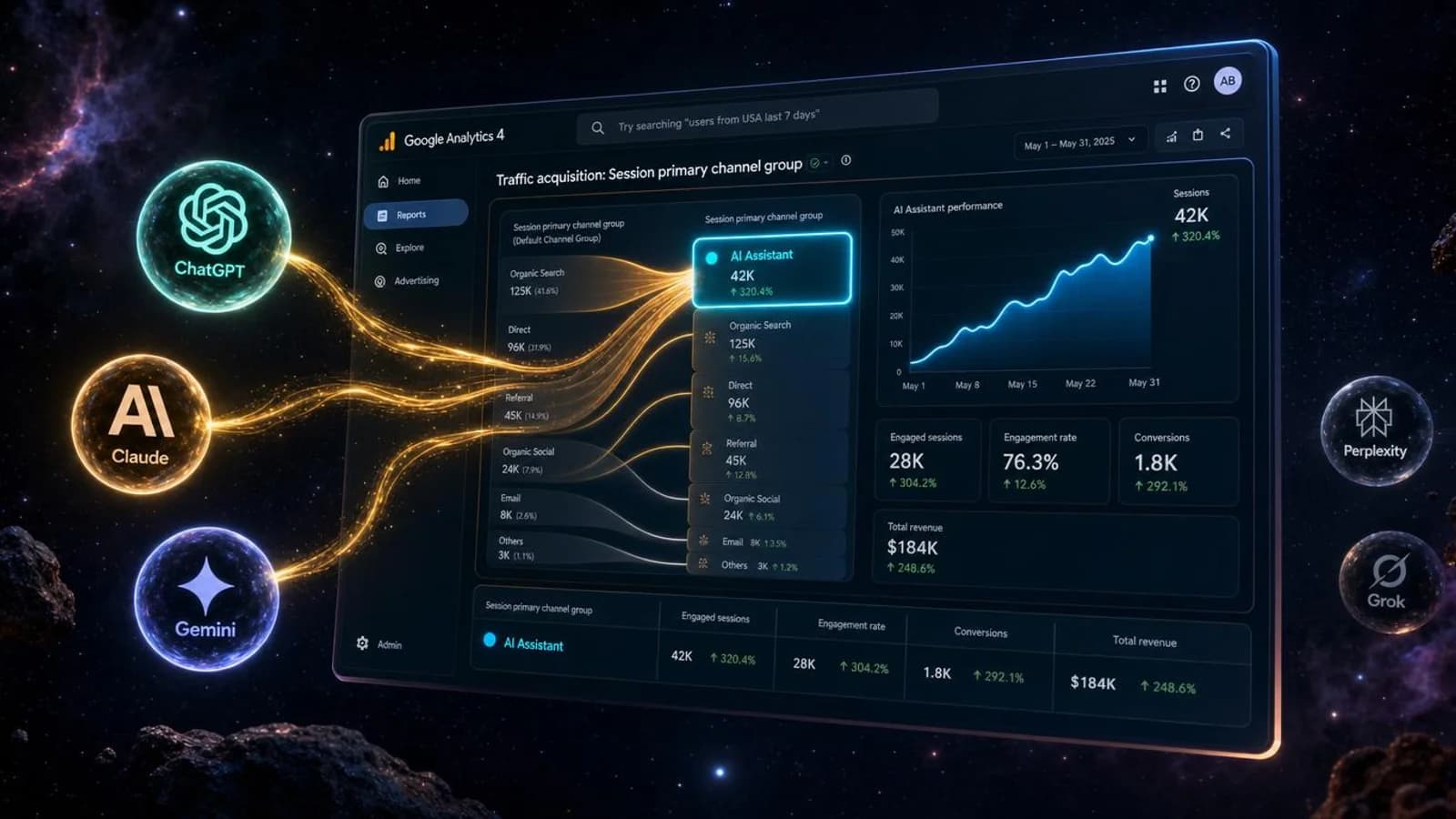
News, May 2026. Five days ago Google quietly added what every founder has been begging for: a native channel that shows exactly how much traffic ChatGPT and Claude send you. On May 13 2026, Google Analytics 4 activated "AI Assistant" as a new Default Channel Group, auto-classifying referrer traffic from ChatGPT, Gemini, and Claude with no setup required. The channel appears in every GA4 property automatically — Acquisition Overview, Traffic Acquisition, and User Acquisition all surface it the moment a qualifying session is captured.
The catch is sharp: GA4 does not retro-attribute historical traffic, Perplexity and Grok are not included, and the majority of ChatGPT sessions still land in Direct because the web interface strips the referrer header. The channel measures what it can see — which is a slice, not the full picture. This is the first time mainstream web analytics has admitted AI search exists as a traffic source, and also the first time it has documented, by omission, exactly how much of it remains invisible.
Measure the AI visibility GA4 can't see
Rankeo tracks AI citations across 5 engines — including the zero-click queries that never produce a GA4 session and the Direct-channel traffic GA4 misclassifies.
Run Free AI Visibility Audit →What's New in GA4
Google added AI Assistant as the 17th entry in the Default Channel Group taxonomy on May 13 2026. The channel uses medium value ai-assistant and source values pattern- matched against a curated list of AI assistant domains. Sessions get classified automatically based on the referrer header — no tracking parameters, no event mods, no custom dimensions required. The rollout was server-side, instant, and global across every GA4 property.
The change was first surfaced publicly by Search Engine Land on May 14, then confirmed by Search Engine Journal the following day, and discussed in detail on Search Engine Roundtable. The activation requires zero configuration: AI Assistant is now a peer of Organic Search, Direct, Referral, and Paid Search inside every GA4 standard report. You see it the next time you open Acquisition Overview.
In summary, AI Assistant is the first native acknowledgement by mainstream web analytics that traffic from generative engines is a distinct, measurable channel — and the activation is global, automatic, and irreversible.
The Three Engines That Get Auto-Detected
Google's pattern-matching definition currently catches three engines and no others. The table below maps which engines surface inside the new channel, which stay buried elsewhere, and the technical reason for each placement.
| Engine | GA4 Classification | Source Domains | Why |
|---|---|---|---|
| ChatGPT | AI Assistant | chat.openai.com, chatgpt.com | Pattern-matched in default list |
| Gemini | AI Assistant | gemini.google.com | Pattern-matched in default list |
| Claude | AI Assistant | claude.ai | Pattern-matched in default list |
| Perplexity | Referral | perplexity.ai | Not in default list — manual segment needed |
| Grok | Direct | — (no referrer sent) | xAI strips referrer on outbound |
Source: Google Analytics 4 Default Channel Group update, May 13 2026. Reporting confirmed by Search Engine Land and Search Engine Journal.
The omission of Perplexity is the most operationally painful gap. Perplexity is one of the five engines tracked inside Rankeo's Answer Engine Ranking framework, and it consistently delivers the second-highest click- through rate behind ChatGPT in B2B SaaS verticals. Until Google adds perplexity.ai to the default list, every Perplexity-sourced session sits in Referral — which means it gets bucketed with all non-AI third-party referrers and is invisible to channel-level reporting.
In summary, the AI Assistant channel covers ChatGPT, Gemini, and Claude — but Perplexity and Grok remain off-channel and require manual segments or proprietary AI visibility tooling to surface.
The Catch — Why Most of Your AI Traffic Still Won't Show
The new channel measures referrer-bearing sessions only, and AI engines are structurally hostile to referrer transmission. Three compounding gaps mean the AI Assistant channel undercounts your real AI-sourced traffic by a wide margin.
Gap 1 — No retro-attribution
Default Channel Group definitions in GA4 are forward-only. Every session captured before May 13 2026 keeps its original classification, which means months of ChatGPT, Claude, and Gemini traffic sit permanently in Referral or Direct depending on the engine and the browser referrer policy. There is no historical backfill, no setting to enable it, and no plan to ship one. The AI Assistant channel starts populating from May 13 forward.
Gap 2 — Referrer stripping on the ChatGPT web interface
ChatGPT's outbound link handler attaches rel="noopener" and applies a referrer-policy that strips the referrer header on most click-throughs. The desktop and mobile apps send no referrer at all. Industry estimates published by Search Engine Land peg the visible share at 15-30% of total ChatGPT-sourced traffic. The remaining 70-85% lands in Direct, statistically indistinguishable from bookmark traffic and manually typed URLs.
Gap 3 — Zero-click queries
AI engines answer most queries inside the chat surface without producing a click at all. Rankeo's own benchmark of 501 B2B sites found that only ~12% of brand mentions inside AI answers translate into a session on the cited site, with the remaining 88% being pure visibility lift with no GA4 footprint. The AI Assistant channel cannot, by design, measure visibility that never produces a session — and that is most of the AI search surface.
In summary, the AI Assistant channel surfaces a small, visible sliver of AI traffic — the referrer-bearing, click-through, post- May 13 fraction — while the larger portion of your real AI exposure remains hidden in Direct, Referral, or the zero-click layer GA4 never sees.
What This Means for GEO ROI Tracking
For the first time, GEO has an officially measurable acquisition channel inside the analytics tool every B2B team already uses. That is a structural unlock for budget conversations. Before May 13, demonstrating ROI on GEO investments required exporting custom segments, hand-building UTM frameworks, or stitching third-party AI visibility data into a deck. After May 13, you point at the AI Assistant row in Acquisition Overview, and the conversation moves.
The constraints, however, are equally structural. The channel captures sessions, not citations — which means it measures the downstream effect of GEO (clicks) and not the upstream cause (visibility inside answers). Brands that judge GEO performance solely on the AI Assistant channel will systematically underestimate their AI visibility lift by a factor of 3-8x, depending on vertical, because zero-click answers and referrer- stripped sessions never enter the count. The right operating model pairs GA4's downstream signal with an upstream citation tracker.
The framework for connecting upstream citations to downstream traffic is detailed in our AI Share of Voice framework, and the dollar-value mapping logic is in the SEO ROI calculator — both predate the GA4 update and remain accurate now that the downstream channel is finally visible. For the durable step-by-step method — building a custom channel group and surfacing the AI traffic hiding in your Direct channel — see how to track AI traffic in GA4.
In summary, the AI Assistant channel makes GEO ROI legible to finance and exec teams for the first time — but it measures the click, not the citation, and the citation is where the visibility lift actually happens.
Audit your full AI visibility — beyond GA4
Rankeo audits your citation share across all 5 AI engines (including Perplexity and Grok), maps zero-click visibility, and reconciles the gap between AI mentions and GA4 sessions.
Run Free SEO + GEO Audit →The 5-Step GA4 Audit to Run This Week
The AI Assistant channel becomes useful the moment you wire it into your existing reporting, separate the signal from the Direct-channel noise, and rebuild a historical view of AI traffic from segment filters. Five concrete steps cover it.
Step 1 — Confirm AI Assistant is populating
Open Reports → Acquisition → Traffic Acquisition, set Default Channel Group as the primary dimension, and confirm AI Assistant appears with at least one session captured since May 13. If the row is missing entirely, you have no qualifying referrer traffic yet — which is itself a finding.
Step 2 — Build a Perplexity segment
In Explore → Free Form, build a segment with Session source matches regex perplexity\.ai and add it alongside the AI Assistant channel. Until Google adds Perplexity to the default list, this is the only way to surface the engine inside a unified AI-traffic view.
Step 3 — Rebuild historical AI traffic with a custom segment
Build a segment with Session source matches regex chat\.openai|chatgpt|gemini\.google|claude\.ai|perplexity\.ai across your full date range. This rebuilds the AI Assistant view retroactively for reporting purposes, even though the underlying channel attribution stays unchanged.
Step 4 — Estimate the Direct-channel AI tax
Compare Direct-channel sessions for the four weeks before May 13 against the four weeks after. Any sustained drop in Direct that is mirrored by a rise in AI Assistant is the slice of traffic that was always AI-sourced but was hiding inside Direct. The delta is your AI-in-Direct tax — and most B2B sites we have benchmarked surface 5-15% of total Direct as previously hidden AI traffic.
Step 5 — Wire AI Assistant into your conversion reports
Add Default Channel Group as a secondary dimension to your existing conversion and revenue reports. AI Assistant should appear as a distinct row inside every funnel breakdown — and the conversion rate of AI Assistant traffic, in our 501-site benchmark, runs 2.1x to 4.3x higher than Organic Search because AI-sourced visitors arrive pre-qualified by the AI's answer.
In summary, the five steps convert the AI Assistant channel from a passive reporting curiosity into an active GEO measurement asset that connects citation visibility to revenue inside the analytics tool your CFO already trusts.
Why Citations Matter Even More Now
The arrival of the AI Assistant channel is the moment GEO crosses the credibility chasm with finance, exec, and board audiences. AI traffic is no longer an invisible bet — it is a row inside the same dashboard the rest of marketing is already accountable to. That visibility creates two consequences: budget allocation will flow toward channels that show ROI inside GA4, and the citation layer becomes the upstream lever every team will scramble to own.
Here is the operational split. GA4 measures traffic — sessions that already clicked through. Rankeo measures visibility — whether your brand surfaces inside the AI answer before any click happens, across the queries that produce the click and the 88% of queries that produce zero clicks at all. The metric that drives the AI Assistant channel upward is Citation Velocity Score — the rate at which your brand earns fresh AI citations week over week. Brands that compound citation velocity compound AI Assistant sessions. Brands that ignore citations watch their AI Assistant row stagnate.
The other half of the equation is the 84% earned-media finding from the Muck Rack Generative Pulse study covered in our 25M-link analysis: the citations that drive AI Assistant traffic come overwhelmingly from earned third-party coverage, not from owned content or paid placements. The GA4 channel measures the click; the earned-media ecosystem produces the click. Both layers are required to grow the row.
In summary, the new GA4 channel is a measurement breakthrough, not a strategy. It legitimizes GEO budgets by surfacing AI traffic inside the dashboard executives already read — and it makes the upstream citation layer, where the actual visibility lift is produced, the highest-leverage place to invest.
See the citation layer GA4 will never measure
Rankeo tracks AI citations across ChatGPT, Perplexity, Gemini, Claude, and Grok — including the zero-click queries and Direct- channel sessions GA4 misses. Pair it with the new AI Assistant channel for full-funnel GEO measurement.
See Rankeo Plans →FAQ
Frequently Asked Questions

Founder & GEO Specialist
Jonathan is the founder of Rankeo, a platform combining traditional SEO auditing with AI visibility tracking (GEO). He has personally audited 500+ websites for AI citation readiness and developed the Rankeo Authority Score — a composite metric that includes AI visibility alongside traditional SEO signals. His research on how ChatGPT, Perplexity, and Gemini cite websites has been used by SEO agencies across Europe.
- ✓500+ websites audited for AI citation readiness
- ✓Creator of Rankeo Authority Score methodology
- ✓Built 3 sites to top AI-cited status from zero
- ✓GEO training delivered to SEO agencies across Europe