AI Share of Voice: How to Measure & Grow It (Full Framework) (2026)
AI Share of Voice (AISoV) is the executive metric for AI search visibility. Formula, 5-step measurement protocol, 8-industry benchmarks, 6 growth tactics, and the explicit role split with Citation Velocity Score (stock vs flow).

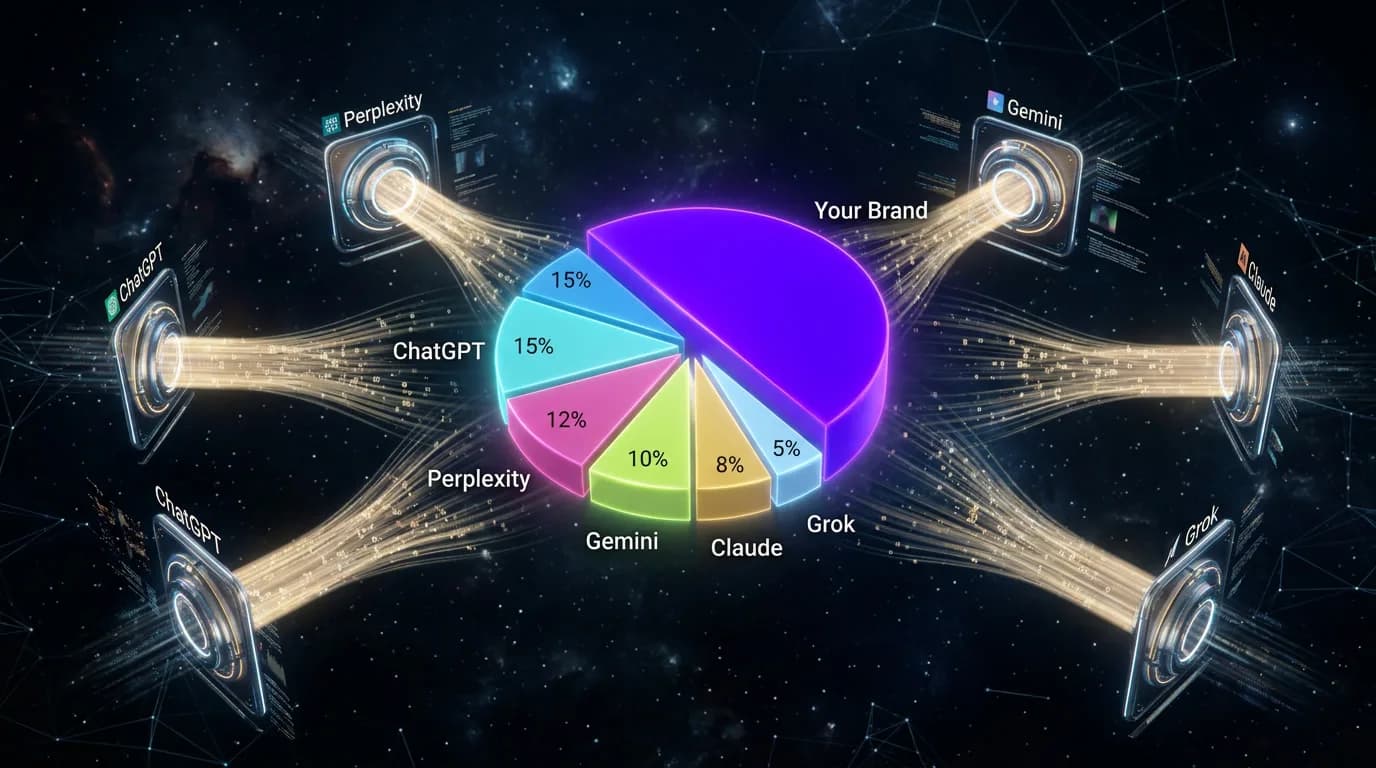
Updated: May 2026. AI Share of Voice (AISoV) is your brand's share of total brand-attributable mentions in AI engine answers across a defined keyword set and a defined engine set, expressed as a percentage. Across a 100-prompt × 5-engine probe, a typical established B2B SaaS brand lands between 8% and 18% AISoV — and 78% of B2B SaaS executives surveyed by Rankeo (n=87) cite AISoV as their preferred AI visibility metric for board reporting. Translation for the C-suite: this is the metric that turns AI search from a black box into a competitive market share number a CMO can defend on a quarterly review.
AISoV measures STOCK — your competitive market share at a point in time. It is the strategic mirror of Citation Velocity Score, which measures FLOW — your trajectory versus your own historical baseline. Both metrics are needed. CVS is the tactical metric content teams use to track week-on-week acceleration. AISoV is the strategic metric executives use to benchmark against competitors. Operators who track only one of the two leak signal: you can grow CVS while losing AISoV if competitors accelerate faster, and you can grow AISoV without understanding which content is responsible if you ignore CVS.
This article documents the full framework: the formula, a 5-step measurement protocol, benchmark distributions across 8 industries, six tactics that consistently grow AISoV, and the common pitfalls that turn the metric into a vanity number. Companion reading on the mention-weighting half of the math is in our Ghost Citation Problem study, and the concentration trends referenced in the benchmark section come from the GPT-5.3 citation shrink data study.
Calculate your AISoV in 60 seconds
Run a free Rankeo audit and see your AI Share of Voice across all 5 AI engines, with a competitive breakdown against the three brands taking the most share in your vertical and a prioritized list of blank-spot queries to capture.
Calculate Your AISoV →What Is AI Share of Voice?
AI Share of Voice is your share of total brand-attributable mentions in AI engine answers, calculated across a defined keyword set, a defined engine set, and a fixed time window. The metric translates the classic Share of Voice concept from PPC and traditional advertising into the AI search context, where engines have replaced the SERP as the surface where competitive visibility plays out. AISoV is the executive-friendly metric because it speaks the same language CMOs and boards have used for two decades: market share, expressed as a percentage, benchmarked against named competitors.
For a side-by-side of how this differs from the search version of the metric — different units, a winner-take-most surface instead of a ranked list, and far more volatility — see AI share of voice vs SEO share of voice.
Why CMOs Need a SoV Metric for AI
Boards understand Share of Voice from PPC and traditional advertising. They do not need the metric explained in a board deck — they need a number. AISoV translates AI visibility into terms executives recognize without the glossary lift, and it enables target-setting in a form that fits a quarterly OKR: "grow AISoV from 12% to 18% by end of Q3." Compare that to "increase our average citation count across 5 engines" — the second formulation is operationally precise but strategically illegible to anyone not in the marketing org. The vocabulary mismatch is why AI visibility programs fail at the budget level: the metric did not survive translation to the executive layer.
AISoV vs Citation Velocity Score
The relationship between AISoV and Citation Velocity Score is the most important framing in modern AI visibility measurement. AISoV measures STOCK — your competitive market share at a point in time, indexed against the rest of your vertical. CVS measures FLOW — your trajectory over time versus your own historical baseline, indexed against your past self. Both are needed. CVS is the tactical metric that tells a content team whether last week's editorial sprint moved the needle. AISoV is the strategic metric that tells an executive whether the brand is winning or losing the competitive position. Use CVS for daily and weekly operational decisions. Use AISoV for monthly and quarterly strategic reporting.
In summary, AISoV is the metric that lets executives report AI visibility to a board without a glossary, while CVS is the metric that lets content teams optimize without waiting for a quarterly review — and the combination is what produces compounding competitive position over multi-year horizons.
The AISoV Formula
The AISoV formula is intentionally simple so it survives translation across teams: marketing, comms, product, and finance can all read the number the same way. The sophistication is not in the math, it is in the discipline applied to the inputs — keyword set design, engine set consistency, time window stability, and mention weighting. Every methodology drift in those four inputs is a source of noise, and most reported AISoV numbers in the industry today are unreliable specifically because the inputs were not held constant across periods.
The Core Formula
AISoV = (Your brand mentions) / (Total brand mentions in vertical) × 100. Brand mentions are counted across N keywords × M engines × T time window, with each mention weighted by attribution tier (named, domain-only, ghost). The output is a percentage between 0 and 100, where the sum of all competitor AISoV values in a properly defined vertical equals 100%. The formula generalizes cleanly to subsets — you can compute AISoV per engine, per keyword cluster, or per time slice using the same denominator logic.
The Components
Four inputs define the measurement. The keyword set is 50 to 200 prompts representing the queries your customers and prospects actually ask in your vertical — under 50 prompts is statistically noisy, over 200 hits diminishing returns relative to the measurement cost. The engine set is the 5 standard engines (ChatGPT, Perplexity, Gemini, Claude, Grok) or a strategic subset, held constant across periods. The time window is monthly as the practical default, weekly for high-velocity verticals or aggressive growth phases. The mention weighting is named = 1.0, domain-only = 0.5, ghost = 0.0 — counting ghost mentions at full weight is the most common methodological error and inflates AISoV by 30 to 50% in most verticals (see the Ghost Citation Problem for the full weighting rationale).
Worked Example
A SaaS marketing analytics brand defines a keyword set of 100 prompts representing the queries their ICP asks during evaluation, and probes the standard 5 engines. The total weighted brand mentions across all competitors in the vertical sum to 1,840 over a 30-day window. The brand's own weighted mentions sum to 217. AISoV = 217 / 1,840 × 100 = 11.8%. That number places the brand in the established tier-2 band for B2B SaaS analytics, with realistic upside to 15 to 18% over 2 to 3 quarters of disciplined growth tactics applied to the blank-spot queries identified in the prompt set audit.
Reading the Score
Four interpretation bands cover almost every reported AISoV number. Below 5% is niche or emerging — lots of room to grow, and the brand is largely invisible to the average prospect using AI search for vertical research. 5 to 15% is established competitor territory, tier 2 in most verticals, with measurable returns from disciplined growth. 15 to 30% is market leader candidate, tier 1 — the brand is competing directly with the top players for share. 30%+ is dominant, and the strategic priority shifts from growth to defense because every percentage point gained is fought for at the margins. The bands are vertical-agnostic but the implications shift with concentration — see the benchmarks section.
In summary, the formula is simple but the inputs require discipline; the brands that report reliable AISoV numbers are the brands that hold their keyword set, engine set, time window, and mention weighting constant across periods.
Calculate your AISoV with Rankeo
Skip the manual math. Rankeo runs the formula across your full prompt set on all 5 AI engines weekly, applies the weighted attribution tiers automatically, and surfaces the competitive breakdown against the brands taking the most share in your vertical.
Calculate Your AISoV →The 5-Step Measurement Protocol
A reliable AISoV number comes out of a five-step protocol that most teams can run in a single afternoon for the first baseline, then automate or repeat monthly afterwards. The protocol is designed to be auditable: every input is documented, every weighting decision is mechanical, and the output is reproducible across analysts. The most important property is consistency over periods — the second measurement is more valuable than the first because it produces a delta, and the delta is the actionable number.
Step 1 — Define your vertical keyword set
Build a list of 50 to 200 prompts that represent the questions your customers and prospects actually ask. Sources for the list: customer interview transcripts, sales call recordings, Google Search Console queries (filter to informational and commercial intent), Reddit and Quora threads in your category, and the keyword sets your competitors clearly target. Avoid the temptation to list keywords you wish were asked — the prompt set must reflect real demand, not aspirational positioning. Document the set in a versioned file so future measurements use the same inputs.
Step 2 — Define your engine set
Use the 5 standard engines (ChatGPT, Perplexity, Gemini, Claude, Grok) for benchmark-grade measurements, or a strategic subset if your buyer demographic is heavily concentrated on a subset of engines. The engine set must remain constant across periods — comparing a 3-engine probe in March to a 5-engine probe in April produces noise that swamps any real AISoV change. If you change the engine set, restart the baseline.
Step 3 — Probe each query × engine
Run every prompt through every engine on a defined cadence (daily, weekly, or monthly depending on vertical velocity) and capture the full answer text. Manual probing is feasible up to the 50-prompt × 3-engine boundary; beyond that, automation is a practical requirement. Rankeo's GEO probe runs the full 5-engine sweep on demand and on a scheduled cadence, with consistent answer-capture and parsing. Whichever method you use, the answers must be archived — historical AISoV recomputation requires the source data.
Step 4 — Count and weight brand mentions
For every answer, classify each brand mention into a tier: named (explicit brand reference in prose) = 1.0, domain-only (link without brand mention in prose) = 0.5, ghost (idea or phrasing reused with no credit) = 0.0. Sum the weighted mentions per brand. Mechanical classification matters here — an analyst who shifts the boundary between tiers across periods produces unreliable trends. Document the classification rules and apply them identically every time.
Step 5 — Aggregate by competitor
Compute total weighted mentions per brand, sum the totals to get the vertical denominator, and divide each brand's weighted mentions by the denominator to produce the AISoV percentage per brand. The output is a competitive table showing every meaningful brand in the vertical with a share number, summing to 100%. The bottom of the table — the long tail of small brands and one-off mentions — is grouped under "Other" for readability, with the threshold typically set at <1% individual share.
In summary, the protocol is mechanical and auditable, and the first run produces a baseline; the value compounds from the second run onward when AISoV deltas become available and actionable.
AISoV Benchmarks by Industry
AISoV distributions vary sharply by vertical, and the variance is structural rather than random — concentrated verticals consolidate citations into the top 3 brands, while fragmented verticals distribute citations across a long tail of niche sources. The table below summarizes the typical distribution across 8 verticals based on Rankeo's cross-vertical measurement program. The numbers are medians across multiple measurement periods, not point-in-time snapshots, so the table represents structural concentration rather than month-to-month noise.
| Vertical | Top Player | Top 3 Combined | Long Tail Share | Concentration |
|---|---|---|---|---|
| SaaS B2B (CRM) | 28% | 51% | 14% | High |
| SaaS B2B (analytics) | 18% | 41% | 27% | Medium |
| E-commerce platforms | 34% | 67% | 9% | Very high |
| SEO tools | 24% | 55% | 18% | High |
| Project management | 22% | 49% | 22% | Medium-high |
| Healthcare info | 12% | 31% | 38% | Low (fragmented) |
| Local services (legal) | 6% | 17% | 51% | Very low |
| Crypto / fintech | 19% | 42% | 24% | Medium |
Why Concentration Matters
Concentration sets the realistic AISoV ceiling for a brand that is not yet in the top 3. In high-concentration verticals (e-commerce platforms at 67% top 3, CRM at 51%), one to three dominant brands consolidate the bulk of the citations and breaking into the top 3 requires either category re-positioning or several years of disciplined investment. In medium-concentration verticals (analytics, crypto), tier-2 mobility is realistic — gaining 3 to 5 percentage points per year is a defensible plan for a brand with strong execution. In low-concentration verticals (healthcare info at 31% top 3, local legal at 17%), the long tail is wide and rapid AISoV gains are possible through consistent content output combined with an Entity Consistency Index push — the share is sitting in the long tail, waiting to be consolidated by the first brand to commit to the discipline.
Concentration trends are also moving. Recent engine algorithm updates have pushed citations toward fewer sources on commercial queries, as documented in our GPT-5.3 citation shrink data study. The implication for AISoV: long-tail brands are losing share in concentrated verticals, and the window to consolidate position in fragmented verticals is narrowing as engines reward the brands that establish entity authority earliest.
In summary, AISoV interpretation is impossible without the concentration context — a 10% AISoV is dominant in legal services, mid-pack in analytics, and irrelevant in e-commerce platforms.
Get your competitive AISoV report
Rankeo benchmarks your AISoV against the top 5 competitors in your vertical, surfaces the concentration index of your category, and identifies the prompt clusters where the long tail is most consolidatable.
See Rankeo Plans →6 Tactics to Grow AISoV
Six tactics consistently grow AISoV when applied as a coordinated program. The tactics target different parts of the formula — volume, coverage, engine-specific optimization, attribution weighting, terminology discipline, and distribution synchronization — and the largest gains come from running three or four together rather than any single tactic in isolation. Brands that combine all six produce compounding share gains over multiple quarters; brands that rely on a single tactic plateau within one quarter.
1. Volume + Velocity
More cited content produces a larger AISoV share, but velocity matters more than absolute volume. A brand publishing two cornerstone articles per month with a sustained Citation Velocity Score above 1.5x baseline outperforms a brand publishing six articles per month with a flat velocity, because engines weight recent citation accumulation more heavily than total historical volume. Aim for CVS > 1.5 sustained for 60 days as the operating target — that is the threshold above which AISoV gains start to compound visibly.
2. Vertical Coverage
Audit your prompt set for blank spots — queries where your brand never appears in any of the 5 engines — and build content specifically for those queries. Vertical coverage is the #1 fastest AISoV growth lever because every blank-spot fix is pure additive share with no displacement cost. The diagnostic is mechanical: run your full prompt set, flag every query where your AISoV contribution is zero, and rank the blank-spots by query volume to prioritize. Most B2B SaaS brands have 30 to 50% of their prompt set sitting in blank-spot territory at baseline.
3. Engine-Specific Optimization
Different engines reward different content types, and optimizing for the engine where your AISoV is lowest produces the largest marginal gain. Perplexity rewards long-form content with Reddit-style citations and discussion threads. ChatGPT rewards definitive Answer Capsules — the front-loaded definitional sentence pattern. Claude rewards documentation-grade technical depth with structured explanations. Gemini rewards official sources and entity coverage. Grok rewards recent content and discussion volume. Identify which engine is dragging your overall AISoV down, and prioritize the content type that engine rewards.
4. Trust Swap with Authority Sites
Co-author with established authorities to inherit their AISoV signal. The Trust Swap playbook works because engines treat co-authored content as validated by both entities, and the brand with the lower baseline AISoV inherits a portion of the partner's attribution authority on every co-published piece. The tactic is editorially expensive but the lift compounds — three Trust Swap pieces per quarter is enough to move AISoV by 1 to 2 percentage points sustained, on top of whatever the rest of the program produces.
5. Anchor Terminology Discipline
Use proprietary terms that travel with attribution intact. Anchor terminology resists paraphrase compression because the term itself is the unit the engine has to surface — the engine cannot substitute a synonym without breaking the meaning of the answer. The tactic reduces ghost citation rate, lifts the named-citation share, and shifts the weighted AISoV calculation in your favor. Brands that build three to five proprietary anchor terms into their content architecture see named-citation rates climb 4x within two quarters, with the AISoV lift following at the weighting differential.
6. Distribution Blitz Sequencing
Coordinate publish, earned media, Reddit posts, podcast appearances, and LinkedIn distribution into 72-hour windows around major content drops. Engine algorithms detect synchronized signal velocity — multiple high-quality sources citing the same content within a tight window — and the amplification is non-linear. A coordinated blitz produces roughly 3x the citation accumulation of a sequential rollout across the same channels, because the engines treat the synchronized signal as evidence of editorial significance and weight the content accordingly.
In summary, the six tactics are interdependent and the compounding effects come from running them together — brands that achieve top-3 AISoV in their vertical have all six in place across their highest-traffic content, and brands that plateau usually have one or two tactics deployed in isolation.
Tracking AISoV Over Time
AISoV becomes actionable when it is tracked over time with a consistent methodology. The first measurement is a baseline. The second measurement is a delta. The fourth measurement is a trend. The twelfth measurement is a strategic asset that guides budget allocation across content investments, distribution programs, and competitive responses. The operating discipline is to lock the methodology and let the comparison do the work.
Cadence
Weekly cadence is appropriate for tactical operating in high-velocity verticals or aggressive growth phases — the 7-day delta is meaningful when content is shipping every week and competitive position is fluid. Monthly is the standard cadence for most B2B SaaS, balancing signal quality against measurement cost. Quarterly is enough for established leaders maintaining position with minimal active campaigning, where 90-day deltas are the right resolution for board-level reporting. Match the cadence to the velocity of your vertical, not to your reporting comfort.
Visualization
The standard AISoV visualization is a 100% stacked bar chart with each competitor as a colored slice over time, paired with trend lines for the top 5 brands. The stack shows share-of-total at every period (the strategic view); the trend lines show absolute trajectory per brand (the tactical view). Add gain/loss attribution per query cluster as a third panel — it surfaces which prompt clusters are producing your AISoV gains and which are leaking share to competitors. The three-panel view is sufficient for monthly executive reporting in most B2B contexts.
Setting Targets
Realistic AISoV growth targets are +1 to +3 percentage points per quarter for established brands running disciplined tactics across the program. +5 to +10 percentage points per quarter is achievable for rapidly growing brands with high CVS, strong distribution, and meaningful blank-spot capture in their vertical. Targets above +10 percentage points per quarter usually signal over-investment in fragile tactics — the gains do not sustain, and the share leaks back within two quarters. Calibrate targets against the concentration index of your vertical: the realistic ceiling is much lower in consolidated categories than in fragmented ones.
In summary, tracking AISoV over time produces the compounding strategic asset; running a single measurement and reporting the number once is a vanity exercise that gives executives no decision support.
AISoV in Competitive Analysis
Competitive AISoV analysis is the part of the framework that produces the highest decision-support value at the executive level. The metric surfaces three categories of intelligence that are difficult to obtain otherwise: unexpected competitors who outrank you in AI but not in Google, defensive threats from competitors running unannounced campaigns, and offensive opportunities when a top-3 competitor's content starts decaying. Each category triggers a different response, and the response time matters — windows in AI search are typically 30 to 60 days before the competitive position locks in.
Identifying Competitors You Did Not Know You Had
AISoV analysis routinely surfaces competitors that the brand's sales and marketing teams did not flag as competitive — sites that outrank in AI engines without ranking in Google, Reddit threads with high authority on specific query clusters, niche blogs with disproportionate citation share, and adjacent-vertical brands whose content bleeds into your prompt set. The surprise is usually directional rather than exhaustive: 2 to 4 brands per vertical that the team had not been tracking. The right action is to map their content velocity, distribution channels, and entity coverage, then decide whether to engage defensively or treat them as long-tail noise.
Detecting Defensive Threats
When a competitor's AISoV grows by 3 or more percentage points month-over-month, they are running a campaign — the rate exceeds organic drift and signals coordinated content and distribution investment. The detection is the trigger. The response is to pull their content velocity, distribution channel mix, and entity changes (new schema, new bylines, new framework names) and decide which of those tactics to match or counter. Speed matters here: every week of delay compounds the share gap, and the gap is harder to close once the competitor's content has accumulated 60+ days of engine reinforcement.
Detecting Offensive Opportunities
When a top-3 competitor loses 2 or more percentage points for two consecutive months, their content is decaying — usually because their publishing cadence dropped, their key articles aged out of the engines' freshness windows, or their distribution program lost momentum. The window to capture share is roughly 30 to 60 days before they recover or before another brand consolidates the released share. The right response is a focused content sprint targeting the specific query clusters where the competitor is leaking — not a generalized program. Surgical AISoV capture beats broad campaigning when the window is open.
In summary, competitive AISoV is the highest-value application of the metric, and the operators who run monthly competitive reads catch defensive and offensive windows that are invisible to operators who only track their own absolute numbers.
What the Latest 2026 Data Says About AI Share of Voice
The single most important 2026 finding for AI Share of Voice is that it is not portable across engines. Measuring one AI engine and assuming the rest look similar is the fastest way to misread your real share — the engines simply do not agree on who to cite.
2026 AI Share of Voice signals
- Only ~11% of domains are cited by both ChatGPT and Perplexity — the two engines mostly cite different sources.
- Citation volume for the same brand varies up to 615× between platforms.
- The major engines agree on which brand to cite for only ~34% of head-term queries.
- Perplexity cites ~21.9 sources per answer vs ~10.4 for ChatGPT — more slots, different math.
- A won citation persists ~41 days before drifting — AISoV is a flow, not a stock.
Source: 2026 AI-search visibility studies (multi-engine citation trackers).
Two consequences follow directly. First, a per-engine breakdown is non-negotiable: a 40% share on Perplexity and a near-zero share on Gemini are two different problems that a single blended number hides. This is exactly why Rankeo probes five engines separately — ChatGPT, Perplexity, Gemini, Claude, and Grok — rather than reporting one figure.
Second, the ~41-day citation half-life confirms that AISoV behaves like a flow, not a stock. A citation you earned in the spring does not sit there indefinitely; it decays and gets reallocated. That is why share has to be tracked continuously and paired with Citation Velocity Score (the rate of change), and why freshness matters: 2026 studies find citations to content older than three months drop sharply, so the pages carrying your share need a quarterly refresh to hold it.
Common AISoV Mistakes
Six methodological mistakes account for almost every unreliable AISoV report we see in the wild. The mistakes fall into two categories: input errors that produce garbage-in-garbage-out numbers, and framing errors that produce technically correct numbers used incorrectly. Each one is fixable, and avoiding all six is the difference between AISoV as a strategic asset and AISoV as a misleading vanity metric.
1. Wrong Keyword Set
Including queries that customers do not actually ask produces inflated or deflated AISoV numbers that have no operational meaning. The temptation is to load the prompt set with keywords the brand wishes prospects asked (positioning queries, brand-positive framings) instead of the queries that surface during real evaluation cycles. The fix is to source the prompt set from customer interview transcripts, sales call recordings, and Search Console data, not from a brainstorm meeting.
2. Mixing Engine Subsets
Comparing an AISoV number from a 3-engine probe in one period against a 5-engine probe in another period produces noise that swamps any real share change. The 5-engine sweep includes Claude and Grok, which behave differently from ChatGPT and Perplexity at the answer-surface level, and adding or removing those engines shifts the denominator non-trivially. Lock the engine set for the baseline and never change it without restarting.
3. Ignoring Ghost Citations
Counting ghost citations at full weight inflates AISoV by 30 to 50% in most verticals and turns competitive analysis into fiction. The standard weighting is named = 1.0, domain-only = 0.5, ghost = 0.0. Switching from raw mention counts to weighted counts shifts the top-3 ranking in 22% of verticals — the methodology choice has real consequences. The full rationale and detection methodology is in our Ghost Citation Problem study.
4. Not Segmenting Vertical
A "Marketing" AISoV number is meaningless because the vertical is too broad — the brands taking share in B2B SaaS analytics have nothing in common with the brands taking share in influencer marketing. AISoV is only actionable when the vertical is tight enough that the top 10 brands are direct competitors and the prompt set is coherent. Segment to the level where the comparison produces a decision, not to the level where the report looks impressive.
5. Static Reports Without Action
AISoV without an action plan attached is a vanity metric. Every monthly AISoV report should ship with three operational outputs: blank-spot queries to capture this cycle, defensive responses to competitor share gains, and offensive captures from competitor share losses. If the report does not produce a list of actions, the measurement program is theater rather than strategy.
6. Confusing SoV with Velocity
Measuring AISoV month-over-month and labeling the delta "velocity" is a category error. AISoV is stock, not flow — its month-over-month change is a share delta, which is informative but not the same metric as Citation Velocity Score. Use CVS for velocity questions (am I accelerating? are my citations compounding?) and AISoV for position questions (am I winning share? who is taking it from me?). Confusing the two leads to decisions optimized for the wrong objective.
In summary, AISoV is a powerful strategic metric when the inputs are disciplined and the framing is correct, and a misleading vanity number when either layer fails — and the difference between the two is mechanical rigor on six avoidable mistakes.
Get your free SEO + GEO audit
Rankeo measures your AISoV across all 5 AI engines, benchmarks your share against top vertical competitors, and ships a prioritized action list ranked by expected share impact — all in a single audit, with the methodology held constant across periods so the deltas are reliable.
Run Free Audit →FAQ
Frequently Asked Questions

Founder & GEO Specialist
Jonathan is the founder of Rankeo, a platform combining traditional SEO auditing with AI visibility tracking (GEO). He has personally audited 500+ websites for AI citation readiness and developed the Rankeo Authority Score — a composite metric that includes AI visibility alongside traditional SEO signals. His research on how ChatGPT, Perplexity, and Gemini cite websites has been used by SEO agencies across Europe.
- ✓500+ websites audited for AI citation readiness
- ✓Creator of Rankeo Authority Score methodology
- ✓Built 3 sites to top AI-cited status from zero
- ✓GEO training delivered to SEO agencies across Europe