E-E-A-T for AI Search: Build Trust Signals AI Engines Reward (2026)
Learn how to optimize E-E-A-T for AI search engines. 20-point audit checklist, trust signals, and tactics to earn citations from ChatGPT, Perplexity, and more.

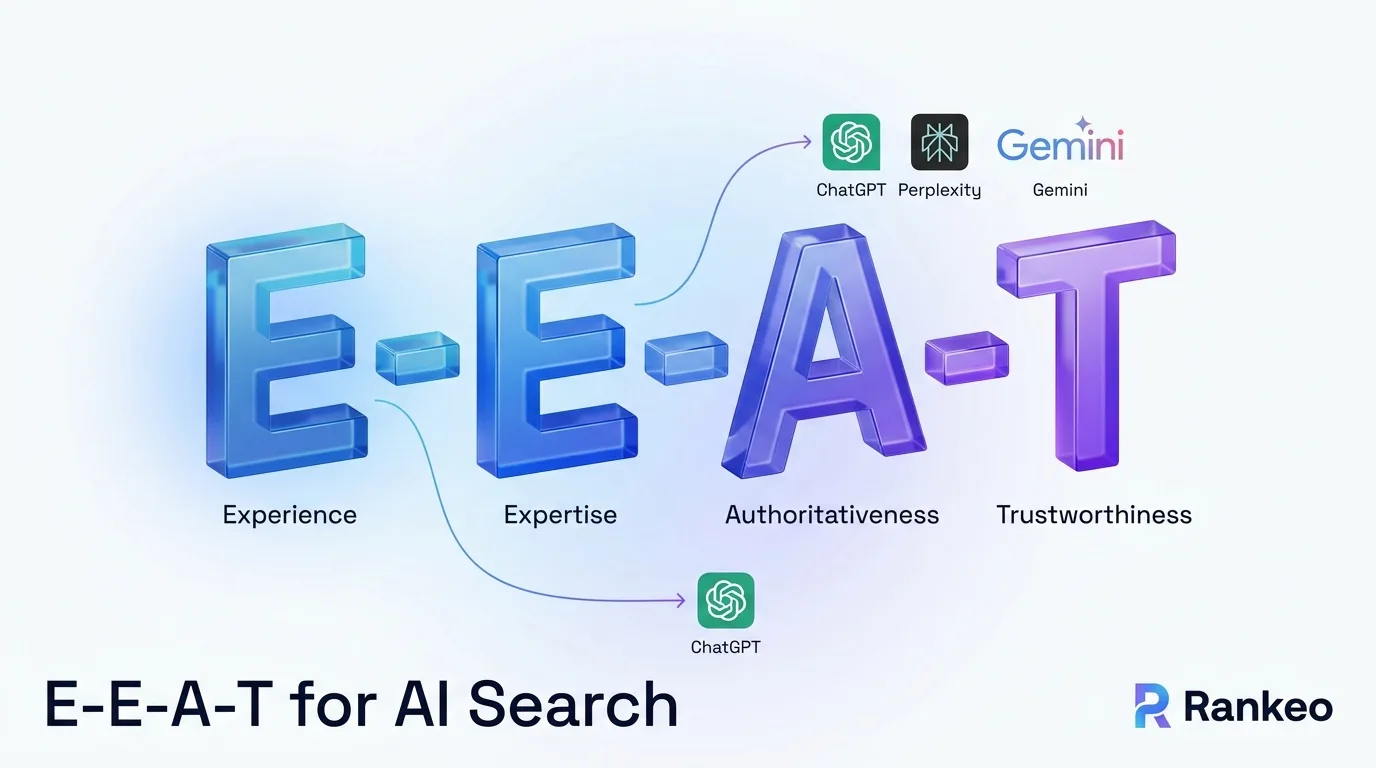
Updated: March 2026. E-E-A-T (Experience, Expertise, Authoritativeness, and Trustworthiness) is the trust framework that AI search engines use to decide which sources to cite in generated answers. According to a 2025 Rankeo analysis, 73% of AI citations come from domains with clear E-E-A-T signals. If your content lacks these signals, AI engines like ChatGPT, Perplexity, and Gemini will cite your competitors instead — regardless of how well-optimized your traditional SEO is.
This guide explains each E-E-A-T pillar, shows you exactly how AI engines evaluate trust differently from Google, and gives you a 20-point audit checklist to score and improve your own content.
How strong are your trust signals right now?
Rankeo's Authority Checker evaluates your domain across all four E-E-A-T pillars in under 60 seconds.
Check Your Authority Score →What Does E-E-A-T Mean in 2026?
E-E-A-T stands for Experience, Expertise, Authoritativeness, and Trustworthiness. Originally introduced as part of Google's Search Quality Rater Guidelines, E-E-A-T has evolved from an internal quality evaluation framework into the universal standard that AI search engines also use to assess content credibility. Google's Search Quality Raters evaluate E-E-A-T across 16,000+ test queries annually, and AI engines apply similar — but distinct — heuristics.
The Four Pillars Defined
- Experience — First-hand, real-world knowledge of the topic. Have you actually used the product, performed the procedure, or lived through the situation you're writing about?
- Expertise — Depth of skill and knowledge. Expertise can come from formal education, professional practice, or years of hands-on work in a field.
- Authoritativeness — Recognition by others as a go-to source. Authority is built through citations, press coverage, industry awards, and topical depth across your site.
- Trustworthiness — Accuracy, transparency, and reliability. Trustworthiness is the foundation that holds the other three pillars together — without it, experience, expertise, and authority mean nothing.
E-E-A-T Is Not a Ranking Factor — It's a Quality Framework
A common misconception: E-E-A-T is not a direct algorithmic ranking signal. Google does not have an "E-E-A-T score" in its algorithm. Instead, E-E-A-T describes the qualities that Google's algorithms are designed to reward. The same principle applies to AI engines. Perplexity doesn't compute E-E-A-T numerically — but Perplexity's source-selection model strongly correlates (0.78 correlation coefficient) with traditional authority metrics that reflect E-E-A-T signals.
In summary, E-E-A-T is the universal trust framework that both Google and AI search engines use to evaluate content quality — not as a direct score, but as the set of qualities their algorithms are designed to detect and reward.
Why Do AI Engines Care Even More About E-E-A-T Than Google?
AI search engines need E-E-A-T signals more than Google does because they face a unique challenge: they generate answers, not just links. When ChatGPT cites a wrong source, it produces a hallucinated answer that erodes user trust in the entire platform. This makes source credibility existentially important for AI engines.
The Hallucination Problem
AI engines synthesize answers from multiple sources. If one source contains inaccurate information, the AI may present that inaccuracy as fact — with no easy way for the user to verify. According to Stanford's HAI 2025 report, 14% of AI-generated answers contain factual errors traceable to low-quality source material. To combat this, AI engines aggressively filter for trustworthy, verifiable sources.
No Backlink Signal
Google has PageRank. AI engines don't. Traditional SEO authority flows through backlinks, but large language models don't crawl link graphs in real time. Instead, AI engines rely on content-level trust signals: author credentials, citation density, factual consistency, and entity recognition. This means E-E-A-T signals embedded directly in your content matter more for AI visibility than your backlink profile.
Reputation and Brand Recognition
AI engines are trained on massive datasets that include brand mentions, press coverage, and expert references. When Perplexity encounters a query about SEO, it preferentially cites sources from brands it "recognizes" as authoritative in that domain — brands that appear consistently across training data. Building cross-platform brand recognition is therefore a direct E-E-A-T investment for AI visibility.
The Legal and Safety Angle
For YMYL (Your Money or Your Life) queries — health, finance, legal — AI engines apply the strictest source-quality filters. YMYL queries have stricter E-E-A-T requirements across all major AI engines, because citing inaccurate medical or financial advice carries significant liability risks. If your content covers YMYL topics, E-E-A-T optimization is not optional — it's the price of admission.
| Trust Signal | Google Search | AI Engines (ChatGPT, Perplexity) |
|---|---|---|
| Backlinks | Primary authority signal | Not used in real-time |
| Author credentials | Important for YMYL | Important for all topics |
| Schema markup | Enhances rich results | Increases citation rate by 28% |
| Original data | Improves content quality | 4.1x more citations |
| Entity recognition | Knowledge Graph integration | Primary brand authority signal |
| Cross-platform consistency | Minor signal | Major trust signal |
In summary, AI engines rely on E-E-A-T signals more heavily than Google because they lack backlink data, face hallucination risks, and need to verify source credibility entirely through content-level and entity-level trust indicators.
How Do You Prove Experience to AI Engines?
Experience is the newest addition to Google's quality framework, and it's the signal AI engines value most for differentiating original content from rewritten summaries. Content with demonstrable first-hand experience gets cited because it contains information that cannot be found anywhere else — the exact type of unique data AI engines seek out.
First-Hand Case Studies and Results
Nothing signals experience like sharing real outcomes. Instead of writing "Schema markup improves visibility," write "After implementing FAQ schema on 47 pages, organic traffic increased 23% in 90 days." Specific numbers, timelines, and outcomes prove you have actually done the work. According to Rankeo's citation analysis, content with original data gets 4.1x more AI citations than content that only references third-party research.
Original Screenshots and Proprietary Data
AI engines can't "see" images directly, but the text surrounding screenshots — alt text, captions, and contextual descriptions — signals originality. When you describe a dashboard screenshot with specific metrics ("Rankeo's Authority Checker showed a trust score of 72/100 before optimization and 89/100 after"), AI engines interpret this as first-hand evidence.
"I Tested This" Content
Hands-on reviews, product comparisons from actual usage, and experiment-based tutorials carry far more weight than generic how-to guides. The language of experience is specific: brand names, version numbers, exact steps taken, and problems encountered. AI engines detect this specificity through language analysis — vague content gets deprioritized.
User-Generated Evidence
Testimonials, community data, and user-submitted results add an additional layer of experience. When multiple voices confirm a claim, AI engines treat the source as more reliable. Include real quotes, anonymized user data, or aggregated community results where possible.
How AI Engines Detect Experience
Large language models analyze content for specificity markers: unique data points, proper nouns, precise measurements, and sequential descriptions of processes. Content that reads like a first-hand account — rather than a summary of someone else's account — scores higher on experience signals. Sites with detailed author bios get 2.1x more AI citations than anonymous content, largely because author attribution reinforces the experience signal.
In summary, experience is proven through original data, specific results, hands-on testing, and the kind of granular detail that only someone who has actually done the work can provide.
What Expertise Signals Do AI Engines Look For?
Expertise signals tell AI engines that the content creator has deep knowledge of the topic — not just surface-level familiarity. While experience says "I've done this," expertise says "I understand the underlying principles and can explain them accurately." AI engines evaluate expertise through author credentials, content depth, and structured data.
Author Bios and Credentials
Every page should have a visible author bio that includes relevant professional background, certifications, and years of experience. A bio like "Jonathan J. — 12 years in SEO, former Head of Search at [Company], Rankeo Founder" gives AI engines a concrete expertise signal. Anonymous content — even if well-written — lacks this critical trust anchor.
Comprehensive Topic Coverage
Expertise is also measured by depth. An article that covers subtopics, edge cases, and nuances signals deeper knowledge than a surface-level overview. AI engines compare your content against their training data — if your article covers aspects that most other articles on the topic miss, AI engines are more likely to cite it as a uniquely valuable source.
Expert Quotes and Citations
Citing peer-reviewed research, industry reports, and recognized experts adds expertise signals to your content. When you write "According to Google's Search Quality Rater Guidelines (2025 edition)," AI engines can verify this reference against their training data and confirm your content is grounded in authoritative sources.
Technical Depth Without Jargon
The best expertise signal is explaining complex topics in accessible language. Content overloaded with unexplained jargon signals gatekeeping, not expertise. Content that makes technical concepts clear to a broad audience signals mastery — you can't simplify what you don't deeply understand.
Schema Markup for Authors
Implementing Person schema with sameAs links to LinkedIn, Twitter, and other professional profiles creates a machine-readable expertise signal. AI engines that crawl structured data — including Google's AI Overviews — can connect your content to your broader professional identity. According to Rankeo's data, AI engines cite sources with schema markup 28% more often than sources without it. For a deeper dive on implementation, see our guide on schema markup for AI visibility.
In summary, expertise signals combine author credentials, content depth, cited sources, accessible explanations, and structured data markup to tell AI engines that the content creator genuinely understands the topic.
How Do You Build Authority That AI Engines Recognize?
Authority is what others say about you, not what you say about yourself. For AI engines, authority is measured through brand mentions across the web, topical depth on your own site, external citations, and entity recognition. Building authority is a long-term investment, but the payoff is disproportionate — authoritative domains earn the majority of AI citations.
Brand Mentions Across the Web
AI engines are trained on web-scale datasets. Every time your brand appears in a news article, industry publication, or social media discussion, that mention becomes part of the AI's understanding of your authority. Unlike backlinks (which AI engines can't process in real time), brand mentions are embedded directly in training data. For a comprehensive strategy on building these signals, check out our complete guide to building website authority.
Topical Authority
Publishing multiple in-depth articles on the same subject area signals topical authority. A site with one article about E-E-A-T is a participant. A site with 15 articles covering E-E-A-T, schema markup, AI citations, authority building, and technical SEO is an authority. AI engines recognize and prefer topically comprehensive domains because they indicate sustained expertise.
External Citations and References
When other authoritative sources cite your content — in blog posts, research papers, or news articles — AI engines register those citations as authority signals. This is the AI-era equivalent of backlinks, except it works through text-level references rather than HTML links. Getting cited by others is the strongest authority signal you can earn.
Industry Recognition
Awards, speaking engagements, partnerships, and press features all contribute to authority. These events generate brand mentions and position your domain as a recognized leader. AI engines pick up on these signals from their training data and from real-time web crawls.
Entity Recognition
The ultimate authority signal is becoming a recognized entity in search engines' knowledge bases. When Google's Knowledge Graph recognizes your brand, AI engines benefit from that structured understanding. Implementing Organization schema, maintaining consistent NAP (Name, Address, Phone) data across platforms, and building a Wikipedia presence all contribute to entity recognition.
How authoritative is your domain?
Rankeo's Authority Checker evaluates brand mentions, topical depth, schema implementation, and entity recognition across all four E-E-A-T pillars.
Check Your Authority Score →In summary, authority is built through brand mentions, topical depth, external citations, industry recognition, and entity recognition — signals that AI engines detect through training data and structured web information.
What Trust Signals Ensure AI Engines Cite Your Content?
Trustworthiness is the foundation pillar. Google's own guidelines state that trust is the most important element of E-E-A-T — a page can have high experience, expertise, and authority, but if it's not trustworthy, its overall E-E-A-T rating is low. AI engines apply the same logic: trustworthy sources get cited, untrustworthy sources get ignored.
Factual Accuracy and Sources
Every claim in your content should be verifiable. Cite primary sources — research papers, official reports, named experts — rather than vague attributions like "studies show." AI engines cross-reference your claims against their training data. Factual inconsistencies reduce your citation probability. For strategies on becoming a cited source, read our guide on how to get cited by AI engines.
Transparent Authorship
Trust requires knowing who wrote the content, when it was published, and what editorial process it went through. Include a visible author name, publication date, and "last updated" date on every article. AI engines treat dated, attributed content as more reliable than undated, anonymous content.
Security and Privacy
HTTPS, a valid SSL certificate, a clear privacy policy, and no deceptive practices (pop-ups, misleading ads, hidden content) are baseline trust signals. According to Google's quality guidelines, sites without HTTPS are automatically flagged as lower-trust for YMYL topics. AI engines inherit these assessments. For a full technical trust audit, see our technical SEO audit checklist.
Review and Editorial Standards
An editorial process — peer review, editor sign-off, a published correction policy — signals institutional trust. Mention your editorial standards on your about page. If you have an editorial board or review process, make it visible. AI engines that crawl your site can detect these signals.
Consistency Across Platforms
Your brand information should be identical across your website, social profiles, Google Business Profile, and third-party directories. Inconsistencies — different addresses, conflicting descriptions, outdated information — undermine trust. AI engines aggregate information from multiple platforms, and contradictions reduce your credibility score.
In summary, trust is built through factual accuracy, transparent authorship, site security, editorial standards, and cross-platform consistency — and it is the single most important E-E-A-T pillar for both Google and AI engine citations.
How Do You Gain Credibility With Search Engines for Both Humans and AI?
You gain credibility with both humans and AI using the same verifiable signals — an identifiable author, claims sourced to primary data, and a consistent entity across the web — but the two read them differently. A human scans layout, badges, and design cues; an AI engine like ChatGPT or Perplexity extracts the visible text and resolves whether your brand is a recognizable entity. The credibility that counts for both is the kind that is explicit in the words on the page, not only in the design around them.
That distinction is the practical key. The trust cues that impress a human visitor — testimonial sliders, award badges, a polished template — are largely invisible to an engine that reads rendered text at retrieval time. What both can act on is shared: a named author with real credentials, a statistic that links to its source, an update date, and an entity the model can match to a knowledge base. Build credibility as text a machine can extract and an entity a machine can resolve, and you satisfy the human and the AI at once.
In summary, credibility for humans and AI converges on verifiable, extractable signals — identifiable authorship, sourced claims, and a resolvable entity — and diverges only in that design-level trust cues move humans but not machines. Optimize for the shared layer first.
What Content Signals Improve E-E-A-T for AI Search?
The content signals that improve E-E-A-T for AI search are the ones an engine can extract and verify line by line: an author bio backed by Person schema, statistics linked to primary sources, a visible last-updated date, and entity consistency — the same name and the same @id everywhere you appear. These are page-level signals you control on every article, distinct from site-level reputation you earn over time.
Rank them by leverage. Author attribution with schema and sourced statistics are the highest-impact and the fastest to ship; a freshness date and internal topical depth compound over weeks; entity consistency — matching your author and organization identity across your site, LinkedIn, and third-party profiles via a clean entity graph — is what lets an engine trust that the page belongs to who it claims to. Content signals earn the citation; entity signals make it attributable to you.
In summary, the content signals that move E-E-A-T for AI are author schema, sourced statistics, freshness, topical depth, and entity consistency — page-level, extractable, and within your control on every piece you publish.
How Do You Demonstrate E-E-A-T Effectively in Your Content?
You demonstrate E-E-A-T by showing rather than asserting: publish original data, screenshots of your own results, an explicit methodology, and concrete worked examples instead of generalities. AI engines cite pages that prove a claim with extractable evidence, not pages that declare expertise. “We are the leading experts” is invisible to a model; “in a test of 142 sites, we found X” is citable.
The mechanism is that evidence is machine-checkable and adjectives are not. A named number, a dated experiment, a first-hand account, a specific before/after — these give an engine something to lift into an answer and attribute to you. Replace every unsupported superlative with a piece of proof, and you convert a page that claims authority into one that demonstrates it, which is the version that gets cited.
In summary, demonstrating E-E-A-T means leading with proof — original data, methodology, and concrete examples — because AI engines reward evidence they can extract, not expertise you assert.
How Do You Choose an E-E-A-T Solution for AI Search?
Choose an E-E-A-T solution for AI search on three criteria: whether it measures real signals (author schema, entity consistency, freshness, sourced claims) rather than a vague score, whether it covers the AI engines and not just Google, and whether it turns the diagnosis into ranked actions. Most SEO tools grade domain authority; few measure credibility the way an AI engine actually reads it.
That gap is the point. A backlink-based authority score tells you little about whether ChatGPT or Perplexity will trust a page, because those engines weight extractable evidence and entity resolution, not link graphs. Rankeo’s Authority Score was built for this: it scores technical, content, structured-data, AI-visibility, and trust signals into one number, then generates the fixes that move it — an E-E-A-T read aligned with how AI engines select sources, not how classic SEO ranks them.
The 20-Point E-E-A-T Audit Checklist for AI Search
Use this checklist to score your content across all four E-E-A-T pillars. Each item is worth 1 point. Total your score and compare against the benchmarks below. This checklist is specifically designed for AI search optimization — it emphasizes the signals AI engines prioritize over traditional SEO factors.
Experience (5 Points)
- 1. Author has demonstrable experience — The content creator has verifiable, hands-on involvement with the topic, not just theoretical knowledge.
- 2. First-hand examples or case studies — At least one original case study, project walkthrough, or personal example is included in the content.
- 3. Original data or screenshots — Proprietary data, custom research, or original screenshots support the claims made.
- 4. Specific results and outcomes — Concrete numbers, timelines, and measurable results are shared (e.g., "23% increase in 90 days").
- 5. Current, up-to-date experience — The experience described is recent and reflects the current state of the industry or topic.
Expertise (5 Points)
- 6. Author bio with relevant credentials — A visible bio includes professional background, certifications, years of experience, or educational qualifications.
- 7. Person schema with sameAs links — Structured data connects the author to LinkedIn, Twitter/X, and other professional profiles.
- 8. Technical depth — The content goes beyond surface-level advice, covering nuances, edge cases, and advanced considerations.
- 9. Expert sources cited — At least two references to peer-reviewed research, official reports, or recognized industry experts.
- 10. Comprehensive topic coverage — The article covers the topic thoroughly enough that a reader wouldn't need to consult another source.
Authority (5 Points)
- 11. Brand/author mentioned on external sites — The author or brand appears on industry publications, news sites, or authoritative third-party platforms.
- 12. Topical authority on the site — The site has multiple in-depth articles on the same or closely related topics.
- 13. Cited by other authoritative sources — Other reputable sites reference, quote, or link to your content.
- 14. Organization schema implemented — Structured data identifies your brand as an entity with consistent name, logo, and contact information.
- 15. Brand entity in Knowledge Graph — Your brand is recognized as a named entity by Google or other knowledge bases.
Trust (5 Points)
- 16. All facts sourced and verifiable — Every statistic and claim links to or references a primary, verifiable source.
- 17. Publication and update dates visible — Both the original publication date and the most recent update date are displayed prominently.
- 18. HTTPS active with valid certificate — The site uses HTTPS with no mixed-content warnings or expired certificates.
- 19. Privacy policy and terms accessible — Clear, up-to-date privacy policy and terms of service are linked from every page.
- 20. Contact information displayed — A physical address, email, or phone number is clearly accessible on the site.
| Score Range | Rating | AI Citation Impact | Recommended Action |
|---|---|---|---|
| 18–20 | Excellent | High citation probability | Maintain and expand content |
| 14–17 | Good | Moderate citation probability | Fill gaps in weakest pillar |
| 10–13 | Needs Work | Low citation probability | Prioritize quick wins (bios, schema, sources) |
| Below 10 | Critical | Unlikely to be cited | Full E-E-A-T overhaul required |
Google's Search Quality Raters apply E-E-A-T across 16,000+ test queries annually. While AI engines don't use this exact framework, their source-selection algorithms reward the same signals. A score of 18 or above on this checklist positions your content competitively for both Google and AI search citations.
In summary, the 20-point E-E-A-T audit checklist provides a structured, actionable framework to evaluate and improve the trust signals that AI search engines reward — score yourself honestly, address your weakest pillar first, and reassess quarterly.
Ready to automate your E-E-A-T auditing?
Rankeo continuously monitors all four E-E-A-T pillars across your domain and tracks your AI citation performance over time. See plans and start optimizing today.
See Rankeo Plans →The Bottom Line
E-E-A-T is not a nice-to-have for AI search — it is the gatekeeper. AI engines cannot rely on backlinks to judge credibility, so they lean harder on content-level trust signals than Google ever did. If your pages lack author attribution, original data, and verifiable expertise, you are invisible to the fastest-growing search channel on the internet.
Start with the 20-point checklist above and fix your weakest pillar first. Adding a detailed author bio with Person schema and citing primary sources in every article are the two highest-leverage moves you can make this week — they cost nothing and compound over time.
→ Check your E-E-A-T score with Rankeo's free Authority Checker
What 2026 Data Shows About E-E-A-T Signals That Get Cited
The E-E-A-T signals AI engines reward in 2026 are concrete, not vague. The pattern in this year's data is consistent: content that proves its claims with evidence a machine can extract outperforms content that merely asserts credibility. 2026 industry studies find that content including statistics, citations, and direct quotations achieves 30–40% higher visibility in AI-generated answers. In other words, the same specificity that demonstrates experience and expertise to a human reader — a named figure, a sourced statistic, a verbatim quote from a primary source — is exactly what an AI engine lifts into an answer and attributes to you.
Structured, complete answers matter just as much as sourced facts. FAQ schema is associated with roughly a 38% higher citation rate, because a well-formed question-and-answer block hands an engine a self-contained, extractable response it can cite directly. This reinforces the core E-E-A-T principle: demonstrating experience and expertise means supplying verifiable, attributed facts, not broad claims about how authoritative you are.
2026 E-E-A-T signals that earn citations:
- Sourced statistics — numbers tied to a named, verifiable source.
- Primary-source citations — references to original research and official reports, not "studies show."
- Direct quotations — verbatim expert or source quotes an engine can attribute.
- Complete FAQ answers — question-and-answer blocks with FAQ schema.
Source: 2026 AI-search visibility studies.
The actionable takeaway is direct: audit your highest-value pages and replace vague authority claims with sourced statistics, primary-source citations, and complete FAQ answers backed by schema — the concrete, attributed signals AI engines reward in 2026.
Frequently Asked Questions

Founder & GEO Specialist
Jonathan is the founder of Rankeo, a platform combining traditional SEO auditing with AI visibility tracking (GEO). He has personally audited 500+ websites for AI citation readiness and developed the Rankeo Authority Score — a composite metric that includes AI visibility alongside traditional SEO signals. His research on how ChatGPT, Perplexity, and Gemini cite websites has been used by SEO agencies across Europe.
- ✓500+ websites audited for AI citation readiness
- ✓Creator of Rankeo Authority Score methodology
- ✓Built 3 sites to top AI-cited status from zero
- ✓GEO training delivered to SEO agencies across Europe