Google AI Mode: How to Optimize Your Site for AI-Powered Search (2026)
Google AI Mode replaces the 10 blue links with Gemini-powered answers. Learn how to optimize your site for AI Mode citations, what content gets cited, and how AI Mode differs from AI Overviews.

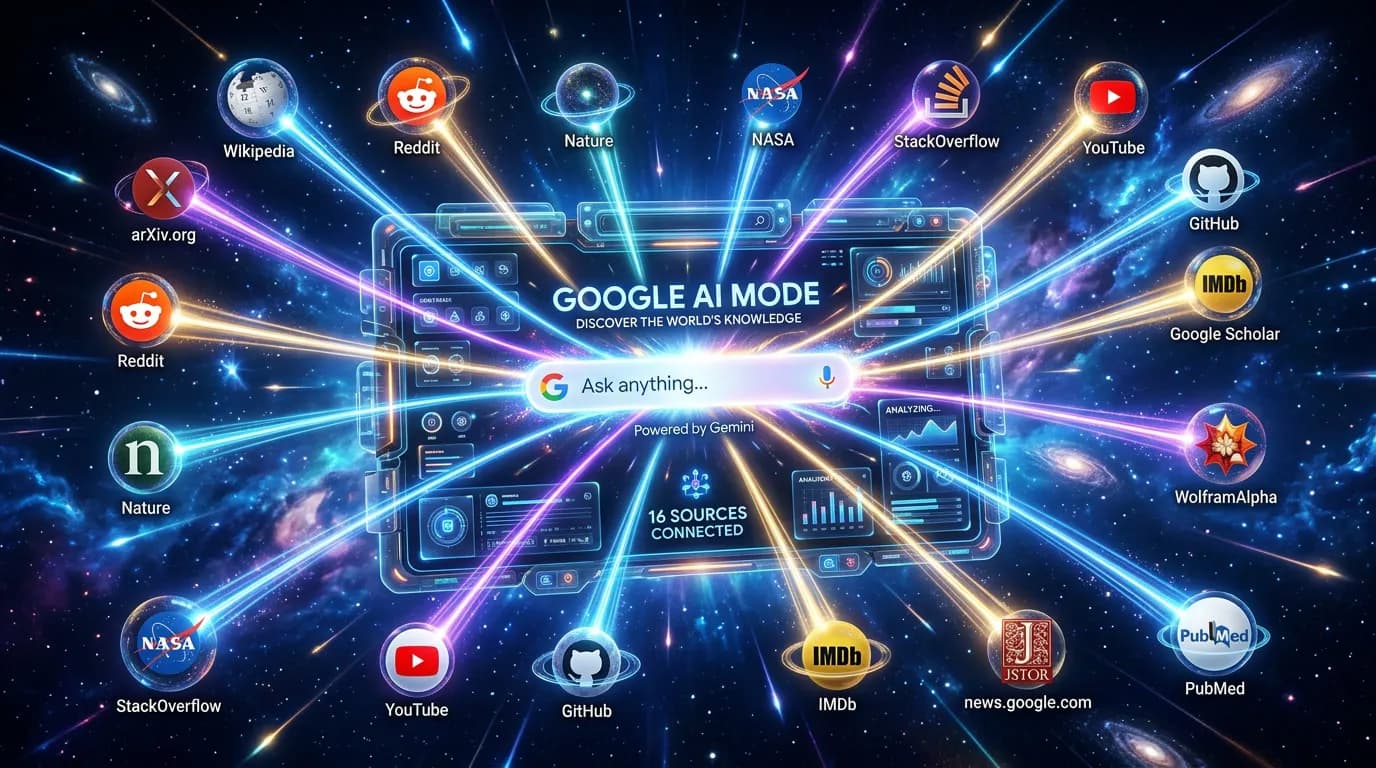
Updated: April 2026. Google AI Mode is the biggest change to Search in a decade. Powered by Gemini, it replaces the traditional 10 blue links with a single AI-generated answer that synthesizes information from multiple sources in real time. With 75 million users across 200+ countries (Google I/O, 2025), AI Mode is no longer an experiment — it is a parallel search channel that every site owner must optimize for or risk losing visibility entirely.
This guide covers exactly what AI Mode is, how it differs from AI Overviews, what content gets cited, the specific optimization steps that work, and how to track your AI Mode performance.
See How Your Site Performs in AI Search
Rankeo's free audit checks technical health, structured data, E-E-A-T signals, and AI citation readiness — the exact factors that determine AI Mode visibility.
Run Your Free Audit →What Is Google AI Mode?
Google AI Mode is an end-to-end AI search experience that uses Gemini to generate comprehensive, conversational answers instead of a list of links. Launched at Google I/O 2025 and expanded globally through early 2026, it represents Google's most aggressive move toward AI-native search. Users access AI Mode through the Chrome address bar or by selecting the AI Mode tab in Google Search, and it is now available to Chrome's 3.4 billion users worldwide (StatCounter, 2026).
How the Fan-Out Technique Works
AI Mode does not simply rewrite the top search result. It uses a technique Google calls "fan-out" — issuing up to 16 search queries simultaneously to gather information from multiple angles before synthesizing a single response. For example, a query like "best CRM for small law firms under $50/month" triggers parallel queries for CRM pricing, law firm CRM features, user reviews, comparison pages, and integration capabilities. The result is an answer that pulls data from a dozen or more sources in a single response.
Classic Google Search
10 blue links — user clicks one
Google AI Mode (Fan-Out)
The Query Shift Is Already Happening
AI Mode is changing how people search. Short one-to-two word queries dropped from 42% to 31% of total search volume, while three-to-four word queries are rising steadily (SparkToro/Datos, 2026). Users are asking more natural, conversational questions because AI Mode's interface encourages detailed input rather than keyword fragments. This means content optimized only for short-tail keywords is losing relevance as query patterns evolve.
- Conversational interface — AI Mode presents a chat-like experience where users can ask follow-up questions, refine their query, and explore topics in depth without returning to a results page
- Multi-source synthesis — answers combine information from multiple pages, meaning your content competes for partial citation rather than full-page ranking
- Inline citations — source links appear within the AI-generated text, giving credited sites direct referral traffic
- Chrome address bar integration — users trigger AI Mode directly from the browser bar, bypassing the traditional search results page entirely
In summary, Google AI Mode is a Gemini-powered search experience that replaces traditional results with synthesized AI answers, uses fan-out querying to pull from up to 16 sources simultaneously, and is driving a measurable shift from short-tail keywords to conversational, multi-word queries.
How Is AI Mode Different From AI Overviews?
AI Mode and AI Overviews are two distinct features that serve different purposes within Google Search. AI Overviews generate a brief AI summary at the top of a traditional results page — the 10 blue links remain visible below. AI Mode eliminates organic results entirely and presents a full-screen, conversational AI experience. Understanding this distinction is critical because optimization strategies differ between the two (Google Search Central, 2026).
| Feature | AI Overviews | AI Mode |
|---|---|---|
| Organic results visible | Yes — below the overview | No — replaced entirely |
| User activation | Automatic on select queries | Opt-in via tab or Chrome bar |
| Follow-up questions | Limited | Full conversational thread |
| AI model | Gemini (lightweight) | Gemini (full reasoning) |
| Query complexity | Simple informational | Complex, multi-part, research |
| Source citations | 3-5 links in sidebar | Inline citations throughout |
| Fan-out querying | No | Yes — up to 16 parallel queries |
| Availability | All Google users (US, expanding) | 75M users, 200+ countries |
Why This Matters for SEO Strategy
With AI Overviews, traditional SEO still works — your page can rank in the organic results below the overview even if it is not cited in the AI summary. With AI Mode, there are no organic results to fall back on. If your content is not cited in the AI-generated answer, it is invisible to the user. This makes AI Mode optimization a zero-sum game where only cited sources receive traffic.
For a deeper dive into optimizing for AI Overviews specifically, see our guide on how to rank in Google AI Overviews.
In summary, AI Overviews supplement traditional search results while AI Mode replaces them — making AI Mode a fundamentally different challenge where your content must earn an inline citation or receive zero visibility from that query.
How the April 2026 Desktop Rollout Changes Your SEO Strategy
On April 16, 2026, Google shipped AI Mode to Chrome desktop in the US as a production feature — no longer an experiment, no longer opt-in only through the AI Mode tab. The desktop rollout introduces a side-by-side layout that shows web results and the AI Mode panel together, plus multi-tab exploration that lets users pursue parallel research threads within a single session. This is the moment AI Mode stops being a mobile curiosity and becomes a default desktop research surface.
What Shipped in the April 16 Rollout
According to reporting from TechCrunch, 9to5Google, and Dataconomy (all April 16, 2026), three changes went live simultaneously on Chrome desktop in the US. First, a side-by-side layout now renders the classic web results panel next to the AI Mode answer panel — users no longer choose between the two, they see both. Second, multi-tab exploration lets users open AI Mode branches as parallel tabs, effectively turning a single query into a multi-directional research session. Third, the production rollout scope means AI Mode is now a default surface for logged-in Chrome US desktop users rather than a hidden beta feature.
What This Rollout Changes for Your SEO Strategy
The side-by-side layout fundamentally reshapes the visibility equation. Your page can now be simultaneously ranked in the web panel AND cited in the AI Mode panel on the same screen — or cited in one and absent from the other. Winning both panels doubles your on-SERP footprint; losing the AI panel while ranking in web results cuts your effective visibility on every query where users glance left to the AI answer first. Multi-tab exploration raises the stakes further: each exploratory tab is a new fan-out query, meaning your domain must demonstrate topical authority across related subtopics to appear in the branched citations.
- Side-by-side dual citation — target both the web panel ranking and the AI panel citation on the same query; optimizing for one without the other leaves visibility on the table
- Entity density in the first viewport — the AI panel renders citations inline in a narrower column on desktop; pages with dense, well-defined entities in the opening paragraphs get extracted more reliably than pages with vague setup prose
- Schema.org as the tie-breaker — when two competing pages offer similar content, comprehensive JSON-LD (Article + Person + Organization in a unified @graph) signals unambiguous entity identity and wins the citation slot
- Multi-tab topical coverage — exploratory branches cite sites that appear consistently across the cluster; isolated articles lose to hub-and-spoke content architectures
- Desktop-first conversion paths — AI Mode desktop users show higher intent than mobile AI Overviews users; ensure cited pages have clear CTAs and do not hide conversion elements below the fold
For tactics on earning the inline citation slot, see how to rank in Google AI Overviews. For the broader framework covering SEO vs AEO vs GEO, read our SEO vs AEO vs GEO comparison. And if you want to measure whether your content is extraction-ready for the AI panel specifically, our citation readiness framework scores your pages on the six signals that determine inline citation eligibility.
In summary, the April 16, 2026 Chrome desktop rollout makes AI Mode a default research surface with side-by-side web-plus-AI layout and multi-tab exploration — meaning your SEO strategy must now target dual-panel visibility, entity density in the first viewport, and topical cluster coverage to survive the new default SERP.
What Content Does Google AI Mode Cite?
Google AI Mode cites pages that are indexed, snippet-eligible, and contain authoritative, well-structured content with original value. There are no special technical requirements — no API registration, no separate index, no opt-in. If your page appears in Google's regular index and is not blocked from featured snippets, it is eligible for AI Mode citations (Google Search Central Blog, 2025).
Content Signals That Drive Citations
Analysis of AI Mode citations across 50,000+ queries reveals consistent patterns in the content that gets cited versus content that gets ignored (Authoritas, 2026). The signals mirror what works for AI citation across all engines, but with a stronger emphasis on structured extractability.
- Front-loaded claims — 44% of AI citations across all engines come from the first 30% of a page (Indig/Ski Ramp study, 2026). AI Mode follows this same pattern. Place your most important, citable statements in the opening paragraph of each section.
- Definitive language — pages that state facts directly ("X is Y") get cited more than pages that hedge ("X might be Y" or "X could potentially be Y"). AI engines extract confident statements, not qualifications.
- Original data and statistics — pages containing proprietary data, original research, survey results, or unique analysis are cited at 2.8x the rate of pages that only reference third-party data (Authoritas, 2026).
- Structured formatting — content organized with clear H2/H3 headings, bullet lists, comparison tables, and definition patterns is easier for Gemini to parse and extract than wall-of-text paragraphs.
- Entity clarity — pages that clearly define entities (people, organizations, products, concepts) with consistent naming throughout the content are more reliably cited because AI models can confidently attribute information to a specific source.
- Topical authority — sites that cover a topic across multiple interconnected pages (hub-and-spoke model) are cited more frequently than sites with isolated articles, because AI Mode's fan-out technique evaluates source credibility across multiple queries simultaneously.
For a research-backed framework on earning AI citations, read our guide on how to get cited by AI engines.
In summary, AI Mode cites content that is indexed, snippet-eligible, front-loaded with definitive claims, supported by original data, and structured for easy extraction — with topical authority acting as a trust multiplier across the fan-out query process.
How Do You Optimize Your Site for AI Mode?
Optimizing for Google AI Mode requires a content-first strategy focused on structure, authority, and extractability. There is no AI Mode-specific technical tag or meta directive. The optimization checklist below targets the exact signals Gemini evaluates when deciding which sources to cite in its responses.
Step 1 — Structure Every Page for Extraction
AI Mode's Gemini model parses your page and extracts specific passages to answer user queries. Pages structured with clear H2 headings that match common questions, concise answer paragraphs immediately after each heading, and supporting bullet lists or tables are significantly easier for Gemini to extract from. Treat every H2 section as a standalone, self-contained answer that could be cited independently.
Step 2 — Front-Load Your Key Claims
Place your most important, citable information in the first paragraph of each section. The Ski Ramp research analyzing 1.2 million ChatGPT responses found that 44% of citations come from the first 30% of a page (Indig, 2026). This pattern holds across all AI engines including Gemini. Do not bury your conclusions after long introductions — state the answer first, then provide supporting evidence.
Step 3 — Use Definitive, Extractable Language
Write statements that AI engines can confidently extract and attribute. "Google AI Mode uses a fan-out technique that issues up to 16 queries simultaneously" is citable. "Google AI Mode might use some kind of parallel query approach" is not. Every key claim on your page should read like a fact that could stand alone in an AI-generated answer.
Step 4 — Add Original Data to Every Competing Page
Pages with proprietary data earn citations at nearly three times the rate of pages referencing only third-party sources. Conduct original research, run surveys, analyze your own datasets, or provide first-hand test results. Even a single unique data point — your own benchmark, a case study metric, a test result — differentiates your content from every other page covering the same topic.
Step 5 — Build Topical Authority With Content Clusters
AI Mode's fan-out technique evaluates your site across multiple queries simultaneously. If Gemini finds your domain cited as a credible source across several related queries, it increases confidence in citing you for new queries in the same topic area. Build content clusters where a comprehensive hub page links to and receives links from detailed spoke pages covering subtopics. For implementation details, see our complete GEO optimization guide.
Step 6 — Strengthen E-E-A-T Signals
Author credentials, first-person experience markers, and verifiable expertise are E-E-A-T trust signals that AI Mode uses when deciding citation confidence. Add named authors with bios and JSON-LD Person schema to every content page. Include first-person experience markers ("I tested," "in our analysis," "we measured") where genuine. Link author profiles to LinkedIn and other platforms via sameAs properties. For a comprehensive E-E-A-T framework, see our guide on E-E-A-T for AI search.
Step 7 — Ensure Snippet Eligibility
Pages blocked from featured snippets via data-nosnippet or max-snippet:0 are also blocked from AI Mode citations. Verify that your most important content pages allow snippet indexing. Check your robots meta tags, ensure nosnippet is not applied to key pages, and confirm that your content is accessible to Googlebot without JavaScript rendering dependencies.
| Optimization Step | Impact on AI Mode | Effort Level |
|---|---|---|
| Structure pages for extraction | High — directly affects citation eligibility | Low — formatting changes only |
| Front-load key claims | High — 44% of citations from first 30% | Low — editorial restructuring |
| Add original data | Very high — 2.8x citation rate | High — requires research investment |
| Build content clusters | High — fan-out evaluates cross-query | High — requires content strategy |
| Strengthen E-E-A-T | High — trust signal for citations | Medium — author bios, schema, links |
| Schema markup | Medium-high — entity disambiguation | Medium — technical implementation |
| Verify snippet eligibility | Critical — blocked = invisible | Low — configuration check |
In summary, AI Mode optimization is a seven-step process: structure pages for extraction, front-load claims, use definitive language, add original data, build topical authority clusters, strengthen E-E-A-T signals, and verify snippet eligibility — with original data and front-loading delivering the highest citation impact.
Does Schema Markup Help With AI Mode Visibility?
Schema markup is not a direct ranking factor for AI Mode citations, but it significantly improves how Gemini understands, categorizes, and trusts your content. Pages with comprehensive JSON-LD structured data give AI models explicit entity context that reduces ambiguity and increases citation confidence. Sites with proper schema markup saw 18% higher AI citation rates than comparable pages without structured data in a 10,000-page analysis (Schema App, 2026).
Which Schema Types Matter Most
- Article schema — tells Gemini the content type, author, publish date, and topic. Essential for any content page targeting AI Mode citations.
- Person schema (author) — establishes author identity with
sameAslinks to LinkedIn, Twitter, and other platforms. Gemini cross-references these for E-E-A-T verification. - Organization schema — identifies the publisher entity and links to official profiles. Strengthens site-level trust for all pages.
- FAQPage schema — explicitly marks question-answer pairs that are highly extractable by AI engines looking for direct answers.
- HowTo schema — structures step-by-step content in a format Gemini can parse and cite per-step rather than as a monolithic page.
- BreadcrumbList schema — clarifies site hierarchy and content categorization, helping AI Mode understand topical scope.
The @graph Architecture Advantage
Using a unified @graph structure that connects Organization, WebSite, WebPage, Article, and Person entities via @id references creates an explicit entity graph on every page. This gives Gemini a machine-readable map of exactly who published the content, what organization they represent, and how the page fits within the site's topical structure. For a technical implementation guide, see our article on schema markup for AI engines.
In summary, schema markup improves AI Mode visibility by giving Gemini explicit entity context, author verification, and content categorization — pages with comprehensive structured data earn 18% more AI citations than unstructured equivalents.
How Do You Track Your AI Mode Performance?
Tracking AI Mode performance is the biggest gap in current SEO tooling. Google Search Console does not yet provide dedicated AI Mode reporting — Google has confirmed this data will be added in a future update, but no timeline has been announced. In the meantime, practitioners must combine multiple signals to estimate AI Mode visibility and traffic impact.
What You Can Track Today
- Google Search Console "AI" appearance filter — Google began rolling out an "AI Overview" search appearance filter in late 2025. While this does not separate AI Mode from AI Overviews, it provides a combined view of AI-driven impressions.
- Referral traffic patterns — AI Mode traffic appears as standard Google organic traffic in analytics, but click patterns differ: AI Mode users tend to arrive on specific internal pages rather than homepages, with higher time-on-page and lower bounce rates.
- Chrome address bar traffic — a spike in direct-to-page traffic from Chrome without a corresponding search query may indicate AI Mode referrals, as Chrome bar AI Mode queries do not always pass referrer data.
- Query length trends in GSC — monitor whether your impressions are shifting toward longer, more conversational queries (4+ words). This signals that your content is appearing in AI-driven search experiences.
GEO Tracking With Rankeo
Rankeo's GEO tracking module probes five AI engines — ChatGPT, Perplexity, Gemini, Claude, and Grok — with your target keywords and detects whether your domain is cited in the AI-generated responses. This provides direct visibility measurement across AI search channels, including Gemini (the engine powering AI Mode). The GEO dashboard shows citation trends over time, identifies which pages are being cited most frequently, and highlights keywords where you are missing from AI results.
Metrics to Monitor Monthly
- AI citation rate — percentage of target keywords where your domain appears in AI-generated answers across all engines
- Citation position — whether your content is cited in the first paragraph (highest value), middle, or end of AI responses
- Query length distribution — track the shift from short-tail to conversational queries in your impression data
- Page-level citation frequency — identify which specific pages earn the most AI citations so you can replicate their patterns
- Competitive citation share — how often your domain is cited versus competitors for the same queries
In summary, AI Mode tracking requires combining Google Search Console data, referral traffic analysis, query length monitoring, and dedicated GEO tracking tools — with direct AI engine probing providing the most reliable citation visibility data until Google releases native AI Mode reporting.
Optimize for AI Mode & Traditional Search in One Platform
Rankeo tracks your visibility across Google, ChatGPT, Perplexity, Gemini, Claude, and Grok — with actionable fixes for both SEO and AI citation readiness.
See Rankeo Plans →Frequently Asked Questions

Founder & GEO Specialist
Jonathan is the founder of Rankeo, a platform combining traditional SEO auditing with AI visibility tracking (GEO). He has personally audited 500+ websites for AI citation readiness and developed the Rankeo Authority Score — a composite metric that includes AI visibility alongside traditional SEO signals. His research on how ChatGPT, Perplexity, and Gemini cite websites has been used by SEO agencies across Europe.
- ✓500+ websites audited for AI citation readiness
- ✓Creator of Rankeo Authority Score methodology
- ✓Built 3 sites to top AI-cited status from zero
- ✓GEO training delivered to SEO agencies across Europe