How to Rank in ChatGPT Search and Perplexity: What Actually Works (2026)
Learn how to rank in ChatGPT Search and Perplexity with platform-specific tactics. Only 11% of domains appear in both — here is exactly how to join them.

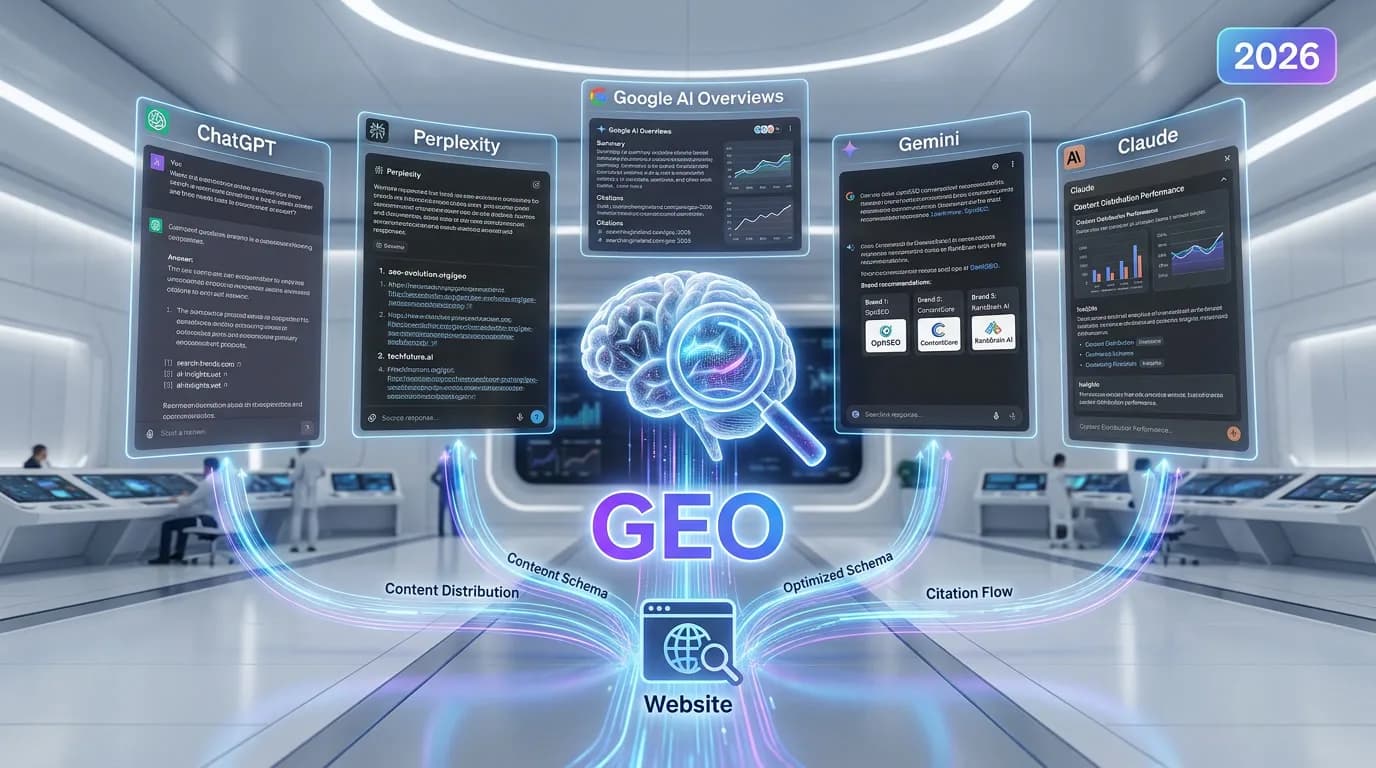
Updated: March 2026. Ranking in ChatGPT Search and Perplexity requires understanding that these two AI-native search engines use fundamentally different source selection mechanisms. Only 11% of domains are cited by both ChatGPT and Perplexity simultaneously, according to cross-platform citation analysis (2025). This means most optimization advice that treats "AI search" as a single channel leaves massive visibility gaps.
This guide breaks down exactly how each platform selects sources, what tactics work for both, and how to join the 11% of domains that achieve dual coverage. If you're new to AI engines, start with our complete guide to GEO for foundational context.
Find out if ChatGPT and Perplexity cite your site
Rankeo's free audit scans your site for SEO issues AND probes five AI engines to check if you're being cited — or invisible.
Run free SEO + GEO audit →ChatGPT Search vs Perplexity — How They Actually Work
ChatGPT Search and Perplexity are the two dominant AI-native search engines, but they work differently. ChatGPT Search uses the Bing index as its primary source, while Perplexity runs its own crawler (PerplexityBot) alongside Bing results. According to OpenAI (2025), ChatGPT has 200M+ weekly active users. Perplexity processes 100M+ queries per week (Perplexity Labs, 2025). Understanding the architectural differences between these platforms is the foundation of any effective ChatGPT search optimization strategy.
ChatGPT Search Architecture
ChatGPT Search works by issuing real-time queries to the Bing index when a user asks a question that requires current information. The system evaluates conversation context to determine whether a web search is needed, then retrieves and synthesizes results from Bing's indexed pages.
- Primary data source: Bing index (not Google, not its own crawler)
- Crawling: OAI-SearchBot for verification, but Bing is the backbone
- Real-time search: Triggered by queries needing current data
- Conversation context: Follow-up questions inherit context from the thread
- Citation style: Inline links embedded directly in the response text
Perplexity Architecture
Perplexity takes a hybrid approach. PerplexityBot crawls approximately 50 million pages per day (Perplexity Labs, 2025), building its own index. Perplexity supplements PerplexityBot data with Bing results, then applies its own ranking algorithm to determine which sources get cited.
- Primary data source: PerplexityBot crawler + Bing supplementation
- Crawling: PerplexityBot actively crawls and indexes pages independently
- Ranking algorithm: Proprietary blend of relevance, authority, and data density
- Source diversity: Perplexity intentionally cites varied sources, not just top-ranked pages
- Citation style: Numbered references with expandable source cards
Key Differences Table
| Factor | ChatGPT Search | Perplexity |
|---|---|---|
| Primary Data Source | Bing index | PerplexityBot + Bing |
| Own Crawler | OAI-SearchBot (supplementary) | PerplexityBot (~50M pages/day) |
| Citation Format | Inline links in response text | Numbered references + source cards |
| Update Frequency | Real-time (Bing re-indexing speed) | Continuous crawl + periodic Bing refresh |
| Source Selection Bias | Bing ranking position + authority | Data density + source diversity |
| Follow-Up Context | Strong (conversation threading) | Moderate (related questions) |
| Weekly Active Users | 200M+ (OpenAI, 2025) | 100M+ queries/week (Perplexity Labs, 2025) |
| robots.txt Agent | OAI-SearchBot | PerplexityBot |
In summary, ChatGPT Search and Perplexity use fundamentally different source selection architectures — Bing-dependent vs. hybrid crawler — and optimizing for one does not guarantee visibility in the other.
How Does ChatGPT Search Select Sources?
ChatGPT search ranking depends on a chain that starts with the Bing index and ends with OpenAI's relevance model. Understanding each link in this chain is essential for anyone trying to figure out how to rank in ChatGPT.
Bing Index Dependency
The single most important factor for ChatGPT search optimization is Bing indexing. If your page is not in the Bing index, ChatGPT Search cannot find it. Bing Webmaster Tools indexing directly impacts ChatGPT Search visibility (Microsoft, 2025).
- Submit your sitemap to Bing Webmaster Tools
- Use the IndexNow protocol for instant indexing of new and updated content
- Verify your pages are actively indexed by checking the "URL Inspection" tool in Bing
- Fix any crawl errors that prevent Bingbot from accessing your content
Content Relevance Matching
Once ChatGPT retrieves Bing results, OpenAI's model evaluates each page against the user's query. ChatGPT Search favors content that directly and comprehensively answers the question. Pages that bury the answer deep in the content or hide it behind vague language perform poorly.
Practical tip: Place a direct answer to your target query in the first 100 words of your page. Use the exact phrasing of the question in your H1 or H2. ChatGPT's model extracts and synthesizes these early-position answers.
Authority Signals
ChatGPT Search inherits Bing's authority signals, which include domain authority, backlink quality, brand recognition, and E-E-A-T factors. Domains with strong Bing authority profiles are cited more often. Notably, Bing places higher weight on exact-match domain names and social media signals than Google does.
Freshness Weighting
For time-sensitive queries (e.g., "best SEO tools 2026"), ChatGPT Search strongly favors recently published or updated content. Pages with an explicit last-modified date and current-year references rank higher for these queries. This is where IndexNow becomes critical — it notifies Bing of updates within minutes.
ChatGPT Citation Format
ChatGPT Search embeds inline links directly in its response text. Unlike Perplexity, ChatGPT does not use numbered references or source cards. The cited text is typically a phrase or sentence that links to the source page. This means your page's title tag and meta description influence how the citation appears.
In summary, ChatGPT search optimization starts with Bing indexing, requires direct answers in early content positions, and rewards freshness through IndexNow and explicit date signals.
How Does Perplexity Select Sources?
Perplexity SEO differs significantly from ChatGPT search optimization because Perplexity operates its own crawler and ranking algorithm. Understanding how Perplexity selects and ranks sources gives you an edge over competitors who treat AI search as a monolith.
PerplexityBot Crawling
PerplexityBot crawls approximately 50 million pages per day (Perplexity Labs, 2025). PerplexityBot prioritizes pages that are frequently updated, well-linked from other authoritative sites, and structurally clear. Crawl budget considerations apply: if your site has thousands of pages, PerplexityBot will prioritize the most linked and updated ones.
- Crawl frequency: Higher for pages updated weekly or more often
- Priority signals: Internal links, external backlinks, sitemap inclusion
- Content types: HTML pages (PerplexityBot does not deeply index PDFs or JavaScript-rendered content)
Perplexity's Ranking Algorithm
Perplexity ranking factors include content relevance, data density, source authority, and content structure. According to Perplexity Labs (2025), pages with inline statistics, comparison tables, and clear heading hierarchies are cited 3-4x more often than narrative-only content.
Perplexity's algorithm also weighs content uniqueness. Pages that add original data, proprietary research, or expert analysis rank higher than pages that simply repackage existing information.
Source Diversity
Perplexity intentionally diversifies its source citations. Where ChatGPT might cite the same top-ranked Bing result repeatedly, Perplexity tries to pull from 3-6 different sources per response. This creates an opportunity for smaller, niche-authoritative domains to get cited alongside larger competitors.
Perplexity Citation Format
Perplexity uses numbered inline citations (e.g., [1], [2]) with expandable source cards at the bottom of each response. Each source card shows the page title, domain, and a brief snippet. This means your title tag and opening paragraph directly influence how your citation appears to Perplexity users.
Allowing PerplexityBot
Many sites inadvertently block PerplexityBot. Check your robots.txt file to ensure PerplexityBot has access. Here is the recommended configuration:
# Allow AI search crawlers
User-agent: PerplexityBot
Allow: /

User-agent: OAI-SearchBot
Allow: /

# Standard sitemap
Sitemap: https://yourdomain.com/sitemap.xml
In summary, Perplexity SEO requires allowing PerplexityBot in robots.txt, creating data-dense content with clear structure, and leveraging Perplexity's source diversity bias to earn citations even against larger competitors.
What Works for Both ChatGPT Search and Perplexity?
Despite their architectural differences, ChatGPT Search and Perplexity share several ranking preferences. The tactics below improve visibility across both platforms simultaneously. For a deeper dive into cross-engine optimization, see our guide on how to get cited by AI.
Comprehensive, Data-Dense Content
Both engines prefer thorough, statistics-backed content. Content with data tables gets 4.1x more citations across both platforms (Rankeo citation analysis, 2025). Include at least one sourced statistic per 300 words. Use specific numbers, not vague claims.
Clear Heading Structure
Both ChatGPT Search and Perplexity extract relevant sections using heading hierarchy. A clean H2/H3 structure allows the AI to identify and cite the specific section that answers the user's query, rather than summarizing the entire page vaguely.
- Use H2 headings phrased as questions users actually ask
- Use H3 headings for subtopics within each H2 section
- Keep each H2 section focused on a single, answerable topic
Schema Markup
Structured data (Article, FAQPage, HowTo schema) helps both platforms understand your content's type and structure. FAQPage schema is particularly effective — both engines extract FAQ content for direct answers. Article schema provides author, date, and topic signals that reinforce E-E-A-T.
E-E-A-T Signals
Both platforms prioritize content with clear author attribution, demonstrated expertise, and trust signals. Include author names, credentials, and publication dates on every page. Link to author profiles and relevant credentials.
Topical Authority
Covering a topic comprehensively across multiple related pages signals expertise to both engines. A single article on "AI SEO" will be outperformed by a site with 10+ interlinked articles covering AI visibility, GEO, specific AI engines, and related tactics. For context on the broader optimization landscape, see our breakdown of SEO vs AEO vs GEO.
Regular Content Updates
Freshness matters for both platforms. Update high-priority pages at least monthly. Add new data, update statistics, and revise outdated sections. Both ChatGPT Search (via Bing) and Perplexity (via PerplexityBot) prioritize recently modified content.
In summary, data-dense content with clear heading structure, schema markup, strong E-E-A-T signals, topical authority, and regular updates improves visibility across both ChatGPT Search and Perplexity simultaneously.
What Are the Platform-Specific Tactics for ChatGPT and Perplexity?
Beyond the shared fundamentals, each platform responds to distinct optimization tactics. Applying generic advice equally to both is why most domains fail to achieve dual coverage.
ChatGPT-Specific Tactics
- Submit your sitemap to Bing Webmaster Tools. This is non-negotiable. ChatGPT Search cannot cite pages that Bing hasn't indexed.
- Implement IndexNow. IndexNow notifies Bing instantly when you publish or update content. This directly accelerates how quickly ChatGPT Search can reference your pages.
- Optimize for conversational query patterns. ChatGPT users ask questions in full sentences. Target long-tail, conversational keywords — not just two-word phrases.
- Clarify your brand entity. ChatGPT Search uses brand recognition as an authority signal. Ensure your brand name appears consistently in title tags, About pages, and structured data.
- Leverage Bing-specific ranking signals. Bing weights exact-match keywords, social media signals, and domain age more than Google. Optimize your Bing-specific profile.
Perplexity-Specific Tactics
- Allow PerplexityBot in robots.txt. Check and confirm access. Many sites block PerplexityBot by default through broad AI crawler blocks.
- Create content that answers follow-up questions. Perplexity generates "Related Questions" — content that anticipates and answers these follow-ups gets cited more.
- Use inline data and statistics. Perplexity's algorithm weights data density heavily. Embed specific numbers, percentages, and sourced claims throughout your content.
- Create comparison content. Perplexity strongly favors content that compares options, tools, or approaches. Comparison tables are cited 4.1x more than narrative-only content.
- Build deep content clusters. Perplexity's source diversity bias rewards sites with multiple authoritative pages on related subtopics.
In summary, ChatGPT-specific optimization centers on Bing indexing, IndexNow, and brand entity clarity, while Perplexity-specific optimization requires allowing PerplexityBot, embedding inline data, and creating comparison content.
Only 11% of Domains Appear in Both — How Do You Join That Group?
The 11% overlap statistic reveals a critical gap in most AI search strategies. Understanding why this overlap is so low — and what the dual-visible domains do differently — is the key to maximizing your reach across AI search engines.
The Overlap Problem
Most domains are cited by one AI engine but not the other. This happens because ChatGPT Search and Perplexity pull from different indexes and apply different ranking criteria. A domain that ranks well in Bing (and therefore ChatGPT) may not be well-crawled by PerplexityBot. Conversely, a domain with excellent data density may be cited by Perplexity but rank poorly in Bing.
Cross-Platform Optimization Checklist
Follow this 10-point checklist to optimize for ChatGPT search ranking and Perplexity ranking factors simultaneously:
- Submit your sitemap to Bing Webmaster Tools — ensures ChatGPT Search access
- Allow PerplexityBot in robots.txt — ensures Perplexity crawl access
- Allow OAI-SearchBot in robots.txt — ensures ChatGPT verification access
- Implement IndexNow — accelerates Bing re-indexing for ChatGPT freshness
- Add Article and FAQPage schema — helps both platforms parse content
- Include at least 1 data table per article — 4.1x more citations across both
- Include sourced statistics every 300 words — data density drives Perplexity citations
- Use clear H2/H3 heading hierarchy — enables section-level extraction by both engines
- Add author attribution and date stamps — E-E-A-T signals for both platforms
- Update high-priority content monthly — freshness matters for both engines
Are You Visible on Both ChatGPT and Perplexity?
Run a GEO probe across all 5 major AI engines to find out where you're cited — and where you're invisible. Rankeo checks ChatGPT, Perplexity, Gemini, Claude, and Copilot in one scan.
Run Your GEO Probe →Content Types That Perform on Both
Based on citation analysis across both platforms, three content types consistently earn dual citations:
- Data-driven guides: Long-form content packed with sourced statistics, data tables, and specific numbers. Both engines prioritize verifiable claims.
- Comparison articles: Side-by-side breakdowns of tools, approaches, or strategies. Perplexity cites comparison tables aggressively; ChatGPT uses them for structured answers.
- Expert analysis with original data: Content featuring proprietary research, survey results, or unique datasets. Original data is the strongest differentiator for AI citation.
The Monitoring Loop
Dual visibility is not a one-time achievement. Both platforms update their source preferences continuously. Establish a monthly monitoring loop:
- Query both ChatGPT Search and Perplexity with your target keywords
- Record which pages are cited and in what position
- Identify gaps — pages cited by one engine but not the other
- Apply platform-specific fixes (Bing indexing for ChatGPT, data density for Perplexity)
- Re-check after 2-4 weeks and iterate
In summary, joining the 11% of dual-visible domains requires simultaneous optimization for Bing indexing (ChatGPT) and PerplexityBot crawling (Perplexity), combined with data-dense content formats and a continuous monitoring loop.
How Do You Monitor Your Visibility on ChatGPT and Perplexity?
Optimization without measurement is guesswork. Monitoring your AI search visibility on both ChatGPT Search and Perplexity requires a combination of manual probing and automated tracking.
Manual Probing
The simplest approach is to manually query both engines with your target keywords and check whether your domain is cited. Use these steps for systematic manual probing:
- Compile a list of 20-50 target queries that match your content topics
- Search each query in both ChatGPT Search and Perplexity
- Record: (a) whether your domain was cited, (b) citation position, (c) which specific page was cited
- Note the competing domains that were cited instead
- Repeat monthly to track trends
Manual probing is labor-intensive but reveals qualitative insights — like how your content is paraphrased and whether the citation sentiment is positive, neutral, or negative.
Automated Monitoring with Rankeo
Rankeo's GEO probe automates cross-platform visibility monitoring across all five major AI engines: ChatGPT Search, Perplexity, Google Gemini, Claude, and Microsoft Copilot. Rankeo runs your target queries against each engine, tracks citation frequency and position, and alerts you to changes.
The advantage of automated monitoring is scale. Instead of manually checking 50 queries across 2 platforms (100 manual searches), Rankeo's GEO probe runs hundreds of queries across 5 engines simultaneously. For a free check, see our AI visibility check guide.
Key Metrics
Track these four metrics across both ChatGPT Search and Perplexity:
- Citation frequency: How often your domain is cited for your target queries (aim for 30%+ of queries)
- Citation position: Where your citation appears in the response (first source cited vs. fifth)
- Citation sentiment: Whether the AI engine frames your content positively, neutrally, or critically
- Competitor citation share: What percentage of your target queries cite competitors instead of you
Setting Up Alerts
Check your AI search visibility weekly for high-priority keywords and monthly for your broader keyword set. Set up alerts for:
- Citation drops: When a previously cited page stops appearing in AI search results
- New competitor citations: When a competitor domain starts getting cited for your target queries
- Sentiment shifts: When the AI engine changes how it frames your brand or content
When you detect a change, respond within one week. Update the affected content, check Bing indexing status, and verify PerplexityBot crawl access.
Check Your AI Visibility for Free
Find out if ChatGPT, Perplexity, and three other AI engines are citing your content — or your competitors. Rankeo's free AI visibility check takes under 60 seconds.
Free AI Visibility Check →In summary, monitoring AI search visibility requires tracking citation frequency, position, sentiment, and competitor share across both ChatGPT Search and Perplexity — ideally automated with a tool like Rankeo's GEO probe to achieve scale across all five major AI engines.
The Bottom Line
Stop treating AI search as one channel. ChatGPT and Perplexity run on different indexes, different crawlers, and different ranking logic. Optimizing for one and hoping the other follows is why 89% of domains remain invisible on at least one platform. You need a dual-track strategy: Bing indexing plus IndexNow for ChatGPT, PerplexityBot access plus data-dense content for Perplexity.
Start by verifying your robots.txt allows both OAI-SearchBot and PerplexityBot, then submit your sitemap to Bing Webmaster Tools today. These two steps alone put you ahead of most competitors who have not even checked.
→ Check your AI visibility score across all 5 engines for free
Frequently Asked Questions
Frequently Asked Questions

Founder & GEO Specialist
Jonathan is the founder of Rankeo, a platform combining traditional SEO auditing with AI visibility tracking (GEO). He has personally audited 500+ websites for AI citation readiness and developed the Rankeo Authority Score — a composite metric that includes AI visibility alongside traditional SEO signals. His research on how ChatGPT, Perplexity, and Gemini cite websites has been used by SEO agencies across Europe.
- ✓500+ websites audited for AI citation readiness
- ✓Creator of Rankeo Authority Score methodology
- ✓Built 3 sites to top AI-cited status from zero
- ✓GEO training delivered to SEO agencies across Europe