SEO vs AEO vs GEO: What's the Difference and Why You Need All Three (2026)
SEO, AEO, and GEO are three distinct strategies. Learn how they differ, why you need all three in 2026, and how to audit your coverage.

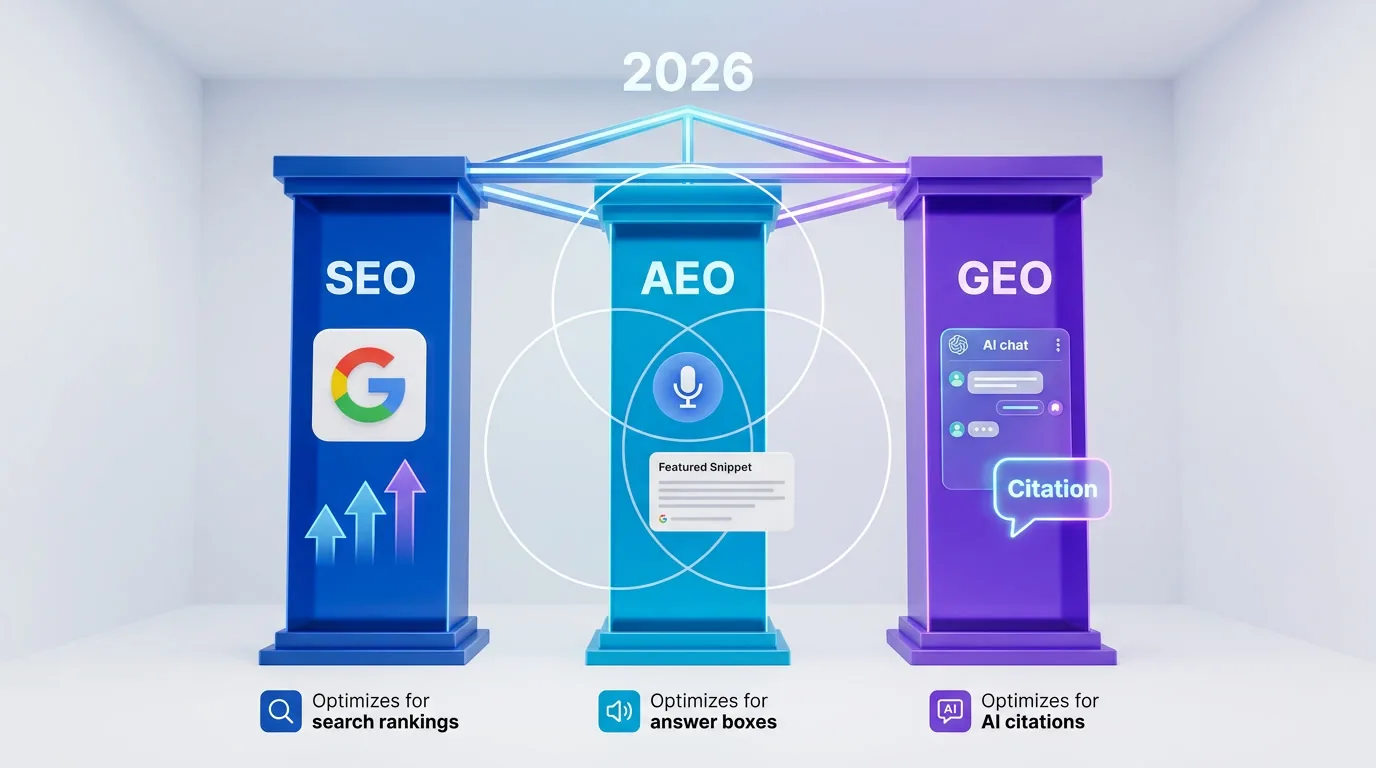
Updated: March 2026. Search in 2026 has three layers: SEO (Search Engine Optimization) gets you ranked on Google. AEO (Answer Engine Optimization) gets you featured in answer boxes and AI Overviews. GEO (Generative Engine Optimization) gets you cited by AI engines like ChatGPT and Perplexity. According to Bain & Company, 80% of Google searches now end without a click — meaning if you only optimize for traditional rankings, you're invisible in the majority of search interactions.
This guide explains the difference between SEO, AEO, and GEO, shows you a side-by-side comparison, and gives you a concrete audit framework to assess your coverage across all three.
Check your SEO + GEO coverage in 60 seconds
Rankeo's free audit scans your site for traditional SEO issues AND tests your visibility across five AI engines.
Run free SEO + GEO audit →What Are SEO, AEO, and GEO? (The Quick Answer)
SEO (Search Engine Optimization) is the practice of optimizing web pages to rank higher in traditional search engine results — primarily Google. SEO focuses on keywords, backlinks, technical health, and content quality. It has been the foundation of digital marketing since the late 1990s.
AEO (Answer Engine Optimization) is the practice of optimizing content to appear as a direct answer in search features like Google Featured Snippets, AI Overviews, People Also Ask boxes, and voice assistant responses. AEO focuses on structured answers, FAQ schema, and concise formatting.
GEO (Generative Engine Optimization) is the practice of optimizing content to be cited by AI-powered search engines — ChatGPT, Perplexity, Gemini, Claude, and Grok. GEO focuses on topical authority, entity clarity, data density, E-E-A-T signals, and structured data that helps large language models understand and reference your content.
| Dimension | SEO | AEO | GEO |
|---|---|---|---|
| Target | Google SERPs | Answer boxes / AI Overviews | AI chat engines |
| Goal | Rank higher | Be the direct answer | Get cited in AI responses |
| Content Format | Long-form, keyword-optimized | Concise, structured answers | Data-dense, authoritative |
| Key Signals | Backlinks, relevance, CWV | Schema, FAQ, how-to markup | E-E-A-T, freshness, entities |
| Measurement | Rankings, organic traffic | Featured Snippet rate | AI citation count |
| Timeline | Months | Weeks to months | Weeks |
In summary, SEO gets you ranked, AEO gets you featured, and GEO gets you cited — and the most visible brands in 2026 are doing all three.
How Does Traditional SEO Still Work in 2026?
Traditional SEO remains the foundation of online visibility. Google processes over 8.5 billion searches per day, and organic results still account for the majority of web traffic. SEO works by making your pages discoverable (crawling), understandable (indexing), and authoritative (ranking) to Google's algorithms.
What SEO Optimizes For
SEO targets Google's organic search results — the ten blue links. The core mechanics include:
- Crawling — ensuring Googlebot can access and navigate your site (robots.txt, sitemap, internal linking)
- Indexing — ensuring your pages are stored in Google's index with the right content and metadata
- Ranking — earning higher positions through relevance, authority, and user experience signals
SEO Ranking Factors That Still Matter
Google's core ranking factors in 2026 include content quality and relevance, backlink profile and domain authority, technical health (Core Web Vitals, mobile-friendliness, HTTPS), and user engagement signals. According to a study by Backlinko, the average first-page result on Google has 3.8x more backlinks than positions 2 through 10.
The Limits of SEO Alone
The problem with SEO-only strategies in 2026 is clear: 80% of Google searches now end without a click (Bain & Company, 2026). AI Overviews, Featured Snippets, and Knowledge Panels satisfy user intent directly on the results page. According to WebProNews, publishers have seen a 30-40% decline in organic traffic since AI Overviews rolled out. SEO alone leaves you ranked but increasingly unclicked.
In summary, SEO is still essential as the foundation of search visibility, but relying on it exclusively means losing ground to AI-powered search features.
What Is Answer Engine Optimization (AEO)?
Answer Engine Optimization (AEO) is the strategy of formatting content to appear as a direct answer in search features. These include Google Featured Snippets, AI Overviews (formerly SGE), People Also Ask boxes, and voice assistant responses from Siri, Alexa, and Google Assistant.
How AEO Differs from SEO
While SEO aims to rank a page in the top 10, AEO aims to be the answer — position zero. AEO requires a different content structure: concise answer paragraphs, question-based headings, numbered lists, and comparison tables. According to Semrush data, AEO-optimized content with FAQ schema earns 2x more Featured Snippets than content without structured answer formatting.
AEO in Practice
AEO tactics include:
- FAQ schema markup — structures your Q&A for direct extraction and citation by AI answer engines (ChatGPT, Perplexity, Gemini, Claude)
- How-to schema — formats step-by-step instructions for Featured Snippets
- Direct answer paragraphs — the first 40-60 words under each H2 answer the question directly
- Comparison tables — Google heavily favors structured data in table format for answer boxes
- Concise definitions — bold the key term, define it in one sentence
Google AI Overviews now appear in 35% of all search queries, and up to 80% of problem-solving queries (Google, 2025). AEO is how you capture that real estate.
In summary, AEO bridges the gap between traditional SEO rankings and AI-powered answer features by structuring content as direct, machine-readable answers.
What Is Generative Engine Optimization (GEO)?
Generative Engine Optimization (GEO) is the practice of optimizing content to be cited, referenced, or recommended by AI-native search engines — ChatGPT, Perplexity, Gemini, Claude, and Grok. Unlike Google, these engines don't show a list of links. They generate a synthesized answer and selectively cite sources within that answer.
How AI Engines Work Differently
Traditional search engines rank pages. AI engines generate responses. The process follows Retrieval-Augmented Generation (RAG): the AI retrieves relevant pages from its index, evaluates their authority and relevance, then synthesizes an answer — citing specific sources as inline references.
This means being ranked is not enough. Your content must be structured, authoritative, and data-rich enough for the AI to select it as a citation source. According to a Search Engine Land analysis of 8,000 AI citations, only 11% of domains are cited by both ChatGPT and Perplexity — meaning most websites are invisible to at least one major AI engine.
GEO Ranking Factors
The factors that increase AI citation probability include:
- Topical authority — comprehensive coverage of a topic across multiple pages
- E-E-A-T signals — author credentials, expert quotes, first-hand experience
- Structured data — JSON-LD schema markup increases AI citations by 28%
- Content freshness — content updated within 30 days gets 3.2x more AI citations
- Data density — pages with data tables get 4.1x more AI citations than text-only pages
- Entity clarity — naming specific brands, tools, and concepts rather than vague pronouns
ChatGPT alone has 200M+ weekly active users (OpenAI, 2025), and Perplexity processes over 100M queries per week. These numbers are growing monthly.
In summary, GEO is the newest and fastest-growing optimization discipline, and it requires a fundamentally different approach than traditional SEO.
SEO vs AEO vs GEO — What's the Difference?
The three strategies target different stages of the search ecosystem. Here's a detailed comparison across every key dimension:
| Dimension | SEO | AEO | GEO |
|---|---|---|---|
| Where you appear | Google organic results (10 blue links) | Featured Snippets, AI Overviews, PAA boxes | ChatGPT, Perplexity, Gemini, Claude, Grok |
| User interaction | User clicks your link | User reads your answer on Google | AI cites you in its generated response |
| Primary KPI | Organic traffic, keyword rankings | Featured Snippet win rate, impression share | AI citation count, brand mentions |
| Content strategy | Keyword-targeted long-form content | Question-based, concise answer blocks | Data-dense, entity-rich, authoritative content |
| Technical requirements | Site speed, mobile, HTTPS, sitemap | FAQ schema, HowTo schema, speakable | JSON-LD @graph, llms.txt, entity registry |
| Trust signals | Backlinks, domain age | Structured data, page authority | E-E-A-T, author credentials, citations |
| Competitive landscape | Saturated — 20+ years of competition | Moderate — growing adoption | Low — early mover advantage available |
| Best tool | Semrush, Ahrefs, Google Search Console | Google Rich Results Test, Schema Validator | Rankeo (SEO + GEO combined) |
The key insight: SEO, AEO, and GEO are not competing strategies. They're layers. SEO is the foundation. AEO captures Google's answer features. GEO captures AI engine citations. Together, they cover the full search ecosystem of 2026.
In summary, the difference between SEO, AEO, and GEO is where you appear, how users interact with your content, and what signals each system uses to select sources.
Why Do You Need All Three in 2026?
Search Is Fragmenting
Users no longer search in one place. A 2026 survey by SparkToro found that 40% of 18-34 year olds now start product research on ChatGPT or Perplexity instead of Google. Meanwhile, Google's own AI Overviews answer an increasing share of queries directly on the search page. The result: search traffic is splitting across traditional results, answer features, and AI engines.
The Traffic Data Shows the Shift
According to WebProNews, publishers experienced a 30-40% decline in organic traffic in 2025-2026 due to AI-generated answers. But websites that optimized for AI citations saw a new traffic channel emerge: referral clicks from Perplexity, ChatGPT search, and Gemini — sources that didn't exist two years ago.
The Compound Effect
Optimizing across all three creates a compound effect:
- SEO builds the authority and technical foundation that both AEO and GEO rely on
- AEO captures the 35% of Google queries that trigger answer features — preventing zero-click losses
- GEO captures the growing AI engine audience — 200M+ weekly ChatGPT users alone
- Schema markup helps all three: Google rankings (SEO), answer eligibility (AEO), and AI citation rate (GEO)
What Happens If You Only Optimize for One
SEO only: you rank on Google but get zero AI citations. As AI Overviews eat more clicks, your traffic declines. GEO only: you might get cited by ChatGPT, but without SEO fundamentals (backlinks, technical health), Google's algorithms won't rank you — and 85%+ of search still flows through Google. AEO only: you capture some Featured Snippets but miss the larger organic rankings and the growing AI engine traffic.
In summary, the convergence of traditional search, answer features, and AI engines means that a combined visibility score across all three is the most reliable measure of search performance in 2026.
How to Audit Your Coverage Across SEO, AEO, and GEO
Here's a five-step framework to assess your visibility across all three search layers:
Step 1 — Run a Technical SEO Audit
Start with the foundation. Check crawl errors, broken links, Core Web Vitals, mobile responsiveness, and HTTPS status. Tools: Google Search Console, Rankeo's free audit, or Screaming Frog. A site with technical issues will underperform in all three layers.
Step 2 — Check Your Featured Snippet and AI Overview Coverage (AEO)
Search your top 20 keywords on Google. For each query, note whether an AI Overview or Featured Snippet appears — and whether your site is the source. Check if you have FAQ and HowTo schema markup on key pages. Use Rankeo's free Schema Validator to verify structured data.
Step 3 — Probe AI Engines for Citations (GEO)
Ask ChatGPT, Perplexity, and Gemini questions about your industry. Check if your brand appears in the responses. Follow the 5-minute AI visibility self-audit for a structured testing framework. Or use Rankeo's GEO probe to automate this across five engines.
Step 4 — Calculate a Combined Visibility Score
Assign each layer a score from 0 to 100. SEO: based on organic rankings and traffic. AEO: based on Featured Snippet win rate. GEO: based on AI citation count. A combined visibility tool like Rankeo's Authority Checker calculates this automatically across five dimensions including AI visibility.
Step 5 — Prioritize Actions Based on Gaps
Most sites have strong SEO fundamentals but weak AEO and GEO coverage. Typical priorities:
- No schema markup? → Add Organization, Article, and FAQPage JSON-LD first
- No AI citations? → Add data tables, entity clarity, and an llms.txt file
- No Featured Snippets? → Restructure H2s as questions, add direct answer paragraphs
- Technical issues? → Fix Core Web Vitals and crawl errors before anything else
In summary, auditing all three layers reveals gaps that single-dimension tools miss — and the fix is usually adding structured data and reformatting existing content, not creating new pages.
Ready to cover all three layers?
Rankeo is the only platform that audits SEO, tracks AI citations across five engines, and generates the schema markup and llms.txt files you need — all in one dashboard.
See Founding Member pricing →The Bottom Line
Treating SEO, AEO, and GEO as separate strategies is already outdated. They are three layers of one system, and the brands dominating search in 2026 optimize all three simultaneously. The good news: roughly 80% of the work overlaps — structured data, authoritative content, and clear entity signals feed every layer at once. The brands still running SEO-only playbooks are bleeding visibility to competitors who understood this convergence six months ago.
Start by auditing where you actually stand across all three layers. You cannot fix gaps you have not measured, and most sites have strong SEO foundations but near-zero AEO and GEO coverage.
→ Measure your SEO + GEO visibility with Rankeo's free Authority Checker
Frequently Asked Questions

Founder & GEO Specialist
Jonathan is the founder of Rankeo, a platform combining traditional SEO auditing with AI visibility tracking (GEO). He has personally audited 500+ websites for AI citation readiness and developed the Rankeo Authority Score — a composite metric that includes AI visibility alongside traditional SEO signals. His research on how ChatGPT, Perplexity, and Gemini cite websites has been used by SEO agencies across Europe.
- ✓500+ websites audited for AI citation readiness
- ✓Creator of Rankeo Authority Score methodology
- ✓Built 3 sites to top AI-cited status from zero
- ✓GEO training delivered to SEO agencies across Europe