How to Rank in Google AI Overviews: The Complete Optimization Guide (2026)
Learn how to rank in Google AI Overviews with 10 proven optimization strategies. Discover ranking factors, query types, and tracking methods for AI Overview citations.

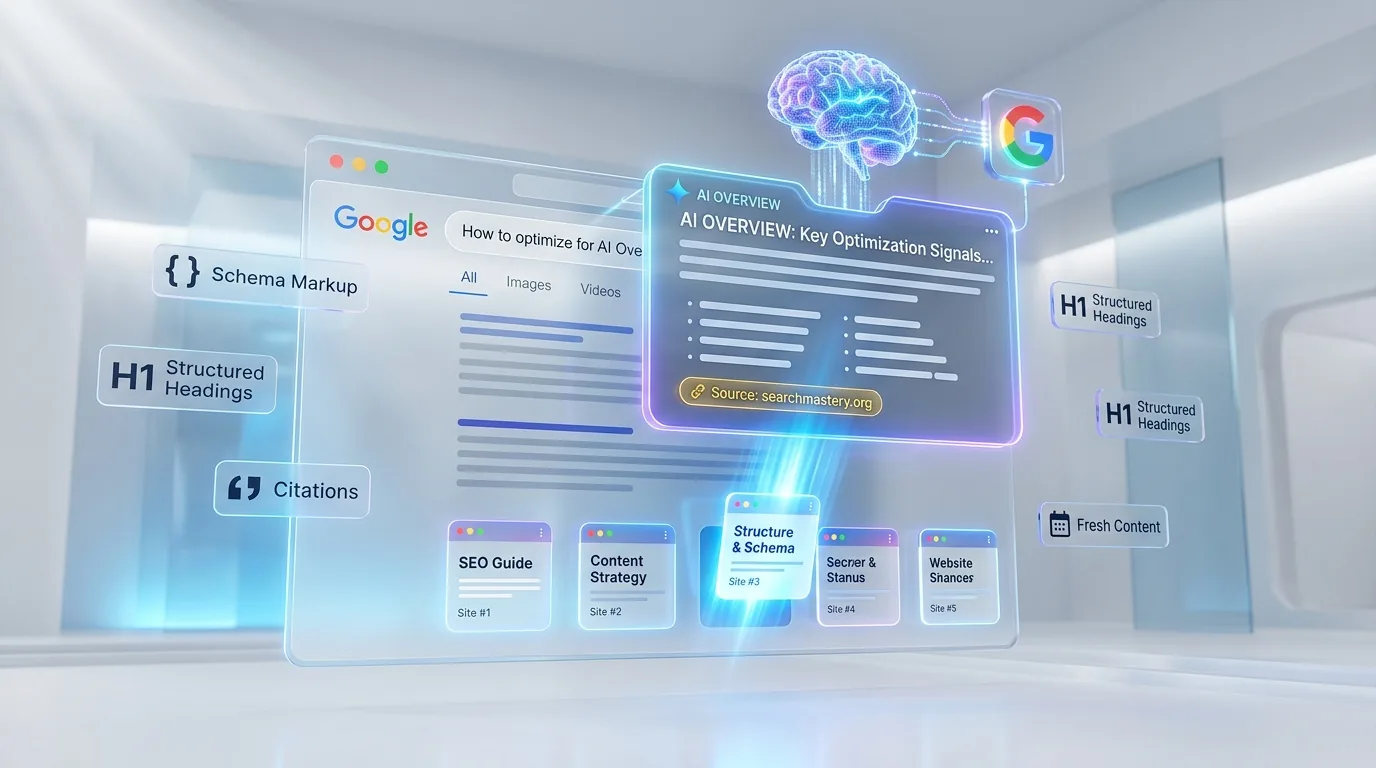
Google AI Overviews optimization is the process of structuring your content so Google's AI selects and cites your pages in the AI-generated summaries that now appear at the top of 35% of all search results. According to Google (2025), pages cited in AI Overviews earn 35% more clicks than uncited pages on the same SERP. For any website relying on organic search traffic, appearing in AI Overviews is no longer optional — it's the new battleground for visibility.
Updated: March 2026. This guide covers everything you need to know about how to rank in AI Overviews, from understanding how Google selects sources to implementing 10 specific optimization strategies. Whether you're already ranking well organically or just beginning your SEO, AEO, and GEO strategy, this article gives you a tactical roadmap for AI Overview citation.
What Are Google AI Overviews?
Google AI Overviews (formerly called Search Generative Experience, or SGE) are AI-generated summaries displayed at the top of Google's search results page. Google's AI reads and synthesizes information from multiple web sources, then presents a concise paragraph-style answer along with cited links to the original pages.
AI Overviews trigger for queries where Google determines a synthesized answer provides more value than a standard list of blue links. According to Google (2025), AI Overviews now appear for approximately 35% of all queries — a number that continues to grow quarter over quarter.
How AI Overviews Differ from Featured Snippets
Featured snippets and AI Overviews may look similar at first glance, but they operate on fundamentally different principles:
- Source count: Featured snippets pull from a single source. AI Overviews synthesize content from 3-5 distinct sources.
- Content generation: Featured snippets extract text verbatim from a page. AI Overviews generate original text by paraphrasing and combining information from multiple pages.
- Query complexity: Featured snippets typically appear for simple, direct questions. AI Overviews trigger for more complex, multi-faceted queries.
- Length: Featured snippets are usually 40-60 words. AI Overviews range from 150-300 words, sometimes more.
In summary, AI Overviews represent a shift from extracting single-source answers to synthesizing multi-source, AI-generated responses — making optimization a fundamentally different challenge than traditional featured snippet optimization.
The Anatomy of an AI Overview
Every Google AI Overview follows a consistent visual structure:
- Header: A bolded title or rephrased version of the query at the top of the AI Overview box.
- Summary paragraph: The main AI-generated answer, typically 150-300 words, synthesized from multiple sources.
- Cited source links: Small favicon + URL cards appearing alongside or below the summary, linking to the 3-5 pages Google used as sources.
- "Show more" expansion: A collapsible section that reveals additional detail or supplementary information.
- Follow-up suggestions: Related questions users can click to generate new AI Overviews, creating a conversational search flow.
In summary, understanding the anatomy of an AI Overview helps content creators structure their pages to match what Google's AI looks for when building these summaries.
AI Overview Statistics You Need to Know (2026)
The data paints a clear picture: AI Overviews are rapidly becoming the dominant SERP feature. Here are the numbers every SEO professional and content strategist needs to internalize:
- 35% of all Google queries now trigger AI Overviews (Google, 2025).
- 80% of problem-solving and how-to queries display AI Overviews, making instructional content the highest-opportunity category.
- 35% more clicks go to pages cited in AI Overviews compared to uncited pages in the same SERP (Semrush, 2025).
- 80% of AI Overview sources come from pages ranking in the top 10 organic results (Google, 2025).
- 3-5 distinct sources are cited in the average AI Overview, meaning multiple pages can benefit from a single query.
- 200+ countries and territories now see AI Overviews, up from just the US at launch.
- 60% of AI Overview citations come from pages with structured data markup (Semrush, 2025).
- 2.5x more likely to be cited: content updated within the last 90 days has a 2.5x higher citation rate (Ahrefs, 2025).
In summary, AI Overviews now affect over a third of all searches, and the citation advantage is significant enough that ignoring AI Overview optimization means leaving measurable traffic on the table.
How Does Google Select Sources for AI Overviews?
Google's AI Overview source selection relies on a combination of traditional SEO signals and AI-specific content quality factors. Understanding these six dimensions is critical for earning citations.
Organic Ranking Foundation
Organic rankings remain the most important prerequisite for AI Overview citation. According to Google (2025), 80% of AI Overview sources come from pages already ranking in the top 10 organic results. Google's AI trusts the same pages that Google's traditional algorithm ranks highly.
This means AI Overview optimization does not replace SEO — it builds on top of SEO. If your pages don't rank on page 1, your chances of appearing in AI Overviews are dramatically lower.
Content Relevance and Depth
Google's AI favors pages that comprehensively cover the query topic. Thin content that answers only the surface-level question rarely gets cited. The AI looks for pages that address the primary question plus related subtopics, providing enough depth to synthesize a thorough answer.
For example, a page about "how to improve page speed" that covers image optimization, code minification, CDN setup, and Core Web Vitals benchmarks will outperform a page that only mentions "compress your images."
E-E-A-T Signals
Google's E-E-A-T framework (Experience, Expertise, Authoritativeness, Trustworthiness) plays a heightened role in AI Overview source selection. The AI prioritizes content from authors and websites with demonstrated E-E-A-T credentials and website authority. Author bylines, credentials, cited sources, and domain authority all influence whether Google's AI trusts your page enough to cite it.
Structured Data and Schema
According to Semrush (2025), 60% of AI Overview citations come from pages with schema markup. Structured data helps Google's AI understand the relationships between entities on your page — what the article is about, who wrote it, what questions it answers, and how the content is organized. Article, FAQ, HowTo, and BreadcrumbList schemas are particularly valuable.
Content Freshness
Content freshness is a strong citation signal for AI Overviews. According to Ahrefs (2025), content updated within the last 90 days is 2.5x more likely to be cited than older content. Google's AI checks the "dateModified" schema property and visible update dates to assess freshness.
Page Experience Signals
Core Web Vitals, mobile-friendliness, HTTPS security, and the absence of intrusive interstitials all feed into Google's page experience evaluation. Pages with poor performance metrics are less likely to be cited, even if their content is excellent.
In summary, Google selects AI Overview sources using a multi-factor evaluation that combines organic ranking strength, content depth, E-E-A-T signals, schema markup, freshness, and page experience — excelling in all six areas maximizes your citation probability.
What Are the 10 Best Strategies to Appear in AI Overviews?
Below are 10 specific, actionable strategies for earning Google AI Overview citations. Each strategy includes concrete implementation steps and real examples.
Strategy 1: Target Question-Based Queries
AI Overviews disproportionately trigger for question-based queries — searches that begin with "what," "how," "why," "which," or "when." Build your keyword strategy around these question patterns.
- Use tools like AnswerThePublic, AlsoAsked, or Google's "People Also Ask" to find question-based queries in your niche.
- Map each target question to a specific H2 section in your content.
- Phrase your H2 headings as the exact question users type, e.g., "How Does Schema Markup Help AI Visibility?"
Strategy 2: Structure Content with Clear H2/H3 Hierarchy
Google's AI uses heading structure to understand content organization. Pages with clean H2/H3 hierarchies are easier for the AI to parse and extract relevant sections from.
- Use one H1 per page (the title).
- Every major topic gets an H2. Every subtopic under that H2 gets an H3.
- Never skip heading levels (e.g., jumping from H2 to H4).
- Keep headings descriptive and keyword-rich, not clever or vague.
Strategy 3: Lead Sections with Concise Answer Paragraphs
Immediately after each H2, include a concise 40-60 word paragraph that directly answers the question posed in the heading. Google's AI frequently extracts these lead paragraphs as source material for AI Overviews.
Example: If your H2 is "What Is Schema Markup?", the first paragraph should be: "Schema markup is a standardized vocabulary of HTML tags that helps search engines understand the meaning and relationships of content on a web page. Schema markup improves how pages appear in search results and increases the likelihood of AI citation."
Strategy 4: Use Data Tables and Comparison Charts
AI Overviews frequently include or reference tabular data. Pages with structured comparison tables are 4.1x more likely to be cited by AI systems, according to Authoritas (2025). Tables make data scannable for both humans and AI.
- Include at least one comparison table per article.
- Use semantic HTML (<table>, <thead>, <tbody>, <th>) rather than CSS-only grid layouts.
- Label columns clearly with descriptive headers.
Strategy 5: Implement Comprehensive Schema Markup
Schema markup is one of the highest-impact levers for AI Overview optimization. Implement a @graph architecture that connects multiple schema types on a single page. At minimum, every content page should include Article, BreadcrumbList, and Organization schema. For guides, add HowTo schema. For FAQ sections, add FAQPage schema.
Read Rankeo's complete guide to schema markup for step-by-step implementation instructions.
Check Your AI Overview Readiness
Run a free SEO audit to see how your pages score on the six factors Google uses to select AI Overview sources — organic ranking, content depth, E-E-A-T, schema, freshness, and page experience.
Run Free SEO Audit →Strategy 6: Add FAQ Sections with Schema
FAQ sections serve double duty: they provide direct answers to common questions (which AI Overviews love to cite) and they generate FAQPage structured data that Google explicitly recognizes. Include 5-8 questions per FAQ section, with answers limited to 2-3 sentences each.
- Use real questions from Google's "People Also Ask" and your site's search analytics.
- Start every answer with a direct response, then elaborate.
- Implement FAQPage schema for every FAQ section.
Validate Your Schema Markup
Use Rankeo's free Schema Validator to check your Article, FAQ, and HowTo markup for errors before deploying to production.
Validate Schema Free →Strategy 7: Include Original Data, Stats, and Research
AI Overviews prioritize pages that contain unique, citable data. Original research, proprietary statistics, survey results, and case study numbers give Google's AI a reason to cite your page instead of a competitor's.
- Conduct original surveys or analyze proprietary data from your platform.
- Present data in clear formats: "According to [Your Brand] analysis of [N] [subjects], [finding] ([year])."
- Include at least one sourced statistic per 300 words throughout your content.
Strategy 8: Optimize for Semantic Relevance
Google's AI evaluates semantic relevance by checking whether your content covers the full topic graph around a query. This means including related entities, subtopics, and terminology that a comprehensive answer would naturally contain.
- Use tools like Rankeo's content analysis to identify related entities and missing subtopics.
- Cover "what," "why," "how," and "when" dimensions of your primary topic.
- Include definitions of key terms, even if they seem obvious to experts.
- Reference related concepts and link to supporting content.
Strategy 9: Keep Content Fresh
According to Ahrefs (2025), content updated within the last 90 days is 2.5x more likely to be cited in AI Overviews. Google's AI checks both the "dateModified" schema and visible last-updated dates on the page.
- Set a content refresh calendar: review and update every 30-90 days.
- Update statistics, add new examples, and refresh screenshots.
- Update your "dateModified" schema value with every meaningful edit.
- Add a visible "Last updated: [date]" note near the top of the article.
Strategy 10: Ensure Excellent Core Web Vitals
Page experience is a confirmed ranking factor, and Google's AI inherits the same quality signals. Pages with poor Largest Contentful Paint (LCP), First Input Delay (FID), or Cumulative Layout Shift (CLS) scores are less likely to earn citations.
- Target LCP under 2.5 seconds, FID under 100ms, and CLS under 0.1.
- Optimize images with next-gen formats (WebP, AVIF) and lazy loading.
- Minimize JavaScript bundles and use efficient rendering strategies.
- Check Rankeo's SEO optimization guide for detailed optimization steps.
In summary, these 10 strategies work together as a system — targeting question-based queries, structuring content for AI extraction, and backing everything with strong technical foundations maximizes your probability of appearing in Google AI Overviews.
| Strategy | Impact | Effort | Recommended For |
|---|---|---|---|
| 1. Target Question-Based Queries | 🟢 High | Low | All content types |
| 2. Clear H2/H3 Hierarchy | 🟢 High | Low | All content types |
| 3. Concise Answer Paragraphs | 🟢 High | Low | How-to guides, explainers |
| 4. Data Tables & Charts | 🟢 High | Medium | Comparison, review content |
| 5. Schema Markup (@graph) | 🟢 High | Medium | All content types |
| 6. FAQ Sections with Schema | 🟡 Medium | Low | Informational, guide content |
| 7. Original Data & Stats | 🟢 High | High | Research, data-driven content |
| 8. Semantic Relevance | 🟢 High | Medium | Long-form, pillar content |
| 9. Content Freshness | 🟡 Medium | Low (ongoing) | All evergreen content |
| 10. Core Web Vitals | 🟡 Medium | Medium-High | All pages |
What Types of Queries Trigger AI Overviews?
Not every Google search triggers an AI Overview. Understanding which query types activate AI Overviews helps you focus your content strategy on the highest-opportunity keywords.
Problem-Solving Queries
Queries like "how to fix a leaking faucet" or "how to improve website speed" are the most common AI Overview triggers. According to Google (2025), 80% of problem-solving and how-to queries now display AI Overviews. These queries demand step-by-step, actionable answers — exactly what AI Overviews are designed to synthesize.
Comparison Queries
Searches like "React vs Vue for enterprise apps" or "best CRM for small businesses" frequently trigger AI Overviews with comparison-style responses. Google's AI pulls from pages that include structured comparison tables, pros/cons lists, and balanced analysis of multiple options.
Definitional Queries
"What is" and "meaning of" queries generate AI Overviews when the topic is complex enough that a standard dictionary definition is insufficient. For instance, "what is generative engine optimization" triggers an AI Overview, while "what is a dog" typically does not.
Process Queries
Queries beginning with "steps to," "guide to," or "process for" consistently trigger AI Overviews. Google's AI assembles numbered step sequences from multiple sources, making HowTo schema particularly valuable for these queries.
Queries That Rarely Trigger AI Overviews
Certain query types rarely or never display AI Overviews:
- Navigational queries: "Facebook login" or "Amazon Prime" — users want a specific website, not a synthesized answer.
- Transactional queries: "Buy Nike Air Max" — Google shows Shopping results instead.
- Some YMYL queries: Highly sensitive health, financial, or legal queries may not trigger AI Overviews due to Google's caution around misinformation risk.
In summary, content creators should prioritize problem-solving, comparison, definitional, and process queries when building their AI Overview optimization strategy, as these four categories account for the vast majority of AI Overview appearances.
How Can You Track Your AI Overview Appearances?
Measuring your AI Overview citation performance requires a combination of tools and manual processes, since Google does not yet provide a dedicated AI Overview report in Search Console.
Google Search Console Insights
Google Search Console's Performance report now includes filter options for "Search Appearance" that let you identify queries where your pages appeared alongside or within AI Overviews. While the data is not granular enough to show exact citation position, it provides directional insight into which queries trigger AI Overview appearances for your domain.
Third-Party Tools
SEO platforms like Semrush, Ahrefs, and specialized AI search trackers now offer AI Overview monitoring features. These tools track whether your pages appear as cited sources for specific keywords, how citation frequency changes over time, and which competitors are earning citations you are not. Rankeo integrates both SEO rankings and AI citation tracking into a single dashboard.
Manual Spot-Checking
For your highest-priority keywords, perform manual searches in an incognito browser window to verify AI Overview appearances. Document the results in a spreadsheet: query, whether an AI Overview appeared, which sources were cited, and your citation position (1st, 2nd, 3rd, etc.).
Metrics to Track
Focus on four key metrics for AI Overview performance:
- AI Overview appearance rate: What percentage of your target keywords trigger AI Overviews?
- Citation rate: Of those, what percentage cite your pages?
- Citation position: Are you the 1st, 2nd, or 3rd cited source? First-position citations earn the most clicks.
- CTR impact: Compare CTR for keywords where you are cited in AI Overviews versus keywords where you are not.
In summary, tracking AI Overview appearances requires combining Search Console data with third-party monitoring tools and periodic manual checks — the teams that measure AI Overview performance consistently are the ones that improve it fastest.
AI Overviews vs Featured Snippets — Should You Optimize for Both?
Many SEO professionals wonder whether they should focus on AI Overviews or featured snippets. The answer is both — and the good news is that most optimization tactics overlap significantly.
| Dimension | AI Overviews | Featured Snippets |
|---|---|---|
| Sources | Multiple (3-5 cited pages) | Single page |
| Length | 150-300 words | 40-60 words |
| Content Format | AI-synthesized paragraph | Extracted verbatim text |
| Query Type | Complex, multi-faceted queries | Simple, direct Q&A |
| SERP Position | Top of SERP (above all results) | Position 0 (above organic) |
| Optimization Focus | Depth, schema, multi-topic coverage | Concise answer paragraphs, lists |
| Schema Importance | High (60% of cited pages use schema) | Moderate |
The tactical overlap is substantial. Clear heading structure, concise answer paragraphs, structured data, and strong E-E-A-T signals benefit both AI Overviews and featured snippets. The primary difference is depth: AI Overviews reward comprehensive, multi-section content, while featured snippets reward tight, focused answers.
The most effective strategy is to structure each H2 section so the opening paragraph works as a featured snippet candidate (40-60 words, direct answer), while the full section provides the depth that AI Overviews require.
In summary, optimizing for both AI Overviews and featured snippets is not only possible but recommended — the core tactics overlap, and pages optimized for both maximize their SERP real estate across traditional and AI-powered search features.
Conclusion: Start Optimizing for AI Overviews Today
Google AI Overviews are reshaping how search works. With 35% of all queries now triggering AI Overviews and that number growing every quarter, the window to establish your pages as cited sources is narrowing. The 10-strategy framework in this guide — from targeting question-based queries to maintaining excellent Core Web Vitals — provides a comprehensive roadmap.
The key insight is that AI Overview optimization is not a replacement for traditional SEO. It is an extension of SEO. You need strong organic rankings to qualify as a source, and you need AI-optimized content structure to actually get cited. Both matter. Both work together.
Start with the highest-impact, lowest-effort strategies first: target question-based queries (Strategy 1), structure your content with clear heading hierarchies (Strategy 2), and lead every section with a concise answer paragraph (Strategy 3). Then layer in schema markup, original data, and freshness routines.
Ready to Optimize for AI Overviews?
Rankeo audits your pages for both traditional SEO health and AI Overview readiness in a single pass. See exactly where your content stands — and what to fix first.
See Rankeo Pricing →Frequently Asked Questions

Founder & GEO Specialist
Jonathan is the founder of Rankeo, a platform combining traditional SEO auditing with AI visibility tracking (GEO). He has personally audited 500+ websites for AI citation readiness and developed the Rankeo Authority Score — a composite metric that includes AI visibility alongside traditional SEO signals. His research on how ChatGPT, Perplexity, and Gemini cite websites has been used by SEO agencies across Europe.
- ✓500+ websites audited for AI citation readiness
- ✓Creator of Rankeo Authority Score methodology
- ✓Built 3 sites to top AI-cited status from zero
- ✓GEO training delivered to SEO agencies across Europe