The Rankeo Score Explained: How We Calculate SEO + AI Visibility in One Number
How the Rankeo Score combines traditional SEO metrics with AI visibility into a single 0-100 score. Methodology, sub-scores, and how to improve yours.

Domain Authority tells you how strong your backlinks are. Google PageRank (RIP) told you how important your page was. Neither tells you if ChatGPT, Perplexity, or Gemini will ever mention your brand.
The Rankeo Score is different. It is a single 0–100 number that combines traditional SEO signals with AI visibility into one unified metric. Instead of checking five different tools to understand your online presence, you check one score and immediately know where you stand across both Google and AI search engines.
We built it because no existing metric answered the question every business owner asks in 2026: “When someone asks an AI about my industry, does my brand show up?” Domain Authority cannot answer that. PageSpeed scores cannot answer that. The Rankeo Score can.
In this article, we will walk through the exact methodology: the five pillars, their weights, how each sub-score is calculated, and the specific actions you can take to move the needle. No black boxes. Full transparency. For definitions and formulas of the individual metrics that feed the score — Citation Rate, AI Share of Voice, Answer Position and the rest — see the AI search visibility metrics reference.
Why Existing SEO Metrics Miss Half the Picture
The SEO industry has spent two decades building metrics around backlinks. Moz created Domain Authority. Ahrefs built Domain Rating. Semrush launched Authority Score. Each one measures some combination of linking domains, link quality, and referring pages. They are useful, but they were designed for a world where Google was the only search engine that mattered.
That world no longer exists. In 2026, an estimated 30% of informational queries start in an AI interface rather than a traditional search bar. ChatGPT, Perplexity, Gemini, Claude, and Grok are answering questions, recommending products, and citing sources. The rules that govern which sites they cite are fundamentally different from Google’s PageRank algorithm.
Here is the disconnect: roughly 40% of sites that rank in Google’s top 10 for a query are never mentioned by ChatGPT for the same query. The reverse is also true. Sites with mediocre backlink profiles but excellent structured data and clear entity definitions are getting cited by AI engines that Google might rank on page two.
Traditional metrics measure the backlink game. They do not measure whether your structured data helps AI models understand what your business does, whether your content is formatted in a way AI can parse and verify, or whether any AI engine has ever cited you as a source. That is an enormous blind spot, and it grows larger every quarter as AI search adoption accelerates.
| Metric | What It Measures | What It Misses |
|---|---|---|
| Moz DA | Backlink strength, linking domains | Content quality, schema, AI visibility |
| Ahrefs DR | Backlink profile quality | Technical SEO, structured data, AI citations |
| Semrush Authority Score | Links + traffic + spam signals | Structured data, AI visibility, content depth |
| Google PageSpeed | Performance and Core Web Vitals | Backlinks, content, schema, AI citations |
| Rankeo Score | Technical + Content + Schema + AI Visibility + Trust | Nothing in the modern search landscape |
The Rankeo Score was built to fill this gap. It does not replace Domain Authority. It replaces the need for Domain Authority by including backlink-adjacent trust signals alongside the metrics that DA ignores entirely.
The 5 Pillars of the Rankeo Score
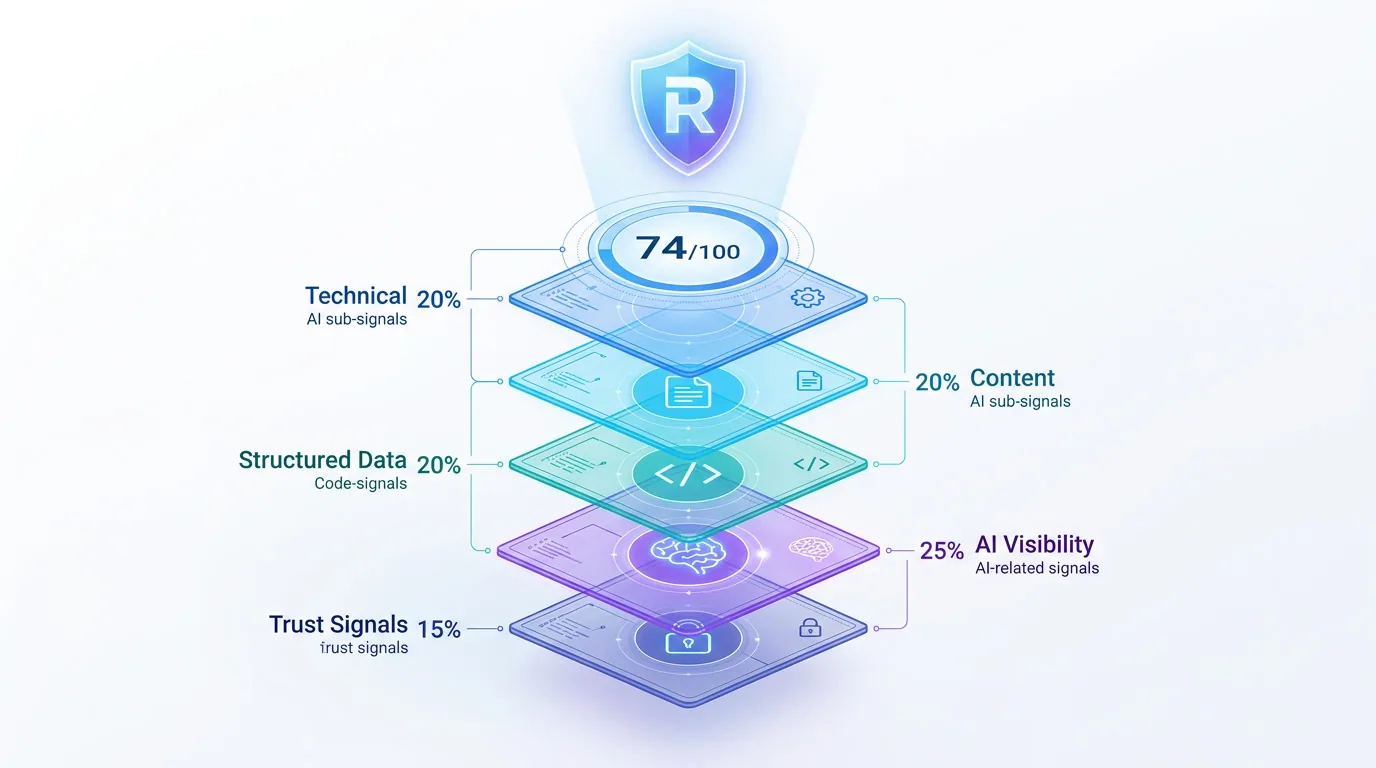
The Rankeo Score is a weighted composite of five sub-scores. Each pillar is scored independently on a 0–100 scale, then combined using fixed weights that reflect how much each category contributes to real-world visibility in 2026. Here is every pillar, what it measures, and why it matters.
1. Technical Health (20%)
Technical Health measures whether your site meets the baseline infrastructure requirements that both search engines and AI crawlers expect. Think of it as the foundation: without it, nothing else matters. A beautifully written page with broken SSL will not rank on Google and will not be cited by AI engines.
This sub-score evaluates your SSL certificate status, page load speed, mobile responsiveness, the presence and correctness of your XML sitemap, your robots.txt configuration, canonical tag implementation, and whether your site returns proper HTTP status codes. Each signal is binary or graded: SSL is either valid or it is not, while page speed is scored on a curve against industry benchmarks.
We weight Technical Health at 20% because it is a prerequisite rather than a differentiator. Most modern sites get the basics right. But when they do not, the penalty is severe: a single missing SSL certificate can drop this entire sub-score to near zero, dragging down your overall Rankeo Score significantly.
2. Content Quality (20%)
Content Quality measures how well your on-page content is structured and optimized for both human readers and machine parsing. This is not about subjective “good writing” — it is about the measurable signals that correlate with higher rankings and more AI citations.
The sub-score evaluates your title tag optimization (length, keyword presence, uniqueness), meta description quality, H1 tag usage, heading hierarchy (H2 through H4), word count relative to the page type, internal link density, and image alt text coverage. Each factor is scored individually and then aggregated into the Content Quality sub-score.
Internal linking gets special attention in this pillar. AI engines rely heavily on link context to understand entity relationships. A page with zero internal links pointing to it is effectively invisible to both Googlebot and AI crawlers trying to map your site’s knowledge graph. We measure both the quantity and contextual relevance of your internal links.
Content Quality is weighted at 20% because it represents the substance of what you offer. Great technical infrastructure with thin content will not sustain rankings or earn AI citations. This pillar ensures your content meets the depth and structure thresholds that modern search demands.
3. Structured Data (20%)
Structured Data measures the presence, correctness, and completeness of your schema markup. This is the pillar that most sites neglect and where the biggest quick wins exist.
We check for the presence of key schema types: Organization, WebSite, WebPage, BreadcrumbList, LocalBusiness (if applicable), Product, Article, and FAQ. Beyond mere presence, we validate the structure. Is your Organization schema using a proper @id reference? Does your WebSite schema include a SearchAction? Are your breadcrumbs correctly nested? Incomplete or malformed schema counts for partial credit, not full marks.
The reason structured data gets a full 20% weight is its outsized impact on AI visibility. AI engines do not “see” your website the way a human does. They parse your HTML, and if they find valid JSON-LD schema, they can extract entities, relationships, and facts with far higher confidence. Sites with comprehensive schema markup are significantly more likely to be cited as sources by ChatGPT, Perplexity, and Gemini. Our data shows that sites with three or more schema types implemented see up to 3x more AI citations than sites with no structured data.
You can check your current schema markup using our free Schema Validator tool, and generate production-ready JSON-LD for your site with Rankeo’s Schema Generator.
4. AI Visibility — GEO (25%)
AI Visibility is the pillar that makes the Rankeo Score unique. No other authority metric measures this. It answers a simple question: do AI search engines mention your brand?
This sub-score is derived from our GEO (Generative Engine Optimization) probing system. We send industry-relevant queries to five major AI engines — ChatGPT, Perplexity, Gemini, Claude, and Grok — and analyze whether your brand, domain, or content is cited in the responses. The score factors in citation frequency (how often you appear), citation prominence (are you mentioned first or buried in a list?), and engine coverage (appearing in one engine is good; appearing in four is exceptional).
We weight AI Visibility at 25%, the highest of any single pillar, because it represents the frontier of search. AI-driven answers are growing at an exponential rate. A site that is invisible to AI engines today is leaving an accelerating amount of traffic and brand awareness on the table. By giving this pillar the most weight, the Rankeo Score rewards sites that are future-proofing their visibility rather than optimizing only for the search paradigm of the past.
If your AI Visibility sub-score is low, it does not mean your site is bad. It means AI engines have not yet learned to trust and cite you. The most effective levers are structured data (Pillar 3), authoritative content that AI models can verify, and explicit entity definitions that help AI understand who you are and what you do.
5. Trust Signals (15%)
Trust Signals measure the external indicators that both search engines and AI models use to assess your site’s credibility. These are signals you accumulate over time rather than implement in an afternoon.
This sub-score evaluates domain age (older domains carry more inherent trust), SSL certificate validity and issuer quality, the presence of social media profiles linked from your site, the number of indexed pages (a proxy for content breadth), and basic trust markers like a physical address, privacy policy, and contact information. When we integrate third-party data sources like Moz and DataForSEO in the future, backlink metrics such as Domain Authority, referring domains, and spam score will feed into this pillar as well.
Trust Signals is weighted at 15%, the lowest of any pillar, because these signals are the slowest to change and the least actionable in the short term. You cannot make your domain older. You cannot instantly earn a thousand referring domains. But the signals still matter: a brand-new domain with zero trust indicators will score lower than an established site, all else being equal. This pillar ensures the Rankeo Score accounts for the long-term credibility that both Google and AI engines factor into their ranking and citation decisions.
The Formula
The Rankeo Score is calculated as a weighted sum of the five pillar sub-scores:
Rankeo Score = (Technical Health x 0.20) + (Content Quality x 0.20) + (Structured Data x 0.20) + (AI Visibility x 0.25) + (Trust Signals x 0.15)Each sub-score ranges from 0 to 100. The weights sum to 1.0, so the final Rankeo Score also falls on a 0–100 scale. There is no logarithmic transformation, no mystery normalization. A site that scores 80 in every pillar will have a Rankeo Score of 80.
The reason AI Visibility carries the highest weight (25%) is deliberate. Traditional SEO metrics already over-index on backlinks and technical signals. The Rankeo Score is designed to reflect where search is going, not just where it has been. As AI search grows from 30% to 50% of informational queries, the 25% weight for AI Visibility ensures that your score penalizes AI invisibility proportionally to the opportunity cost it represents.
We also chose linear weighting over logarithmic scaling to keep the score intuitive. If your Structured Data sub-score improves from 40 to 60, you know your Rankeo Score will improve by exactly 4 points (20 point gain times 0.20 weight). No guesswork, no diminishing returns hidden behind a curve. Transparency is a feature, not an afterthought.
How to Improve Each Sub-Score
Understanding the methodology is useful. Acting on it is what moves your score. Here are the highest-impact actions for each pillar.
Improve Technical Health
Start with SSL: if your certificate is expired or missing, fix it immediately. It is the single largest drag on this sub-score. Next, run a speed test and address anything that pushes your Largest Contentful Paint above 2.5 seconds. Ensure your XML sitemap is present, correctly formatted, and submitted to Google Search Console. Verify that your robots.txt is not accidentally blocking important pages. Finally, check for mobile responsiveness issues using Google’s mobile-friendly test. These are all binary fixes: do them once, and your Technical Health sub-score jumps immediately.
Improve Content Quality
Audit your title tags: every page should have a unique title under 60 characters that includes your primary keyword. Write meta descriptions that are compelling and under 155 characters. Ensure every page has exactly one H1 tag and a logical heading hierarchy. Add internal links between related pages, aiming for at least 3–5 internal links per page. Check that every image has descriptive alt text. If your key pages have fewer than 800 words, consider expanding them with substantive content that adds genuine value.
Improve Structured Data
Deploy Organization, WebSite, and WebPage schema on every page as a baseline. Add BreadcrumbList schema for navigation clarity. If you run a local business, add LocalBusiness schema. For blog posts, add Article schema. For product pages, add Product schema. Use our Schema Validator to check your existing markup for errors, then use our complete schema guide to build a comprehensive implementation. Aim for at least three distinct schema types across your site to maximize AI visibility benefits.
Improve AI Visibility
AI Visibility is driven by the other pillars plus external factors. The most direct lever is structured data (see above). Beyond that, create content that AI models can easily fact-check: include specific data points, cite your sources, and define your entities clearly. Add an llms.txt file to help AI crawlers understand your site. Read our complete GEO guide for the full playbook on getting cited by AI search engines. The key insight is that AI visibility is not a separate optimization — it is the cumulative result of doing everything else well, plus making your site explicitly machine-readable.
Improve Trust Signals
Some trust signals are out of your immediate control (domain age), but others are not. Link your official social media profiles from your site footer. Add a physical address, a privacy policy, and clear contact information. Publish consistently to increase your number of indexed pages. Get listed in relevant industry directories. Over time, build genuine backlinks through guest posts, original research, and digital PR. Trust Signals is the slow-burn pillar, but every incremental improvement compounds.
Check Your Rankeo Score
You can check your Rankeo Score right now. Our free Authority Checker tool calculates your overall Rankeo Score and all five sub-scores in seconds. Enter your domain, and you will see exactly where you stand across Technical Health, Content Quality, Structured Data, AI Visibility, and Trust Signals.
For ongoing monitoring, create a free Rankeo account to track your score over time, get actionable recommendations tailored to your weakest pillars, and receive alerts when your score changes significantly. Pro and Business plans include automated re-audits so your score stays current without any manual effort.
The Rankeo Score is not a vanity metric. It is a diagnostic tool. Every point below 100 represents a specific, fixable gap in your search visibility. Use it to find those gaps, close them, and watch your traffic grow across both traditional and AI search.
The Bottom Line
Domain Authority had its decade. It measures one dimension of a multi-dimensional problem. In 2026, a site with DA 70 and zero AI citations is losing ground to a site with DA 30 that ChatGPT and Perplexity actually recommend. The Rankeo Score exists because no single number previously captured both traditional search strength and AI engine visibility together.
Run your score now and focus on your weakest pillar first. For most sites, that means structured data or AI visibility, the two pillars legacy tools completely ignore.
Frequently Asked Questions

Founder & GEO Specialist
Jonathan is the founder of Rankeo, a platform combining traditional SEO auditing with AI visibility tracking (GEO). He has personally audited 500+ websites for AI citation readiness and developed the Rankeo Authority Score — a composite metric that includes AI visibility alongside traditional SEO signals. His research on how ChatGPT, Perplexity, and Gemini cite websites has been used by SEO agencies across Europe.
- ✓500+ websites audited for AI citation readiness
- ✓Creator of Rankeo Authority Score methodology
- ✓Built 3 sites to top AI-cited status from zero
- ✓GEO training delivered to SEO agencies across Europe