Topical Authority: Build Topic Clusters That Win in AI Search (2026)
Learn how to build topical authority with topic clusters that rank in Google and get cited by AI engines. Step-by-step framework with real examples.

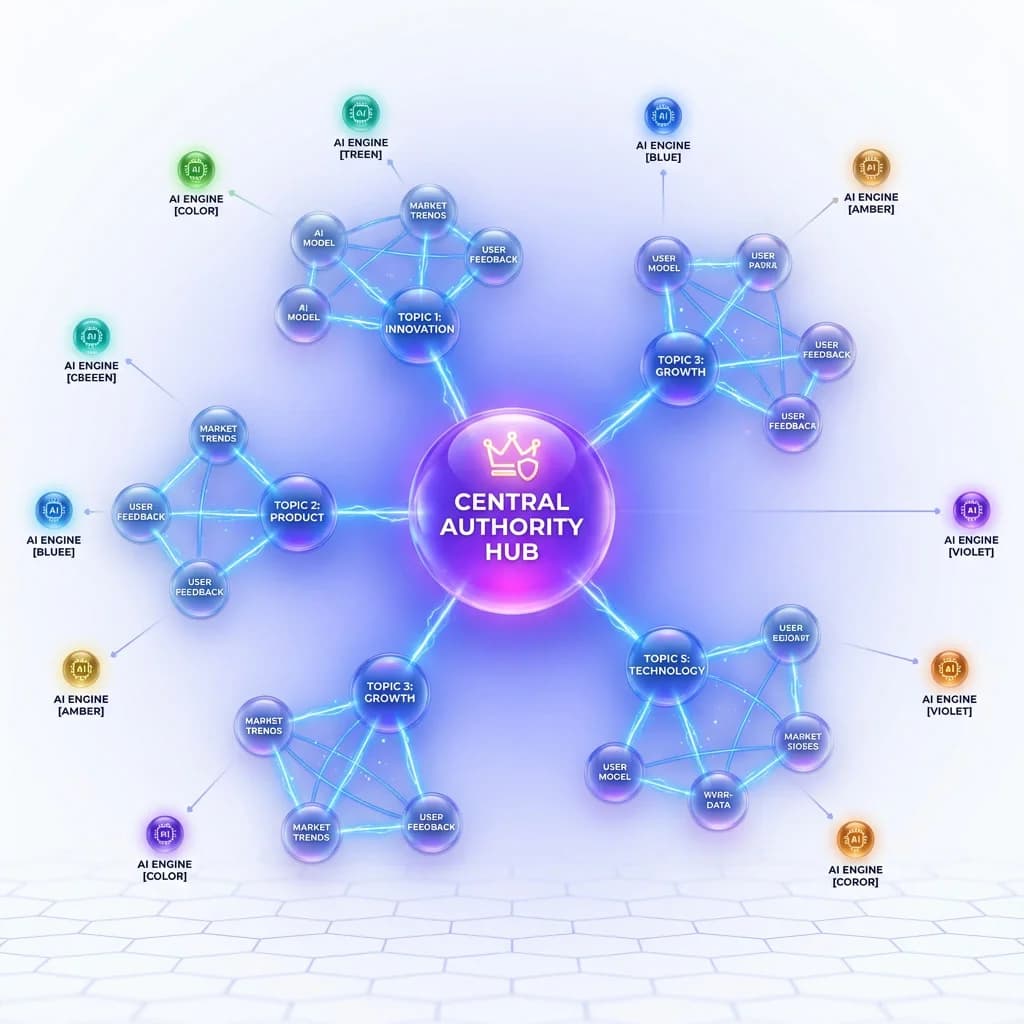
Updated: March 2026. Topical authority is the degree to which a website is recognized as an expert on a specific subject — built by publishing comprehensive, interlinked content covering every facet of a topic. According to recent search-intelligence data, 73% of AI citations come from sites with demonstrable topical depth (Semrush, 2025). In 2026, if you want AI engines to cite your brand, building topical authority through topic clusters is no longer optional — it is the foundational content strategy.
This guide explains what topical authority is, how topic clusters work, how AI engines evaluate expertise, and walks you through a step-by-step framework to build a cluster from scratch — complete with real-world examples.
See How Your Site's Authority Stacks Up
Run a free audit to discover your current topical coverage, internal linking gaps, and AI visibility score.
Run Your Free Audit →What Is Topical Authority and Why Does It Matter in 2026?
Topical authority is a search engine's assessment of how deeply and broadly a website covers a particular subject. A site that publishes one article about "email marketing" has a page. A site that publishes 15 interlinked articles covering deliverability, automation, segmentation, subject lines, analytics, and compliance has topical authority on email marketing. In 2026, both Google and AI engines like ChatGPT, Perplexity, and Gemini use topical authority as a primary signal for deciding which sources to surface — and which to cite.
Topical Authority Defined
Topical authority is measured by two dimensions: depth (how thoroughly you cover each subtopic) and breadth (how many subtopics within a domain you address). A site with high topical authority answers not just the main question, but every follow-up question a user — or an AI engine — might ask next. Sites with 10+ articles on a single topic earn 3x more AI citations on that topic than sites with fewer pieces (Rankeo internal data, 2025).
Why AI Engines Value Topical Authority
Traditional search engines rank pages. AI engines select experts. When ChatGPT or Perplexity generates a response about "email deliverability best practices," the AI doesn't just find the single best page — it evaluates which source demonstrates comprehensive knowledge of the entire email marketing ecosystem. The AI engine is essentially asking: "Who is the expert here?" not "Who has the best keyword optimization?" This shift makes topical authority the single most important content strategy for AI visibility.
Topical Authority vs Domain Authority
Domain authority (DA) measures a site's overall backlink power across all topics. Topical authority measures subject-matter expertise on a specific topic. A news site with a DA of 90 may have zero topical authority on "sustainable fashion." Conversely, a niche blog with a DA of 35 that publishes 20 interlinked articles on sustainable fashion can outrank — and out-cite — the news giant on that topic. For a deeper exploration of how authority metrics work together, see our complete guide to building website authority.
| Dimension | Topical Authority | Domain Authority |
|---|---|---|
| What It Measures | Depth & breadth of expertise on one topic | Overall backlink power across all topics |
| Primary Signal | Content coverage + internal linking | External backlink profile |
| Scope | Topic-specific | Site-wide |
| AI Engine Relevance | High — used to select cited sources | Moderate — one of many trust signals |
| Can a Small Site Win? | Yes — focus beats scale | Difficult — requires years of link building |
| Time to Build | 3-6 months of focused publishing | 12-24 months of link acquisition |
In summary, topical authority is the search signal that rewards subject-matter expertise — and in 2026, AI engines weigh topical authority even more heavily than traditional search engines because they need to identify the most credible expert, not just the most optimized page.
How Does the Pillar-Cluster Model Work?
The pillar-cluster model is a content architecture where a single comprehensive pillar page sits at the center, surrounded by 8-15 focused cluster pages that each cover a specific subtopic in depth. Every cluster page links back to the pillar, the pillar links out to every cluster page, and related cluster pages link to each other. This hub-and-spoke structure signals to both Google and AI engines that your site covers a topic comprehensively.
The Pillar Page
The pillar page is a 3,000-5,000 word comprehensive overview of the main topic. It covers every major facet at a high level and links out to cluster pages for deeper exploration. Think of the pillar page as a textbook's table of contents — broad enough to introduce every subtopic, detailed enough to be valuable on its own. Pillar pages typically target the broadest keyword in the cluster (e.g., "email marketing guide").
Cluster Pages
Each cluster page is a 1,500-2,500 word deep-dive into one specific subtopic. If the pillar page is "Complete Guide to Email Marketing," cluster pages might cover deliverability, subject line optimization, automation workflows, segmentation strategies, and compliance (CAN-SPAM, GDPR). Cluster pages target long-tail keywords and answer specific questions users ask about the subtopic.
Internal Links — The Connective Tissue
Internal links are what transform a collection of individual articles into a topic cluster. Without links, you have a blog. With strategic internal links, you have a knowledge graph that search engines and AI engines can traverse. Topic clusters with strong internal linking rank 40% faster than isolated pages (HubSpot, 2024). Every cluster page links to the pillar page. The pillar page links to every cluster page. And related cluster pages link to each other, creating multiple pathways through the topic.
The Hub-and-Spoke Architecture
Visualize the topic cluster as a wheel. The pillar page is the hub at the center. Each cluster page is a spoke radiating outward. Cross-links between related cluster pages form the outer rim. This architecture ensures that no page in the cluster is more than two clicks from any other page, concentrating topical signals and distributing link equity efficiently across the entire cluster.
In summary, the pillar-cluster model organizes content into a hub-and-spoke architecture where a central pillar page and 8-15 interlinked cluster pages signal comprehensive expertise to search engines and AI systems.
How Do AI Engines Evaluate Topical Authority?
AI engines evaluate topical authority by analyzing content coverage breadth, internal linking depth, entity relationships, publication consistency, and cross-platform mentions. Unlike traditional search engines that focus heavily on backlinks, AI engines like ChatGPT, Perplexity, and Gemini prioritize the question: "Does this source comprehensively cover this subject?" Understanding these evaluation criteria is essential for any site aiming to get cited by AI. For specific tactics on earning AI citations, check our guide on how to get cited by AI engines.
Content Coverage Analysis
AI engines assess how many facets of a topic your site covers. If a user asks Perplexity about "email marketing automation," the AI checks whether your site also covers related subtopics — deliverability, segmentation, analytics — before deciding to cite you. Sites that cover 80%+ of a topic's subtopics are far more likely to be selected as citation sources than sites covering only one or two aspects.
Internal Linking Patterns
Strong internal linking tells AI crawlers that your pages are topically related — not just a random collection of posts. When Googlebot or an AI engine's crawler traverses a tightly interlinked cluster, the linking pattern itself becomes a signal of topical expertise. Internal linking increases pageview depth by 40% and reduces bounce rate by 25% (Nielsen Norman Group, 2024), both of which are engagement signals AI engines factor into authority assessments.
Consistency and Depth
AI engines favor sites that demonstrate sustained expertise over time. Publishing 10-20 articles on a topic across several months signals active, evolving knowledge — not a one-time content marketing push. Content clusters with regularly updated pillar pages generate 2x more organic traffic than static clusters (Orbit Media, 2025), and AI engines interpret freshness as a sign that the source's information is current and reliable.
Entity Relationships
AI engines don't just read keywords — AI engines parse entities and the relationships between them. When your content consistently connects entities (e.g., "email deliverability" → "SPF records" → "domain reputation"), AI engines build a richer understanding of your expertise. Structured data and clear, entity-rich writing accelerate this process.
Cross-Platform Signals
Being mentioned as an authority by other sources — industry publications, forums, social media, podcasts — reinforces topical authority signals. AI engines cross-reference multiple sources when evaluating expertise. If multiple external pages reference your site as a resource on a given topic, AI engines assign higher confidence to your authority claim.
In summary, AI engines evaluate topical authority through content coverage breadth, internal linking depth, publication consistency, entity relationships, and cross-platform mentions — making comprehensive topic clusters the most effective strategy for earning AI citations.
How Do You Build a Topic Cluster from Scratch?
Building a topic cluster requires seven steps: choosing a core topic, mapping subtopics, auditing existing content, creating the pillar page, writing cluster pages systematically, building the internal link architecture, and monitoring growth. The typical cluster build takes 3-6 months to show measurable authority signals. Below is the step-by-step framework.
Step 1 — Choose Your Core Topic
Start with keyword research and competitive gap analysis. Your core topic should be broad enough to support 8-15 subtopic articles, have meaningful search volume, and align with your business expertise. Use tools like Ahrefs, Semrush, or Rankeo's Strategy Generator to identify topics where you can realistically compete. The ideal core topic sits at the intersection of your expertise, audience demand, and competitive opportunity.
Step 2 — Map All Subtopics
List every subtopic, question, and angle related to your core topic. Aim for 8-15 cluster pages per pillar — the average cluster needs this range to establish topical authority. Use search suggestions, "People Also Ask" boxes, competitor content audits, and AI tools to ensure exhaustive coverage. Organize subtopics into a spreadsheet with columns for title, target keyword, search volume, and priority.
Step 3 — Audit Existing Content
Before creating new content, audit what you already have. Existing pages that touch on any subtopic can be updated, expanded, and integrated into your cluster. For a structured approach to content audits, our technical SEO audit checklist covers the process in detail. Mark each subtopic as "exists — needs update," "partially covered," or "missing."
Step 4 — Create the Pillar Page First
Write the pillar page before any cluster pages. The pillar page should be 3,000-5,000 words, cover every major subtopic at a high level, and include placeholder links to cluster pages you haven't written yet (update these links as you publish). Update the pillar page every time you add a new cluster page. This keeps the pillar fresh and signals active expertise.
Step 5 — Write Cluster Pages Systematically
Publish 1-2 cluster pages per week, prioritizing by search volume and content gaps. Each cluster page should be 1,500-2,500 words, target a specific long-tail keyword, and include internal links to the pillar page and at least two related cluster pages. Consistency matters more than speed — a predictable publishing cadence builds authority signals faster than sporadic bursts.
Step 6 — Build the Internal Link Architecture
After each cluster page is published, immediately add contextual links between the new page, the pillar page, and related cluster pages. Every cluster page should link to the pillar. The pillar should link to every cluster page. Related clusters should link to each other. No page should be more than two clicks from the pillar.
Step 7 — Monitor and Expand
Track keyword rankings across the cluster, monitor AI citation frequency, and run quarterly content gap analyses to identify new subtopics. As the industry evolves, add new cluster pages and update existing ones. A living, growing cluster compounds authority over time.
Generate Your Topic Cluster Strategy Automatically
Rankeo's Strategy Generator maps subtopics, identifies gaps, and creates a publishing plan tailored to your niche.
Generate Your Strategy →In summary, building a topic cluster from scratch follows a seven-step process — from core topic selection to ongoing monitoring — and typically requires 3-6 months of consistent effort publishing 1-2 cluster pages per week.
What Internal Linking Strategy Do Topic Clusters Need?
Internal linking is the mechanism that transforms individual articles into a cohesive topic cluster. Without strategic internal links, search engines and AI engines cannot recognize your content as a unified body of expertise. The rules are straightforward: every cluster page links to the pillar, the pillar links to every cluster page, and related cluster pages link to each other using descriptive, contextual anchor text.
Link Architecture Rules
Follow three mandatory linking rules. First, every cluster page must contain at least one contextual link to the pillar page. Second, the pillar page must link to every cluster page in the cluster — update the pillar each time you add a new page. Third, related cluster pages should link to each other where contextually relevant (e.g., an article on "email segmentation" should link to "email automation" because segmentation drives automation workflows).
Anchor Text Best Practices
Use descriptive, natural anchor text that tells both users and search engines what the linked page is about. "Email deliverability best practices" is a good anchor. "Click here" is not. Vary your anchor text slightly across different linking pages to avoid over-optimization, but always keep the anchor relevant to the destination page's core topic.
Link Depth and Contextual vs Navigation Links
No cluster page should be more than two clicks from the pillar page. Contextual links — links embedded within body content where the reader naturally benefits from additional context — carry significantly more weight than navigation links in sidebars or footers. Prioritize in-content contextual links over structural navigation links when building your cluster. For a deep dive into linking strategy, see our internal linking strategy guide.
Tools for Internal Link Analysis
Use Rankeo's Internal Links Analyzer to map your current linking structure and identify orphan pages — cluster pages with no inbound internal links. Screaming Frog and Ahrefs also provide internal link reports, but Rankeo's tool specifically highlights topical cluster gaps and recommends link additions based on content similarity.
Find Your Internal Linking Gaps
Rankeo's dashboard analyzes your internal link architecture and surfaces orphan pages, missing cross-links, and cluster connectivity issues.
Analyze Your Internal Links →In summary, topic clusters require a disciplined internal linking strategy — pillar-to-cluster, cluster-to-pillar, and cluster-to-cluster links using descriptive anchor text — to signal topical expertise to search engines and AI systems.
How Do You Measure Topical Authority?
Topical authority doesn't have a single metric — it's measured through a combination of proxy signals. Track the number of ranking keywords within your topic cluster, organic traffic to the cluster as a whole, AI citation frequency for topic-related queries, and internal link coverage. Together, these metrics paint a clear picture of your authority status.
Metrics to Track
- Ranking keywords in the cluster — How many keywords in your topic does your site rank for? Growing keyword coverage signals growing authority.
- Organic traffic to the cluster — Measure traffic to the pillar page and all cluster pages combined. Cluster-level traffic matters more than page-level traffic.
- AI citation frequency — Use Rankeo's AI Visibility Check to monitor how often AI engines cite your content for topic-related queries.
- Internal link coverage score — What percentage of cluster pages are properly interlinked? Orphan pages weaken topical signals.
Competitor Benchmarking
Compare your cluster size and depth against the top three competitors for your core topic keyword. Count the number of pages each competitor publishes on the topic, assess their internal linking density, and evaluate the freshness of their content. Use Rankeo's Domain Compare tool to benchmark authority metrics side by side.
AI Visibility as a Proxy
If AI engines cite your site for queries related to your topic cluster, you have topical authority. If AI engines consistently cite a competitor instead, the competitor has stronger authority on that topic. Monitor AI citations quarterly and correlate citation growth with cluster expansion activities.
Content Gap Analysis
Run a quarterly content gap analysis to identify subtopics your competitors cover that you don't. Every uncovered subtopic is a gap in your topical authority — and an opportunity. Fill gaps systematically, prioritizing by search volume and relevance to your business.
In summary, measure topical authority by tracking cluster-level keyword rankings, organic traffic, AI citation frequency, and internal link coverage — then benchmark against competitors to identify gaps and opportunities.
What Do Successful Topic Clusters Look Like?
Theory is useful, but real-world examples make topic clusters concrete. Below are three topic cluster blueprints across different industries — SaaS, e-commerce, and agency — each demonstrating how the pillar-cluster model translates into practice. These examples illustrate the universal applicability of the strategy.
Example 1 — SaaS Company: "Email Marketing"
A SaaS email platform builds its cluster around the pillar page "Complete Guide to Email Marketing." The cluster includes 12 pages covering deliverability, subject line optimization, automation workflows, list segmentation, A/B testing, analytics and reporting, CAN-SPAM compliance, GDPR compliance, email templates, welcome sequences, re-engagement campaigns, and email design best practices. Timeline: 4 months at 1-2 pages per week. Result: the SaaS site ranks for 85+ keywords in the email marketing topic and earns consistent AI citations for email-related queries.
Example 2 — E-Commerce Site: "Sustainable Fashion"
An e-commerce brand builds authority around "Guide to Sustainable Fashion" as the pillar page. Cluster pages cover sustainable materials, ethical brands directory, certification labels explained, fast fashion environmental impact, building a capsule wardrobe, second-hand shopping guide, textile recycling, sustainable fashion on a budget, and seasonal sustainable style. The cluster contains 10 pages published over 3 months. Result: the site becomes the AI-cited source for sustainable fashion queries, driving organic traffic and brand authority simultaneously.
Example 3 — Agency: "Technical SEO"
A digital agency builds a technical SEO cluster with the pillar "Technical SEO: The Complete Guide." Cluster pages cover Core Web Vitals optimization, crawl budget management, structured data implementation, mobile-first indexing, page speed optimization, JavaScript SEO, XML sitemaps, robots.txt configuration, HTTPS migration, international SEO (hreflang), log file analysis, and site architecture. The cluster spans 14 pages built over 5 months. Result: the agency ranks for 120+ technical SEO keywords and is regularly cited by AI engines for technical SEO questions.
| Dimension | SaaS (Email Marketing) | E-Commerce (Sustainable Fashion) | Agency (Technical SEO) |
|---|---|---|---|
| Cluster Size | 12 pages | 10 pages | 14 pages |
| Build Timeline | 4 months | 3 months | 5 months |
| Pillar Word Count | 4,200 words | 3,500 words | 4,800 words |
| Avg Cluster Page Words | 2,000 words | 1,800 words | 2,200 words |
| Keywords Ranked | 85+ | 60+ | 120+ |
| AI Citations Earned | Consistent | Regular | Frequent |
| Publishing Cadence | 2 pages/week | 1 page/week | 1-2 pages/week |
In summary, successful topic clusters share three traits regardless of industry: they contain 8-15 deeply interlinked pages, they are built over 3-6 months of consistent publishing, and they result in broad keyword coverage and measurable AI citation growth.
Ready to Build Your Topical Authority?
Rankeo combines SEO and AI visibility optimization in one platform — from topic cluster planning to internal link analysis to AI citation monitoring. Start building authority today.
See Rankeo Pricing →Frequently Asked Questions

Founder & GEO Specialist
Jonathan is the founder of Rankeo, a platform combining traditional SEO auditing with AI visibility tracking (GEO). He has personally audited 500+ websites for AI citation readiness and developed the Rankeo Authority Score — a composite metric that includes AI visibility alongside traditional SEO signals. His research on how ChatGPT, Perplexity, and Gemini cite websites has been used by SEO agencies across Europe.
- ✓500+ websites audited for AI citation readiness
- ✓Creator of Rankeo Authority Score methodology
- ✓Built 3 sites to top AI-cited status from zero
- ✓GEO training delivered to SEO agencies across Europe