Internal Linking Strategy for SEO & AI Visibility (2026)
Master internal linking for SEO and AI visibility. Learn hub-and-spoke models, anchor text best practices, and how to audit your link structure in 2026.

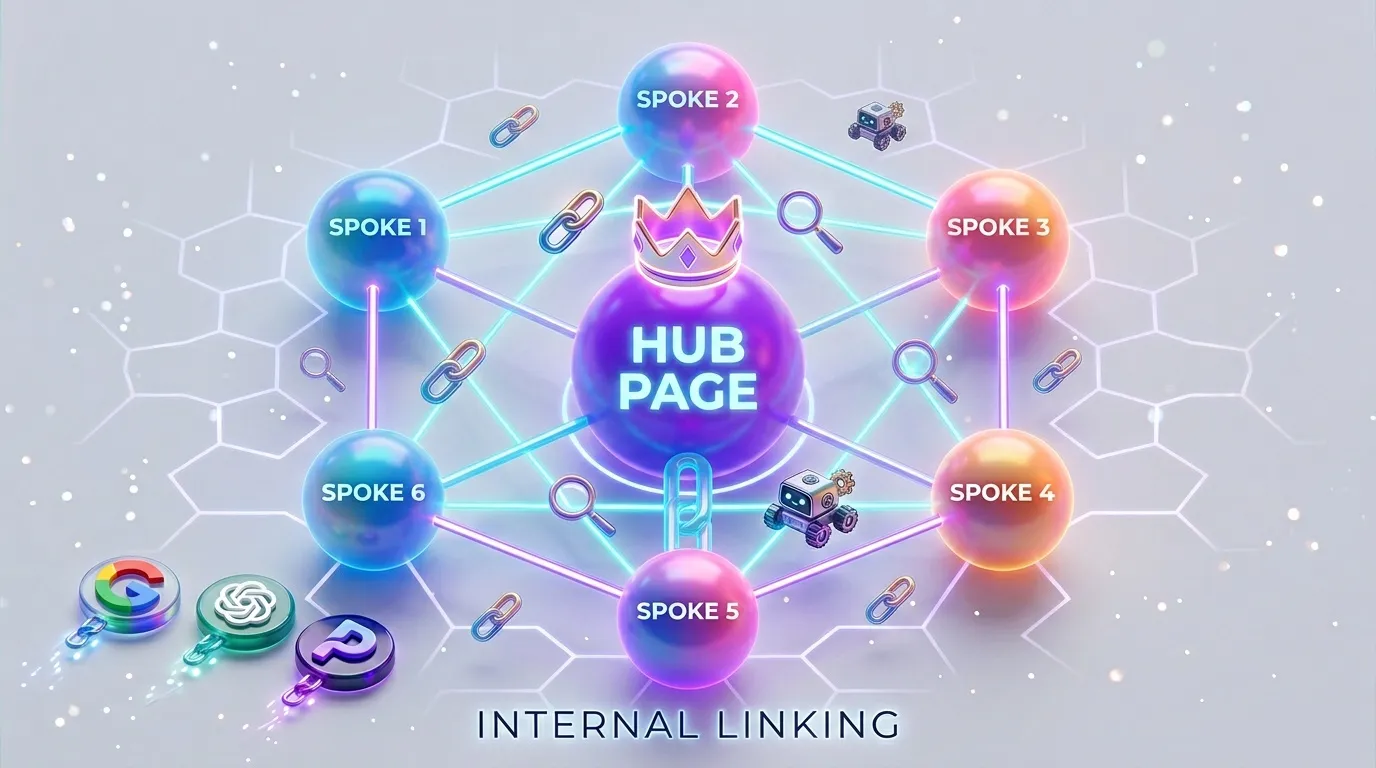
Updated: April 2026. An internal linking strategy is a deliberate plan for connecting pages on the same website to distribute link equity, establish topical relationships, and guide both users and crawlers through your content. According to Ahrefs, sites that optimize internal linking see approximately 40% more indexed pages on average. For marketers in 2026, internal linking is no longer just an SEO tactic — it is the foundation that determines whether AI engines can map, understand, and cite your content.
This guide explains why internal links are underrated, how the hub-and-spoke model works, how AI crawlers use your link structure, and the seven best practices every site should follow right now.
Find broken links, orphan pages, and equity leaks in minutes
Rankeo's free audit crawls your site and identifies internal linking issues that hurt both SEO and AI visibility.
Run Your Free Audit →Why Is Internal Linking the Most Underrated SEO Tactic?
Internal linking is the most underrated SEO tactic because it is free, fully within your control, and compounds over time — yet the majority of websites treat it as an afterthought. The average top-10 ranking page has 40+ internal links pointing to it, according to Ahrefs data from 2025. Despite this, most content teams publish new pages without adding a single internal link from existing content.
What Internal Links Actually Do
Every internal link serves multiple purposes simultaneously. Understanding these functions is the first step toward building a deliberate linking strategy rather than linking at random.
- Distribute link equity — PageRank flows through internal links, passing authority from strong pages to weaker ones that need a ranking boost
- Enable crawling and indexing — search engine bots discover new and deep pages by following internal links from already-indexed pages
- Establish topical relationships — linking related pages together tells Google and AI engines that your site covers a topic comprehensively
- Guide users through conversion funnels — strategic links move visitors from awareness content to comparison content to pricing pages
The AI Visibility Bonus
Beyond traditional SEO, internal links now play a critical role in AI visibility. AI crawlers like GPTBot, ClaudeBot, and PerplexityBot follow internal links to build context maps of your domain. Well-linked content clusters signal topical expertise to large language models, making those models more confident when deciding whether to cite your content in their responses.
Pages with strong internal link context get cited more frequently because the AI engine can verify claims by cross-referencing multiple connected pages on the same site. This verification loop — unique to well-linked sites — is something isolated or orphaned pages simply cannot trigger. For a deeper dive into how topical clusters drive authority, see our guide on topical authority and topic clusters.
In summary, internal linking is the rare SEO tactic that costs nothing, improves crawlability, distributes equity, and now directly influences whether AI engines trust and cite your content.
What Is the Hub-and-Spoke Linking Model?
The hub-and-spoke linking model is a content architecture pattern where a single comprehensive "hub" page links to and receives links from multiple detailed "spoke" pages covering subtopics. This model mirrors how both search engines and AI engines evaluate topical depth — a hub page supported by 8-15 spoke pages signals far greater expertise than 15 unconnected articles.
What Is a Hub Page?
A hub page is a comprehensive pillar piece that covers a broad topic at a high level. Hub pages tend to have higher word counts (2,000-5,000 words), target competitive head terms, and accumulate the most backlinks and internal links on a site. For example, a page titled "Schema Markup: The Complete Guide" serves as a hub that covers every dimension of schema — from technical implementation to business impact. To see a hub page in action, check out our schema markup complete guide.
What Are Spoke Pages?
Spoke pages are detailed, focused articles that target long-tail keywords within the hub's topic cluster. Each spoke links back to the hub page and cross-links to two or three related spokes. Examples include "Schema Markup for SaaS Companies" or "Schema for Local Businesses." The bidirectional linking between hub and spokes creates a closed topical loop that search engines and AI engines recognize as comprehensive coverage.
Building Your Hub-and-Spoke Map
Start by identifying five to seven hub topics that represent your core business areas. For each hub, map 8-15 spoke pages that cover specific subtopics, questions, or use cases. Use a spreadsheet with columns for hub URL, spoke URL, anchor text, and link direction (hub → spoke, spoke → hub, spoke → spoke).
- Step 1 — Identify your clusters — group existing content by topic and find gaps where spoke pages are missing
- Step 2 — Designate hub pages — choose or create one definitive page per cluster to serve as the hub
- Step 3 — Map bidirectional links — ensure every spoke links to the hub and the hub links to every spoke
- Step 4 — Add cross-spoke links — connect related spokes to each other (2-3 links per spoke)
- Step 5 — Audit quarterly — new content must be wired into existing clusters within one week of publishing
Find orphan pages hiding on your site
Rankeo's free audit detects pages with zero internal links, broken link paths, and clusters that lack a clear hub.
Run a Free Audit →In summary, the hub-and-spoke model organizes your content into tightly linked clusters that signal topical depth to both search engines and AI engines, making every page in the cluster stronger.
How Do Internal Links Help AI Engines Understand Your Site?
Internal links help AI engines build entity-level context maps of your website by propagating topical signals from page to page. AI crawlers such as GPTBot, ClaudeBot, and PerplexityBot follow internal links during indexing, using anchor text, surrounding paragraph context, and cluster structure to determine what each page is about and how much authority it carries on a given topic.
Context Propagation Through Links
When an AI crawler follows an internal link, it does not just register the destination URL. The crawler captures three contextual signals from the linking page: the anchor text itself, the sentence and paragraph surrounding the link, and the overall topic of the source page. These signals propagate to the destination page, enriching the AI engine's understanding of what that page covers.
- Anchor text signals — descriptive anchor text like "technical SEO audit checklist" tells AI engines the exact topic of the linked page
- Semantic context — the surrounding paragraph adds nuance, such as whether the linked page covers beginner or advanced material
- Cluster mapping — multiple pages linking to the same destination with varied but related anchors build a rich entity profile
For a practical walkthrough of technical optimizations that complement internal linking, see our technical SEO audit checklist.
Why Orphan Pages Are Invisible to AI
Orphan pages — pages with zero internal links pointing to them — are effectively invisible to AI engines. According to Rankeo's internal analysis, orphan pages receive zero AI bot crawls in 87% of cases. Without internal links, there is no context propagation, which means the AI engine has no confidence in the page's topic or authority. The fix is straightforward: every page on your site should have a minimum of three internal links pointing to it from topically relevant pages.
In summary, internal links are the primary mechanism AI engines use to propagate topical context across your site — orphan pages without internal links are invisible to AI and will not be cited.
What Are the 7 Internal Linking Best Practices for 2026?
The seven internal linking best practices for 2026 combine traditional SEO link optimization with AI-readiness principles. Following these practices ensures that both Google's crawler and AI bots can efficiently discover, contextualize, and rank every page on your site.
1. Use Descriptive Anchor Text
Avoid generic anchors like "click here" or "read more." Instead, use keyword-rich, natural phrases that describe the destination page's content. Descriptive anchors serve as explicit topic labels for both search engines and AI crawlers.
2. Link from High-Authority Pages to New Content
Pages with the most backlinks and traffic are your strongest equity sources. When you publish a new article, add a contextual link from at least two high-authority existing pages. Pages with 5+ internal links pointing to them rank 3.5x higher on average, according to Ahrefs data.
3. Keep Link Depth Under Three Clicks
Important pages should be reachable within three clicks from the homepage. Pages buried five or more levels deep are rarely crawled by search engines and almost never discovered by AI bots. Flatten your architecture by linking deep pages from hub pages and category pages.
4. Add Contextual Links Within Body Content
Contextual body links pass roughly 5x more equity than navigation or footer links (Moz, 2024). Navigation links help with crawlability, but body links embedded in relevant paragraphs carry the strongest ranking and topical signals. Learning how to build website authority starts with mastering contextual linking.
5. Maintain a Reasonable Link Count per Page
Aim for 3-10 contextual internal links per 1,000 words of body content. Too few links and you waste equity distribution opportunities. Too many links and you dilute the equity each link passes while creating a cluttered user experience.
6. Update Old Content with Links to New Pages
Bidirectional linking matters. When you publish a new spoke page, add links to it from the existing hub and related spokes. Content teams that update old articles within one week of publishing new content see significantly faster indexing and ranking improvements.
7. Use Breadcrumbs with Structured Data
Breadcrumb navigation with BreadcrumbList schema helps both users and crawlers understand your site hierarchy. According to Google's search documentation, breadcrumb schema increases click-through rate by 10-15% in SERPs because breadcrumbs appear as rich results beneath the page title.
In summary, the seven best practices — descriptive anchors, equity-aware linking, shallow depth, contextual placement, balanced link counts, bidirectional updates, and breadcrumb schema — form a complete internal linking playbook for both SEO and AI visibility in 2026.
Which Tools Should You Use to Audit Internal Links?
The right auditing tool reveals orphan pages, equity distribution gaps, broken links, and anchor text issues that manual review cannot catch at scale. Several tools excel at internal link auditing, but they differ in focus, pricing, and whether they account for AI visibility signals.
| Tool | Orphan Page Detection | Equity Mapping | AI Visibility Signals | Pricing |
|---|---|---|---|---|
| Screaming Frog | ✅ Yes | Basic | ❌ No | Free / £199/yr |
| Ahrefs Site Audit | ✅ Yes | Advanced | ❌ No | From $99/mo |
| Sitebulb | ✅ Yes | Advanced | ❌ No | From $13.75/mo |
| Google Search Console | Partial | ❌ No | ❌ No | Free |
| Rankeo | ✅ Yes | Advanced | ✅ Yes | Free audit / Plans |
Rankeo's Internal Links Analyzer
Rankeo's Internal Links Analyzer is purpose-built for the dual SEO + AI visibility era. The tool detects orphan pages, maps link equity distribution visually, identifies hub pages with insufficient spoke links, and flags pages with too few or too many internal links. Critically, Rankeo also checks anchor text diversity and evaluates whether your link clusters provide enough context for AI crawlers to confidently cite your pages.
- Orphan page detection — instantly find pages with zero internal links pointing to them
- Equity flow visualization — see how authority distributes across your domain in a visual graph
- Hub gap analysis — identify clusters that lack a clear hub page or have too few spokes
- Anchor text audit — flag over-optimized or generic anchor text patterns
- AI readiness score — evaluate whether each page has sufficient internal link context for AI citation
In summary, while traditional tools like Screaming Frog and Ahrefs handle SEO-focused link auditing well, Rankeo is the only tool that also evaluates your internal link structure for AI visibility readiness.
What Are the Most Common Internal Linking Mistakes?
Five internal linking mistakes account for the majority of lost equity, poor crawlability, and missed AI citations. Identifying and fixing these mistakes is often the fastest path to improved rankings because the fixes require no new content creation — only structural changes to existing pages.
Mistake 1 — Over-Linking Navigation and Footer
Many sites load their navigation and footer with dozens of links, assuming this distributes equity evenly. In reality, navigation and footer links carry far less weight than contextual body links. Moz research confirms that contextual links pass roughly 5x more equity. The fix: reserve navigation for essential pages and invest effort in adding body-content links within articles and guides.
Mistake 2 — Ignoring Deep Pages
Pages buried five or more clicks from the homepage rarely get crawled by search engine bots and almost never get discovered by AI crawlers. If a page is important, link to it from a hub page or high-authority page to bring it within three clicks of the homepage.
Mistake 3 — Exact-Match Anchor Text Everywhere
Using the identical exact-match anchor text for every link pointing to the same page looks manipulative to search engines and reduces the topical diversity signals AI engines use. Vary your anchor text naturally — use synonyms, partial matches, and contextually descriptive phrases.
Mistake 4 — Linking to Irrelevant Pages
Linking a page about "email marketing automation" to a page about "office furniture recommendations" confuses topical signals for both search engines and AI models. Every internal link should connect pages that share genuine topical relevance. If the link does not make sense contextually in the paragraph, remove it.
Mistake 5 — Never Updating Old Links
New content published without links from existing pages starts with zero internal equity and zero context propagation. Content teams should maintain a "new page wiring" checklist: within one week of publishing, add at least three internal links from relevant existing pages to the new page and at least one link from the new page back to the hub.
In summary, the five most damaging internal linking mistakes — over-reliance on navigation links, deep page neglect, repetitive anchors, irrelevant links, and failure to update old content — are all fixable within a single audit cycle.
Ready to Fix Your Internal Link Structure?
Rankeo combines SEO auditing with AI visibility analysis so you can optimize your internal links for both Google and generative AI engines — in one platform.
See Rankeo Pricing →Frequently Asked Questions

Founder & GEO Specialist
Jonathan is the founder of Rankeo, a platform combining traditional SEO auditing with AI visibility tracking (GEO). He has personally audited 500+ websites for AI citation readiness and developed the Rankeo Authority Score — a composite metric that includes AI visibility alongside traditional SEO signals. His research on how ChatGPT, Perplexity, and Gemini cite websites has been used by SEO agencies across Europe.
- ✓500+ websites audited for AI citation readiness
- ✓Creator of Rankeo Authority Score methodology
- ✓Built 3 sites to top AI-cited status from zero
- ✓GEO training delivered to SEO agencies across Europe