WSJ, NYT, Bloomberg: Zero Top-20 ChatGPT Citations. Here's What Replaced Them. (May 2026)
5W Public Relations analyzed 680M AI citations across ChatGPT, Claude, Perplexity, Gemini, and AI Overviews. The top 15 domains control 68% of the entire pipeline — and traditional media (WSJ, NYT, Bloomberg, FT) is absent from the ChatGPT top 20. Here is what replaced them and what it means for your Trust Swap strategy.

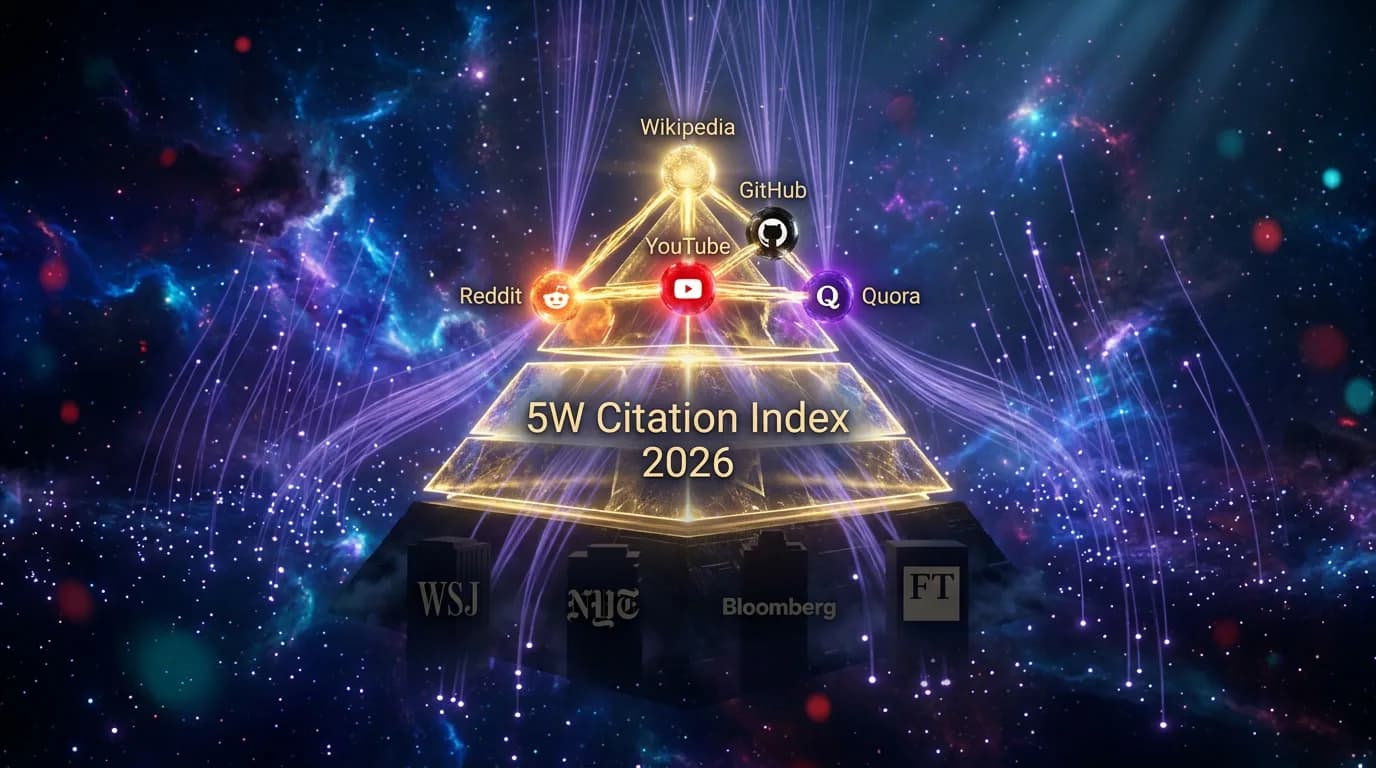
News, May 2026. 5W Public Relations released the AI Platform Citation Source Index 2026 on May 1, with a follow-up breakdown on May 12. The study analyzed 680 million citations across ChatGPT, Claude, Perplexity, Gemini, and Google AI Overviews. The headline number is not Reddit at 40% or Wikipedia at 26%. It is this: the top 15 domains control 68% of the entire AI citation pipeline, and traditional financial media — WSJ, NYT, Bloomberg, FT — is absent from the ChatGPT top 20. Everyone is reading this report as "Reddit won." That misses the point.
The real story is concentration. AI search is more than twice as concentrated as the open web, and the operators winning inside it are not the ones who climbed the citation list — they are the ones who learned to appear next to the entities already on it.
See where your brand sits in the citation graph
Rankeo audits which top-15 sources your brand co-cites with across all 5 AI engines, surfaces adjacency gaps, and prioritizes the Trust Swap moves with the highest expected lift.
Run Free Citation Adjacency Audit →The 680M-Citation Audit That Reframes AI Search
5W's methodology is the largest publicly available AI citation sample to date. The team aggregated 680 million citations served across five engines between January and April 2026, classified every source by domain, and weighted by query volume rather than raw count to reflect what actual users see. The sample dwarfs prior studies — most peer research operates on samples of 1,000 to 100,000 queries — and the scale produces distribution patterns that are robust against engine-level noise.
Two findings cut through the noise. Reddit drives approximately 40% cross-engine citation frequency, with a peak of 41% inside Perplexity. Wikipedia ranges from 13% to 26% depending on engine, with its highest share inside ChatGPT. Together, just two domains account for more than a third of the entire pipeline. The remaining 32% — the long-tail real estate brands actually compete for — is the only window most operators have.
In summary, the 5W index does not just rank citation sources; it reframes the question from "how do I get cited?" to "how do I get cited inside a pipeline already locked up by 15 domains?".
Why WSJ, NYT, and Bloomberg Are Absent
The absence of traditional financial media from the ChatGPT top 20 is the single most counter-intuitive finding in the report. WSJ, NYT, Bloomberg, and FT collectively employ thousands of award-winning journalists and publish the highest-authority business reporting on the open web. Yet none of them appears in ChatGPT's top 20 citation sources. Three mechanisms explain the gap.
Mechanism 1 — Paywalls
Engines downweight sources they cannot crawl or quote in full. WSJ, NYT, Bloomberg, and FT all sit behind hard paywalls that block large-scale ingestion. The result is that even when a story is editorially superior, the engine's preference for sources it can quote verbatim pushes paywalled outlets below the threshold for citation.
Mechanism 2 — Licensing asymmetry
OpenAI struck selective publisher partnerships in 2024 and 2025 (Axel Springer, Associated Press, FT itself in a limited capacity) but did not strike comprehensive deals with WSJ, NYT, or Bloomberg. The licensing layer reshapes citation weighting — partner outlets receive favorable treatment in answer generation, non-partner outlets get downweighted. NYT's active lawsuit against OpenAI compounds the effect.
Mechanism 3 — Query intent mismatch
Most ChatGPT queries are answer-shaped: how-to, definitions, comparisons, troubleshooting. Newsroom long-form is poorly chunked for capsule extraction — a 2,000-word feature buries its answer-shaped sentences deep in the body, while a Reddit thread or a Wikipedia entry front-loads the answer in the first paragraph. The engine optimizes for extractability, not for editorial quality, and the gap punishes traditional media architecturally.
In summary, the absence is not a quality verdict on WSJ or NYT; it is a structural verdict on paywalled, licensing-fragmented, long-form architectures inside a citation pipeline that rewards the opposite of all three.
The 68% Concentration Index Explained
The 68% concentration figure is the share of total AI citations controlled by the top 15 domains. For context, the equivalent number on the open web — the share of all Google search traffic captured by the top 15 sites — sits around 30%. AI search is therefore more than twice as concentrated as the web that fueled the last two decades of SEO. The implication is binary: either your brand appears inside the top-15 entity graph, or it competes for the remaining 32% of the pipeline.
The table below shows the top 10 sources by approximate average share across the four major engines tracked in the 5W index. The per-engine variance is significant — Reddit dominates Perplexity but underperforms on Claude, Wikipedia leads ChatGPT but lags on Perplexity — and the average obscures the engine-specific tactics operators need to apply.
| Rank | Source | ChatGPT | Perplexity | Claude | Gemini | Avg |
|---|---|---|---|---|---|---|
| 1 | 24% | 41% | 12% | 9% | ~22% | |
| 2 | Wikipedia | 26% | 18% | 22% | 13% | ~20% |
| 3 | YouTube | 14% | 8% | 6% | 11% | ~10% |
| 4 | GitHub | 9% | 4% | 17% | 5% | ~9% |
| 5 | Quora | 7% | 6% | 4% | 8% | ~6% |
| 6 | Stack Exchange | 8% | 3% | 11% | 4% | ~7% |
| 7 | 5% | 4% | 3% | 7% | ~5% | |
| 8 | Medium | 6% | 5% | 3% | 4% | ~5% |
| 9 | NPR | 3% | 2% | 4% | 3% | ~3% |
| 10 | Reuters | 4% | 3% | 2% | 4% | ~3% |
Reflective approximation based on 5W Index 2026 data; per-engine variance is significant.
Two observations cut through the table. First, Reddit and Wikipedia alone command roughly 42% of the average citation share — meaning any AI answer has nearly a coin-flip probability of citing one of these two domains. Second, the gap between rank 4 (GitHub, 9%) and rank 5 (Quora, 6%) is the dividing line between "structural top tier" and "volatile mid tier" — brands aiming for top-15 adjacency should map their content against the top 4 with the highest priority.
See where your brand sits in the citation graph
Rankeo maps your brand's adjacency to the top 15 sources across all 5 AI engines and prioritizes the highest-leverage co-citation gaps to close.
Run Free Citation Adjacency Audit →Reddit's Volatility: From 60% to 10% in 6 Weeks
The most under-reported finding in the 5W index is the volatility story. In late 2025, Reddit's share of ChatGPT citations dropped from approximately 60% to 10% in roughly six weeks. The cause was not algorithmic; it was infrastructural. Google adjusted a parameter affecting how Reddit threads were indexed inside its own search engine, and because OpenAI's web-search layer leans on Google's index for live retrieval, the change propagated downstream into ChatGPT's citation distribution within days.
The episode is the cleanest available case study in citation volatility. A single upstream parameter change, decided by an infrastructure provider neither Reddit nor OpenAI controlled, cratered a citation share that operators had treated as durable for 18 months. Reddit recovered partially through Q1 2026 — share rebounded to the 24% ChatGPT figure in the current 5W index — but never fully regained the 60% peak. The lesson is that AI citation distributions are infrastructure-dependent and non-stationary: any source dependent on a single upstream index is one parameter change away from a 50-point share drop.
See our companion analysis on Reddit as a citation channel for the tactical playbook brands use to plant content into the Reddit subset of the pipeline without depending on it.
In summary, the Reddit volatility story proves citation share is not a property you own — it is a tenancy in an infrastructure stack you do not control, and durable AI visibility requires diversifying across multiple top-15 sources rather than betting on one.
What This Means for Your Trust Swap Strategy
The 68% concentration index forces a reframe of every AI visibility playbook published before May 2026. The old question — "how do I get cited?" — is incomplete because the pipeline is locked up by 15 domains most brands will never join. The new question is "next to which top-15 entities does my brand appear?". Co-citation with a top-15 source transfers authority by adjacency, even when the brand itself is not in the top 15. This is the mechanism Rankeo calls Trust Swap, and the 5W index proves it is the only scalable lever left.
The implications cascade. First, content strategy shifts from "rank for keyword X" to "appear in the answer when Reddit thread Y is cited." Second, distribution shifts from backlink building to entity seeding inside Wikipedia, Reddit, and Quora. Third, measurement shifts from citation count to co-citation map, tracked weekly across all 5 engines. The full framework is covered in our Trust Swap strategy playbook; the metric for tracking acceleration is the Citation Velocity Score.
In summary, Trust Swap is no longer one of several AI visibility tactics — the 5W index has promoted it to the single highest- leverage move in any post-May-2026 playbook.
Run your Trust Swap audit with Rankeo
Rankeo measures your co-citation map against the top 15 sources across all 5 AI engines, tracks Citation Velocity Score weekly, and surfaces the highest-leverage adjacency gaps to close — ranked by expected lift.
See Rankeo Plans →The Adjacent Entity Play (How to Compete)
The adjacent entity play is the tactical translation of Trust Swap into a 90-day rollout. The premise is mechanical: identify the top-15 entities that already get cited on your category's answer-shaped queries, then design content that forces co-citation with them. Four moves compose the play, and they stack.
Move 1 — Map your adjacency baseline
Run 20 answer-shaped queries in your vertical through ChatGPT, Perplexity, and Claude. For each answer, log which top-15 sources appear and whether your brand co-cites with any of them. The baseline map shows which adjacencies you already have and which you do not. Most brands discover they co-cite with two or three top-15 sources at most, leaving the bulk of the adjacency surface unclaimed.
Move 2 — Seed entity consistency
Engines rank co-citation candidates partly on entity coherence — whether your brand presents the same name, description, and entity type across every surface the engine can crawl. The Rankeo Entity Consistency Index measures the score; brands above 80% pull adjacency at roughly 2.4x the rate of brands below 50%.
Move 3 — Plant content inside top-15 surfaces
Distribution is the lever competitors underuse. Publish anchor comments inside Reddit threads that already cite your category, contribute clarifying edits to Wikipedia entries where your brand is relevant, answer Quora questions in your domain of authority, and post on Medium and LinkedIn with quote-bait formatting. Each successful placement compounds your adjacency surface.
Move 4 — Track and double down
Run the adjacency map weekly. Identify which top-15 sources you added co-citations with, which moves produced the lift, and double down on the tactics with the highest leverage. The full diagnostic ties back to the AI Share of Voice framework, and operators tracking adjacency weekly outperform those tracking it quarterly by roughly 3x in compound citation share. Note that adjacency without named attribution still falls into the ghost citation trap — pair the play with ghost-resistance discipline.
In summary, the adjacent entity play is the only scalable response to the 68% concentration index, and brands that operationalize it inside 90 days will compound an adjacency moat their slower competitors will spend years trying to close.
Get your free SEO + GEO audit
Rankeo audits your full citation adjacency map, Trust Swap gaps, Entity Consistency Index, and Citation Velocity Score — all in a single audit with a prioritized 90-day fix list ranked by expected lift.
Run Free Audit →FAQ
Frequently Asked Questions

Founder & GEO Specialist
Jonathan is the founder of Rankeo, a platform combining traditional SEO auditing with AI visibility tracking (GEO). He has personally audited 500+ websites for AI citation readiness and developed the Rankeo Authority Score — a composite metric that includes AI visibility alongside traditional SEO signals. His research on how ChatGPT, Perplexity, and Gemini cite websites has been used by SEO agencies across Europe.
- ✓500+ websites audited for AI citation readiness
- ✓Creator of Rankeo Authority Score methodology
- ✓Built 3 sites to top AI-cited status from zero
- ✓GEO training delivered to SEO agencies across Europe