SEO + GEO Visibility for Restaurants
Rankeo helps restaurants dominate local search results and get recommended by AI assistants like ChatGPT, Perplexity, and Google AI Overviews. Audit your online presence, fix structured data, and track your visibility across every discovery channel.
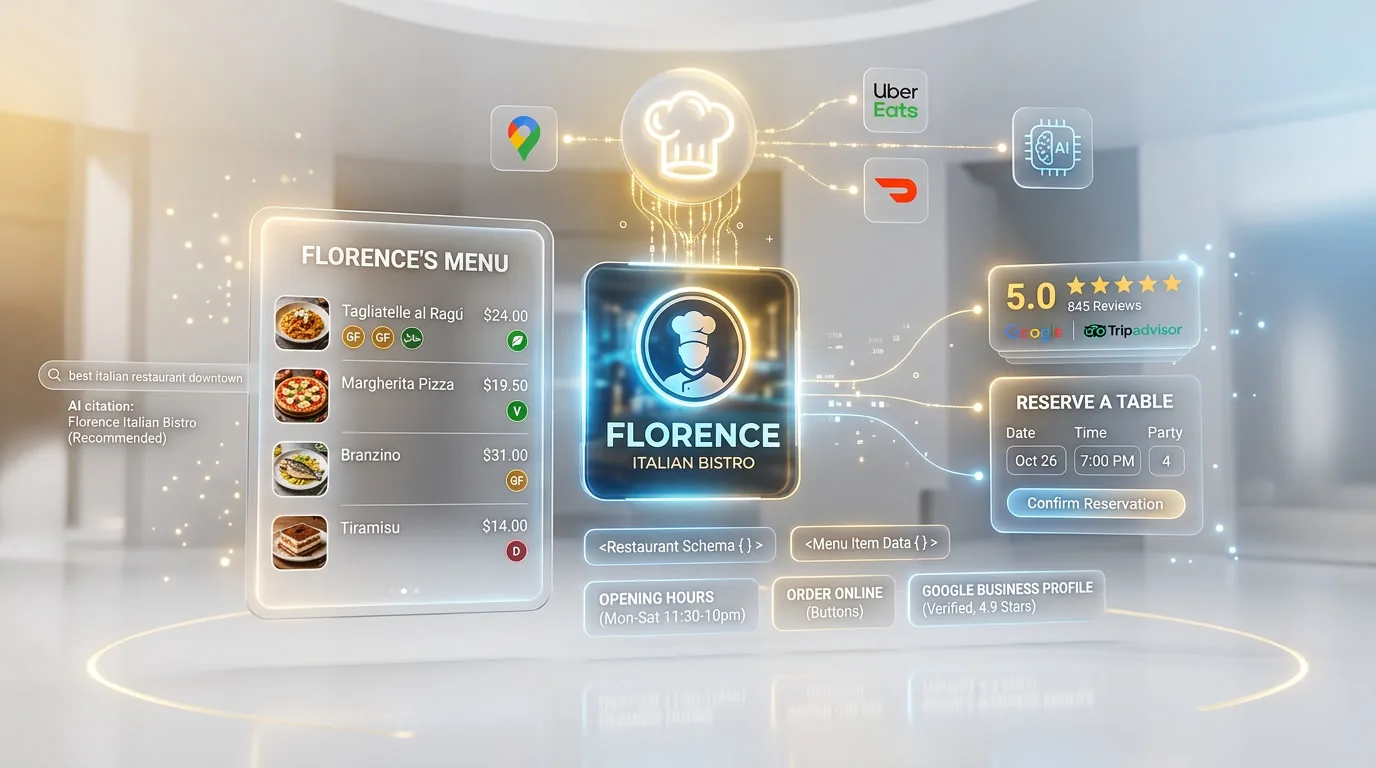
The restaurant industry has undergone a seismic shift in how diners discover where to eat. A decade ago, word-of-mouth and foot traffic drove most bookings. Today, over 80% of diners search online before choosing a restaurant, and a growing share now ask AI assistants for recommendations outright. When someone types "best sushi near me" into Google or asks ChatGPT "where should I eat in downtown Austin tonight?", your restaurant either appears or it doesn't. There is no middle ground. Traditional SEO still matters enormously for restaurants because Google Maps and local pack results remain the top traffic drivers for food establishments. But a new front has opened: generative engine optimization (GEO). AI-powered answer engines are increasingly serving up restaurant recommendations drawn from review aggregators, structured data, and authoritative content. If your restaurant lacks proper schema markup, consistent NAP data, and quality signals that AI models can parse, you will be invisible in this new channel. Rankeo exists at the intersection of these two realities. It audits your restaurant's presence across both classic search and AI engines, identifies exactly where you are losing potential diners, and gives you a clear, prioritized action plan to fix it.
The Challenge for Restaurants
Fragmented Local Listings
Inconsistent NAP (name, address, phone) data across Google, Yelp, TripAdvisor, and dozens of directories tanks your local search ranking and confuses AI models trying to verify your business information.
Complex Schema Markup Requirements
Restaurants need Restaurant, Menu, LocalBusiness, and OpeningHoursSpecification schema working together. Most sites have none of this, making them invisible to structured data consumers.
Mobile Performance Under Pressure
Diners search on their phones, often while walking. A menu page that takes over 3 seconds to load loses the customer entirely, and Google penalizes slow mobile sites in local results.
AI Recommendation Blindspot
Most restaurant owners have no idea that AI assistants are now recommending restaurants to millions of users. Without monitoring this channel, you cannot optimize for it.
Restaurants face a uniquely fragmented discovery landscape. Your potential customers might find you through Google Search, Google Maps, Yelp, TripAdvisor, OpenTable, Instagram, or now through AI assistants like ChatGPT and Perplexity. Each channel has different ranking signals and data requirements, and most restaurant operators lack the technical expertise to optimize for even one of them properly. Local SEO for restaurants is particularly unforgiving. A missing or inconsistent phone number across directories tanks your local pack ranking. Incorrect business hours frustrate customers and generate negative reviews. Menus buried in PDF format are invisible to search crawlers and AI models alike. Schema markup for restaurants is among the most complex in the local business category, requiring accurate representation of menus, opening hours, reservation systems, cuisine types, and price ranges. Beyond traditional search, AI recommendation engines present an entirely new challenge. When a user asks Perplexity "best Italian restaurant in Brooklyn for a date night," the AI synthesizes information from dozens of sources. Restaurants with clean structured data, strong review signals, and well-organized content get cited. Those without it are simply excluded from the conversation. Most restaurant owners don't even know this channel exists, let alone how to optimize for it.
Common SEO Issues We Fix
Run a free Authority Check to see how your site scores across 5 SEO + AI signals.
Schema Types You Need
Restaurant
The core schema type that tells search engines and AI models your cuisine type, price range, and service style. Essential for appearing in rich results and AI recommendations.
Menu
Structures your menu items with names, descriptions, prices, and dietary information so search engines can display rich menu snippets and AI can answer "does this place have vegan options?" accurately.
LocalBusiness
Provides your address, phone, hours, and geo-coordinates in a format that powers Google Maps results, local pack placement, and AI location-based queries.
Review / AggregateRating
Enables star ratings in search results and gives AI models quantified quality signals. Restaurants with visible ratings get significantly higher click-through rates.
OpeningHoursSpecification
Prevents the frustrating "is this place open right now?" problem. Accurate hours in structured data improve trust signals for both search engines and AI assistants.
Rankeo auto-detects missing schema and generates valid JSON-LD markup. Read the full schema guide for restaurants.
How Rankeo Helps Restaurants
Technical SEO Agent
Crawls your restaurant website weekly to catch broken links, missing meta tags, slow pages, and mobile usability issues before they hurt your ranking.
GEO Visibility Agent
Queries AI engines with restaurant-specific prompts to track whether you are being recommended to diners asking for places to eat.
Schema Markup Agent
Generates and validates Restaurant, Menu, and LocalBusiness structured data so search engines and AI models can accurately represent your business.
Content Quality Agent
Evaluates your menu pages, about page, and location content for E-E-A-T signals and keyword relevance that drive local search visibility.
Rankeo gives restaurant owners and their marketing teams a single dashboard to audit, fix, and monitor their visibility across both traditional search and AI recommendation engines. The platform starts with a comprehensive SEO audit tailored to the restaurant vertical. It checks your Google Business Profile consistency, scans for schema markup gaps specific to restaurants (menu items, opening hours, reservation links, cuisine types), analyzes your site speed on mobile where most diners search, and evaluates your internal linking between location pages, menu pages, and booking flows. On the GEO side, Rankeo's AI visibility probe queries five major AI engines with prompts that real diners use, like "best pizza place in [your city]" or "restaurants with outdoor seating near [your area]." It tracks whether your restaurant is being cited, how prominently, and what sources the AI is pulling from. This reveals exactly what data gaps are causing you to be excluded from AI recommendations. The Schema Markup Agent generates restaurant-specific JSON-LD structured data covering Organization, Restaurant, Menu, and LocalBusiness types with proper @id cross-references. This structured data is what both Google and AI models use to understand your business. Rankeo also monitors your Core Web Vitals, since a slow-loading menu page directly impacts both your search ranking and your conversion rate from hungry customers who won't wait three seconds for a page to load. Weekly automated scans ensure your visibility never degrades without you knowing.
Key Metrics to Track
Local Pack Ranking
Top 3 for primary cuisine + city keywords
Weekly SERP tracking with alerts when you drop out of the local 3-pack, plus actionable fixes for the specific signals dragging you down.
AI Citation Rate
Cited in 40%+ of relevant AI recommendation queries
GEO probe monitors 5 AI engines weekly with real diner queries and tracks your citation frequency, position, and the sources AI models reference.
Mobile Page Speed (LCP)
Under 2.5 seconds on menu and location pages
Core Web Vitals monitoring flags performance regressions instantly, with specific recommendations for image optimization, font loading, and server response times.
For restaurants, the metrics that matter tie directly to reservations and foot traffic. Track your local pack ranking position for your top 5-10 keywords (cuisine type + location combinations). Monitor your AI citation rate across ChatGPT, Perplexity, and Google AI Overviews for recommendation queries. Measure organic click-through rate on your Google Business Profile. Watch your structured data validation score, aiming for zero errors on Restaurant and LocalBusiness schema. Core Web Vitals should target sub-2.5 second LCP on mobile. Most importantly, correlate these visibility metrics with actual reservation volume and direction-request clicks to prove ROI.
Frequently Asked Questions
Why do restaurants need GEO optimization?
AI assistants like ChatGPT and Perplexity are increasingly used by diners to find restaurant recommendations. These engines pull from structured data, reviews, and authoritative content. Without GEO optimization, your restaurant is excluded from these high-intent recommendation queries, losing customers to competitors who are visible in AI responses.
What schema markup does a restaurant website need?
At minimum, restaurants need Restaurant, LocalBusiness, Menu, and OpeningHoursSpecification schema types. Ideally, you also add AggregateRating for review stars and GeoCoordinates for map accuracy. Rankeo generates all of these in a single unified @graph structure that search engines and AI models can parse correctly.
How does Rankeo track AI recommendations for restaurants?
Rankeo's GEO probe sends real diner queries like "best Italian restaurant in [city]" to five AI engines: ChatGPT, Perplexity, Gemini, Claude, and Grok. It then analyzes whether your restaurant is cited, your ranking position within the response, and which data sources the AI referenced. Results are tracked weekly to show trends.
Can Rankeo help with Google Maps ranking?
Yes. Rankeo audits the technical signals that affect Google Maps and local pack ranking, including NAP consistency, LocalBusiness schema accuracy, mobile page speed, and internal linking structure. It generates specific action items to improve each signal, helping your restaurant climb into the coveted local 3-pack.
How important is mobile speed for restaurant SEO?
Extremely important. Over 75% of restaurant searches happen on mobile devices, often by people actively looking for a place to eat nearby. Google uses Core Web Vitals as a ranking factor, and slow pages directly increase bounce rates. Rankeo monitors your LCP, FID, and CLS scores and flags regressions before they impact your ranking.
Does Rankeo work for restaurant chains with multiple locations?
Yes. Rankeo supports multiple sites per account, so you can audit and monitor each location independently. The Agency plan covers up to 50 sites, making it ideal for restaurant groups. Each location gets its own schema markup, audit history, and AI visibility tracking with a unified dashboard view.
How often should a restaurant audit its online visibility?
At minimum, monthly. Search algorithms update frequently and AI models retrain on fresh data regularly. Rankeo runs automated weekly scans on Pro plans and above, so you receive alerts when your visibility drops or new technical issues appear. This prevents small problems from becoming costly ranking losses.
What ROI can restaurants expect from SEO + GEO optimization?
Restaurants that move into the local 3-pack typically see a 30-50% increase in direction requests and calls. AI visibility adds a new customer acquisition channel at zero marginal cost per recommendation. Most restaurants recoup Rankeo's monthly fee within the first week from additional reservations driven by improved online discoverability.
The Bottom Line
Restaurants that ignore AI visibility are leaving reservations on the table. The diners who ask ChatGPT where to eat tonight are high-intent customers ready to book. Rankeo is the only platform that audits both your Google ranking and your AI recommendation presence in one place, giving you the complete picture of your online discoverability and a clear path to filling more seats.
Audit your restaurant's search + AI visibility in 60 seconds
No credit card required. Get your SEO + GEO score in minutes and see how restaurants can improve their AI visibility.