SEO & GEO Optimization for SaaS Companies
Rankeo helps SaaS companies dominate organic search and AI-powered engines. Audit your technical SEO, track AI citations, and build the structured data that makes LLMs recommend your product.
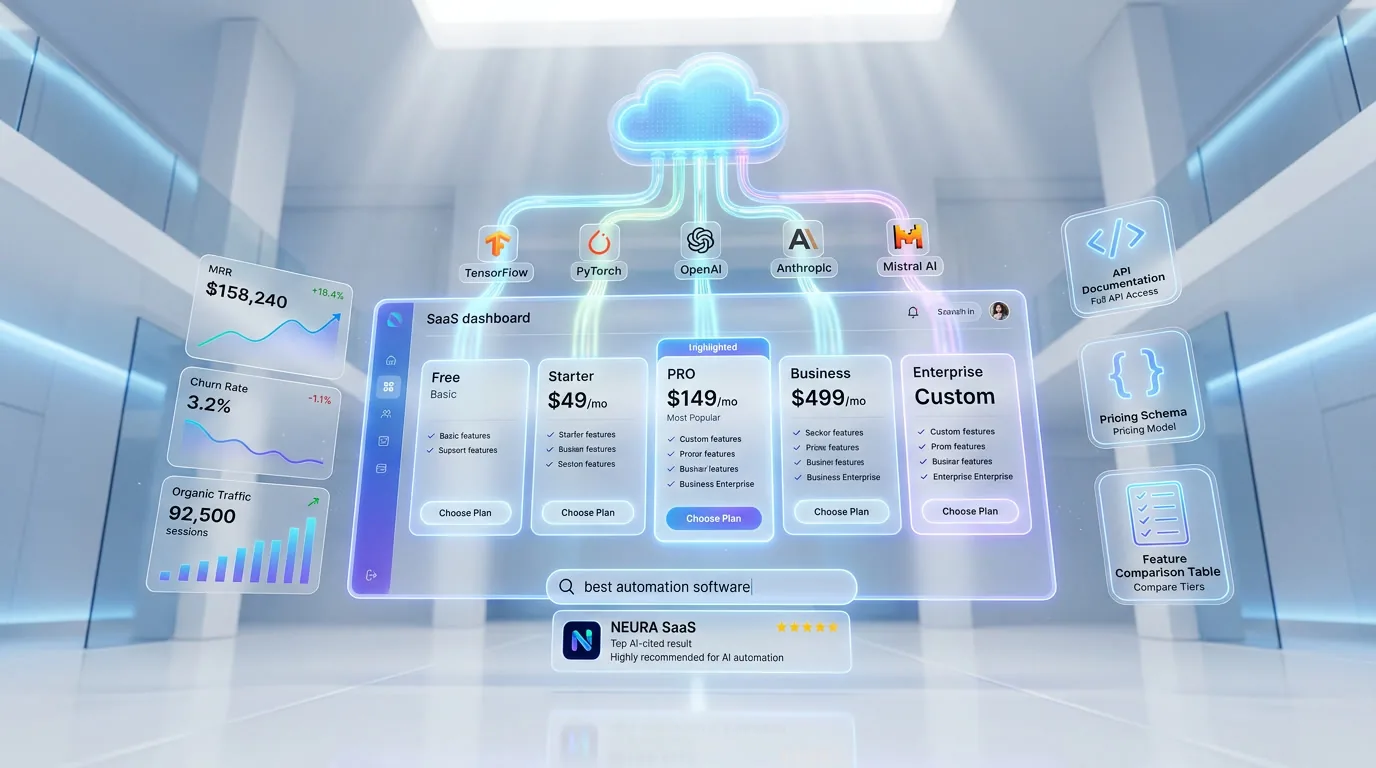
SaaS companies operate in one of the most competitive digital landscapes on the planet. Every product category — from project management to CRM to email marketing — is saturated with well-funded players fighting for the same high-intent keywords. Traditional SEO alone no longer cuts it. When a prospect asks ChatGPT "What is the best invoicing software for freelancers?" or queries Perplexity about alternatives to a competitor, your product needs to surface in those AI-generated answers — not just in Google's blue links. This is the new battleground: Generative Engine Optimization. SaaS brands that ignore GEO risk ceding market share to competitors who show up in AI recommendations while they remain invisible. The stakes are particularly high because SaaS buying cycles start with research, and that research increasingly happens inside AI assistants. If your product is absent from LLM training data, poorly structured for knowledge graphs, or lacking the E-E-A-T signals that AI models weigh when generating citations, you are losing pipeline before prospects even reach your website. Rankeo was built to solve this dual challenge — ensuring your SaaS product ranks in traditional search AND gets cited by the AI engines reshaping how software is discovered and evaluated.
The Challenge for SaaS Companies
Aggregator Dominance in SERPs
G2, Capterra, and TrustRadius pages outrank your own feature pages for high-intent "best software" queries, forcing you to compete for your own brand terms.
JavaScript-Heavy Rendering
Single-page app architectures and dynamically loaded documentation often prevent search engines and AI crawlers from indexing your most valuable content.
Entity Ambiguity in AI Engines
Products with common-word names get confused with unrelated concepts by LLMs, leading to inaccurate or missing citations in AI-generated recommendations.
Technical Debt from Rapid Iteration
Frequent launches and sunset campaigns leave orphaned pages, duplicate meta tags, and broken internal links that dilute crawl budget and domain authority.
SaaS companies face a unique cluster of visibility problems. First, feature pages and comparison pages must compete against aggregator sites like G2, Capterra, and TrustRadius that dominate SERPs with massive domain authority. Second, product-led content — documentation, changelog entries, API references — is often poorly indexed because it lives behind JavaScript-rendered layouts or requires authentication. Third, SaaS sites tend to accumulate technical debt rapidly: orphaned landing pages from past campaigns, duplicate content across localized versions, and bloated JavaScript bundles that tank Core Web Vitals. On the GEO side, the challenge is even sharper. Large Language Models build their understanding of software products from structured data, authoritative mentions, and well-organized documentation. If your schema markup is missing or incorrect, AI engines cannot reliably attribute features to your brand. If competitor comparison pages do not use FAQ or HowTo schema, LLMs may pull answers from third-party reviews instead of your own content. SaaS companies also struggle with entity disambiguation — when your product name is a common English word, AI models may confuse it with unrelated concepts. Without a deliberate structured data strategy, your brand identity in the AI knowledge layer remains fragile and incomplete.
Common SEO Issues We Fix
Run a free Authority Check to see how your site scores across 5 SEO + AI signals.
Schema Types You Need
SoftwareApplication
Defines your product as a distinct entity with name, category, pricing, and review data — critical for LLMs to accurately recommend your software.
Organization
Establishes your company identity, logo, and social profiles in the knowledge graph, preventing brand confusion and strengthening E-E-A-T signals.
FAQPage
Enables rich snippets for comparison and feature pages, and provides structured Q&A pairs that LLMs can directly cite in answers.
HowTo
Marks up onboarding guides and tutorials so AI engines can surface step-by-step instructions when users ask how to accomplish tasks with your product.
Review / AggregateRating
Surfaces star ratings in SERPs and gives AI models quantitative evidence of product quality when generating recommendation lists.
Rankeo auto-detects missing schema and generates valid JSON-LD markup. Read the full schema guide for saas companies.
How Rankeo Helps SaaS Companies
Technical SEO Agent
Scans your marketing site, docs, and changelog for rendering issues, broken links, slow pages, and indexation blockers common in JavaScript-heavy SaaS architectures.
GEO Visibility Agent
Probes ChatGPT, Perplexity, Gemini, Claude, and Grok to check if your SaaS product is cited, how it is described, and which competitors appear alongside you.
Content Quality Agent
Evaluates feature pages, comparison content, and blog articles against E-E-A-T criteria that influence both Google rankings and LLM citation likelihood.
Schema Markup Agent
Generates SoftwareApplication, Organization, and FAQPage structured data in @graph format so AI engines parse your product entity without ambiguity.
Rankeo gives SaaS teams a single platform to diagnose and fix both traditional SEO gaps and AI visibility blind spots. The Technical SEO Agent crawls your marketing site and documentation to flag issues that hurt indexation — JavaScript rendering problems, orphan pages, missing canonical tags, and slow Core Web Vitals caused by heavy SPA bundles. The Schema Markup Agent generates SoftwareApplication, Organization, and FAQPage structured data in a unified @graph format, ensuring LLMs can parse your product entity, its features, pricing, and reviews without ambiguity. The GEO Visibility Agent probes five major AI engines — ChatGPT, Perplexity, Gemini, Claude, and Grok — to show you exactly how each one describes your product, which competitors they recommend alongside you, and whether they cite your documentation or a third-party source. The Content Quality Agent scores your feature pages, comparison pages, and blog posts against E-E-A-T criteria that influence both Google rankings and LLM citation probability. When your content lacks authoritative sourcing or first-hand experience signals, the agent flags it with concrete rewrite suggestions. Finally, the Internal Linking Agent maps your site architecture to ensure link equity flows from high-authority blog content to conversion-critical pages like pricing, demo requests, and feature comparisons — closing the gap between traffic acquisition and revenue generation.
Key Metrics to Track
Organic Traffic to Feature Pages
+40% within 6 months
Technical SEO Agent fixes indexation issues while Content Quality Agent optimizes on-page relevance for high-intent keywords.
AI Citation Rate
Cited in 3+ AI engines for primary use cases
GEO Visibility Agent tracks citation presence weekly and Schema Markup Agent ensures structured data feeds accurate product information to LLMs.
Trial Signup Conversion from Organic
15% improvement in organic-to-trial rate
Internal Linking Agent directs link equity to conversion pages, and Content Quality Agent ensures landing pages meet E-E-A-T standards.
SaaS companies should track a blend of traditional and AI-specific KPIs. On the SEO side, monitor organic traffic to feature and comparison pages, keyword rankings for high-intent queries like "best [category] software," and conversion rate from organic sessions to trial signups or demo requests. On the GEO side, track citation frequency across AI engines — how often your brand appears in responses to product-discovery prompts, whether citations link to your domain or a third party, and sentiment accuracy in AI-generated descriptions. Rankeo's combined SEO+GEO score gives you a single dashboard metric to track progress over time, while weekly agent scans alert you to regressions before they impact pipeline.
Frequently Asked Questions
Why do SaaS companies need GEO in addition to traditional SEO?
Buyers increasingly research software through AI assistants like ChatGPT and Perplexity. If your product is absent from AI-generated recommendations, you lose pipeline before prospects ever visit your site. GEO ensures your brand is cited accurately across all major LLMs, complementing the organic traffic you earn from Google.
What schema markup should a SaaS website implement?
At minimum, SoftwareApplication for your product pages, Organization for your company entity, FAQPage for comparison and support content, and AggregateRating if you display reviews. This structured data helps both Google rich snippets and AI models understand your product category, pricing, and user sentiment.
How does Rankeo track AI citations for SaaS products?
The GEO Visibility Agent sends industry-relevant prompts to five AI engines weekly and analyzes responses for brand mentions, competitor co-citations, factual accuracy, and source attribution. You get a dashboard showing citation frequency, sentiment, and whether the AI links to your site or a third-party review.
Can Rankeo help us outrank G2 and Capterra for our own product keywords?
While aggregators have massive domain authority, Rankeo identifies technical and content gaps on your feature pages that prevent them from competing. By fixing structured data, improving content depth, and building internal link equity to key pages, many SaaS sites reclaim first-page positions for branded and category queries.
How does JavaScript rendering affect SaaS SEO?
Many SaaS sites use React or Angular frameworks that load content dynamically. If Googlebot cannot render your pages or times out during JavaScript execution, critical content never gets indexed. Rankeo's Technical SEO Agent detects rendering issues and recommends server-side rendering or pre-rendering solutions specific to your stack.
What Core Web Vitals problems are common in SaaS websites?
SaaS sites frequently suffer from large Largest Contentful Paint due to hero images and heavy scripts, poor Interaction to Next Paint from complex interactive demos, and cumulative layout shift from dynamically injected CTAs and chat widgets. Rankeo pinpoints the exact elements causing failures and prioritizes fixes by revenue impact.
How often should a SaaS company run SEO and GEO audits?
Given the pace of SaaS development — new features, documentation updates, landing page experiments — we recommend weekly automated scans with Rankeo's agent system. This catches regressions from deploys before they compound, and tracks whether AI engines update their understanding of your product after content changes.
Does Rankeo integrate with our existing SaaS marketing stack?
Rankeo connects to Google Search Console and Google Analytics to pull real performance data into audits. Structured data generation works with any CMS or headless setup. Weekly agent reports are emailed directly to your team, and the dashboard provides export-ready data for stakeholder reporting without requiring additional integrations.
The Bottom Line
In a market where every SaaS category has dozens of competitors, the companies that own both search results and AI recommendations will capture disproportionate market share. Rankeo is the only platform that audits, fixes, and monitors your presence across Google and all five major AI engines in a single workflow. Stop optimizing for yesterday's search landscape.
Audit your SaaS site for SEO + AI visibility gaps — free, no credit card required.
No credit card required. Get your SEO + GEO score in minutes and see how saas companies can improve their AI visibility.