ChatGPT Memory Sources Are Live. Your Brand Now Has 1,000 Different 'Canonical' Answers. (May 2026)
OpenAI shipped Memory Sources with GPT-5.5 Instant on May 5, 2026. Ten days in, here is why personalized AI answers fragment the canonical, and why Entity Consistency Index (ECI) is now the survival metric for brand visibility in AI search.

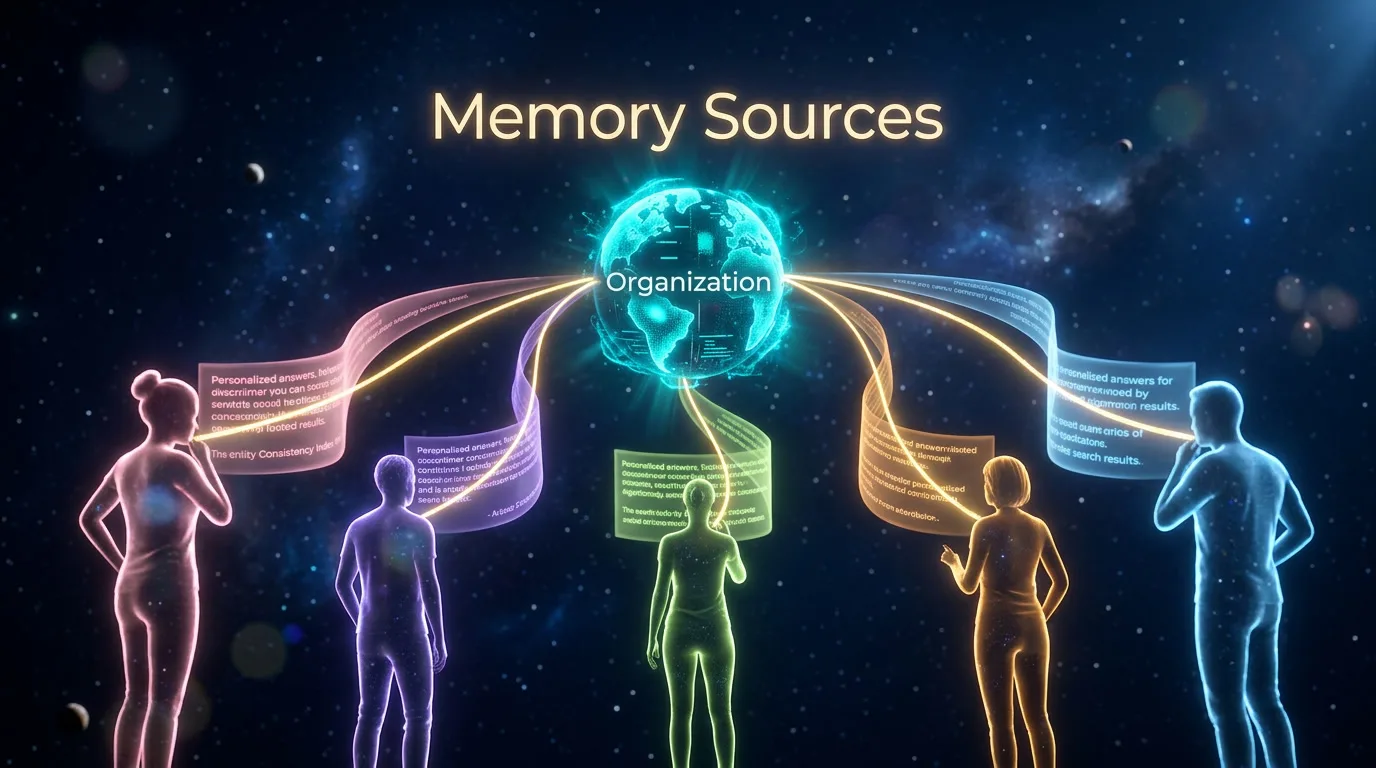
Published: May 15, 2026. Ten days after OpenAI rolled out Memory Sources alongside GPT-5.5 Instant, the AI search landscape has quietly fractured. Every ChatGPT user now receives answers shaped by their saved memories, past chats, connected Gmail, and uploaded files — and ChatGPT now displays which sources nourished each response. The implication most operators have missed: the canonical AI answer is dead. A single brand query no longer produces one canonical answer — it produces one answer per persona context, potentially thousands of variants for a single brand.
This is the second analysis in a two-part series on the May 5 release. The first part covered GPT-5.5 Instant's hallucination changes and citation impact. This piece treats the structural consequence: when answers personalize, brand survival shifts from citation rate to entity consistency across persona variants, and Entity Consistency Index becomes the survival metric.
What Memory Sources Actually Does
OpenAI shipped Memory Sources with GPT-5.5 Instant on May 5, 2026. The feature is a per-response panel that shows which contexts shaped each ChatGPT answer: saved memories, past chats from the current session and prior sessions, connected Gmail content, uploaded files, and persistent profile preferences. Users can click any source to view its content, correct it inline, or delete it from the response's context. The architecture moves personalization from a hidden generation step to an inspectable surface — which is the first time end users have direct visibility into how their ChatGPT answers diverge from the unpersonalized baseline.
What expanded with the May 5 release
Two surfaces expanded materially with the rollout. First, personalization from connected files and Gmail moved from Pro beta to general Plus and Pro availability on web. Second, per-response source attribution shipped across all tiers, which means even free users now see which memories shaped their answers even when the personalization surface is lighter. The combined effect: every paid ChatGPT user is now generating fully persona-shaped answers by default, and every free user is in the on-ramp.
In summary, Memory Sources turned ChatGPT from an opaque personalization engine into a transparent one — and the transparency reveals that the same query produces structurally different answers per user, every time.
The End of the Canonical AI Answer
For the first three years of AI search, the operator mental model held that a brand had one canonical answer per query — what ChatGPT or Perplexity would say about your company when prompted. Optimization meant moving that single canonical answer in your favor: getting cited, fixing factual errors, raising your Citation Readiness. Memory Sources breaks that model. Your brand now has as many canonical answers as there are distinct persona contexts in your addressable market.
The fragmentation surface
A prospect asking "what is the best AI visibility tool" gets different answers depending on what ChatGPT knows about them. A developer whose memory says "I work on SaaS infra" receives a developer-flavored answer. A marketer whose memory says "I run paid ads for a B2B agency" receives a marketer-flavored answer. The brand that surfaces in both — with consistent positioning, schema coverage, and content angles — wins the personalized era. The brand that surfaces only in one persona context loses N-1 of every N answers, where N is the number of distinct contexts in its market.
In summary, AI visibility used to be a one-dimensional rank; it is now a coverage problem across N persona variants, and the brands with thin entity surfaces fragment fastest.
Why Entity Consistency Index Becomes Survival Metric
Entity Consistency Index (ECI) measures how consistently a brand entity surfaces across N variant queries, engines, and contexts — and Memory Sources turns ECI from a useful diagnostic into the survival metric for AI search visibility. A brand with high ECI appears consistently regardless of the user's memory profile; a brand with low ECI appears in some persona contexts and vanishes in others. The metric was already directional before May 5; it is now load-bearing.
What raises ECI
Three structural layers move ECI. First, entity coverage — Organization schema with full sameAs, consistent Person bylines, and stable @id references across pages. Second, Schema-Stitch — weaving the brand entity into Article, FAQ, and HowTo schemas so the brand is grammatically load-bearing across content types, not just on the about page. Third, content diversification — covering the same core topic across multiple angles (technical, commercial, educational, comparative) so each persona context finds a content surface it can latch onto. Brands with three layers in place sustain ECI above 80; brands missing two drop below 50 once personalization compounds.
For the full ECI methodology and how Rankeo measures it, see our deep-dive on Entity Consistency Index as the metric. In summary, ECI was the early warning signal; Memory Sources promoted it to the primary survival metric.
Measure your Entity Consistency Index
Run a free Rankeo audit and get your ECI score across all 5 AI engines — with a prioritized fix list for the schema, entity, and content gaps that fragment your brand across personalized contexts.
Measure Your ECI →The 1,000-Persona Test (Mental Model)
A useful mental model for the post-canonical era: imagine 1,000 prospects in your addressable market, each carrying a distinct ChatGPT memory profile shaped by their role, history, and connected data. The question is no longer "does my brand rank?" — it is "how many of those 1,000 personas see my brand in their personalized answer?". The same query produces 1,000 variants, and your visibility is the percentage of variants that surface your brand at all.
Three persona buckets to test today
The full 1,000-persona test is impractical to run manually, but a three-persona approximation gives a directional read in 15 minutes. Set up three saved-memory profiles in ChatGPT: a technical buyer, a commercial buyer, and a non-buyer learner. Run the same three answer-shaped queries from your vertical in each profile. Count: did your brand surface in all three? Did it surface with consistent positioning? Did the answer pull from different pages of your site for different personas? The pattern across the nine query-persona combinations reveals where your entity coverage breaks down.
How Rankeo formalizes this
Rankeo's Chunk Test playbook already runs persona-style queries across 5 engines for ECI scoring. The Q3 2026 roadmap formalizes a persona-grid view that runs each query against a configurable set of memory-shaped personas in ChatGPT specifically, so brands can see the fragmentation surface in a single dashboard. The test is the operational primitive of post-canonical AI visibility.
In summary, the 1,000-persona test is the right mental model and a three-persona run is the right today-action — start there and graduate to formal grids once the pattern is visible.
Track ECI across personas with Rankeo
Rankeo tracks Entity Consistency Index weekly across all 5 AI engines and alerts you when fragmentation spikes on a specific persona surface — the visibility insurance for the post-canonical era.
See Rankeo Plans →What to Audit Before Personalization Compounds
Personalization compounds — every week Memory Sources is live, more users accumulate richer memory profiles, and the variance between persona variants widens. The audit window to lock in entity consistency before fragmentation becomes structural is roughly 6 to 9 months. Three audits run in sequence cover the highest-leverage gaps.
Audit 1 — Organization entity coverage
Pull your Organization schema and inspect sameAs, founder, foundingDate, knowsAbout, and brand description fields. Empty or thin sameAs is the single most common gap — most brands list 2 or 3 social profiles and miss the LinkedIn company page, the GitHub organization, and the Crunchbase entry. Engines use sameAs to resolve the brand entity across context, and gaps here directly fragment ECI across personas.
Audit 2 — Content angle coverage
Map your top 20 pages to the personas you serve. A B2B SaaS typically serves four personas: technical buyer, commercial buyer, end user, and analyst. If 18 of 20 pages serve only the technical buyer, the engine has nothing to surface for the other three persona contexts. The fix is editorial diversification — publish at least one cornerstone page per persona context with consistent brand entity treatment across all of them.
Audit 3 — Schema-Stitch across content types
Verify the brand entity is woven into Article, FAQ, HowTo, and Product schemas across the site — not just the about page. Every cornerstone post should reference the Organization @id, the Person author @id, and at least one knowsAbout topic. The stitch is what keeps the brand grammatically load-bearing under compression, regardless of which persona context the engine pulls for a given user.
In summary, three audits before personalization compounds — organization coverage, content angle coverage, schema-stitch coverage — buy operators the 6 to 9 months they need to lock in ECI before the variance becomes structural and expensive to retrofit.
Privacy and SEO Implications
Memory Sources has two downstream implications worth tracking. The privacy implication is structural — using Gmail and file context as a generation signal is a material expansion of the data surface, and European regulators are likely to scrutinize whether this constitutes automated decision-making under GDPR Article 22. The SEO implication is operational — your Google rankings are unaffected, but your AI visibility metric now needs a persona dimension that did not exist in the canonical era.
What does not change
Google SEO is unaffected by Memory Sources. Search rankings, SERP features, and traditional zero-click answers remain governed by Google's own ranking systems, and personalization there is limited to location and explicit account preferences. The confusion to avoid: do not assume ChatGPT personalization signals Google personalization is escalating in parallel. They are separate surfaces with separate trajectories.
What does change
AI search visibility metrics need a persona axis. Citation rate, named-citation rate, and ghost rate are still load-bearing — but each needs to be measured across persona variants, not just on unpersonalized baselines. Rankeo's 2026 instrumentation treats persona-grid ECI as the third leg of the AI visibility stack, alongside citation rate and ghost rate. The brands that instrument all three sustain visibility through the fragmentation wave; the brands that instrument only the first two find their visibility eroded silently across persona contexts they never measured.
In summary, the canonical AI answer is dead, ECI is the survival metric, and the 6 to 9 month window to lock in entity consistency is open now — before the variance becomes structural and the retrofit cost doubles.
Get your free SEO + GEO audit
Rankeo measures your Entity Consistency Index, citation rate, and ghost rate across all 5 AI engines — with a prioritized fix list ranked by expected lift in the personalized era.
Run Free Audit →FAQ
Frequently Asked Questions

Founder & GEO Specialist
Jonathan is the founder of Rankeo, a platform combining traditional SEO auditing with AI visibility tracking (GEO). He has personally audited 500+ websites for AI citation readiness and developed the Rankeo Authority Score — a composite metric that includes AI visibility alongside traditional SEO signals. His research on how ChatGPT, Perplexity, and Gemini cite websites has been used by SEO agencies across Europe.
- ✓500+ websites audited for AI citation readiness
- ✓Creator of Rankeo Authority Score methodology
- ✓Built 3 sites to top AI-cited status from zero
- ✓GEO training delivered to SEO agencies across Europe