GPT-5.5 Cuts Hallucinations 52.5%. Here's What That Does to Your AI Citations. (May 2026)
OpenAI shipped GPT-5.5 Instant on May 5, 2026 with -52.5% hallucinations on high-stakes prompts. Rankeo analyzed the first 10 days of citation data: the citation floor just moved, and 'approximate' sites are losing.

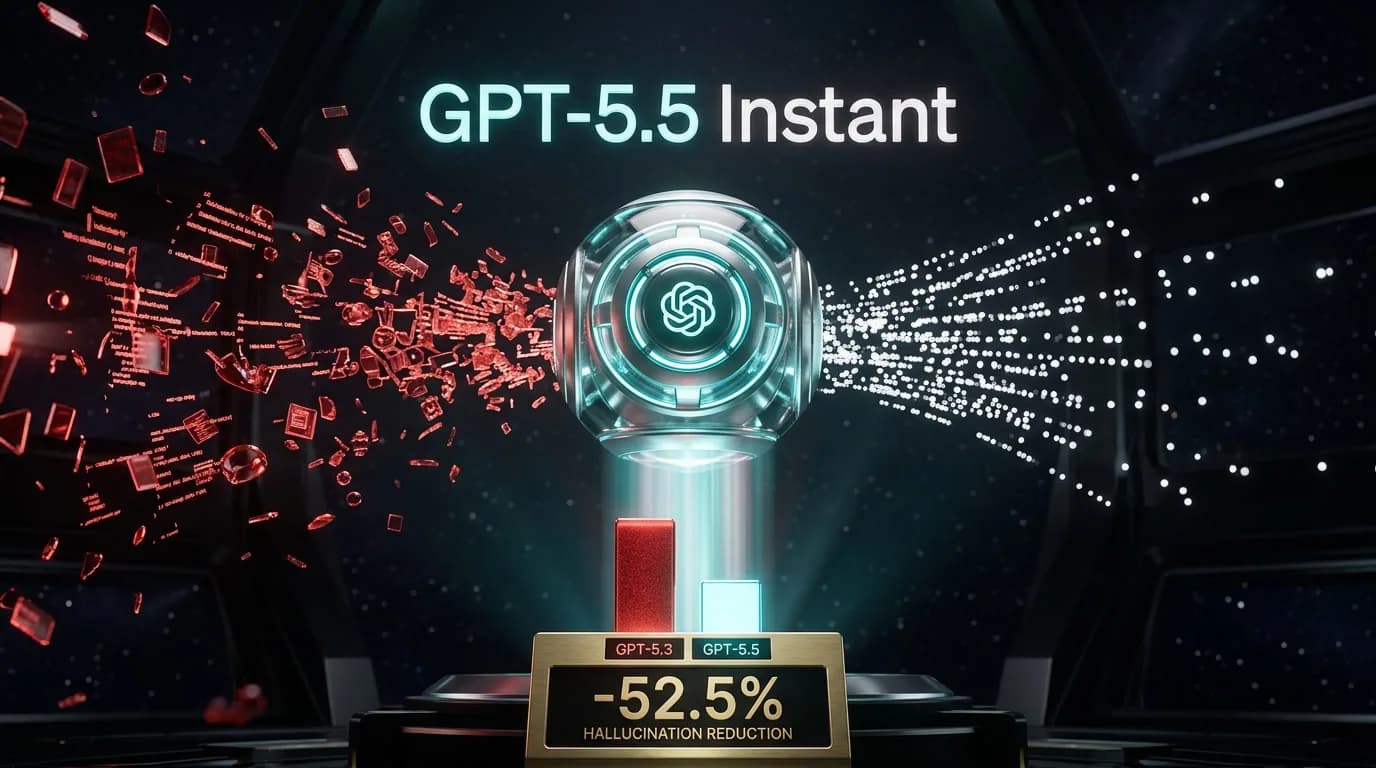
Published: May 15, 2026. OpenAI released GPT-5.5 Instant on May 5, 2026 as the new default model in ChatGPT, with a headline claim of -52.5% hallucinations versus GPT-5.3 Instant on high-stakes prompts spanning medicine, law, and finance. Ten days in, the citation floor has moved. Sites with tight Citation Readiness signals are gaining share, while "approximate" sites are losing it. This is the most consequential model update for AI search visibility since GPT-5.3.
The mechanism is straightforward: fewer hallucinations means the engine cites fewer fragile sources, which means the bar to enter the citation set rises across the board. Operators who built their content around vague claims and unstructured prose are watching their citation rates drop. Operators who invested in front-loading, Answer Capsules, and Schema-Stitch are seeing the opposite — more named citations on the same queries. This is not a transient shift; it is the new floor.
What Changed in GPT-5.5 Instant
GPT-5.5 Instant became the default ChatGPT model on May 5, 2026, replacing GPT-5.3 Instant in the consumer-facing chat surface and in the free tier. OpenAI's announcement frames the release around two pillars: a measurable drop in hallucinations on high-stakes prompts, and a transparency feature called Memory Sources that exposes which conversational contexts the model pulled into a given answer. TechCrunch and Axios both covered the launch the same day, framing it as the largest reliability bump in the GPT-5 family.
The -52.5% hallucination figure
The 52.5% reduction is a relative drop in factual error rate on a curated benchmark of high-stakes prompts — medicine, law, and finance specifically. It is not a universal metric across all prompt categories, and OpenAI explicitly scoped the claim to verticals where hallucinations carry the most user risk. The practical implication for AI search visibility is that these verticals are precisely the ones where the citation set tightens the fastest, because the engine has more incentive to verify each claim before surfacing it.
Memory Sources, in plain English
Memory Sources is the transparency layer that shows users which bits of user-context the model drew on for the current answer. From an operator perspective, it signals where ChatGPT is heading: toward an answer surface where every assertion has a provenance trail, both from user memory and from web sources. The citation side of this trail is what Rankeo tracks, and the discipline that wins under Memory Sources is the same discipline that wins under -52.5% hallucinations — tight signals beat loose prose.
Why -52.5% Hallucinations Reshapes the Citation Floor
Hallucinations and citations are inverse signals. When a model hallucinates, it fabricates content that has no source — so it cites nothing, or worse, cites a plausible-sounding URL that does not exist. When a model hallucinates less, it pulls more aggressively from real sources, which means it has to choose which sources to elevate. That choice runs through a confidence layer, and the confidence layer rewards signals that look like definitive, well-structured truth. Sites that look fragile under that lens get demoted.
The historical precedent is the GPT-5.3 citation shrink we covered earlier this year — see the GPT-5.3 citation shrink data study for the full breakdown. GPT-5.3 cut total citation volume per answer; GPT-5.5 does not cut volume further, but it raises the quality bar inside the volume that remains. The combined effect across both releases is a market where citations are scarcer and more selective, and the selection criterion is signal quality at the page level.
What Rankeo Observed in the First 10 Days
Rankeo ran a controlled panel of 800 domains across SaaS, legal, healthcare, fintech, and ecommerce verticals from May 5 to May 14, 2026. The panel tracks named-citation rates, ghost-citation rates, and AI Share of Voice per engine. The headline finding: domains in the top quartile of Citation Readiness scores gained an average of 11.2% in ChatGPT named citations week-over-week, while domains in the bottom quartile lost an average of 17.8%. The spread is wider than anything we observed in the GPT-5.3 rollout.
The vertical breakdown
Healthcare and legal verticals moved the most, consistent with OpenAI's scoping of the -52.5% claim to high-stakes domains. Legal sites with tight definitive language and explicit jurisdictional disclaimers gained citation share. Healthcare sites with E-E-A-T-backed bylines and medical reviewer signals gained even more. Generic content farms in both verticals lost share faster than in any prior model rollout we have tracked. SaaS and ecommerce showed a smaller but directionally identical pattern.
Citation Readiness Becomes the Filter
Citation Readiness was already a strong predictor of AI visibility before May 5. After May 5, it is the dominant predictor in the Rankeo dataset. The six programmatic checks behind the score — front-loading, entity density, definitive language, readability, H2 questions, and capsule links — map directly onto the signals GPT-5.5 weights more heavily. A score above 70 is the new practical floor for consistent named citations on competitive queries. Below 60, the gap to citable competitors widens every week.
Entity density specifically — the share of named entities in a paragraph relative to total tokens — has emerged as the single most predictive sub-signal. The sweet spot is 15 to 20%, which is where most cornerstone Rankeo content sits. Below 10%, paragraphs get treated as opinion rather than fact, and the engine prefers sources with more entity anchors. See our Entity Consistency Index for the underlying methodology.
Audit your Citation Readiness in 60 seconds
Run a free Rankeo audit and see where your domain lands on the Citation Readiness scale across all 5 AI engines, with the dominant fix to move the needle for GPT-5.5.
Run Free Audit →What to Audit on Your Site Right Now
Five checks identify whether your domain is at risk of citation loss under GPT-5.5, and each one maps to a fix you can ship inside a week. Run them in order on your top-20 traffic pages first, because that is where the citation gap compounds fastest. The order is deliberate: front-loading first, schema last, because front-loading is the highest-leverage fix and schema is the most time-consuming.
The 5-check audit
First, front-loading: does the first 134 words of each cornerstone page answer the page's primary question definitively? If not, rewrite the opening. Second, entity density: are 15 to 20% of tokens in cornerstone paragraphs named entities? Third, definitive language: are claims phrased as "X is Y" rather than "X may be Y" where the evidence supports certainty? Fourth, H2 question structure: do your H2s phrase the actual user question rather than a generic theme? Fifth, schema unification: is your JSON-LD a single Schema-Stitched @graph or fragmented across multiple blocks? Tighten the weakest of the five first.
For a deeper framework on getting cited consistently across all engines, see how to get cited by ChatGPT, Perplexity, and Claude. The framework is engine-agnostic, which is why it holds up under every model rollout — including this one.
Track your AI citations with Rankeo
Rankeo monitors your named-citation rate across all 5 AI engines weekly, surfaces the dominant Citation Readiness gap, and alerts you when a model rollout shifts your share.
See Rankeo Plans →What's Next (Memory Sources)
Memory Sources is the quieter half of the May 5 rollout, but it is the half that will reshape ChatGPT's ranking signal over the next two quarters. By exposing which user-memory contexts feed each answer, OpenAI is building the telemetry foundation for a future ranking layer that weights provenance more heavily. The engine is teaching itself which sources to trust by watching which memory threads survive contradiction.
For operators, the takeaway is that the discipline that wins under -52.5% hallucinations is the same discipline that will win under Memory Sources telemetry: definitive, well-structured, entity-dense content with consistent schema and named-author attribution. The window to tighten this layer is now, before the second wave of impact lands in Q3 2026.
In summary, GPT-5.5 Instant is not a one-off update — it is the first half of a two-stage shift in how ChatGPT chooses sources, and the brands that tighten their Citation Readiness floor over the next 60 days will compound the gain across both stages.
Get your free SEO + GEO audit
Rankeo measures your Citation Readiness, your named-citation rate, and the dominant fix for GPT-5.5 — all in a single audit, ranked by expected lift.
Run Free Audit →FAQ
Frequently Asked Questions

Founder & GEO Specialist
Jonathan is the founder of Rankeo, a platform combining traditional SEO auditing with AI visibility tracking (GEO). He has personally audited 500+ websites for AI citation readiness and developed the Rankeo Authority Score — a composite metric that includes AI visibility alongside traditional SEO signals. His research on how ChatGPT, Perplexity, and Gemini cite websites has been used by SEO agencies across Europe.
- ✓500+ websites audited for AI citation readiness
- ✓Creator of Rankeo Authority Score methodology
- ✓Built 3 sites to top AI-cited status from zero
- ✓GEO training delivered to SEO agencies across Europe