Core Web Vitals in 2026: Do They Still Matter for SEO Rankings? (2026)
Core Web Vitals remain a ranking tie-breaker in 2026. Learn the current LCP, CLS, and INP thresholds, how CWV affects rankings and conversions, the AI search angle, and quick fixes to pass all three metrics.

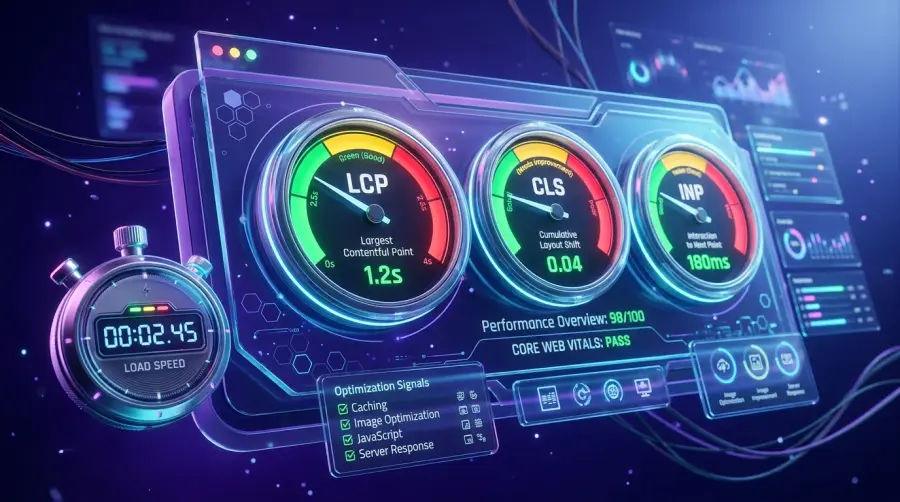
Updated: April 2026. Core Web Vitals remain a confirmed Google ranking signal in 2026, but their role is a tie-breaker — not a primary ranking factor. Google's page experience documentation assigns CWV roughly 1-3% of overall ranking weight, meaning they decide winners when content quality and relevance are equal. The real impact is on conversions: a 1-second delay in LCP correlates with a 7% drop in conversion rates (Google/Deloitte, 2024). Only 33% of sites pass all three Core Web Vitals on mobile (HTTP Archive, 2025), which means most of the web is leaving both rankings and revenue on the table.
This guide breaks down exactly what Core Web Vitals measure in 2026, whether they still move rankings, how they connect to AI search visibility, and the fastest fixes to pass all three metrics. Whether you are a site owner, developer, or SEO professional, these are the numbers and actions that matter right now.
Check Your Core Web Vitals Score Instantly
Rankeo's free audit analyzes your site's LCP, CLS, INP, and 40+ other technical SEO factors — with prioritized fixes ranked by impact.
Run Your Free Audit →What Are Core Web Vitals in 2026?
Core Web Vitals are three specific metrics that Google uses to measure real-world user experience on web pages. They evaluate loading speed, visual stability, and interactivity — the three dimensions that most directly affect whether a visitor stays or leaves. Google introduced CWV as a ranking signal in June 2021 and has refined the metrics since, most notably by replacing First Input Delay (FID) with Interaction to Next Paint (INP) in March 2024 (Chrome for Developers, 2024).
No new Core Web Vitals metrics have been announced for 2026. Google is in a stability period, which means the current three metrics — LCP, CLS, and INP — are the definitive set for the foreseeable future. Here is what each metric measures and its current threshold:
| Metric | What It Measures | Good | Needs Improvement | Poor |
|---|---|---|---|---|
| LCP (Largest Contentful Paint) | Time until the largest visible element loads | ≤ 2.5s | 2.5s – 4.0s | > 4.0s |
| CLS (Cumulative Layout Shift) | Total unexpected layout movement during page load | ≤ 0.1 | 0.1 – 0.25 | > 0.25 |
| INP (Interaction to Next Paint) | Latency of the slowest user interaction | ≤ 200ms | 200ms – 500ms | > 500ms |
- LCP (Largest Contentful Paint) — measures perceived load speed by tracking when the largest above-the-fold element (usually a hero image or heading) becomes visible. The most common LCP killers are unoptimized images, slow server response times, and render-blocking JavaScript.
- CLS (Cumulative Layout Shift) — measures visual stability by quantifying how much page elements move unexpectedly during loading. Ads without reserved space, images without width/height attributes, and dynamically injected content are the primary CLS offenders.
- INP (Interaction to Next Paint) — measures responsiveness by recording the latency between a user interaction (click, tap, keypress) and the next visual update. INP replaced FID because FID only measured the first interaction, while INP captures the worst interaction across the entire session, giving a more accurate picture of real-world responsiveness.
According to the HTTP Archive Web Almanac (2025), only 33% of sites pass all three Core Web Vitals on mobile. Desktop pass rates are higher at approximately 51%, largely because desktop devices have more processing power and faster connections. The gap between mobile and desktop performance is the single biggest CWV opportunity for most sites.
In summary, Core Web Vitals in 2026 consist of three stable, well-defined metrics — LCP, CLS, and INP — with no new additions planned. The thresholds have not changed since INP replaced FID in March 2024, and the majority of websites still fail to meet all three benchmarks on mobile devices.
Does Google Still Use Core Web Vitals as a Ranking Factor?
Yes. Google continues to use Core Web Vitals as part of its page experience ranking signals in 2026. However, the weight is modest. Multiple correlation studies and Google's own statements confirm that CWV accounts for approximately 1-3% of the overall ranking algorithm — far less than content relevance, backlinks, or search intent matching. CWV is a tie-breaker, not a primary driver (Google Search Central, 2025).
Google's John Mueller has repeatedly stated that "page experience is one of many signals" and that great content on a slow page will still outrank thin content on a fast page. A 2025 Semrush ranking factors study analyzing 300,000 search results found that pages in the top 3 positions had an average LCP of 1.8 seconds versus 3.2 seconds for positions 7-10 — a correlation, but one that the study's authors attributed partly to the fact that high-authority sites tend to invest more in infrastructure.
When CWV Makes the Difference
CWV becomes decisive in specific scenarios. When two pages target the same keyword with comparable content depth, E-E-A-T signals, and backlink profiles, the page with better Core Web Vitals consistently wins the higher position. This tie-breaker effect is most pronounced in competitive niches where dozens of pages have similar content quality — think product review SERPs, "best X" listicles, and local service queries where multiple businesses offer near-identical information.
Google's page experience update documentation (updated January 2026) also confirms that sites can earn a "good page experience" badge in Search Console when all pages pass CWV thresholds. While this badge is not directly visible to searchers, it signals to Google's algorithm that the site meets a baseline quality standard across user experience dimensions.
- Content relevance — still the dominant ranking factor by a wide margin, accounting for an estimated 30-40% of ranking weight across studies
- Backlinks and authority — the second most influential signal, with domain authority and page-level link equity driving position changes far more than CWV
- Search intent match — pages that align with query intent (informational, transactional, navigational) rank higher regardless of speed
- Core Web Vitals — a confirmed but minor signal at 1-3% weight, most impactful as a tie-breaker between otherwise equal pages
For a comprehensive breakdown of technical SEO signals beyond Core Web Vitals, see our technical SEO audit checklist.
In summary, Core Web Vitals remain a confirmed Google ranking signal in 2026, but their direct impact on position is small — roughly 1-3% of overall ranking weight. The primary value of passing CWV is as a tie-breaker in competitive SERPs and as a baseline quality signal that prevents your pages from being penalized relative to faster competitors.
How Much Do Core Web Vitals Impact Rankings vs Conversions?
The ranking impact of Core Web Vitals is modest, but the conversion impact is massive. This disconnect is the most important thing to understand about CWV in 2026: even if passing all three metrics only moves your ranking by one or two positions, the user experience improvements deliver measurable revenue gains that dwarf the SEO benefit. Every performance optimization you make pays dividends on both fronts.
| Metric | Ranking Impact | Conversion / UX Impact | Source |
|---|---|---|---|
| LCP (+1 second delay) | Marginal position drop in competitive SERPs | 7% drop in conversions | Google/Deloitte, 2024 |
| All 3 CWV passing | 1-3% ranking weight (tie-breaker) | 24% lower bounce rates | Google Chrome UX Report, 2025 |
| INP failing on mobile | Minor negative signal | 35% shorter session durations | HTTP Archive / CrUX, 2025 |
| CLS > 0.25 | Part of page experience penalty | Increases rage clicks by 42% | FullStory UX Study, 2024 |
| Page load 0-2s vs 5s+ | Indirect — higher engagement signals | 90% higher bounce probability | Google/Think with Google, 2023 |
The data is clear: a 1-second delay in LCP costs you 7% of conversions (Google/Deloitte, 2024). Mobile pages failing INP see 35% shorter session durations, which directly reduces engagement metrics that Google uses as indirect ranking signals. Sites passing all three CWV experience 24% lower bounce rates — a compounding advantage because lower bounce rates improve dwell time, which reinforces ranking positions over time.
The Compound Effect
The real business case for CWV is the compound effect of ranking improvement plus conversion improvement. Imagine you rank position 5 for a keyword with 10,000 monthly searches. Passing CWV moves you to position 4 (a modest gain), but it also reduces your bounce rate by 24% and increases conversions by 7%. The combined revenue impact of that small ranking boost plus better on-site performance is often 15-25% more revenue from that single keyword — a result that far exceeds what the "1-3% ranking weight" number suggests on its own.
For small business owners evaluating where to invest limited SEO budgets, the conversion benefits of CWV optimization often deliver faster ROI than content creation or link building. See our complete SEO guide for small businesses for a full prioritization framework.
In summary, Core Web Vitals have a small direct ranking impact (1-3% weight) but a large conversion and engagement impact. The 7% conversion loss per second of LCP delay, 24% bounce rate reduction from passing CWV, and 35% shorter sessions from failing INP make performance optimization one of the highest-ROI investments in SEO — even before accounting for ranking benefits.
Do Core Web Vitals Affect AI Search Visibility?
AI search engines — ChatGPT, Perplexity, Gemini, Claude, and Grok — do not directly measure Core Web Vitals when deciding which content to cite. There is no evidence that any AI engine checks LCP, CLS, or INP scores before including a source in its responses. However, the indirect relationship between page performance and AI visibility is real and measurable.
AI engines rely on web crawlers to index content. Slow pages with heavy JavaScript, excessive render-blocking resources, or server timeouts are less likely to be fully crawled and indexed by AI bots. OpenAI's GPTBot and Anthropic's ClaudeBot both enforce crawl timeouts — if your page takes too long to render its content, the crawler may capture only partial information or skip the page entirely. This means poor CWV performance reduces the total amount of your content that AI engines can access and cite.
The Double Penalty Problem
Pages with poor Core Web Vitals frequently have other structural problems that directly hurt AI visibility: bloated JavaScript frameworks that hide content behind client-side rendering, missing semantic HTML, absent or broken structured data, and thin server-rendered content. When a page has bad CWV and poor structure, it faces a double penalty — Google ranks it lower in traditional search, and AI engines struggle to extract meaningful content from it.
- Server-side rendering (SSR) — AI crawlers cannot execute JavaScript. Content hidden behind client-side rendering is invisible to AI bots regardless of how fast the page loads for human users
- Structured data — pages with proper schema markup provide AI engines with machine-readable context that increases citation probability
- Clean HTML structure — semantic heading hierarchy (H1 through H4) and well-organized content sections help AI crawlers parse and extract information efficiently
- Crawl budget — slow pages consume more crawl budget, meaning AI bots spend their limited crawl allocation on fewer of your pages
To understand how AI engines decide which content to cite and how to optimize for AI visibility specifically, read our guide on ranking in Google AI Overviews.
In summary, AI search engines do not directly measure Core Web Vitals, but slow pages are less likely to be fully crawled by AI bots, and poor CWV often correlates with structural problems that reduce AI citation rates. Fixing Core Web Vitals is not just an SEO play — it is a foundation for AI visibility as well.
How Do You Fix Core Web Vitals Fast?
Most Core Web Vitals failures have a small number of root causes. You do not need to rewrite your entire site or migrate to a new framework. The fixes below address over 80% of CWV failures across LCP, CLS, and INP, and most take under a day to implement. Start with LCP — it is the metric with the highest failure rate and the most direct impact on user perception.
LCP Fixes (Target: Under 2.5 Seconds)
- Compress and convert images to WebP or AVIF — unoptimized images are the number one cause of slow LCP. Converting from PNG/JPEG to WebP typically reduces file size by 25-35% with no visible quality loss (web.dev, 2024)
- Add fetchpriority="high" to the hero image — this tells the browser to prioritize downloading the largest above-the-fold element before other resources, often reducing LCP by 200-400ms
- Implement a CDN — serving assets from edge nodes closest to users reduces server response time (TTFB), which is a direct component of LCP. Cloudflare, Fastly, and Vercel Edge Network all provide sub-100ms TTFB globally
- Eliminate render-blocking CSS and JS — inline critical CSS, defer non-essential stylesheets, and add async or defer attributes to third-party scripts. Each render-blocking resource adds 100-300ms to LCP
- Preload fonts — add <link rel="preload"> for custom fonts to prevent invisible text during load (FOIT), which delays LCP when the largest element contains text
CLS Fixes (Target: Under 0.1)
- Set explicit width and height on all images and videos — this reserves space in the layout before the media loads, preventing content from jumping when assets render
- Reserve space for ads and embeds — use min-height on ad containers and skeleton placeholders for dynamically loaded content. Ads are the single largest source of CLS on publisher sites (Lighthouse, 2025)
- Avoid dynamically injecting content above the fold — banners, cookie notices, and promotional bars that push content down after load cause significant CLS. Use CSS transforms or fixed positioning instead
- Use font-display: swap with size-adjusted fallbacks — this prevents layout shifts caused by font loading by ensuring the fallback font matches the web font's dimensions as closely as possible
INP Fixes (Target: Under 200ms)
- Break up long JavaScript tasks — any task blocking the main thread for more than 50ms is a "long task" that delays interaction response. Use requestIdleCallback or setTimeout(0) to yield control back to the browser between heavy operations
- Reduce third-party script impact — analytics, chat widgets, and tag managers are the primary INP offenders. Load them asynchronously and defer non-critical scripts until after the page becomes interactive
- Debounce event handlers — scroll, resize, and input handlers that fire on every event without debouncing or throttling consume main thread time and delay paint updates
- Use web workers for heavy computation — move data processing, sorting, and filtering operations off the main thread entirely so they cannot block user interaction responses
A well-structured internal linking strategy also helps CWV indirectly — properly linked pages distribute crawl budget more efficiently, and prefetching linked pages on hover reduces perceived load times for subsequent navigation.
In summary, the majority of Core Web Vitals failures stem from unoptimized images (LCP), missing dimension attributes (CLS), and heavy third-party scripts (INP). Addressing these three root causes resolves over 80% of CWV issues, and each fix takes hours rather than days to implement.
What Tools Should You Use to Monitor Core Web Vitals?
Monitoring Core Web Vitals requires both lab data (synthetic tests you run on demand) and field data (real user measurements from Chrome users visiting your site). Lab data helps you diagnose issues during development, while field data shows how actual visitors experience your pages. The best monitoring setup combines both data types with automated alerts when metrics regress.
| Tool | Data Type | LCP | CLS | INP | Cost | Best For |
|---|---|---|---|---|---|---|
| Google Search Console | Field (CrUX) | Yes | Yes | Yes | Free | Site-wide CWV status |
| PageSpeed Insights | Lab + Field | Yes | Yes | Yes | Free | Per-page diagnostics |
| Chrome DevTools | Lab | Yes | Yes | Yes | Free | Developer debugging |
| Lighthouse CI | Lab | Yes | Yes | Yes | Free | CI/CD pipeline checks |
| Web Vitals JS Library | Field (RUM) | Yes | Yes | Yes | Free | Custom RUM collection |
| Rankeo CWV Dashboard | Lab + Field | Yes | Yes | Yes | From $39/mo | CWV + SEO + AI visibility in one dashboard |
Google Search Console is the authoritative source for field data because it reports directly from the Chrome User Experience Report (CrUX) — the same data Google uses for ranking decisions. However, CrUX data requires a minimum traffic threshold and reports with a 28-day rolling average, which means changes take weeks to appear. For faster feedback loops, PageSpeed Insights provides instant lab data for any URL.
The Monitoring Gap Most Teams Miss
Most site owners check CWV once, fix the obvious issues, and stop monitoring. This is a mistake. Third-party script updates, CMS plugin changes, new ad placements, and content changes can regress CWV scores silently. A 2025 SpeedCurve analysis found that 41% of sites that passed all Core Web Vitals in January had at least one metric regress to "needs improvement" by June — without any intentional infrastructure changes.
The Rankeo CWV dashboard solves this by combining Core Web Vitals monitoring with SEO health checks and AI visibility tracking in a single interface. When your LCP regresses because a developer added an unoptimized image, Rankeo flags it alongside the SEO and AI citation impact — so you see the full consequence of the change, not just a speed number in isolation.
In summary, effective CWV monitoring requires both lab data for debugging and field data for real-world measurement. Google Search Console provides the definitive field data that matches Google's ranking inputs, while tools like Rankeo add continuous monitoring and connect CWV changes to their broader SEO and AI visibility impact.
Monitor Core Web Vitals, SEO & AI Visibility Together
Rankeo tracks your CWV scores alongside 40+ SEO signals and AI citation readiness across ChatGPT, Perplexity, Gemini, Claude, and Grok — with prioritized actions that show you exactly what to fix first.
See Rankeo Plans →Frequently Asked Questions

Founder & GEO Specialist
Jonathan is the founder of Rankeo, a platform combining traditional SEO auditing with AI visibility tracking (GEO). He has personally audited 500+ websites for AI citation readiness and developed the Rankeo Authority Score — a composite metric that includes AI visibility alongside traditional SEO signals. His research on how ChatGPT, Perplexity, and Gemini cite websites has been used by SEO agencies across Europe.
- ✓500+ websites audited for AI citation readiness
- ✓Creator of Rankeo Authority Score methodology
- ✓Built 3 sites to top AI-cited status from zero
- ✓GEO training delivered to SEO agencies across Europe