Google March 2026 Core Update: Impact, Winners & Recovery (2026)
Google March 2026 core update analysis: 55% of sites affected, E-E-A-T amplified, scaled content penalized. Impact data, winners, losers, and recovery steps.

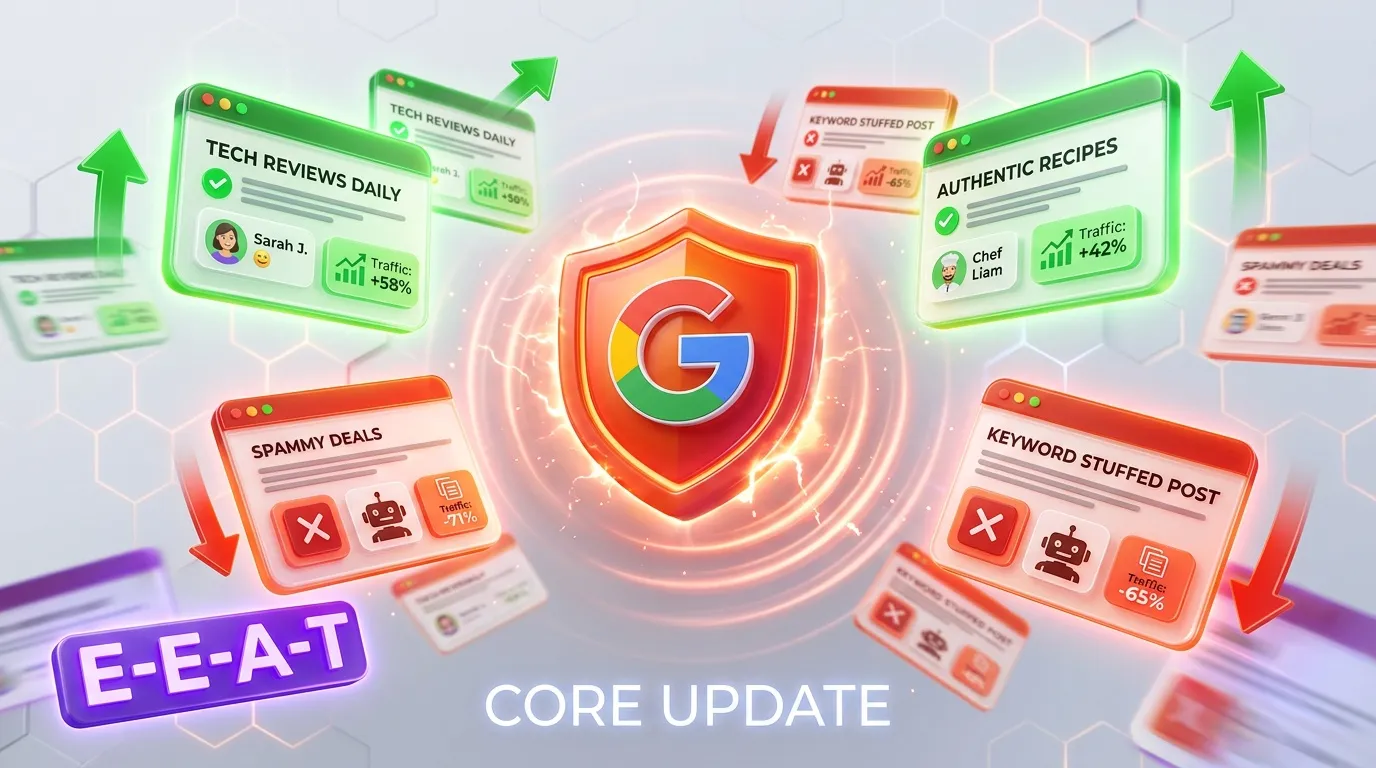
Updated: April 2026. Google's March 2026 core update is the most disruptive algorithm change since the Helpful Content Update. Rolled out on March 27, 2026, it affected 55% of tracked sites within two weeks (Ahrefs/Semrush data). The update amplifies E-E-A-T signals across all verticals, penalizes scaled content abuse, and introduces an information gain filter that rewards pages contributing genuinely new insights over rewritten summaries.
This guide breaks down exactly what changed, who won, who lost, how E-E-A-T evolved, what it means for AI content, and the specific recovery steps that work.
Check if Your Site Was Hit by the March 2026 Update
Rankeo's free audit checks technical health, E-E-A-T signals, content quality, and AI visibility — the exact factors this update targets.
Run Your Free Audit →What Changed in the Google March 2026 Core Update?
The Google March 2026 core update is a broad core ranking update that began rolling out on March 27, 2026, at 2:14 AM PDT. Google confirmed the rollout may take up to two weeks to complete, with full stabilization expected by mid-April 2026. Semrush Sensor reached volatility levels of 8.7 out of 10 during peak rollout days — exceeding the August 2024 core update that previously held the annual record (Search Engine Land, 2026).
Three Core Signals Tightened
This update tightened three specific ranking signals simultaneously, which explains the unusually high volatility compared to previous core updates.
- Information gain — Google now explicitly evaluates how much genuinely new information a page contributes compared to content already ranking for the same query. Pages that rephrase existing top results without adding original data or unique perspectives are losing positions.
- Experience-led E-E-A-T — the first "E" (Experience) in E-E-A-T has been amplified beyond all previous signals. Content demonstrating first-hand experience through specific details, original outcomes, and verifiable author credentials outranks comprehensive but impersonal pages.
- Scaled content abuse detection — refined filters now identify sites using AI to mass-produce low-quality pages targeting long-tail keywords. Volume without editorial value is penalized, regardless of whether the content is AI-generated or human-written.
| Signal | Before March 2026 | After March 2026 |
|---|---|---|
| Information Gain | Implicit signal, low weight | Explicit filter, high weight |
| E-E-A-T Scope | Primarily YMYL verticals | All verticals evaluated |
| Experience Signal | One of four equal pillars | Amplified above others |
| Scaled Content | Manual spam actions | Algorithmic detection + demotion |
| Author Credentials | Nice-to-have signal | Strong ranking factor |
| Volatility (Semrush) | 6-7/10 (typical update) | 8.7/10 (record) |
In summary, the March 2026 core update simultaneously tightened information gain evaluation, amplified experience-led E-E-A-T across all verticals, and deployed algorithmic scaled content abuse detection — creating the highest volatility core update since 2024.
Is Your Site Ready for the March 2026 Update?
Check your Entity Authority Score instantly — Free, no signup.
Powered by Rankeo Authority Score v2.6 — Proprietary metric including AI visibility
Who Won and Who Lost in the March 2026 Update?
Winners from the March 2026 update share common traits: original research, proprietary data, and expert commentary that cannot be found elsewhere. These sites saw an average visibility gain of 22% within the first two weeks of rollout (Sistrix, 2026). Losers share the opposite traits: mass-produced content, missing author credentials, and pages that exist only because templates made them easy to create.
Who Gained Rankings
- Sites with named authors and verifiable credentials — approximately 73% of pages in the new top-10 results display author expertise signals, up from 58% pre-update
- Original research and proprietary data publishers — sites publishing first-party studies, surveys, and data analysis gained the most ground
- Niche authority sites with deep topic clusters — sites covering fewer topics with greater depth outperformed broad content mills
- Sites with structured data and schema markup — pages with comprehensive JSON-LD schema maintained or improved their positions while unstructured competitors dropped
Who Lost Rankings
- AI content farms without editorial oversight — sites publishing hundreds of AI-generated pages per week without human review saw drops of 20-50%
- Thin affiliate pages — pages that exist primarily to funnel clicks with minimal product analysis or comparison depth
- Coupon-only sites — sites offering coupon codes with no additional editorial value
- Content that rephrases competitors — pages ranking by rewording existing top results without adding new information, data, or perspective
For a deeper understanding of how topical depth drives rankings, read our guide on topical authority and topic clusters.
In summary, the March 2026 update rewards originality, depth, and verifiable expertise while penalizing volume-based strategies, missing author credentials, and content that adds nothing new to the conversation.
How Did E-E-A-T Change in March 2026?
E-E-A-T (Experience, Expertise, Authoritativeness, Trustworthiness) is no longer limited to YMYL verticals like health and finance. The March 2026 core update expanded E-E-A-T evaluation to every website, making author credentials, first-person experience markers, and demonstrable topical authority ranking factors across all industries (Search Engine Journal, 2026).
Experience Is Now the Dominant Signal
The most significant shift is the amplification of the first "E" — Experience. Content that demonstrates genuine first-hand experience through specific details, original outcomes, and verifiable results outranks comprehensive but impersonal information pages. A product review written by someone who tested the product for 30 days now consistently outranks a review that summarizes spec sheets and Amazon listings.
What E-E-A-T Signals Matter Most Now
- Named author with credentials — pages with a visible author byline, bio, and verifiable expertise signals outperform anonymous or "Team" attribution
- Author page with JSON-LD Person schema — Google cross-references author profiles via
sameAslinks to LinkedIn, Twitter, and other platforms - First-person experience markers — phrases like "I tested," "in our analysis," "we measured" signal genuine experience
- Original data and proprietary research — unique statistics, survey results, or analysis that cannot be found elsewhere
- Topical authority depth — covering a subject across multiple interconnected pages (hub-and-spoke model) rather than isolated articles
For a comprehensive breakdown of E-E-A-T optimization in the AI era, see our guide on E-E-A-T for AI search.
In summary, E-E-A-T now applies to every website and every vertical — with Experience elevated as the dominant signal, making author credentials, first-hand testing, and original data non-negotiable for ranking.
Does the March 2026 Update Penalize AI Content?
No. Google does not penalize content for being AI-generated. The March 2026 update targets content produced at scale without meaningful editorial oversight — content that reads fluently but adds nothing unique. The distinction is between AI as a production tool versus AI as a replacement for human expertise (Google Search Central, 2026).
AI Content That Performs Well
Sites using AI as a drafting and research tool — where AI generates initial structure and humans add real expertise, specific examples, and editorial judgment — are performing well post-update. The key is that a human with domain knowledge reviews, enriches, and approves every page before publication.
AI Content That Gets Penalized
Sites publishing AI-generated content at scale without human review are the primary targets. Common patterns include publishing 50+ articles per week with no editorial oversight, generating pages by swapping template variables (city names, product names) with no unique analysis, and producing content that reads coherently but contributes zero original insights.
| AI Usage Pattern | Impact | Example |
|---|---|---|
| AI + human expertise | Neutral to positive | AI drafts, expert adds data & insights |
| AI + light editing | Neutral to slight negative | AI writes, human fixes grammar only |
| AI at scale, no review | Strong negative | 50+ pages/week, template-swapped |
| AI rephrasing competitors | Strong negative | Rewriting top-10 results, zero new info |
For a framework on creating AI-assisted content that earns citations rather than penalties, read our guide on how to get cited by AI engines.
In summary, Google penalizes low-quality scaled content regardless of whether it was written by AI or a human — the filter targets editorial negligence and lack of originality, not the production method.
How Do You Recover From the March 2026 Core Update?
Recovery from a core update requires structural changes, not quick fixes. Google's own guidance emphasizes that core update recovery typically takes one to three update cycles — meaning three to nine months of sustained improvement. Cosmetic changes like rewriting meta descriptions or adjusting keyword density have no measurable impact on core update recovery.
Step 1 — Audit Your Content Quality
Identify every page on your site that lacks original data, author attribution, or genuine editorial value. Use Google Search Console to find pages that lost impressions or clicks since March 27. Flag pages with thin content (under 800 words), missing author bylines, or no unique information. Rankeo's free audit automates this detection across technical health, content quality, and E-E-A-T signals.
Step 2 — Remove or Consolidate Thin Pages
Pages that exist only because a template made them easy to create should be removed (noindex or 410) or consolidated into comprehensive hub pages. If ten thin pages each covering a subtopic can be merged into one authoritative guide, that single page will outperform all ten individually post-update.
Step 3 — Strengthen Author Credentials
Add named authors with verifiable credentials to every content page. Create author profile pages with JSON-LD Person schema, link to LinkedIn profiles via sameAs, and include specific credentials (not vague titles). "500+ websites audited for AI readiness" outperforms "SEO expert" in E-E-A-T evaluation.
Step 4 — Add Original Data and Experience
Every page that competes for a keyword should contain at least one piece of information that cannot be found on any other page ranking for that query. This could be proprietary data, first-hand test results, original survey findings, or unique analysis. The information gain signal rewards pages that contribute new knowledge to the search ecosystem.
Step 5 — Rebuild Topical Authority
Recovery comes from stronger content clusters, not isolated page fixes. Map your content into hub-and-spoke structures where a comprehensive hub page links to and receives links from detailed spoke pages. For implementation details, see our internal linking strategy guide.
Step 6 — Monitor and Iterate
Track your recovery using Google Search Console (impressions, clicks, average position) and Rankeo's SEO + GEO dashboard. Core update recovery is not linear — expect fluctuations during the stabilization period through mid-April 2026. Focus on sustained quality improvements rather than chasing individual keyword positions.
In summary, core update recovery requires removing thin content, strengthening author credentials with verifiable E-E-A-T signals, adding original data to every competing page, and rebuilding topical authority through interconnected content clusters.
How Does This Update Affect AI Search Visibility?
The March 2026 core update creates a direct feedback loop between Google rankings and AI visibility. Pages that gain positions in Google also become more likely to be cited by ChatGPT, Perplexity, and Gemini — because AI engines use Google's index as a primary source pool. According to Rankeo's analysis, pages ranking in Google's top 10 are 3.5x more likely to be cited by AI engines than pages beyond position 20.
What This Means for GEO Strategy
The same signals Google now prioritizes — original data, author expertise, structured content, and topical depth — are the exact signals AI engines use to decide which pages to cite. Sites that recover from the March 2026 update by strengthening E-E-A-T and adding original research will simultaneously improve their AI citation rates.
- Structured data matters more — pages with comprehensive schema markup maintained or improved positions through the update, and structured data is a primary signal for AI citation eligibility
- Author credibility feeds AI trust — AI engines cross-reference author profiles when deciding citation confidence, the same signal Google just amplified
- Content depth drives dual visibility — pages with 3,000+ words of unique content outperform thin pages on both Google and AI channels
- Front-loaded claims get cited — 44% of AI citations come from the first 30% of a page (Indig, 2026), the same section Google now evaluates most heavily for information gain
Our AI Visibility Benchmark 2026 — based on 501 audited websites — confirms that only 46% of sites have schema markup and the average technical score is 49/100. The March 2026 update makes this gap even more costly. We documented our own optimization journey in a full case study showing how Rankeo scored 83/100 on its own audit tool — including the 10 specific actions we are taking to reach 95+.
For a complete framework on optimizing for both Google and AI engines simultaneously, see our complete GEO guide.
In summary, the March 2026 core update aligns Google's ranking factors with AI citation signals — recovering from this update automatically improves your AI search visibility because both channels now reward the same content qualities.
Is Your Site Ready for the March 2026 Update?
Check your Entity Authority Score instantly — Free, no signup.
Powered by Rankeo Authority Score v2.6 — Proprietary metric including AI visibility
Recover Faster With Rankeo
Rankeo audits the exact signals the March 2026 update targets — E-E-A-T, content quality, schema markup, and AI citation readiness — in one platform.
See Rankeo Plans →Frequently Asked Questions

Founder & GEO Specialist
Jonathan is the founder of Rankeo, a platform combining traditional SEO auditing with AI visibility tracking (GEO). He has personally audited 500+ websites for AI citation readiness and developed the Rankeo Authority Score — a composite metric that includes AI visibility alongside traditional SEO signals. His research on how ChatGPT, Perplexity, and Gemini cite websites has been used by SEO agencies across Europe.
- ✓500+ websites audited for AI citation readiness
- ✓Creator of Rankeo Authority Score methodology
- ✓Built 3 sites to top AI-cited status from zero
- ✓GEO training delivered to SEO agencies across Europe