Schema Markup for Blogs: Quick Implementation Guide
Implement Article, Person, and BreadcrumbList schema on your blog. Step-by-step guide to structured data that improves search visibility and AI content citations.
Why Schema Matters for Blog
Blog schema markup has evolved from a nice-to-have into an editorial trust signal. Google's E-E-A-T framework evaluates every blog post for experience, expertise, authoritativeness, and trustworthiness — and structured data is how you communicate these signals in machine-readable format. Article schema with proper author attribution, publication dates, and publisher information tells Google exactly who wrote the content and when. Person schema on author pages establishes individual credibility through credentials, expertise areas, and professional profiles. In 2026, this matters beyond Google: AI engines like ChatGPT, Perplexity, and Gemini cite blog content in their responses, and they strongly prefer sources with structured authorship data. When an AI engine encounters an article with verified author credentials via Person schema, it cites that source with higher confidence than anonymous or unattributed content. For blogs that depend on organic traffic — whether personal blogs, company blogs, or media publications — proper schema markup is the difference between being cited as a trusted source and being passed over for competitors whose authorship signals are stronger.
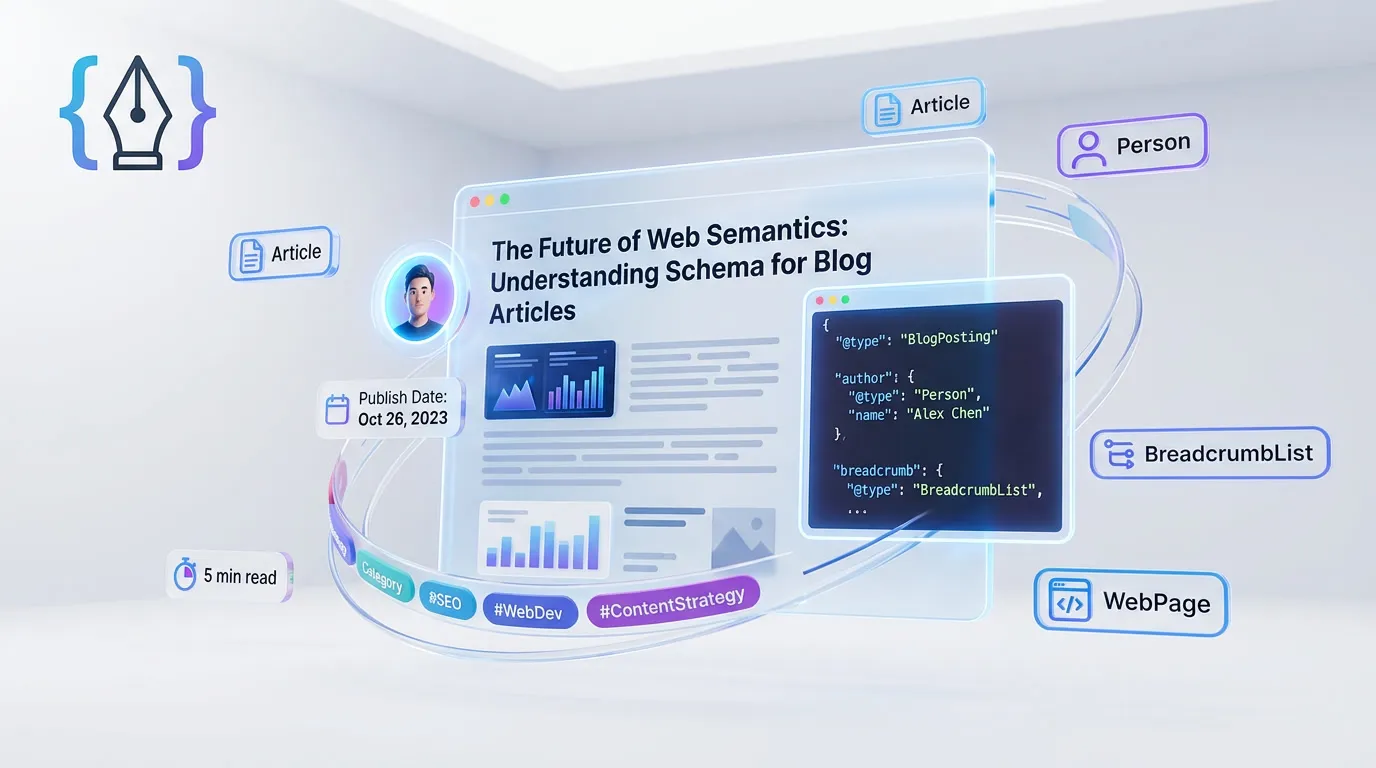
Essential Schema Types for Blog
Implement these 4 schema types to maximize your search visibility and AI engine compatibility.
1.Article
CriticalGoogle Rich ResultsEnables article rich results with author, date, and headline in search
{
  "@type": "Article",
  "headline": "10 Tips for Better Content Marketing",
  "author": {
    "@type": "Person",
    "name": "Alex Rivera",
    "url": "https://yourblog.com/authors/alex-rivera"
  },
  "datePublished": "2025-01-15",
  "dateModified": "2025-03-01",
  "image": "https://yourblog.com/content-marketing-tips.jpg",
  "publisher": { "@id": "#org" }
}
Pro tip: Always include both datePublished and dateModified. When you update an article, update dateModified — this freshness signal is what keeps evergreen content ranking. AI engines also prefer recently updated sources when answering current-state queries.
2.Person
CriticalBuilds author authority signals critical for E-E-A-T evaluation
{
  "@type": "Person",
  "@id": "#author-alex",
  "name": "Alex Rivera",
  "jobTitle": "Senior Content Strategist",
  "url": "https://yourblog.com/authors/alex-rivera",
  "sameAs": [
    "https://twitter.com/alexrivera",
    "https://linkedin.com/in/alexrivera"
  ],
  "knowsAbout": ["Content Marketing", "SEO", "Digital Strategy"]
}
Pro tip: Create a dedicated author page for each writer with their full Person schema. Link every Article back to this author via @id reference. This creates an entity graph where Google can aggregate authority signals across all articles by the same author.
3.BreadcrumbList
RecommendedGoogle Rich ResultsShows navigation breadcrumbs in search for better click-through
{
  "@type": "BreadcrumbList",
  "itemListElement": [{
    "@type": "ListItem",
    "position": 1,
    "name": "Blog",
    "item": "https://yourblog.com/blog"
  }, {
    "@type": "ListItem",
    "position": 2,
    "name": "Content Marketing",
    "item": "https://yourblog.com/blog/content-marketing"
  }, {
    "@type": "ListItem",
    "position": 3,
    "name": "10 Tips for Better Content Marketing"
  }]
}
Pro tip: Include your blog category in the breadcrumb path. This communicates your content taxonomy to Google, helping it understand topical relationships between articles in the same category and boosting the authority of your category landing pages.
4.FAQPage
RecommendedGoogle Rich ResultsStructures Q&A at the bottom of how-to and guide articles for AI engine extraction
{
  "@type": "FAQPage",
  "mainEntity": [{
    "@type": "Question",
    "name": "How often should you publish blog posts?",
    "acceptedAnswer": {
      "@type": "Answer",
      "text": "Quality matters more than frequency. Publishing 1-2 well-researched, comprehensive posts per week is more effective than daily thin content."
    }
  }]
}
Pro tip: Add FAQPage schema to your most comprehensive guide and tutorial posts — the ones that naturally answer multiple questions. These structured Q&A pairs can capture featured snippet positions for long-tail queries and are frequently cited by AI engines answering related questions.
Common Mistakes to Avoid
These are the most frequent blog schema issues we see during audits.
#1 — Missing author information on Article schema
Article schema without author attribution fails E-E-A-T evaluation. Google cannot credit expertise to a specific person, and AI engines have no authorship signal to evaluate when deciding whether to cite your content.
Fix: Add author with @type Person including name and url pointing to a dedicated author page. For multi-author blogs, reference the specific author per article via @id. Never use a generic "Admin" or company name as the sole author.
#2 — No dateModified when articles are updated
Articles with only datePublished and no dateModified look stale to Google even if the content has been updated. This costs you freshness signals that are critical for competitive queries where content recency matters.
Fix: Add dateModified alongside datePublished and update it every time you make a substantive edit to the article. Trivial changes (typo fixes) do not warrant dateModified updates, but content additions and data refreshes do.
#3 — Using BlogPosting without publisher reference
BlogPosting or Article schema without a publisher property disconnects the article from your brand entity. Google cannot attribute the content to your organization, weakening your domain-level authority signal.
Fix: Add publisher referencing your Organization entity via @id. Define the Organization once in your @graph with name, url, and logo, then reference it from every Article via publisher: { "@id": "#org" }.
#4 — No Person schema for author pages with credentials
Linking articles to an author name without a corresponding Person entity on a dedicated author page means Google cannot build an author knowledge graph. Your writers' expertise signals are fragmented and uncredited.
Fix: Create a dedicated /authors/[name] page for each writer with Person schema including jobTitle, knowsAbout, sameAs (social links), and optionally alumniOf. Link this author page from every article they write.
How to Test Your Schema
- 1Check a recent article's source for Article schema with headline, author (Person with name and url), datePublished, dateModified, image, and publisher
- 2Verify your author pages contain Person schema with jobTitle, knowsAbout, and sameAs links to professional profiles
- 3Run Google's Rich Results Test on 3-5 articles to confirm Article rich result eligibility and check for validation warnings
- 4Paste your @graph JSON-LD into Rankeo's Schema Validator and verify that @id references between Article, Person, and Organization entities resolve correctly
- 5Check Google Search Console > Enhancements > Articles to see how many blog posts have valid Article markup and identify any errors or warnings
Generate Blog Schema Instantly with Rankeo
Stop writing schema markup by hand. Rankeo's schema generator builds a complete, validated @graph array for your blog site in seconds — including all 4 essential types above.
- Programmatic builders — no AI hallucinations
- Connected @graph with proper @id references
- Validated against Google Rich Results requirements
- One-click copy to your site
The Bottom Line
Blog schema markup is an E-E-A-T amplifier that directly impacts your content's ranking potential and AI citation frequency. Article schema with proper author attribution, Person schema with verifiable credentials, and BreadcrumbList for content taxonomy create a trust layer that both Google and AI engines use to evaluate your content. Most blogs still lack proper authorship schema — implementing it now gives your content a durable authority advantage that compounds with every article you publish.
Frequently Asked Questions
What schema types does a blog need?
Article or BlogPosting on every post with author and dates, Person schema on author pages with credentials and expertise areas, BreadcrumbList for category navigation, and FAQPage on guide-style posts. These four types cover the essential E-E-A-T signals and rich result opportunities for blog content.
Does schema markup help blog SEO?
Yes. Article schema enables rich results with author photos and publish dates that increase click-through rates. Person schema builds E-E-A-T signals that Google uses to evaluate content quality, especially for YMYL topics. Blogs with strong authorship schema consistently outrank those without for competitive queries.
How do I add schema to my blog posts?
Add Article schema with headline, author (linked to a Person with credentials), datePublished, dateModified, and publisher in a @graph array. Add BreadcrumbList for post categories. Most CMS platforms (WordPress, Ghost, Next.js) support this natively or via plugins.
Should I use Article or BlogPosting schema?
Both work for rich results. BlogPosting is a subtype of Article, so it inherits all properties. Use BlogPosting for informal blog content and Article for longer-form editorial content. Google treats them equivalently for rich result eligibility, so the choice is primarily semantic.
How does author schema affect AI citations?
AI engines evaluate author credentials when deciding which sources to cite. Person schema with jobTitle, knowsAbout, and sameAs links helps AI models assess author expertise. Content from authors with verified credentials via structured data gets cited more frequently and with higher confidence than anonymous content.
Can Rankeo generate blog schema automatically?
Yes. Rankeo's Schema Generator creates a complete @graph with Article, Person, Organization, and BreadcrumbList schema for your blog posts. It connects author entities across articles, validates dateModified freshness, and ensures your publisher attribution builds domain-level E-E-A-T signals.
More Schema Guides
Explore implementation guides for other industries.
4 schema types
4 schema types
4 schema types
4 schema types
4 schema types
4 schema types
4 schema types
4 schema types
4 schema types
Want a full SEO + GEO strategy for your blog site?
See Rankeo for BlogLearn about the difference between SEO, AEO, and GEO.
Read on the blogReady to fix your structured data?
Rankeo audits your schema, generates fixes, and monitors rich result eligibility — all in one dashboard.