Schema Markup for Nonprofits: Quick Implementation Guide
Implement NGO, Organization, and Event schema for your nonprofit. Step-by-step guide to structured data that increases visibility and drives more donations online.
Why Schema Matters for Nonprofit
Nonprofits face a unique digital visibility challenge: they need to compete for attention with for-profit organizations that have 10x their marketing budget. Schema markup levels this playing field. NGO schema tells Google and AI engines that your organization is a nonprofit with a specific mission, cause area, and geographic focus — unlocking cause-related search features and building the trust signals donors evaluate before giving. Event schema structures your fundraisers, volunteer events, and campaigns for Google's event rich results — the carousel format that appears at the top of search results and drives significantly higher engagement than standard listings. In 2026, AI engines are becoming a major channel for cause discovery: people ask ChatGPT "best environmental charities to donate to" or Perplexity "volunteer opportunities near me this weekend." These AI engines recommend organizations with structured data they can parse with confidence — mission, impact metrics, event details, and donation transparency. Nonprofits that implement proper schema markup gain outsized visibility because so few organizations in the sector have done it. Your $0 investment in structured data competes directly with millions in corporate marketing spend.
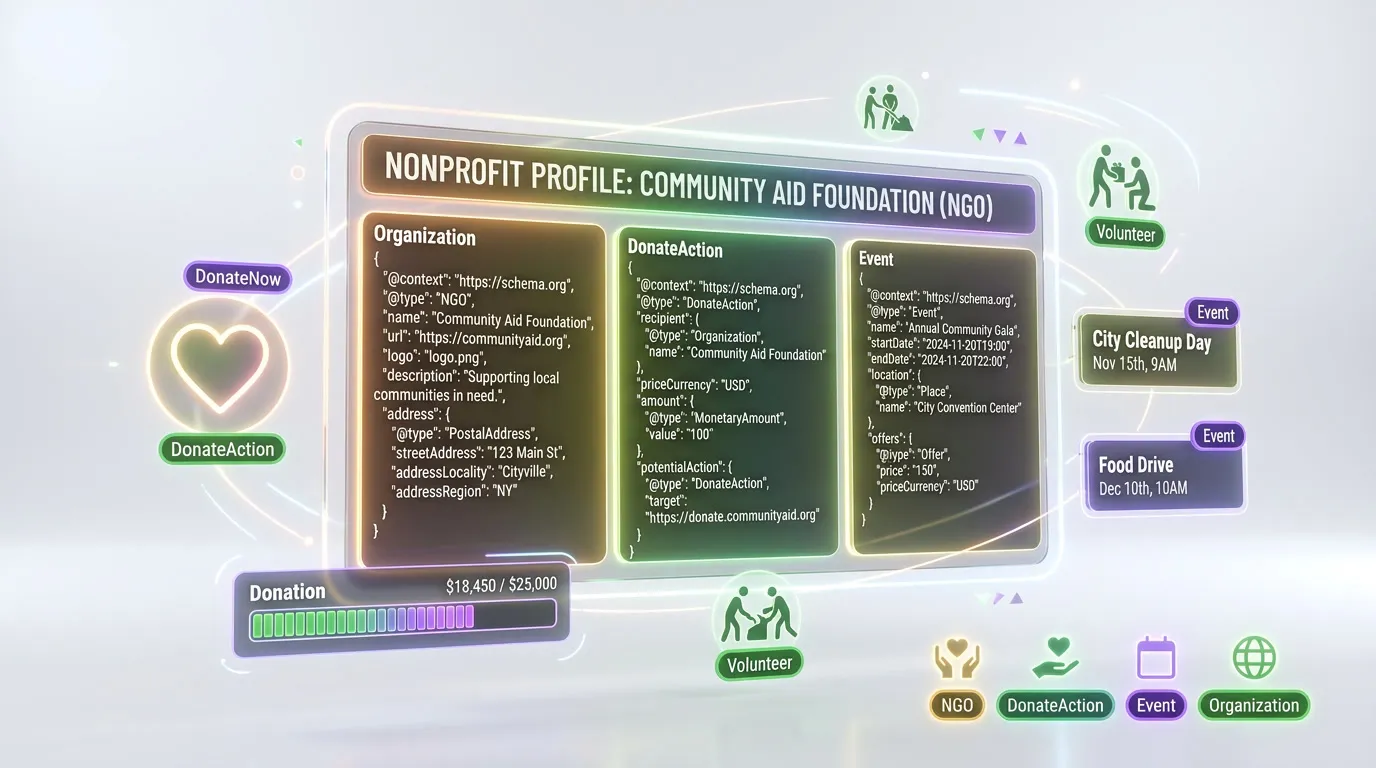
Essential Schema Types for Nonprofit
Implement these 4 schema types to maximize your search visibility and AI engine compatibility.
1.NGO
CriticalIdentifies your organization as a nonprofit for cause-related queries
{
  "@type": "NGO",
  "@id": "#org",
  "name": "Green Earth Foundation",
  "description": "Environmental nonprofit focused on reforestation and ocean cleanup.",
  "url": "https://greenearth.org",
  "logo": "https://greenearth.org/logo.png",
  "address": {
    "@type": "PostalAddress",
    "addressLocality": "San Francisco",
    "addressRegion": "CA"
  },
  "sameAs": [
    "https://twitter.com/greenearth",
    "https://facebook.com/greenearthfoundation"
  ]
}
Pro tip: Add nonprofitStatus (e.g., "Nonprofit501c3") and areaServed to your NGO schema. Also include knowsAbout with your cause areas ("Reforestation", "Ocean Cleanup", "Climate Action"). AI engines use these properties to match your organization with cause-specific donor queries.
2.Event
RecommendedGoogle Rich ResultsEnables event rich results for fundraisers and volunteer activities
{
  "@type": "Event",
  "name": "Annual Beach Cleanup 2025",
  "startDate": "2025-06-15T09:00:00-07:00",
  "endDate": "2025-06-15T14:00:00-07:00",
  "location": {
    "@type": "Place",
    "name": "Ocean Beach",
    "address": "Ocean Beach, San Francisco, CA"
  },
  "organizer": { "@id": "#org" },
  "isAccessibleForFree": true,
  "eventAttendanceMode": "https://schema.org/OfflineEventAttendanceMode"
}
Pro tip: Include isAccessibleForFree: true for free volunteer events — this dramatically increases click-through rates in event rich results. For fundraiser galas with ticket prices, add offers with pricing. Always include eventAttendanceMode to distinguish in-person from virtual events.
3.Article
RecommendedGoogle Rich ResultsStructures impact stories and blog posts for search and AI citation
{
  "@type": "Article",
  "headline": "How We Planted 1 Million Trees in 2024",
  "author": {
    "@type": "Organization",
    "name": "Green Earth Foundation"
  },
  "datePublished": "2025-01-20",
  "image": "https://greenearth.org/million-trees.jpg",
  "publisher": { "@id": "#org" }
}
Pro tip: Use Article schema for impact reports and stories with concrete numbers ("1 Million Trees," "$2.3M Raised"). These quantified impact stories are what AI engines cite when recommending nonprofits — vague mission statements carry far less weight than specific, measurable outcomes.
4.FAQPage
RecommendedGoogle Rich ResultsAnswers donor and volunteer questions directly in search results
{
  "@type": "FAQPage",
  "mainEntity": [{
    "@type": "Question",
    "name": "How are donations used?",
    "acceptedAnswer": {
      "@type": "Answer",
      "text": "92% of every dollar goes directly to our reforestation and ocean cleanup programs. Only 8% covers administrative costs."
    }
  }]
}
Pro tip: Include donation transparency questions ("How are donations used?", "What percentage goes to programs vs admin?") and volunteer logistics ("How do I sign up?", "What should I bring?"). Transparency data in FAQ schema is the strongest trust signal for donor-focused AI recommendations.
Common Mistakes to Avoid
These are the most frequent nonprofit schema issues we see during audits.
#1 — Using generic Organization instead of NGO type
Organization tells Google you are an entity. NGO tells Google you are a nonprofit with a charitable mission. The generic type misses nonprofit-specific properties and fails to signal your tax-exempt status or cause area.
Fix: Change @type from "Organization" to "NGO" and add nonprofit-specific properties: nonprofitStatus, areaServed, and knowsAbout with your cause areas. NGO inherits all Organization properties while adding nonprofit context.
#2 — No Event schema for fundraisers and campaigns
Fundraiser and volunteer event pages without Event schema miss Google's event rich results — the carousel format that captures top-of-SERP real estate. This is one of the most visible rich result types and critically underused by nonprofits.
Fix: Add Event schema to every fundraiser, volunteer event, and campaign page with startDate, endDate, location, isAccessibleForFree, and eventAttendanceMode. Link to your NGO entity via organizer @id reference.
#3 — Missing donation page structured data
Donation pages are the highest-value pages on any nonprofit site, yet they rarely have structured data. Without schema, Google cannot display donation-related rich results and AI engines cannot direct donors to your giving page.
Fix: Add DonateAction schema on your donation page connected to your NGO entity. Include FAQPage schema answering donation transparency questions. This structured data helps AI engines answer "how do I donate to [cause]" queries with direct links to your giving page.
#4 — No impact metrics or transparency signals in schema
Nonprofits with only mission statements and no quantified impact data provide weak signals for both Google E-E-A-T evaluation and AI recommendation engines that prioritize measurable outcomes.
Fix: Include quantified impact in your Article schema headlines and descriptions ("Served 50,000 meals," "Planted 1M trees"). Add FAQ schema with financial transparency data (program expense ratio, admin costs). Concrete numbers build the credibility signals that drive both rankings and AI recommendations.
How to Test Your Schema
- 1Verify your homepage has NGO schema (not generic Organization) with mission description, address, logo, and sameAs links to social profiles
- 2Check each event page for Event schema with proper date formats (ISO 8601), location, isAccessibleForFree, and eventAttendanceMode
- 3Run Google's Rich Results Test on your event pages to confirm event rich result eligibility — check that dates and location display correctly in the preview
- 4Paste your complete @graph JSON-LD into Rankeo's Schema Validator and verify cross-references between NGO, Event, and Article entities
- 5Search for upcoming events on Google and check whether your events appear in the events carousel — if not, verify date formats and resubmit URLs in Search Console
Generate Nonprofit Schema Instantly with Rankeo
Stop writing schema markup by hand. Rankeo's schema generator builds a complete, validated @graph array for your nonprofit site in seconds — including all 4 essential types above.
- Programmatic builders — no AI hallucinations
- Connected @graph with proper @id references
- Validated against Google Rich Results requirements
- One-click copy to your site
The Bottom Line
Nonprofit schema markup delivers outsized impact precisely because so few organizations in the sector have implemented it. NGO schema establishes your charitable identity, Event schema unlocks the most valuable rich result format for fundraisers, and Article schema with quantified impact drives the AI citations that influence donor decisions. With a zero-dollar investment in structured data, your nonprofit can compete for visibility against organizations with exponentially larger marketing budgets. The visibility advantage compounds over time as every new event, impact story, and FAQ reinforces your structured data foundation.
Frequently Asked Questions
What schema types does a nonprofit website need?
NGO schema for your organization identity with mission and cause areas, Event for fundraisers and volunteer events, Article for impact stories with measurable outcomes, and FAQPage for donor transparency questions. These four types maximize your search visibility and AI recommendation eligibility.
Does schema markup help nonprofit SEO?
Yes. NGO schema helps Google recognize your nonprofit status and mission, Event markup enables rich results for fundraisers in the events carousel, and Article schema with impact data builds the E-E-A-T authority that YMYL-adjacent charitable content requires for ranking.
How do I add schema to my nonprofit website?
Add NGO and Organization schema on your homepage with your mission, address, and social links. Create Event schema for each fundraiser or campaign page with dates and location. Add FAQPage schema on your donation and about pages with transparency data.
How does schema affect nonprofit AI visibility?
AI engines recommend nonprofits based on structured data about mission, impact, and transparency. When someone asks an AI "best environmental charities to donate to," it evaluates NGO schema for cause alignment, Article schema for measurable impact, and FAQ data for financial transparency. Organizations with this structured data get recommended over those with only unstructured content.
Should nonprofits add DonateAction schema?
Yes. DonateAction schema on your donation page tells search engines and AI assistants that donations can be made directly on your site. Connected to your NGO entity, it creates a clear donation path that AI engines can surface when users express intent to support a cause.
Can Rankeo generate nonprofit schema automatically?
Yes. Rankeo's Schema Generator creates a complete @graph with NGO, Event, Article, and FAQPage schema tailored to your organization's mission and events. It structures your impact data, validates event date formats, and ensures donation transparency signals are properly marked up.
More Schema Guides
Explore implementation guides for other industries.
4 schema types
4 schema types
4 schema types
4 schema types
4 schema types
4 schema types
4 schema types
4 schema types
4 schema types
Want a full SEO + GEO strategy for your nonprofit site?
See Rankeo for NonprofitLearn about the difference between SEO, AEO, and GEO.
Read on the blogReady to fix your structured data?
Rankeo audits your schema, generates fixes, and monitors rich result eligibility — all in one dashboard.